
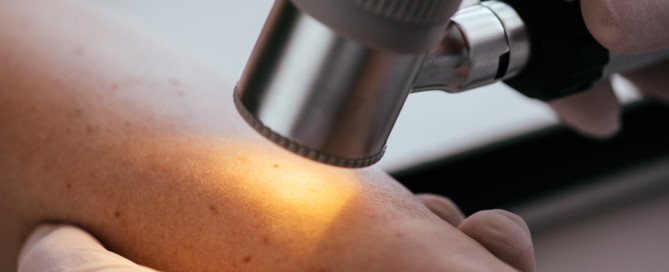
What Is a Dermatoscope?
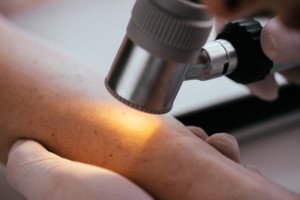
What exactly is a dermatoscope? First off, next time you see a dermatologist for a skin cancer screening, make sure the doctor is using a dermatoscope.
Sometimes, a dermatoscope is incorrectly called a dermoscope. “Derma” means skin, and “scope” means to view.
A dermatologist, when examining a patient’s moles for signs of melanoma, should use a dermatoscope.
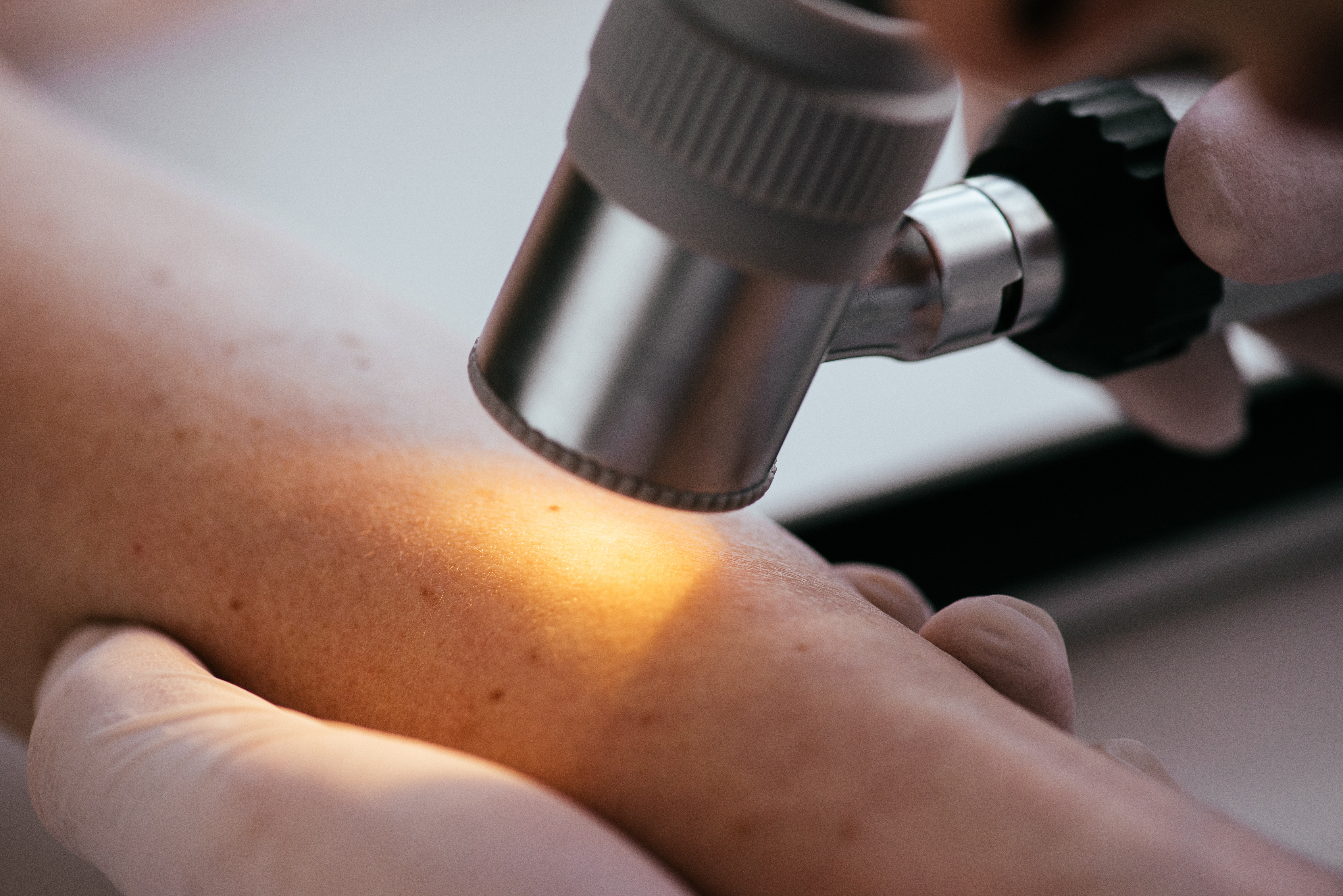
“This is a specialized dermatologist’s tool that uses polarized light and magnification to spot irregularities in the skin,” says Bobby Buka, MD, a NYC dermatologist and CEO of The Dermatology Specialists, and author of “Buka’s Emergencies in Dermatology” and “Top 50 Dermatology Case Studies for Primary Care.”
“It’s a handheld device that your doctor can use to inspect spots wherever they occur,” continues Dr. Buka.
“The polarization of the light it emits allows us to more clearly see pigment inconsistencies that can indicate melanomas or other skin problems.”
A more sophisticated model has several magnifying lenses together that are in a tube with a polarized or non-polarized light source.
The more complex the instrument, the more information a doctor will get when viewing your moles and other skin lesions.
For instance, a seborrheic keratosis may look very much like a common mole – until the doctor views the former through a dermatoscope.
The newest instruments have a bright LED light encircling the magnifying lens. There may also be a digital camera, which is very useful when a mole wants to be tracked over time.
To get a close-up inspection of the skin, a doctor will place the dermatoscope against the skin and look very close into it.
The tool will likely have liquid that’s between the lens and the skin to reduce light glare and scatter, improving visibility of the lesion.
When a normal mole is viewed through this device, it can look “bad” to the layperson, because the layperson doesn’t know what’s normal or what’s suspicious.
This is why laypeople should not purchase these devices, which are sold online.
A layperson with health anxiety will set himself up for much anxiety by getting into the habit of inspecting their moles with a dermatoscope.
Dermatologists spend enormous hours of training and learning what characteristics in a mole to look for that are suspicious for melanoma.
After looking at thousands of different kinds of skin lesions that can pass for melanoma, as well as actual melanomas, doctors will still be crafting their expertise at knowing what they’re looking at.
Can a Dermatoscope Diagnose Melanoma?
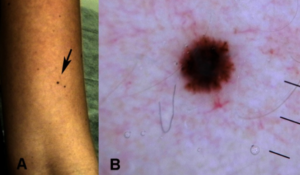
Dermatol Pract Concept. 2013 Apr Copyright ©2013 Pellizzari et al
There’s no doubt that this tool can show classic features of melanoma.
But it is not a diagnostic tool.
A doctor will inform the patient that the lesion should be biopsied.
Not all the biopsy results, however, come back positive for disease.
A mole can look suspicious under the magnifying lens but come back benign.
Other Uses of a Dermatoscope
• Evaluation of skin capillaries
• Assess patterns of hair follicles
• Examine other conditions like actinic keratosis
Remember, don’t go buying a dermatoscope to check your moles! You don’t know what to look for. Leave it up to your dermatologist.
 Dr. Buka is the contributing Founder and Chief Science Officer of the First Aid Beauty skin care line. firstaidbeauty.com
 Lorra Garrick has been covering medical, fitness and cybersecurity topics for many years, having written thousands of articles for print magazines and websites, including as a ghostwriter. She’s also a former ACE-certified personal trainer.
.
Top image: Shutterstock/LightField Studios

Do Heart Attacks Always Cause a Loss of Consciousness?

Have you ever wondered if heart attacks always cause a loss of consciousness, even if for just a few moments?
Chest Pain from Deadlifts: Cause, Solution by Chiropractor

If you’ve connected your chest pain to your deadlift routine—a definite cause and effect—yet experience no chest pain during other strenuous activities, this is very likely musculoskeletal in origin.
If any pain or pressure in the chest is accompanied by shortness of breath, unexplained sweating, nausea, a faint feeling and/or pain in the arm or jaw, you should go to the emergency room to get checked for heart trouble.
The deadlift is one of the greatest compound exercises, involving the whole body, though some muscles much more than others.
Being the fierce whole-body exercise that it is, why wouldn’t it cause chest discomfort in some people on occasion?
Though the deadlift is primarily a back exercise, with arm and leg involvement, this doesn’t mean that the chest structure does simply nothing during the action.
“I have treated many weightlifting patients who suffered from some degree of costo-sterno chondritis or simply a misaligned rib head or heads as they insert into the sternum,” says Dr. Tom Carpenter, corrective exercise specialist, certified personal trainer and chiropractor, inventor of Stand Corrected™, a portable harness-like stretching tool that helps alleviate back, neck and shoulder pain.
“This can be due to the excessive internal rotation of the anterior rib cage when deadlifting,” continues Dr. Carpenter.
“Many times treating the involved rib head(s) with chiropractic adjustments and resting the area will solve the problem.”
In addition, make sure that you’re thoroughly warming up before pulling heavy weight.
Don’t just dive into the heavy loads. A great warmup for your deadlift routine is that of deadlifts — yes, the very same exercise — but at lighter loads; do multiple sets (they can be low rep) before getting into your working sets.

Photo credit: Aleesia Forni
Based upon 30+ years of experience, Dr. Carpenter’s practice approach reflects his belief that restoring optimum health and function will enable his patients to enjoy a much greater amount of vitality and wellness. Chiropractic care is true health care, not sick care!
Lorra Garrick has been covering medical, fitness and cybersecurity topics for many years, having written thousands of articles for print magazines and websites, including as a ghostwriter. She’s also a former ACE-certified personal trainer.
.
Top image: Freepik.com pressfoto
Thigh Hematoma after Cardiac Ablation: Causes, Solutions
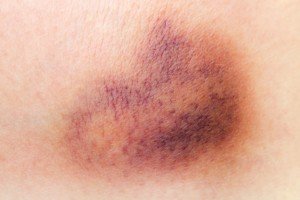
Sometimes, a hematoma (blood mass) in the thigh forms after cardiac ablation.
“When we perform cardiac ablations we most commonly utilize the blood vessels in the groin,” says Michael Hoosien, MD, MSc, a cardiac electrophysiologist with Piedmont Heart Hospital in Atlanta, GA. (more…)

Sudden Shortness of Breath with a Racing Heartbeat: Causes

“There are a myriad of reasons someone might experience short-lived palpitations — or the sensation of the heart ‘racing,’” says Michael Hoosien, MD, MSc, a cardiac electrophysiologist with Piedmont Heart Hospital in Atlanta, GA. (more…)
Does Feeling Palpitations in the Neck Mean Something’s Wrong?

If you’ve been feeling palpitations when your fingertips are against your neck, this can mean more than one situation internally. (more…)
If Doctor Thinks Teen’s Mole Must Be Watched, Why Not Biopsy It?
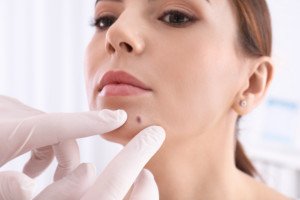
If a teen’s mole is suspicious enough for a doctor to say, “It should be watched,” then why not just biopsy it in case it’s melanoma?
Teens DO get melanoma.
“Melanoma among adolescents and young adults (aged 15-39 years) is more commonly seen in females compared to males, with the majority seen on the trunk,” says Nita Patel, MD, Medical Director of Advance Dermatology and Laser Medical Center in Marina Del Rey, CA.
Teen’s “Watched” Mole Turns out to Be Melanoma Two Years Later
I was inspired to write this article after reading in an online health forum about a boy, 15, who had a new “mole” on his head examined by a dermatologist.
None of it was removed for biopsy even though the doctor told him and his parents to keep an eye on it.
Two years later it seemed a little bigger, and this time it was removed for biopsy. The diagnosis was melanoma that had spread to the lymph nodes.
He underwent chemo and radiation, but five years later, he died from metastatic melanoma.
I wondered why the mole, which was suspicious enough for the doctor to tell the teen and his parents to keep an eye on it, wasn’t simply biopsied right from the get-go.
The earlier that melanoma is diagnosed, the higher the chance of long-term survival. In fact, the 10-year survival rate for stage 0 (in situ) melanoma is 99 percent.
“The decision to biopsy is typically a clinical judgement,” says Dr. Patel. However, if the parents want a mole biopsied, a doctor will very likely honor this request.
Depending on the doctor’s philosophy, a mole will be biopsied simply if the patient feels uneasy about it.
Of course, there are limits to this, in that a doctor isn’t going to remove every single mole just because the patient is fearful of melanoma. But within reason, a biopsy request is usually granted.
“If a mole has a slight irregularity, close monitoring is helpful to decide if a mole should be biopsied,” says Dr. Patel.
“Re-evaluating a mole in a 1-2 month period for changes can help determine if a biopsy is indicated.
“An alternative approach is the use of a new adhesive patch biopsy kit that tests for gene sequences that are seen with melanoma.
“This is a noninvasive method of collecting additional information especially in pediatric populations which may not be able to undergo an invasive biopsy.”
Suspicious Mole on Teen: Watch It or Biopsy It?
“Typically if the mole shows some signs of irregularity, I discuss the option of close monitoring, evaluation excision with a punch biopsy or adhesive biopsy and pigment lesion assay (PLA),” says Dr. Patel.
“The PLA uses advanced genetics to identify two genes, LINC and PRAME, which are elevated in melanoma skin cancer.”
DermTech’s PLA can differentiate melanoma from a benign mole or other lesion with a negative predictive value (meaning no disease) of over 99 percent.
This tool yields a sensitivity of 91 percent and a specificity of 69 percent – without the need for invasive biopsy.
A biopsy of a mole is not as invasive as a teen or parents might think. Hearing the word “biopsy” can unsettle a patient, but the actual procedure is not as penetrating as it sounds.
The needle for the local anesthetic usually causes less pain than a typical paper cut or razor nick.
Nevertheless, a patient may want to forego a biopsy (which, depending on the type of procedure and the size of the mole, will require stitches).
If a doctor wants your teenager’s mole to be “watched” or to “keep an eye on it,” the PLA will offer the advantage of patient comfort plus convenience, especially if there is more than one suspicious mole or a mole is in a cosmetically sensitive area.
“If the parents choose to pursue a biopsy, an excisional biopsy is performed to obtain a complete visualization of the mole on pathologic exam,” says Dr. Patel.
“I send the slide to a dermatopathologist for microscopic examination.”
 Dr. Patel is a Diplomate of the American Board of Dermatology and has extensive experience in general dermatology, skin cancer surgery, cosmetic procedures and lasers.
Lorra Garrick has been covering medical, fitness and cybersecurity topics for many years, having written thousands of articles for print magazines and websites, including as a ghostwriter. She’s also a former ACE-certified personal trainer.
.
Top image: Shutterstock/New Africa
Sources
Weir, Hannah et al. J Am Acad Dermatol. 2011 November;65 (5 Suppl 1);S38-49
dermtech.com/wp-content/uploads/2018/05/DermTech_ProductOverview.pdf.

Big Red Pimple on Teen’s Nose that Won’t Go Away

What appears to be a big red pimple on a teen’s nose may actually be melanoma, the deadliest form of skin cancer. (more…)

What Are All the Different Colors that Nail Melanoma Can Be ?
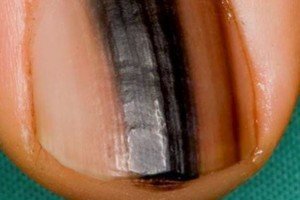
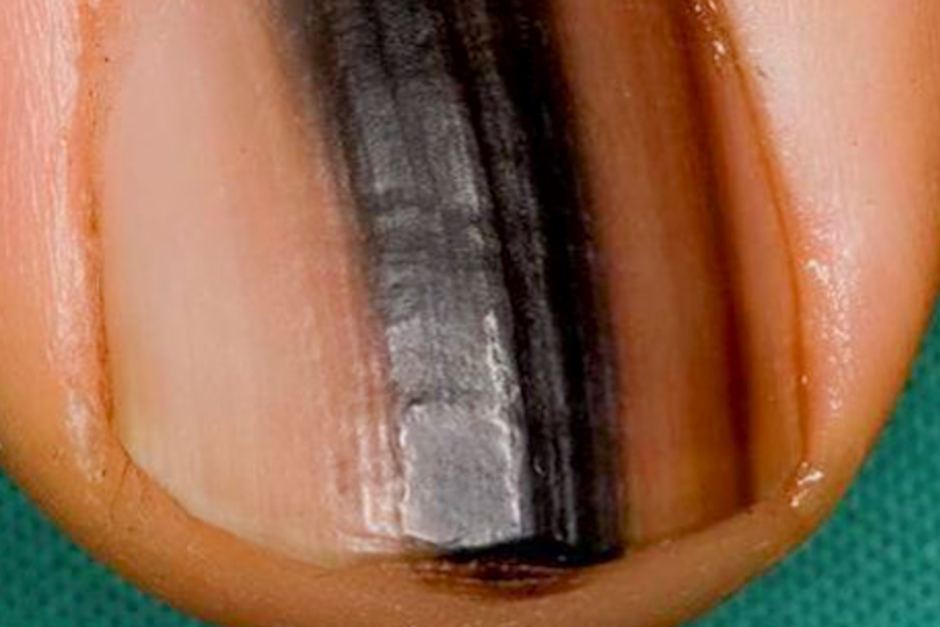
That line or stripe down a nail that’s melanoma isn’t always black or dark brown. It can be other colors, too, and it’s not always a stripe or line, either.
Nail melanoma is also called subungual melanoma, and technically, it’s a cancer UNDER the nail – on the nail bed itself – rather than arising from the dead cells that make up the actual nail.
The line, stripe or band is then seen through the fingernail. Nail melanoma, as it’s commonly called by laypeople, typically presents in some shade of brown.
It can also be what would be described as black or off-black. But other colors can be part of this cancer as well.
“Subungual melanomas can initially begin as a pigment stripe and it changes into light brown, or black,” says Nita Patel, MD, Medical Director of Advance Dermatology and Laser Medical Center in Marina Del Rey, CA.
Dr. Patel continues, “Due to the depth of the pigment, it may also appear greyish or purple.
“It can include the proximal nail fold (also known as Hutchinson’s sign) and also appear as a small bump under the nail with no color.”

Hutchinson’s sign
So we have shades of tan and brown, off-black and black, and also greyish and purple, as possible colors. And of course, no color as a bump under the nail.
Nail melanoma can also be composed of two or three distinct colors forming a band or thick stripe.
The lines, bands or stripes are vertical. However, subungual melanoma can also present as a smudge-like shape or a smear of sorts.
Subungual melanoma can pass as a benign line or streak under the fingernail.
But there are tell-tale signs that point to cancer and signs that point to a benign origin of a suspicious-looking black line or streak.
Dr. Patel is a Diplomate of the American Board of Dermatology and has extensive experience in general dermatology, skin cancer surgery, cosmetic procedures and lasers.
Lorra Garrick has been covering medical, fitness and cybersecurity topics for many years, having written thousands of articles for print magazines and websites, including as a ghostwriter. She’s also a former ACE-certified personal trainer.





Fast Whooshing Sound in One Ear from Every Loud Sound: Causes?

It’s one thing to have a constant “whooshing” sound in one’s ear, but what does it mean when this happens only from exposure to loud noise?
“Loud noise exposure is a trigger for tinnitus,” says Gene Liu, MD, MMM, and Chief, Division of Otolaryngology, Cedars-Sinai Medical Group.
“Most commonly, tinnitus is described as ringing in the ear, but can also sound like roaring, buzzing, hissing, humming and even whooshing,” explains Dr. Liu.
“It is possible that someone’s personal variation of tinnitus is ‘whooshing.’
“Loud noises can cause the stapedial muscle, a tiny muscle that attaches to the ear bones, to flutter.
“This can be sometimes felt as twitching, but may also be heard as a series of rapid clicks, which perhaps could also be described by the patient as a ‘whooshing’ sound. This is not a serious issue, but can certainly be annoying.”
Pulsatile Tinnitus
If you’ve read up on the so-called pulsatile tinnitus, then you know that it’s not typically triggered by loud sounds.
Rather, when a person hears this, it’s present all the time or most of the time, regardless of noise in the environment.
However, it can be concealed if there’s enough ambient noise. But once the noise quiets down, a person will begin hearing the “whooshing” again, usually in synch with their heartbeat.
This is especially easy to hear once a person gets into bed at night and everything’s very quiet.
And pulsatile or whooshing tinnitus can have benign (earwax buildup, Eustachian tube dysfunction) as well as very serious causes (blood vessel entanglement).
However, Dr. Liu explains, “If there is pulsatile whooshing (matches heartbeat) that is brought about by noise exposure, then consider superior canal dehiscence,” a rare condition that affects hearing and balance.
“This issue usually causes dizziness with loud noise exposure, but can add a component of sound hypersensitivity called hyperacusis, that can exacerbate a whooshing noise (or any other type of tinnitus).”
 Dr. Liu’s clinical areas of focus cover a broad range including surgery of the head and neck, sinuses and thyroid, and disorders of the ears, salivary glands and vocal cords.
Lorra Garrick has been covering medical, fitness and cybersecurity topics for many years, having written thousands of articles for print magazines and websites, including as a ghostwriter. She’s also a former ACE-certified personal trainer.
.