
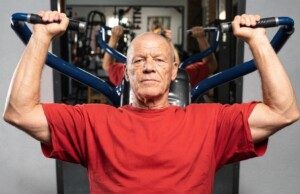
For years it’s been known that training with weights is the Fountain of Youth for keeping muscles strong in old age.
Yet sarcopenia still runs amok among senior age people because they never do weight workouts.
Yes, muscles naturally shrink and weaken with age. BUT — this process can be enormously slowed down with proper strength training.
If you’re getting up there in years, perhaps you’ve been focusing a lot on heart health — which you should definitely do.
But let’s not neglect muscle health. You can have the greatest cardiovascular numbers, but weak muscles will impair your quality of life.
Loss of muscle size and strength as one gets older is called sarcopenia.
Weak muscles can also increase the chances of falls and fractures, especially among older adults. Sarcopenia is particularly common after age 70.
Even if you take that evening walk or perhaps participate in your gym’s cardio dance classes, you should NOT omit training with metal.
Aerobic exercise is no replacement for lifting weights.
Strength training makes muscles work against resistance.
If the weightlifting area of your gym is full of people 18 to 30, never mind that. Just get in there and start training.
You can start with the machines if using free weights seems awkward.
You can also hire a personal trainer. Even just two sessions with a trainer, if you’re short on money, will make all the difference.
Benefits of Strength Training for Older People
- Improves walking speed and balance including over uneven surfaces
- Improves chair-stand ability, getting in and out of cars
- Improves general mobility and makes everyday tasks so much easier
- Reduces risk of falls
- Improves blood sugar metabolism and immune function
- Too many more benefits to list!
A Simple Program Will Work
Consistency is more important than having a complicated program.
Exercises for the lower body deserve attention because strong legs and hips help with stairs, standing and walking. For full independence, you need a fit lower body.
I’ll never forget what a middle age man, who trains with weights, once told me:
“When you lose your legs, it’s over.”
When you lose your legs, it’s over.
Upper body work is also very important. Stronger arms, chest and back muscles make carrying bags, lifting things and maintaining posture easier.
Upper body work is just as crucial for women as it is for men.
Lifting weights is NOT a man’s thing. It’s a human body, especially older, thing.
The exercise should simply be challenging enough that the muscles become tired by the end of the set.
How many repetitions should you perform for the upper body?
Aim for 10 to 12, meaning, by the time you reach this range, you’re feeling a moderate to good amount of effort.
If you crank out too many reps per set, you risk straining elbow tendons.
As for the legs, again, stick to 10 to 12 — as a baseline. Depending on the exercise, you can also do more reps.
For example, with the seated leg press, you can go up to 15 or 20 without worrying about tendons.
Overall, there’s no need to strain and knock yourself out.
How often should older adults strength train?
Daily workouts are not required. Even one strength training session per week can produce useful improvements, especially for beginners.
Exercises can be modified for people with joint problems or chronic conditions.
This is where a personal trainer can be especially beneficial.
Since weight workouts are so helpful, why do many people avoid these?
Some lack confidence or find the gym environment “intimidating.”
- However, the intimidation factor has no roots in reality.
- “Old people” who strength train are admired and get a lot of respect in the gym.
Also, not all gyms are the stereotypical settings where most of the patrons are hulking grunting men. Check out the various clubs in your area.
Another self-imposed barrier is fear of injury.
With proper form and technique, along with not overdoing things, you won’t have to worry about injury.
Instead, be open minded and a good listener if a personal trainer approaches you in the gym and suggests a more effective way of doing an exercise.
- If you’re a beginner at strength workouts, never assume you know more than the trainer who’s young enough to be your grandkid.
For most adults, a practical goal is muscle-strengthening exercise once or twice a week.
I recommend emphasis on the hips and lower body (remember that quote?).
Of course, include the upper body, with major focus on the back, chest and shoulders.
Arm Curls
It’s NOT necessary to do a bunch of arm/biceps curls, even though fitness photographers just love to take images of models posing with the curl exercise.
It makes for great imagery for ads and marketing, BUT arm curls are next to useless for aged people who want to combat sarcopenia.
Plus, too many biceps curls could strain the elbow tendons.
You’re Never Too Old
You can start at home with body-weight movements and make them harder as your strength improves.
Older adults who have never strength trained can still take it up when exercises are adapted to their abilities and supervised by trainers, particularly those who are certified in training the older population.
Those in their 80s and 90s can increase or preserve muscle strength with appropriate training and support.