

Sudden Purple Bruise on Underside of Index Finger
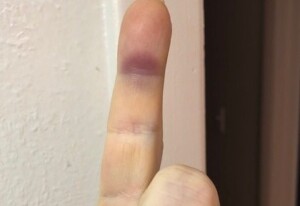
Have you noticed a purple bruise under your index finger that seemingly came out of nowhere? (more…)
10 Ways to Intensify Your Walking Workouts

There are 10 super ways to make your walking sessions more intense — and you probably never even considered some of them — but they truly do work to melt fat and greatly improve heart health.
10 Ways to Add Intensity to Walking
Speed. Set a treadmill to 4.2 mph, or maybe 4.5 mph, and see how long you can keep pace without transitioning to a jog. Add a slight incline. Do not hold on.
Inclines. Inclines are the obvious way to increase the intensity of walking. Some treadmills go up to 30 percent incline.

Freepik.com, tirachard
Holding on will cancel out the incline effect, so don’t cheat. What would your walking speed be if you were ascending a 30 percent incline outside?
You’d be crawling. Likewise, when using a very high incline on a treadmill, BE REALISTIC with the speed so you don’t have to hang on.
To avoid having to hold on, you’ll need to set the speed to perhaps one mph for super high inclines.
Outdoor hills are even better because the terrain is variable. Going up a steep forest floor at a brisk clip is quite intense. You can also try a snow slope in snow shoes; go for it.
Inclines plus hand weights. Hold 2-5 lb. dumbbells while walking a treadmill grade. Be an animal and hold 10 lb. dumbbells.
Regular walking plus very heavy hand weights. See for how long you can walk around the gym holding a 15 or 20 lb. dumbbell in each hand — arms straight. Or try 10 pounders.
You’ll also want to experiment with kettlebells; their unique design has an inviting feel and may be more comfortable than dumbbells.
Panaerobics. While holding 1-5 lb. weights, do arm exercises while on a treadmill or outdoors. Some arm exercises are shoulder press motions, lateral raises, frontal raises and curls.
Weighted backpack, with or without incline. Load a backpack with rocks or a few dumbbells and get going on a treadmill, a hiking trail or residential sidewalks.

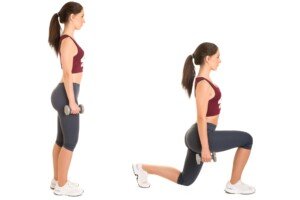
Lunge walking. Do shallow, medium or deep lunges. While lunge walking, add even more intensity by holding weights or combining this with panaerobics.
Shutterstock/ruigsantos
Shadow boxing. While using a level tread or incline, throw uppercuts, crosses and jabs.
Walk backwards on a high treadmill incline. Set speed to 1 mph (YES — ONE MPH) and incline to 15 percent. See how long you can last– without holding on.
Add even more intensity by shadow boxing or holding light hand weights.
High knees. Bring knees up as high as possible while walking on a treadmill or outdoors.
Employ any or all of these 10 fantastic ways to add intensity to your walking workouts, and the excess fat will start coming off — or, if weight loss isn’t your goal, you sure as heck will reap many benefits as far as cardiovascular health, bone strength and joint strength.
 Lorra Garrick is a former personal trainer certified by the American Council on Exercise. At Bally Total Fitness she trained clients of all ages for fat loss, muscle building, fitness and improved health.

How to Track Calories if You’re Obese or Overweight

Here’s how to track calories if your weight is in the obese range.
Calorie tracking can be your best friend if you’re ready to lose a lot of weight and keep it off.
For whom does calorie tracking work best?
• People who enjoy keeping tight track of things.
• People who need to keep lists, charts and other documentation of the important things in life.
• Those who are very organized and require a lot of order and routine.
• Individuals who are detail-oriented.
• Dieters who haven’t had success with long-term weight loss.
Here are calorie tracking essentials from Prajakta Apte, RDN, owner and founder of Right Nutrition Works who helps people create a healthier lifestyle.
• Set a realistic calorie goal and weight goal that you can achieve.
• Keep a food log and enter the calories of each food and drink you consume throughout the day.
• Use apps to keep track of your calories such as MyFitnessPal, Lose It!, to name a few.
• Use measuring cups and spoons or a food weighing scale to measure your food at meals/snacks.
• Try to avoid using your eyes to estimate servings.
• Plan ahead and have a week’s menu ready; this will help cut down on making unhealthy food choices and excess calories.
When Tracking Calories Can Backfire
This article targets those who are drawn to the idea of tracking calories, rather than trying to convince every person who wants to lose weight to track and count calories.
That detail-oriented, list- and chart-keeping perfectionist will tend to gravitate towards keeping track of calories.
But even for the very orderly “everything in place” type of person, calorie tracking can ultimately become a drudgery or obsession.
Calorie Tracking Apps for the Obese and Overweight
In addition to the aforementioned recommendations, there are MANY apps for calorie tracking. You just have to find which one has features that grab your attention.
If you’re not into nit-gritty details, you may want to just track calories the old-fashioned way: in a notebook.
While some will see results from their calorie tracking fast enough for them to stay motivated, others might get frustrated and see the habit as a burden.
The most important thing for achieving weight loss is to find the strategy that works the best for you.
 Prajakta Apte is the author of the eBook “Overcoming Nutrition Roadblocks.” Her personalized approach to nutrition therapies helps treat root causes of conditions such as type 2 diabetes, high cholesterol, GI disorders, hypertension and many more.
 Lorra Garrick has been covering medical, fitness and cybersecurity topics for many years, having written thousands of articles for print magazines and websites, including as a ghostwriter. She’s also a former ACE-certified personal trainer.
.
Top image: Freepik.com,/schantalao

Do Chest Workouts Strain the Heart More than Leg Workouts?

Do you ever wonder if intense chest workouts strain the heart more than heavy deadlifts or squats?
When you do chest routines at the gym, you may have wondered if this puts particular strain on your heart…since chest routines work the chest muscles, which are over your heart.
Furthermore, while performing chest presses (or shortly after, or the day after), perhaps you’ve had “chest pain” (i.e., sore pec muscles).
This may lead you to think that chest presses — particulary heavy benching — strain the heart more than a grueling set of back squats.
However, the heart cannot tell the difference between a bench press and a deadlift or squat.
If the heart is being taxed, it has no idea what body part is being recruited.
Though you may feel more pummeled after a set of intense deadlifts or squats, when compared to a set of bench presses or dumbbell presses, the heart has no idea what you just did.
When the oxygen demands of the body are increased, the heart will beat faster to pump more blood throughout the body — whether you’re straining with chest exercises, deadlifts, pull-ups, running up hills or racing up and down a basketball court.
What makes the heart work harder is the intensity of the exercise.
So if you’re doing a five rep max for the bench press, this will “strain” your heart more than will doing five reps of deadlifts using only 50 percent of your deadlift five RM.
Your heart will be taxed more due to the intensity of the rep max, not the location of the muscles being recruited.
However, a five RM deadlift will tax your cardiovascular systm way more than will a five RM bench press because the deadlift works nearly the entire body — using more muscles — meaning a greater oxygen demand.
Thus, it’s all about exertion, not the location of the muscles being engaged.
In conclusion, location of the muscle worked doesn’t dictate how hard your heart is working.
Lorra Garrick is a former personal trainer certified through the American Council on Exercise. At Bally Total Fitness she trained women and men of all ages for fat loss, muscle building, fitness and improved health.
.