What Will Happen If I Don’t Treat My Bad Breath?

No one wants to be around someone who has bad breath.
You know it will instantly eliminate any chance you have of getting close and is sure to be a date-killer.
While there are several causes of bad breath, you certainly want to stop it before you discover that your family and friends no longer want to be around you.
Finding the right bad breath remedies can help prevent more embarrassing moments, enabling you to have fresh breath. (more…)

Could an Unhealed Canker Sore in Your Mouth Be Oral Cancer?

When cancer develops in your mouth, it is important that it be noticed right away.
Sores in the mouth are rather common, but you do not want to neglect them if they persist. (more…)
Can Missing Teeth Indicate Your Risk of a Heart Attack ?

There is a menacing connection between lost teeth and heart attacks.
A study conducted at the University of Helsinki on 8,400 subjects between 25 and 75 shows a connection between missing teeth and risk of heart attack. (more…)

The Heart Problems that Can Cause Fainting

Whenever fainting is caused by a heart problem, you need immediate medical attention. (more…)

How to Increase Survival Odds with Very Low Ejection Fraction

How long you can survive, once being diagnosed with a very low ejection fraction, depends quite a bit on what you intend on doing about this common affliction.
A very low ejection fraction may be caused by an acute event (namely a heart attack) or by a chronic situation (“congestive” or chronic heart failure).
Chronic heart failure is extremely common, and its chief causes are coronary artery disease, high blood pressure, a sedentary lifestyle, obesity, smoking and untreated sleep apnea.
Suppose you are diagnosed (via echocardiography) with a very low ejection fraction: under 35 percent.
This number is not absolute, in that other factors need to be considered, such as how much blood fills the chamber before the cardiac muscle contracts to pump out blood.
At any rate, the general rule is that survival time once a person is diagnosed with a very low ejection fraction is poor.
However, there is variability, depending on treatments and the patient’s unique medical profile.
For example, in those also with severe coronary artery disease, “Survival improves significantly after a heart bypass in such patients,” says Waqar Khan, MD, who’s been providing state-of-the-art cardiology services to the Houston area for over 20 years, and is author of “Be Heart Smart: Understand, Treat, and Prevent Coronary Heart Disease.”
Most heart failure patients are placed on medications that increase survival, says Dr. Khan.
“Such medications ensure that these patients do not develop life threatening rhythm disorders.”
Diuretics and Hypertension Drugs
Dr. Khan says, “Medications are given to them to get rid of excessive fluid and improve contractility of the heart.”
These would be diuretics and high blood pressure drugs, respectively.
In the so-called congestive heart failure (which causes low ejection fraction), excess fluid is retained, usually in the legs/feet — and causes a “pitting” when the skin is pressed by a finger, as shown below.
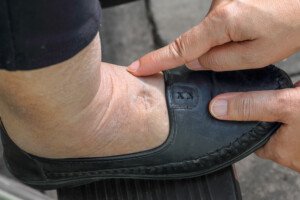
Shutterstock/Toa55
But it can also affect the lungs or the area around the heart. If it’s in the thoracic cavity somewhere, this fluid will strain the heart.
If this is not treated with a diuretic such as Lasix, this strain can certainly impact survival.
A drug for hypertension, such as metoprolol, is often given to heart failure patients to help improve the heart’s pumping action.
This improvement, though, doesn’t always occur, but the drug helps control high blood pressure, which can worsen heart failure.
Implanted Defibrillator
Sometimes “these patients receive defibrillators — which is a device like a pacemaker, which has the ability to shock the heart in the event a patient with low ejection fraction develop a life threatening rhythm disorder,” says Dr. Khan.
Have you just learned your ejection fraction is very low?
“I would suggest that a patient with low EF must discuss his condition in detail with his or her cardiologist regarding different options available to treat their condition which would increase their survival,” says Dr. Khan.

Waqar Khan, MD, has a private practice and serves as an affiliate faculty member at Baylor College of Medicine in Houston, TX. Amazon.com/Be-Heart-Smart-Understand-Coronary/dp/1732268606
 Lorra Garrick has been covering medical, fitness and cybersecurity topics for many years, having written thousands of articles for print magazines and websites, including as a ghostwriter. She’s also a former ACE-certified personal trainer.
.
Top image: Shutterstock/Alexander Raths

Why Does Muscle Twitching Spread throughout the Body?

This isn’t about why the muscle twitching of ALS spreads throughout the body, but why benign fasciculations quickly spread to other areas of the body.
And this quick, so-called spreading typically occurs the moment a person discovers that muscle twitching is one of the symptoms of amyotrophic lateral sclerosis.
Whether the individual’s initial twitching began in the arch of a foot, back of the upper leg, the calf, somewhere in the back, a finger or their neck – the twitching rapidly spreads to the point where it ends up being all over the body.
“All over” may refer to all four limbs, or to the trunk, eyelids, butt and shoulders, or to alternations between major areas such as the calves, then upper legs, then face, then upper legs, etc.
Too Simple…
For some people, it’s too simplistic to just say that anxiety drives this reaction to the fear of having ALS.
It’s too simplistic, perhaps, to point out that feeling fear puts the body in a preparation state for a fight or flight.
If the body’s going to prepare for a fight or flight from a perceived threat (in this case, a deadly disease), the muscles all over will be involved.
After all, you can’t fight or escape from a threat with only one small section of your body. Thus, the twitching is felt all over.
“Muscles are generally not used in isolation, and we use many muscles throughout the course of the day,” says Mitzi J. Williams, MD, clinical neurologist with Morehouse School of Medicine and clinical advisor for the Multiple Sclerosis Foundation.
“Muscle twitching can occur in different muscles as we use different ones. In the case of ALS, the twitching spreads as more nerve junctions are affected.”
But the spread of ALS twitching occurs many times slower than the spread of benign fasciculations driven by anxiety.
Harmless muscle twitching can go from zero to 60 in just seconds with heart-pounding anxiety.
Many men and women suffer from this anxiety, especially if they have pre-existing health worries.
“I would tell them that ALS is characterized by muscle twitching and weakness in various areas of the body,” says Dr. Williams.
“If you have stable twitching with no weakness, and you have been evaluated by a healthcare professional, then it is not likely related to a serious condition.
“Again, pair the knowledge you obtain from reading with a formal medical assessment. Also remember that sometimes anxiety can increase twitching as well.”
Other Benign Causes of Fasciculations
• Caffeine
• Dehydration
• Electrolyte imbalance
• Exercise or physical exertion
• Fatigue or localized muscle strain
• Magnesium deficiency
• Overuse of a small muscle group (e.g., twitching finger from excessive computer mouse use)

Dr. Williams is author of “MS Made Simple: The Essential Guide to Understanding Your Multiple Sclerosis Diagnosis.” She is a member of the American Academy of Neurology.
Lorra Garrick has been covering medical, fitness and cybersecurity topics for many years, having written thousands of articles for print magazines and websites, including as a ghostwriter. She’s also a former ACE-certified personal trainer.
.
Top image: Shutterstock/igorstevanovic
What Exactly Is Mild Multiple Sclerosis?

Ever hear of “mild” multiple sclerosis?
Isn’t this life-changing disease supposed to be serious? And can “mild” MS progress to a severe form?
“A term that is used to describe mild MS is benign MS,” says Mitzi J. Williams, MD, clinical neurologist with Morehouse School of Medicine, an MS specialist and clinical advisor for the Multiple Sclerosis Foundation.
“Benign MS is characterized by episodes of relapse followed by complete return to baseline so that people have no neurologic impairment.”
Alternative treatment made the symptoms disappear…or… was it just mild MS that went into remission?
Hmmm, this is very thought provoking. If one has a mild or benign version of multiple sclerosis, sooner or later – by definition – it will go into remission.
If this coincides with the implementation of an alternative treatment, such as a special diet, the patient might believe that the diet subdued the symptoms.
If there’s another flare-up, however, and the patient has been sticking to the alternative treatment, then the treatment was probably not effective – and the remission was just a coincidence.
Can Mild or Benign MS Actually Exist?
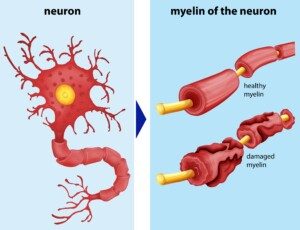
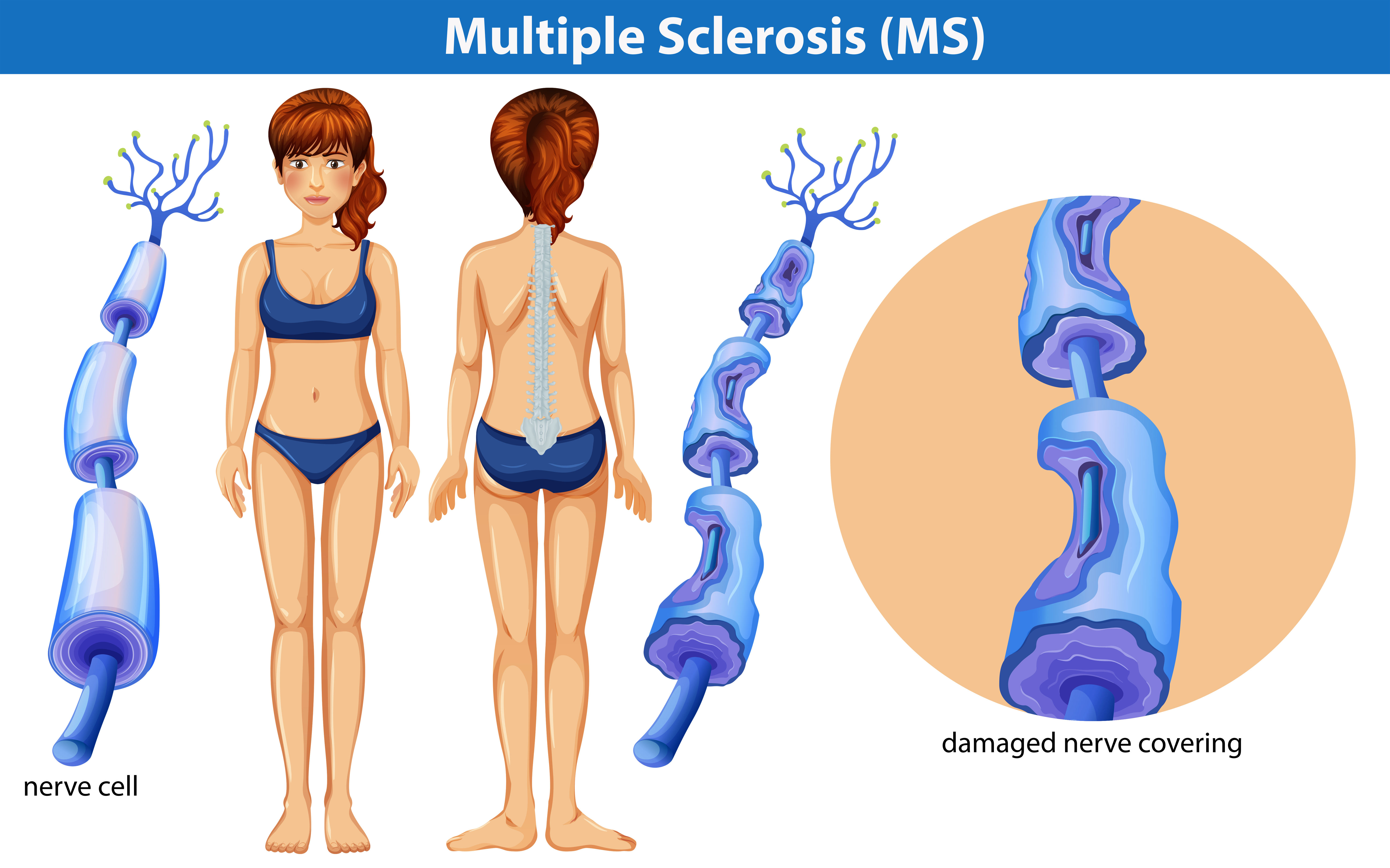
Multiple sclerosis. Freepik/brgfx
“There is some debate in the neurologic community about the term benign MS and if this form of MS really exists, meaning that there may be subtle signs of neurologic dysfunction that progress over time,” says Dr. Williams.
“There are some people who have very good outcomes and do have a milder course of disease, but it is difficult to say what percentage of people living with the disease have this outcome.
“There was a British study describing patients with mild MS over decades, and the data was very interesting, but it would be important to look at similar data in other groups of patients to see if the results are replicated.
“It is important to remember that every person with MS is different, and that generally it is a progressive disease, although some cases may result in milder progression than others.”
Dr. Williams is author of “MS Made Simple: The Essential Guide to Understanding Your Multiple Sclerosis Diagnosis.” She is a member of the American Academy of Neurology.
Lorra Garrick has been covering medical, fitness and cybersecurity topics for many years, having written thousands of articles for print magazines and websites, including as a ghostwriter. She’s also a former ACE-certified personal trainer.
.
Top image: ©Lorra Garrick
Is Twitching More Likely ALS just Because a WHOLE Toe Jerks?

People get more worried if the whole toe “jumps” or jerks vs. just feeling a twitch without seeing it.

Can Shaky Trembling Hands Mean Multiple Sclerosis?