
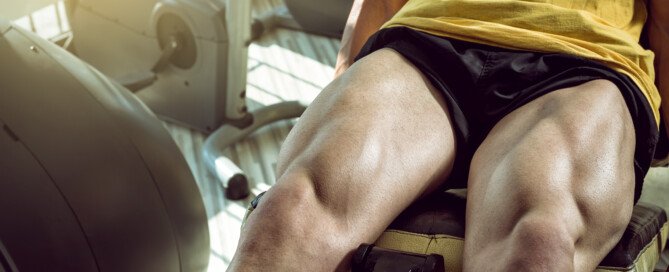
Best Exercise for Tear Drops in the Quadriceps

“What exercise will bring out tear drops in my quads?”
Ahh, tear drops – in the quadriceps muscles, that is! The hallmark of a great pair of legs is the visibility of so-called tear drops, when the insertion points of the quad muscles are visible through the skin.
I recommend several exercises for tear drops (which won’t be visible unless your body fat percentage is low enough, of course), and they are squats and leg extensions.
But let’s focus on leg extensions since they are so incredibly easy to do.
However, the leg extension should be performed in a certain way to maximize the visibility of quad tear drops.
In addition to working the quads with leg extensions, you must also have a low enough body fat percentage for the visibility to occur.
Two Requirements
Thus, two requirements (in addition to squats) for tear drops are: 1) Leg extension workouts, and 2) Low body fat.
This is why people can have low body fat yet absolutely no tear drops whatsoever, not even a hint of them.
Banging out only heavy lifts with leg extensions isn’t the most effective way to get tear drops. I suggest drop sets to the point of inducing a searing burn in the quadriceps.
Drop set leg extensions are one of the most “painful” exercise routines; a high tolerance for lactic acid burn is necessary, and when you bring it to this point, it’s maddening.

Shutterstock/ lunamarina
For the first set, find the weight you need for an 8-12 rep max on the leg extension.
You must be able to complete 8 to 12 reps with good form; i.e., bring the legs up nearly all the way (don’t lock out knees) and then lower with control, rather than let the weights drop down.
At the bottom of every rep, don’t let the weights touch back to where they come to rest; this is cheating.
Come down to within an inch of this point and then lift back up again.
The weight for this first set should allow you to complete 8-12 reps, but with quite a bit of difficulty, yet without cheating.
Promptly after completion, repeat this protocol for 30 pounds less weight.
Again, right after completion, reduce weight load by another 30 pounds. Now you can take a 90 second break. Repeat the drop set routine five more times.
Perform once or twice a week on your leg days. If your leg days are only once a week, do this once a week.
Leg extension drop sets done this way should hurt like crazy; the burn should be very intense.
Tear drops should start becoming visible within several weeks, but only if your body fat percentage is low enough to allow this.
Just how low varies among people. Those extreme tear drops you see in bodybuilders and physique competitors on stage are enhanced by extremely low body fat levels, but you need not get that low in order to see tear drops in the quads.
A “lean” body will have no problem showing tear drops in the quadriceps once the leg extension program is set into place.
To emphasize the outside tear drop, point feet as outward as possible during the leg extensions.
Another exercise you can add to your goal of achieving sculpted quads is the angled leg press, as shown below:

Shutterstock/Free around
The range of motion should be at least a 90 degree angle formed by your femur and shin bones, with feet FLAT on the sled.
Eight to 12 reps; take two seconds to lower the sled; keep your hands off your knees.
 Lorra Garrick is a former personal trainer certified through the American Council on Exercise. At Bally Total Fitness she trained women and men of all ages for fat loss, muscle building, fitness and improved health.
.
Top image: Shutterstock/Ajan Alen
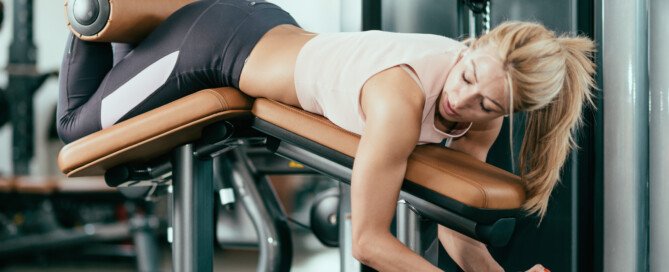
Lying Hamstring Curl vs. Seated: Pros, Cons

Which is better: lying hamstring curl or seated hamstring curl?
Lying hamstring curl vs. seated hamstring curl: Is one better than the other? Or does it come down to personal preference?
As a former certified personal trainer and long-time muscle-building athlete, I like both of these types of routines.
For my own workouts, I do the lying hamstring and seated version curl in the same leg workout session.
Pros with the Lying Hamstring Curl
This recruits the lower back to a minor extent, though for some people it may feel like a major extent.
Even the newer models of benches for this equipment, that are curved to relieve low back pressure, still allow some lower back muscle fibers to get recruited.
Lying hamstring curls are just a plain excellent routine for building size and strength, or just toning, for the hamstring group of muscles.
Cons of the Lying Hamstring Curl
Your nose is pretty darned close to the bench, where the person before you might have left his sweat.
Sometimes you can’t help but detect the odor of that bench, so I suggest using a towel.
People with low back problems might struggle with heavier weights.
And apparently, it’s very inviting to cheat on this machine; almost every time I see a man hoisting up a high weight load, he lets his chest come way off the bench as the weights lower, depriving himself of the negative component of the rep.
Pros with the Seated Hamstring Curl
The seated position allows you to more easily alter your leg position.
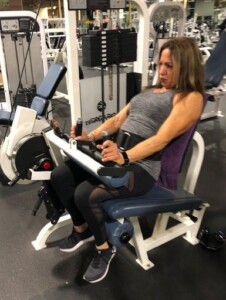
Model: Sharon Smith, 71
I do some sets with my legs as far apart as possible, feet as far as possible on either end of the pad, and feet pointed as far out as possible (knees rotated outward) for different muscle recruitment.
You can see your legs, which is always a nice factor when training.
The support pad that locks in over your thighs allows you to really isolate the hamstrings, and the only way to cheat on this equipment is to let the weight load fly back up instead of controlling the negative.
Cons with the Seated Hamstring Curl
Have you ever seen one of these machines in which the curling pad was not crooked?
What’s up with that? It’s always crooked. This means unequal distribution of forces against your legs.
Adjusting the pad distance from the rotation unit is a hassle, especially since half the time, the knob for tightening or loosening malfunctions. And sometimes the back pad adjustment is stubborn.
The two best exercises for hamstring strength, size, development or just toning, are the lying hamstring curl, and the seated version of this curl. It’s easy to look past the cons.
Sharon Smith has been in the fitness industry for 25+ years and specializes in the over-40 client.
 Lorra Garrick is a former personal trainer certified through the American Council on Exercise. At Bally Total Fitness she trained women and men of all ages for fat loss, muscle building, fitness and improved health.
.
Top image: Shutterstock/Microgen

Why Laughing at a Bully’s Insults Won’t Work

It’s a huge mistake when people urge the victim of bullies to “just laugh with them.”
This is lousy advice and it rarely works.
For the sake of this article, the term “bullying” or “bully” refers to ridicule and taunts, rather than physical aggression or verbal threats of harm.
So let’s take Dyrina, a teen who keeps getting ridiculed. The cards are stacked against her from the start, because she’s introverted, not charismatic.
Her name is pronounced DY-REEN-UH. Within days of starting ninth grade, Dyrina began hearing kids call her diarrhea. All sorts of jokes came out of this as time went on; you can imagine it.
One day Dyrina reported this to her mother. Her mother told her to “laugh along with them and they’ll stop bothering you.” Her father offered the same advice.
Dyrina felt really awkward pretending that the taunts were amusing and funny. She felt totally out of her skin putting on the fake smiles and phony grins.
She even tossed in a few vocal chuckles, and immediately felt alien. This can’t be the right way to handle this, she thought.
Furthermore, the bullying continued.
Laughing Is NOT a Weapon
“Pretending to laugh at a bully’s insults doesn’t usually work because body language is the most honest form of communication,” says Misty Rosier, a licensed clinical mental health clinician out of Utah who has worked with teens for 15+ years and is a frequent presenter on the topic of bullying.
“A bully can see right through the victim, their real emotions and reaction, based on their non-verbal response.”
If you read enough online posts by former bully victims, you might come across one in which the ex-victim says that he ended the bullying by “laughing along with them.”
It’s common advice, actually, but commonality doesn’t mean a high efficiency rate.
Bullies can spot the attempt of the victim to “laugh along with it” a mile away — the victim’s body language, eyes and mannerisms give off their distress like a neon sign.
The only way this could ever stop the bullying is if the victim truly, intrinsically, sincerely was amused.
And YES, this will take the mean kid by surprise and has the potential to close him or her down.
But doggone it, nasty kids can also easily tell the difference between genuine amusement and a forced act by a stressed individual.
Ridicule on the Parent’s Job
Would you, as the parent, as the adult, follow your own advice if, every day on the job, coworkers ridiculed you for your body weight?
“Hey fatty, where’s that report? I wanted that report an hour ago! What’ve you been doing, stuffing your pig face with donuts all morning?”
Yep, laugh along with them. See how long you can last putting on this absurd charade – whether the ridicule is about your size, religion or accent.
See how soon it takes you to file a complaint with the HR department.
Maybe you have a scar from a horrible car accident that killed your best friend and they’re constantly pointing out how ugly it is. Would you simply laugh along with these workplace bullies?
THINK good and hard before you tell a bullied child to “just laugh along with it.” Even if the “teasing” sounds insignificant.
 In addition to bullying, Misty Rosier has expertise in working with grief and loss, relationship struggles, and addictions such as to video games and social media.
Lorra Garrick has been covering medical, fitness and cybersecurity topics for many years, having written thousands of articles for print magazines and websites, including as a ghostwriter. She’s also a former ACE-certified personal trainer.

Why Cyberbullied Kids Keep Visiting Bully’s Facebook Page

Is there a logical reason why a teen or adolescent, who gets bullied online, would keep returning to the scene of the crime, the Facebook page of the perpetrator?
“Cyberbullied kids might continue to visit a bully’s social media pages because, as with all of us, information is power,” explains Misty Rosier, a licensed clinical mental health clinician out of Utah who has worked with teens for 15+ years and is a frequent presenter on the topic of bullying.
“The victim is most likely having all-consuming thoughts about the bully and the bullying.
“Watching the bully’s Facebook page and checking in on what is happening is an attempt on the part of the victim to obtain some sense of control.”
Not all bullied kids will be driven to do this, however. When they realize that a classmate’s Facebook page and other social media pages contain cruel posts, these targeted kids will simply never look there again.
They know it’s continuing to go on, but they’ll fight the temptation to take a peak. The more free time they have on their hands, the more difficult this temptation will be to resist.
If there are far more interesting things to do in life than check in on the latest cruel postings by Breeanna, Jenni, Bob or Tommy, then the targeted child will be less drawn to the bully’s Facebook and other social media postings.
Some kids may feel there’s nothing more interesting to do. This is where the parents come in.
Get your child involved in empowering activities like rock-wall climbing, martial arts, powerlifting and volunteer work.
Rosier cites another reason for why kids keep going back to their bullies’ Facebook postings: “They are also, like most adolescents, interested in fitting in. They are curious about each other and can be desperate for information.”
If your child is the target of online harassment, see if you can find a site that welcomes writers under the age of 18, and encourage your teen or adolescent to write about bullying — how it makes them feel, what can be done about it, etc.
This will discourage them from spending time perusing the cyber bully’s social media.
In addition to bullying, Misty Rosier has expertise in working with grief and loss, relationship struggles, and addictions such as to video games and social media.
Lorra Garrick has been covering medical, fitness and cybersecurity topics for many years, having written thousands of articles for print magazines and websites, including as a ghostwriter. She’s also a former ACE-certified personal trainer.

Don’t Tell Tall Teen Girl Her Bullies Are Jealous of Height

It’s a big mistake to tell a bullied tall teen girl that the mean kids are just jealous of her height.
How many times does it occur, in any given school month, that a tall teen girl is told by well-meaning family and friends that when she gets ridiculed for her height…it’s because the mean kids are “just jealous”?
Really, I’m serious. The “they’re just jealous” mantra is played over and over, all throughout the land, by friends and family of the self-conscious tall teenaged girl, in an attempt to make her feel better.
- But do you really, really think the “they’re just jealous” chant works?
- Where is it engraved in marble that when a girl finds a particular trait in a classmate appealing, this turns her into a bully towards that classmate?
Think about that. A teen girl with pin-straight hair notices that a classmate has glorious natural curls.
What’s the straight-haired girl most likely to do? Poke fun at and taunt her classmate’s curls?
Or compliment her and say something like, “Gee, my hair is so limp and flat; you are, like, SO lucky to have naturally curly hair!”
So if a short or even average height teen girl would love to be tall…don’t you think it’s far more likely that she’d compliment her Amazon classmate rather than bully or insult her?
“To tell a bullied tall teen girl that her bullies are just jealous of her height does not help the victim deal with her own insecurities,” says Misty Rosier, a licensed clinical mental health clinician out of Utah who has worked with teens for 15+ years and is a frequent presenter on the topic of bullying.
“The victim sees right through this as an attempt to make her feel better rather than address the real concern and an appropriate response to the bully.
“There are clear physical elements of the bullying to address; the victim needs to be empowered through confidence development. They will see right through any other approach as ‘babying’ them.”
Perhaps friends and family of the victim fall back on the “they’re just jealous” routine because, quite frankly, this is an easy and fast way out of having to help the victim deal with the problem. People think that those three words will work like magic.
Truth is, they never work. That’s why they have to be repeated over and over. And they still don’t work after a thousand repeats. It’s an insult to the victim’s intelligence.
Think back to when you were a teen (if you already aren’t currently). Imagine a classmate who has a physical trait that you envy. Would you be mean to that person simply because they had an enviable trait?
Of course not! This is insane! If anything, you’d butter up to that person, whether the trait was hair color, eye color, a slim build, a muscular build, a tiny waist, long legs, long hair, a flawless complexion…
- WHO makes fun of a classmate’s perfect complexion out of jealousy?
- WHO pokes fun of naturally long nails that don’t break out of jealousy?
- WHO ridicules extra height out of jealousy? It just doesn’t work that way.
Stop telling tall girls that her bullies are “just jealous.” This is really getting old and is one of the sorriest attempts to help a troubled individual gain self-worth.
Instead, encourage her to get involved in activities that empower. As a martial artist and fitness enthusiast (and former personal trainer), I highly recommend martial arts and powerlifting.
In addition to bullying, Misty Rosier has expertise in working with grief and loss, relationship struggles, and addictions such as to video games and social media.
Lorra Garrick has been covering medical, fitness and cybersecurity topics for many years, having written thousands of articles for print magazines and websites, including as a ghostwriter. She’s also a former ACE-certified personal trainer.
.
Top image: Freepik.com, solominphoto
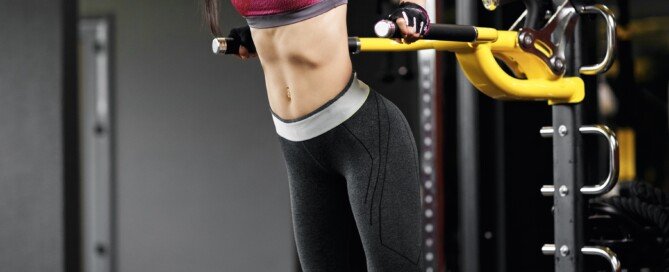
Can Women Learn to Do Parallel Bar Dips without Assistance?
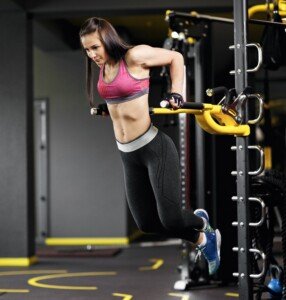
In the past decade I have seen maybe three woman, besides my clients, doing unassisted parallel bar dips. Why is this?
Why don’t women do parallel bar dips without assistance? Can women learn to do such parallel bar dips? Of course they can!
I’m a certified personal trainer, and I myself do unassisted parallel bar dips (I’m a woman) as part of my triceps routine, and I attach weight to my waist, to boot.
The reason is clear why women don’t do parallel bar dips: They are freaking difficult.
The average man off the street can’t do a parallel bar dip attempt much better than the average woman.
That is how hard they are. It’s a completely unnatural motion. If you clicked on this article, you know what a parallel bar dip is, so I’m not going to describe it.
A woman does not need to be skinny to do a parallel bar dip, though if a woman is overweight, even slightly, this will be pretty much like a lean woman trying parallel bar dips with a 20-pound weight plate strapped to her waist.
Here are the prerequisites for learning parallel bar dips, whether you’re a man or a woman.
1. Having reasonable weight for your height. I wouldn’t recommend this workout for people who need to lose a lot of weight.
2. No rotator cuff problems. If you have tweaky shoulders, let alone some kind of rotator cuff problem, then stay away from parallel bar dips.
Here is the training regimen for achieving unassisted parallel bar dips–even if you’re a woman–yes!
1. First do two or three rope drop-sets of triceps push-downs, or your standard seated dip routine.

Shutterstock/GlebSStock
Then you can do a few easy sets of seated chest presses to loosen up the rotator cuff and chest. This will get the blood circulating before the workout.
Never attempt parallel bar dip training on cold, stiff shoulder joints. A little pre-fatigue is very good for them.
Next, stretch your shoulder joints in between sets. Then find a Gravitron or some other type of dip-assist apparatus.
2. Set the assistance such that you can easily dip 12 times. This first set is strictly to loosen up and stretch the shoulder area even further.
3. Your arms should never bend more than 90 degrees. Keep your back straight.
Do not pitch forward as you dip. Many women pitch way forward on these machines.
A little pitching is fine, but be very aware of how much you’re tilting forward. When you get to 90 degrees, hold it there for 2-3 seconds.
When you push back up, do not lock out your elbows. Come back down after half a second.
4. Now, set the assistance so that you can barely get out eight reps; the last two or three should be very difficult.
Repeat the techniques from No. 3 above, including that 2-3 second hold.
5. Rest 90-120 seconds. You may think this is too long a rest. If you do, then the assistance you’re using is too much, believe it or not.
The effort for the last two or three reps should literally take all you’ve got. If it’s too difficult to do eight, then adjust the assistance.
Strive to lower assistance by 5-10 pounds every week until you no longer need it.
6. If you’re already doing independent parallel bar dips, get in the habit of holding the down position for 2-3 seconds.
If you can do more than eight reps this way, attach a weight to your waist with a “dip belt.” Don’t let your body rock as you dip; keep it controlled.
Your body should always be as upright as possible. Do not let it swing such that your chest is tilting towards the floor.
When women do unassisted parallel bar dips, it gets attention, because it is so rare to see women doing these.
It’s common to see women on the Gravitron and like machines using assistance.
But no assistance? I can count on one hand the number of women I’ve seen in my entire life performing this fabulous compound exercise without assistance. It shouldn’t be that way.
Lorra Garrick is a former personal trainer certified through the American Council on Exercise. At Bally Total Fitness she trained women and men of all ages for fat loss, muscle building, fitness and improved health.
.
Top image: Shutterstock/sklyareek

How Much Fat Can Panaerobics Burn?

Panaerobics is a fun form of cardio exercise that amplifies fat burning.
Panaerobics is a unique and effective way to melt off excess fat while also greatly improving heart health–and anybody can do this fun form of exercise.
The word “panaerobics” was coined by Dr. Len Schwartz years ago, and it’s a fusion of panorama and aerobics: whole body aerobics.
In panaerobics, you perform cardio (usually walking) while simultaneously performing upper body movements with very light hand weights, yielding a high fat burn.
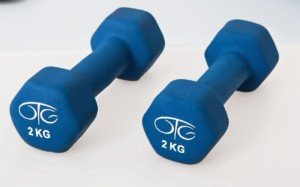
Panaerobics exercises are typically done with 1 to 10 pound weights. The upper body and lower body exercise at the same time.
Panaerobics differs from straight endurance exercise (such as running, cycling or even step aerobics with the arm choreography) because it builds an element of strength due to the hand weights—strength building while building cardiorespiratory fitness.
This doesn’t mean that panaerobics is a substitute for traditional strength training; it’s still a cardio-centric modality. What results from panaerobics is endurance-strength.
Remember, the weight range is 1 to 10 pounds so that you can sustain long duration—loading as much muscle you can while performing aerobic exercise like walking—a great fat burning workout.
Panaerobics burns tons of fat.
Because so much muscle mass is being worked simultaneously, a significant calorie burn results. Photos of Dr. Schwartz in his early 80s are shocking: a ripped physique.
Panaerobics does not include counting reps; you perform reps throughout the duration of the walking, stationary bike pedaling, or use of an elliptical machine or stair climber.
- Start out with very light weights
- Beginners will tire very quickly even with just 1-pounders.
- Go for time lapse, such as 15 minutes nonstop for your first session.
Just like your legs won’t stop during the session, the upper body movements don’t stop, though they can change. It may take time to find the right rhythm.
Some examples of upper body movements: shoulder press, frontal raise, side (lateral) raise, side flye, biceps curl, biceps curl to shoulder press, side raise followed by front raise, front cross-overs, cross or uppercut punching motions, or any other combinations that come to mind. The more vertical the lifting, the more taxing on the muscles.
You need not perform every conceivable motion in one workout. Rather than focusing on increasing the weight during a short session, focus on increasing duration with the same weight.
An hour-long panaerobics session with 2-pound weights will blitz the body and burn substantial fat.
Don’t turn this into merely an extra long weight lifting session (e.g., walking for just five minutes while doing shoulder presses with 20 lb. dumbbells—this is not panaerobics).
Remember, the upper body reps go in synch with the lower body movement.
This means if you’re walking, each shoulder press or frontal press coincides with each footstep.
For pedaling, find a rhythm that upper and lower body share.
If you need to take a rest at some point and just keep the weights hanging at your sides, that’s fine; panaerobics is very fatiguing to those who’ve never done it.
Lorra Garrick is a former personal trainer certified through the American Council on Exercise. At Bally Total Fitness she trained women and men of all ages for fat loss, muscle building, fitness and improved health.
.
Top image: Shutterstock/Vladimir Borozenets
Source: heavyhandsfitness.com/content.aspx?idx=55

Does Rock Climbing Make Your Hands Bigger?

A study from the University of Tennessee investigated whether or not rock climbing put the athletes at a higher risk for developing osteoarthritis.
“According to a 2006 study, rock climbers can develop increased bone thickness,” says Jessalynn Adam, MD, who specializes in primary care sports medicine with OrthoVirginia.
“This study demonstrated a greater cross-sectional area, and greater total width, due to subperiosteal bone deposition and remodeling related to climbing,” explains Dr. Adam.
“They found that this was related to high intensity mechanical stress and not repeated low intensity stress.”
Does this translate to bigger hands from rock climbing?
Well, for sure, it means larger or thicker bones — but would this necessarily cause the actual appendage to measure bigger, as in, longer fingers, greater finger diameter, greater palm width?
If playing piano could make hands bigger, wouldn’t serious rock climbing?
My mother began studying classical piano at a very young age.
She’s four inches shorter than me, yet her hands are larger than mine, and I have large ones relative to my height – not super large, but I’ve noticed that they are larger than other women my height or even several inches taller.
My mother’s finger span width is greater than mine. When we put our hands together at the palms, it’s obvious that hers are larger than mine.
Logic says this is from the decades of piano playing while her body was still growing.
The study on rock climbers shows that the cortical bone thickness is increased in their fingers and hands.
And that rock climbers do not have a higher risk of osteoarthritis when compared to people who do not rock climb.
 Dr. Adam specializes in the care of athletes and active individuals of all ages, offering prevention, diagnosis and treatment of sports and exercise injuries. Dr. Adam’s care focuses on muscle injuries and biomechanics.
Lorra Garrick has been covering medical, fitness and cybersecurity topics for many years, having written thousands of articles for print magazines and websites, including as a ghostwriter. She’s also a former ACE-certified personal trainer.
.
Top image: Shutterstock/Photobac
Source: ncbi.nlm.nih.gov/pmc/articles/PMC2100343/
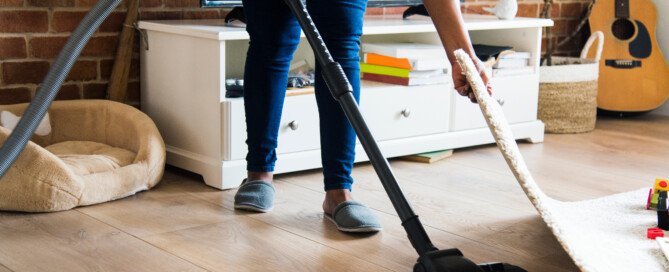
Why Housework Is Worthless for Losing Weight

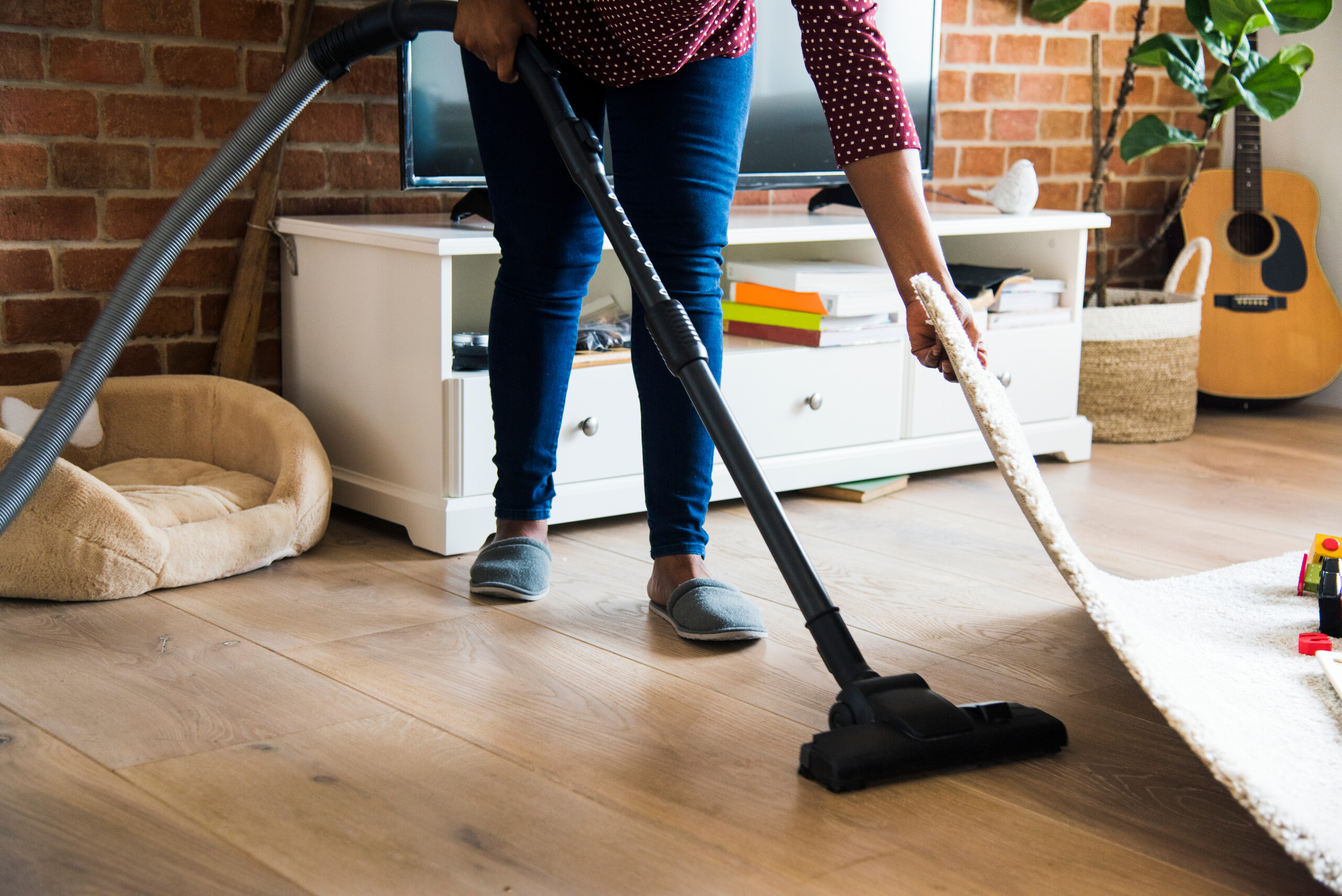
Housework does not replace structured exercise, and thus, is a poor tool to rely upon for any fitness goal, including weight loss.
The BMC Public Health journal (October, 2013) has the latest report on the fallacy that more housework or any amount leads to weight loss.
The study analyzed data of self-reports of exercise. The more that housework was self-reported as part of one’s exercise time for the week, the heavier that person was.
In fact, when people included cleaning the home as their moderate to vigorous physical activity, they tended to be heavier when compared to subjects who reported the same amount of time doing non-housework forms of action.
The report notes that the UK Department of Health guidelines for exercise are 150 minutes weekly of moderate to vigorous activity.
The analyzed data comes from the Sport NI Sport & Physical Activity Survey by the University of Ulster.
People who named housework as a part of their weekly time spent exercising had a tendency to be heavier, says this report.
The study leader, Professor Marie Murphy, explains that in theory, any physical activity (of which housework is, of course) should increase caloric expenditure.
“But we found that housework was inversely related to leanness,” says Murphy, “which suggests that either people are overestimating the amount of moderate intensity physical activity they do through housework,” or, she says, they’re eating too much to offset the activity.
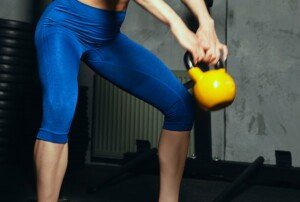
To some people, mopping a floor is vigorous activity. As a fitness professional, my definition of vigorous activity is doing hill dashes or 30 consecutive kettlebell swings with a 25 pound weight.
Shutterstock/The Faces
I’ve noted in many articles of mine, however, that “strenuous” or “vigorous” is subjective, and to a very out-of-shape, overweight person, walking 3 mph up a slight incline can exhaust them within 60 seconds — and hence, for that individual, it qualifies as “vigorous.”
However, this same person may be able to perform typical household duties without any difficulty other than some faster breathing and a little perspiration.
Murphy explains that it must be clarified that as far as amount of exercise for health-yielding results, that “housework may not be intense enough to contribute to the weekly target,” and, as she adds, “that other more intense activities also need to be included each week.”
A closer look at the inverse relationship between amount of housework self-reported and the bodyweight of the participant:
It stands to reason that someone who makes excuses not to perform structured strength training and cardio workouts will freely convince themselves that cleaning the home provides adequate exercise.
It’s not difficult to understand why overweight or obesity would be more prevalent in this demographic.
An overweight or clinically obese person is perfectly capable of conducting household chores.
Because they’re heavy and don’t do adequate structured exercise, doing certain household tasks will quickly fatigue them or make them ache. Because of this, they consider housework “vigorous.”
A fit person, on the other hand, would consider the same degree of housework as very light duty.
Lorra Garrick is a former personal trainer certified through the American Council on Exercise. At Bally Total Fitness she trained women and men of all ages for fat loss, muscle building, fitness and improved health.
Top image: Freepik.com
Source: sciencedaily.com/releases/2013/10/131017214855.htm





Low Back Pain with Treadmill Incline: Cause, Solutions
Find out the cause and solutions to low back pain from using a treadmill incline.
Have you noticed that using an incline on a treadmill triggers low back pain or an ache?
There’s a reason why using an incline on a treadmill is uncomfortable for your lower back.
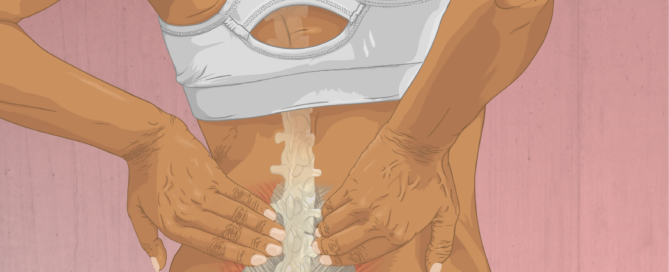
This article is about low back pain that results from de-conditioning or poorly trained, weak soft tissue of the low spinal region.
If you have sharp, shooting pains in your low back, this needs medical evaluation for a nerve related problem.
Most low back pain is caused by under-exercising the muscles in this area, especially in combination with poor biomechanics in daily life such as picking something heavy off the floor with your back rather than legs.
Low Back Pain when Using Treadmill Incline
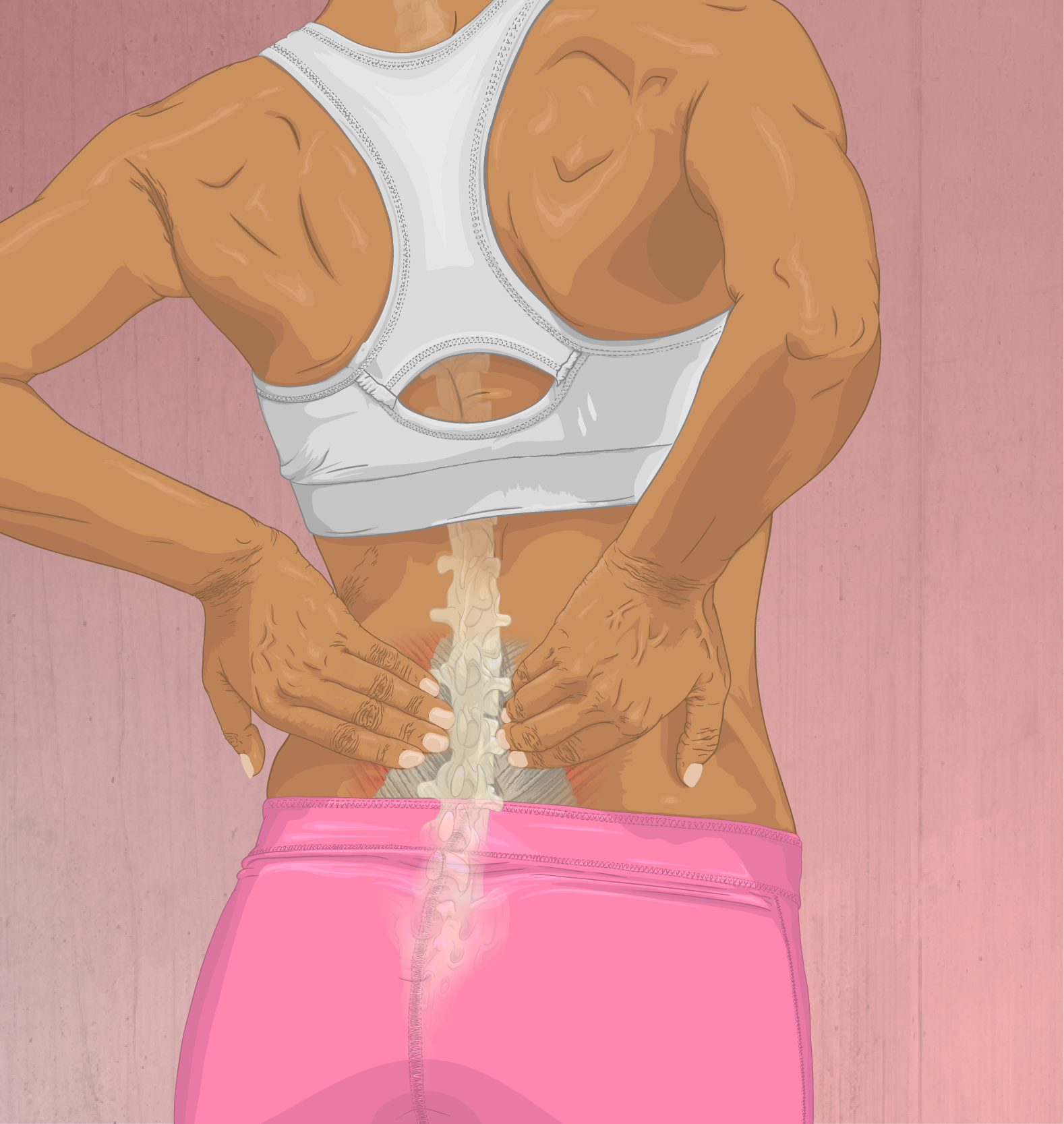
The low back pain comes from weak, out-of-shape muscles; these muscles are part of the core, which includes the erector spinae muscles.
The erector spinae’s job is to stabilize the spine, which includes the task of keeping it upright.
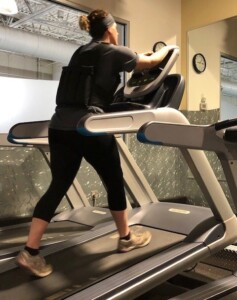
When you use the treadmill’s incline without holding onto the machine, these low back muscles are put into action:
They work hard to keep you erect, to keep you from falling off the tread.
Walking an incline isn’t just leg work. It is core work.
Believe it or not, the abs get engaged, too, as long as you’re NOT holding onto the machine.
Problem is, the vast majority of people hold on when using an incline.
I’ve been told by some of them it’s because their low back “hurts” when they let go of the treadmill.
To them, the smart thing to do is to simply hold on to ward off low back discomfort. But this is a big mistake.
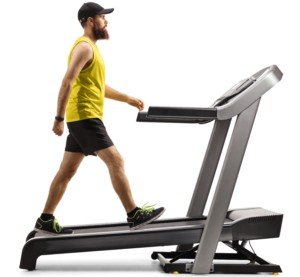
Solution to Low Back Pain on Treadmill Incline
Shutterstock/Ljupco Smokovski
The solution is to let go of the machine, but at a pace that you can handle without struggling to keep up with the tread.
The “hurt” in an otherwise normal back (the assumption is that there’s no herniated disc, slipped disc or nerve impingement) comes from fatiguing muscles.
Muscles are supposed to “hurt” when you exercise them.
This is a good kind of pain that’s in the muscle, not the joint.
When muscles are worked and begin fatiguing, they’re not supposed to feel comfortable.
If you were to avoid exercise because it “hurts” your muscles, you’d never do any exercise.
Walking on a treadmill incline, without holding on, exercises the low back.
If it hurts, this is the same discomfort mechanism that occurs when, for example, your shoulders “hurt” when pushing dumbbells over your head.
The low back muscles absorb forces when you use an incline without holding onto the treadmill.
Do not give in to holding on to alleviate this discomfort any more than you’d avoid shoulder exercises to prevent your shoulder muscles from hurting (if the joint hurts, stop).
Again, this all assumes your lower spinal region is otherwise normal: no bone or nerve problems.
To strengthen your shoulders, you force yourself to tolerate the muscle burn.
To strengthen your legs, you force yourself to endure the muscle burn when doing walking lunges or squats.
Same thing applies to the low back: To strengthen these muscles, you must force yourself to endure the aching, which is actually the muscle burn of the erector spinae: Keep your hands off the treadmill.
This doesn’t mean you must do a marathon incline session.
Work the incline, hands off, for five minutes, then go back to zero incline and continue walking with an arm swing. Don’t hold on.
When the burn subsides, go back to incline use for a few minutes or so.
Introduce your erector spinae muscles to exercise intermittently, interval-style.
It may take a few weeks for the lower back muscles to adapt and no longer “hurt” when you use an incline.
Start off with a small incline, just like you’d start out with light dumbbells when doing shoulder presses for the first time.
Though weak shoulders or weak thigh muscles don’t typically hurt, it’s a fact that weak low back muscles tend to cause pain or aching.
Remember, holding onto a treadmill when using the incline greatly cheats the low back muscles from getting stronger, and puts you at risk for increased pain in this area.
If this article provided you with helpful information or reassurance, please consider supporting my work through Ko-fi. Donations help me continue writing detailed medical content that’s easy to understand.
Lorra Garrick is a former personal trainer certified through the American Council on Exercise. At Bally Total Fitness she trained women and men of all ages for fat loss, muscle building, fitness and improved health.
.