
Why You Shouldn’t Hold a Treadmill Even with One Hand
Just take that hand off the front bar or side rail already; otherwise it makes your body work unevenly, plus numerous other problems.
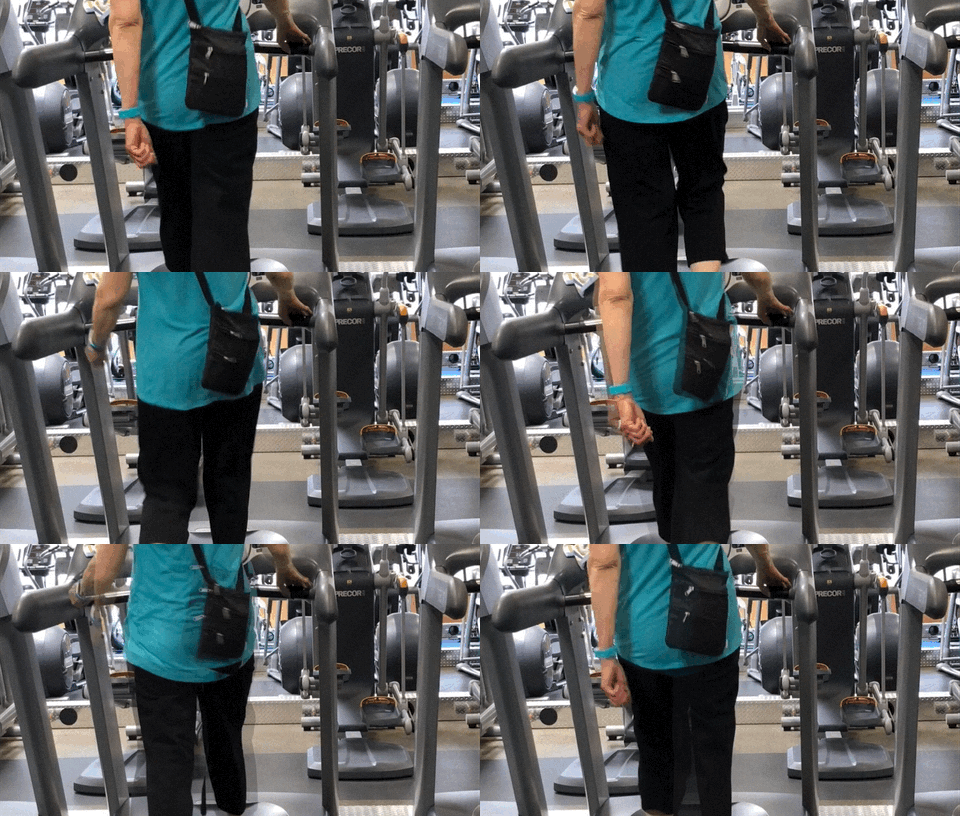
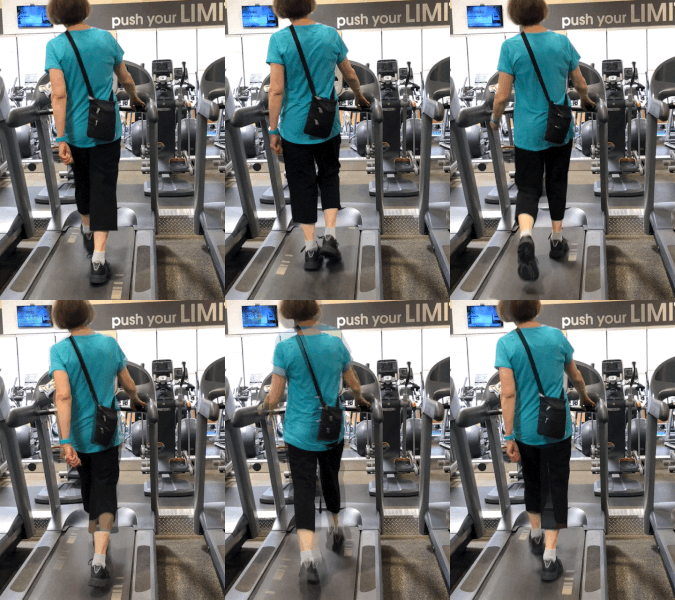
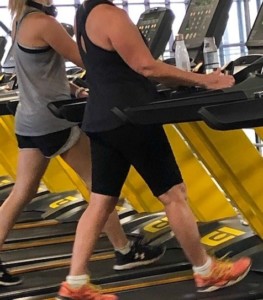
Look at the woman above holding onto the treadmill with one hand. She was not modeling this; she was an actual gym user doing her “workout.”
You need not be a spine doctor to immediately see how bad this is for her vertebral column and the soft tissue that it’s part of. Her ENTIRE GAIT is thrown off whack.
This is a very unnatural way to walk. You might be thinking, “She appears older; maybe it’s better for her to walk with one hand on the treadmill.”
However, being older or new to the treadmill is ALL THE MORE REASON to walk naturally: arms swinging at your sides in harmony with the movement of your lower body.
The one-hand approach is a bad habit. Ask yourself why you feel it’s mandatory to do this. The purpose of a treadmill is to simulate walking.
Though some will argue that walking on a moving tread hardly simulates “real” walking, training on a treadmill without holding onto it actually does a good job of carrying over to “real” walking (or running).
The one-hand hold provides stabilization to the body that the body doesn’t have to be accountable for.
And when you venture outside, you’re not holding onto anything. Stabilization, then, must come from YOU.
If you’ve taught your body to depend on that one hand holding onto the treadmill, you have caused your body to regress, not progress.
Why do people hold onto a treadmill with one hand?
Typically, they switch hands every so often during their walk or jog. One person told me she gets dizzy.
The most common reason seems to be that people think they’ll lose their balance.
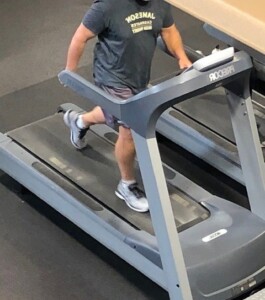
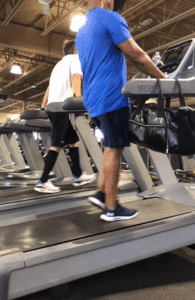
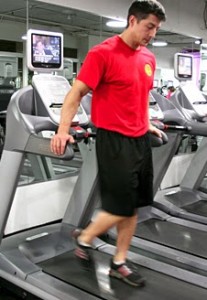
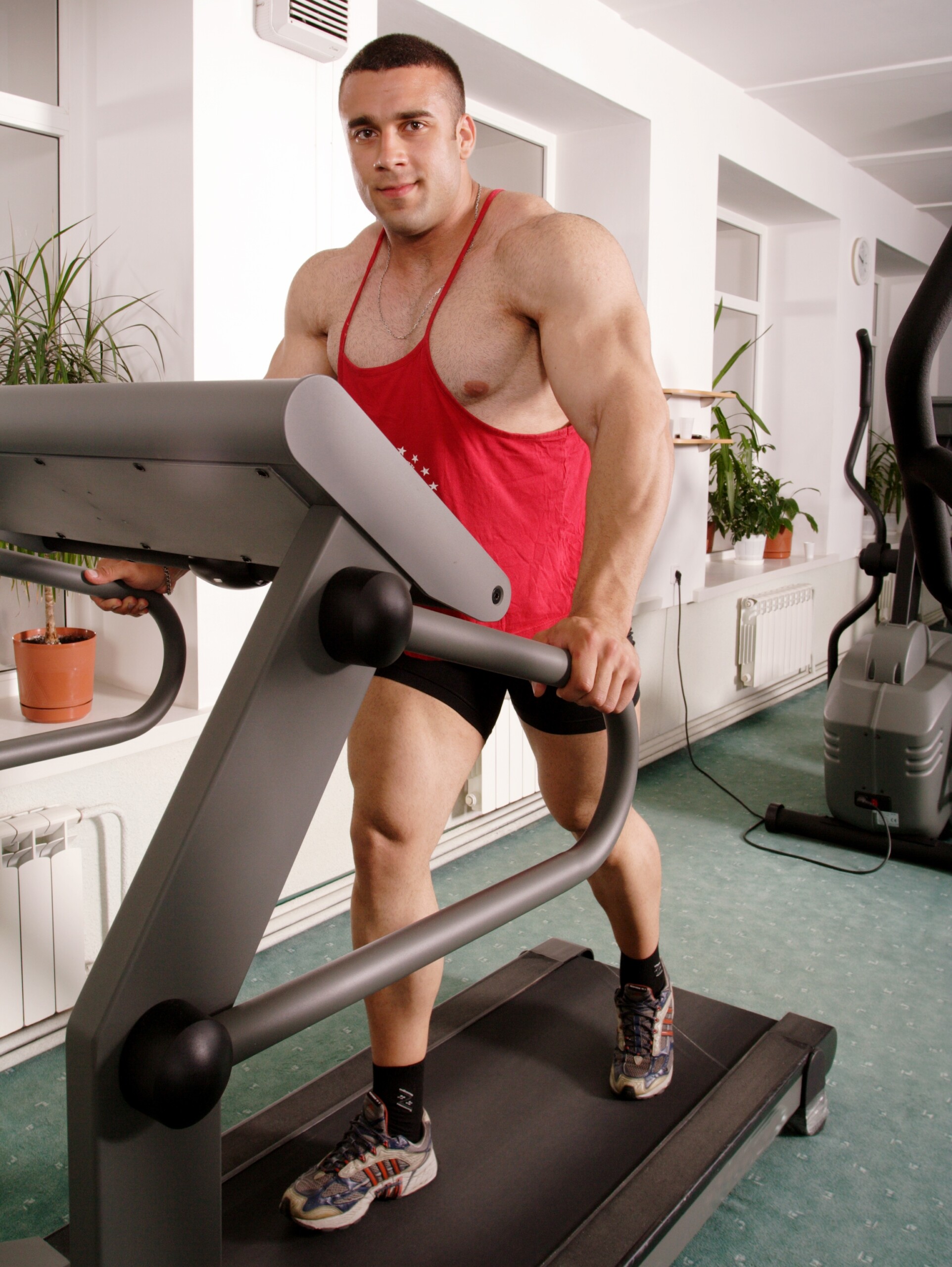
This includes the strapping burly man in the image above. This is not a model posing.
He was caught actually holding onto the front bar with one hand during his entire walk.
Can we really believe this muscular dude had a balance disorder? He had no problem going up the flight of stairs after his fake walking workout.
So then, WHY was he, and all the ohters like him, holding on with one hand?
Because he’s MENTALLY not ready to do the extra work it requires to walk wtihout holding on.
This is akin to stopping at 10 pushups when you know you can do 15, or curling 20 pound dumbbells for eight reps when you know you can do 25 pounds for eight reps. It’s psychological laziness.
Is it really believable that the burly guy TRULY FEARED he’d topple off the tread if he let that one hand go? Come ON, people.
Why is one hand on a treadmill a bad thing?
By keeping one hand on a treadmill, you will create an uneven gait pattern, even if you switch hands and give each hand equal time on the rails or bar.
Switching hands doesn’t matter because while you’re walking with that one hand on the bar or rail, here’s what’s happening:
Your hips are moving unevenly. One side of your upper body is locked up while the other side is moving.
The hip on the side of the hand that’s holding on is overcompensating to make up for the immobilized upper body on that same side.
Meanwhile, the other hip is trying to match the motion of the overcompensating one. This imbalance does NOT get offset by switching hands.
Holding on with one hand creates a ripple effect of skewered gait mechanics that begins at the shoulder and goes all the way down to the foot.
“Changing of the gait can always lead to injuries, especially soft tissue injuries such as tendinitis,” says Dr. Oliver Zong, DPM, a foot specialist and surgeon based in New York.
“To the extent that holding on to the treadmill changes one’s gait, this could happen. Clearly it is better to walk or run naturally with a natural gait pattern.”
The net effect of holding onto a treadmill with one hand, even if they’re switched, is an increased risk of repetitive stress injuries in the shoulder, hip, low back and foot.
Even if you don’t get an RSI, you’ll fail to train your body to be more efficient at balance and coordination.
In fact, you’ll “de-train” it by making it more dependent upon external support (the bar or rail).
This will not translate to real-world movement and will actually make you less efficient in the real world of uneven surfaces, steps, puddles to step over, etc.
- Next time you’re on a treadmill, ditch the one-hand approach and walk the natural way.
- Swing the arms rhythmically as the rest of your body moves.
- If you fear losing your balance, use a slower speed and then progress from there.
Holding onto a treadmill with one hand will cause a deficit in your ability to balance and coordinate your movements in the real world.

Dr. Zong, a foot and ankle surgeon, has appeared on national and local TV programs such as “Good Morning America” and “The Doctors.”
 Lorra Garrick has been covering medical, fitness and cybersecurity topics for many years, having written thousands of articles for print magazines and websites, including as a ghostwriter. She’s also a former ACE-certified personal trainer.
Why Do Bodybuilders Hold Onto a Treadmill when Walking?

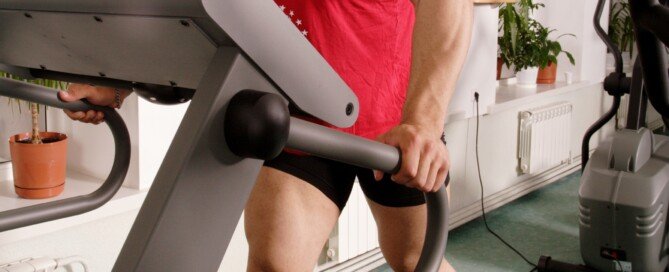
If you think hanging onto a treadmill is an approach mostly committed by elderly walkers, think again.
Even big strong bodybuilders commit this sabotaging habit.
Many walkers who hold onto a treadmill are muscle-building or physique athletes in perfect health.
Typically, a bodybuilder or physique athlete will use a treadmill, especially an incline, to burn fat to prepare for a competition.
Many non-competitive bodybuilders or physique enthusiasts will gravitate towards the treadmill incline to slash body fat to get that super-cut appearance.
These same men and women will perform impressive feats with heavy barbells and dumbbells that require a lot more balance than what’s required for keeping up on a moving tread.
For example they’ll do walking lunges holding heavy dumbbells; repetitive jumps onto a stool; and squats with a very heavy barbell across the top of their upper back.
Yet they can’t walk on a treadmill without holding on?
Live life on the edge! LET GO!
Well, there is some truth to this. The reason bodybuilders need to hold onto a treadmill is the same reason that so many other grippers need to employ this sabotaging habit:
The speed is too fast. Or the incline is too high.
It’s that simple. A naïve trainee will think he’s burning tons of calories because the console shows a gazillion calories burned after “walking” 4 mph at 15 percent incline for 45 minutes.
What this individual fails to realize is that this calorie readout is generated by the settings in the machine’s computer and has nothing to do with that actual person moving on the tread!
To prove this, stand next to an empty treadmill. Now, press the button to start it, then set the speed at 4 mph, and then set the incline to 15 percent. Let the machine run without anybody on it.
The calorie total will immediately start tallying up. It will be a big total after 30 minutes, even though nobody was on the machine.
Thus, when you’re on a treadmill for a while, high incline, fast speed, hands on the bar, don’t let the big calorie total fool you.
You burn about 25 percent fewer calories, maybe 30 percent fewer, than what you would burn with a hands-off walk.
If a bodybuilder wants to burn maximal amounts of fat, they will achieve this much faster, and I mean MUCH faster, by using a slower speed and/or lower incline, and keeping their hands off the treadmill.
A fast tread or high incline are meaningless if you’re hanging onto the treadmill.
The irony is that a devoted bodybuilder or physique enthusiast will typically be very diligent about proper form when it comes to strength training exercises.
Why they toss efficient form out the window when it comes to the treadmill is a mind-buzzing mystery.
Lorra Garrick is a former personal trainer certified through the American Council on Exercise. At Bally Total Fitness she trained women and men of all ages for fat loss, muscle building, fitness and improved health.
.
Top image: Dreamstime.com, Aleksandar Todorovic
Sources forum.bodybuilding.com/showthread.php?t=123430321&page=1; musclechemistry.com/upload/musclechemistry-discussion/52686-holding-treadmill.html; musclechemistry.com/upload/musclechemistry-discussion/52686-holding-treadmill.html
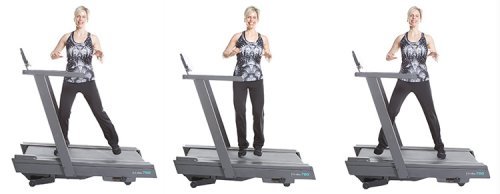
Walking Sideways on a Treadmill: Why You Should NOT Hold On
You will gain absolutely nothing by holding onto the rails of a treadmill while walking sideways.
This waste of time may lead to worsening of the posture.
Walking sideways on a treadmill has become more popular over the years, but still remains a rare sight to see.
As a former certified personal trainer, I will point out that sideways walking on a treadmill should NOT be considered a gimmick or fad, as it does have some unique benefits.
I am faithful to including sideways walking as part of my treadmill routines, and this lateral form of exercise (“frontal plane”) should be conducted without holding on.
“Unless someone requires handrail support initially to walk sideways on a treadmill because of health reasons [such as spinal stenosis], holding onto the rails of the treadmill will detract from its benefits,” says Dr. Tom Carpenter, corrective exercise specialist, certified personal trainer and chiropractor, and inventor of Stand Corrected™, a portable harness-like stretching tool that helps alleviate back, neck and shoulder pain.
Dr. Carpenter adds, “Hands-free side walking improves lateral (side to side) stability in regards to the kinetic chain. Think core. The body moves in neurologic/muscular systems naturally, not as isolated movements.”
Now think about that next time your hands go for the rails!
“Any interruption in this kinetic chain, such as holding onto the treadmill supports, will create adverse compensations in the way we would otherwise move naturally,” says Dr. Carpenter.
Ask yourself why you want to walk sideways on a treadmill at all. Whatever the reason, you will defeat the purpose by cheating.

WRONG, no matter HOW many people do this.
Holding on while walking sideways on the machine will not improve balance at all, nor will it promote your cardiovascular fitness.
Plus, next time you see a person at the gym walking sideways on the treadmill while holding on, take note of their posture.
They are bent over, and not just forward, but to the side. This is bad for the individual’s spinal column and it throws gait off completely.
Pointers for Walking Sideways on Treadmill
Begin at a speed that you think is too slow for your liking. You will not trip at only 1 mph. Turn sideways and let go. This is not as tricky as you think.
In fact, think of sports that you’ve played that involve lateral movements: basketball, volleyball, soccer, boxing, karate, tennis.
A moving tread is no different. It’s easier because you are not handling a ball.
If you hold on at a faster speed, you will not achieve anything except a distorted gait. Holding on will remove some body weight, and the legs and core muscles will not really be supporting you.
Let go at a slow speed and you’ll quickly get used to it. Focus on correct posture, correct spinal alignment and square, balanced shoulders.
- Those who hold on always have hunched up and crumpled shoulders.
- And their hips are out of whack.
- The posture is crooked.
- They will never improve their balance or fitness.
If you fear stumbling then watch your feet. As you get used to the 1 mph, increase the speed to 1.5 mph.
After you get used to that small increase, then raise it to 2 mph. Don’t rush with this progression.
When you walk sideways on the treadmill, your legs and core really should do all the work for maximal calorie burn (if that’s important to you), best neurological recruitment and most efficient cardio training effect (once you start moving faster). Do not rely on the machine’s rails to do these jobs!
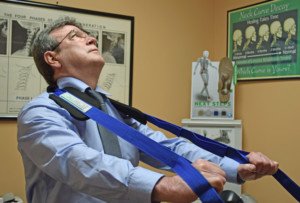
Photo credit: Aleesia Forni
Based upon 30+ years of experience, Dr. Carpenter’s practice approach reflects his belief that restoring optimum health and function will enable his patients to enjoy a much greater amount of vitality and wellness. Chiropractic care is true health care, not sick care!
Lorra Garrick has been covering medical, fitness and cybersecurity topics for many years, having written thousands of articles for print magazines and websites, including as a ghostwriter. She’s also a former ACE-certified personal trainer.

Backward Walking on a Treadmill: Take Your Hands Off Rails!
Did you know you’re wasting your time if you hold onto the rails when “walking” backwards on a treadmill?
Watch someone doing this. How does their posture look?
I’m a former certified personal trainer, and from time at the gym I saw a person walking backwards on a treadmill and holding on.
You may think, “Gee, isn’t that the smart thing to do? Otherwise you’ll fall, right?”
I walk backwards on a treadmill all the time and I never hold onto the rails.
To do so is akin to lying back-down on a floor, grabbing a rope in front of you that’s tethered to a base, holding it at your chest, pulling yourself up into a sitting position, and then saying you just did a sit-up.
You won’t fall if you train correctly and believe a little more in yourself.
Retro walking on a treadmill while holding on is an exercise (no pun intended) in futility.
People I see walking backwards on a treadmill are almost always in their 20s and 30s. The vast majority are women.
Can you retro walk across your living room?
If yes, then you can walk backwards on a treadmill without holding on.
Why do you retro walk on a treadmill?
Is it because you heard that it can lessen pre-existing knee pain? Did you read somewhere that walking backwards stimulates muscles that going forward misses?
Whatever your reason, holding on will defeat the purpose and encourage bad posture.
If you want to improve your posture, retro walking on a treadmill sans holding on will do wonders at improving your spinal posture!
You will be forced into perfect posture by keeping your hands off the rails. This beats walking around with a book on your head any day.
The minute you place your hands on the rails, there’s no longer a need to keep the spine erect and shoulders square.
Want to improve your balance? Let go. You can’t improve balance (be it in martial arts, dance, yoga or whatever) by holding onto something, though some people initially must hold on to a support.
But even then, in the case of martial arts, ice skating, etc., the goal is to perform the activity without clinging to anything.
This should be the case with retro walking on a treadmill.
To get the full benefits, to engage your entire body, to really tap into the core and strengthen these muscles, and to improve coordination and balance, you must walk with your hands free.
Set the speed at 1 mph and give it a try.
Grasping the rails while your feet get moved on a 4 mph tread is worthless.
Retro walking with your hands free will strengthen the ankles, too. Using the rails will block this effect.
- Start slowly.
- As you acclimate, increase speed a little.
- Keep your eyes fixed on a point that stabilizes you.
- If you must keep your eyes on your feet at first, then do so. Gradually move them out more as you acclimate.
“Some treadmill companies manufacture a rail that can be placed over the treadmill for stabilization while walking backwards,” notes Dr. Charles J. Pelitera, assistant professor of kinesiology and coordinator of the Health/Wellness Program at Canisius College, NY.
He adds that “there is more benefit to not holding onto a rail while walking backwards, but there is a proprioceptive learning curve in regards to being confident enough to not hold on.”
The learning curve is psychological. A former client of mine was a 65-year-old, 220-pound woman with arthritis in her knees.
I had her retro walking on the first session — without holding on. She had a bear of a personality, so it’s not surprising she showed no fear and adapted quickly.
“Once mastered, retro-walking can be a great method of cross training,” says Dr. Pelitera.
Retro walking on a treadmill produces a number of benefits, but only if you do not hold on.
 Dr. Pelitera is the owner of Pelitera Fitness Consultants, which specializes in athletic training, weight loss and strength training.
Lorra Garrick is a former personal trainer certified through the American Council on Exercise. At Bally Total Fitness she trained women and men of all ages for fat loss, muscle building, fitness and improved health.
Treadmill Routine with 30 Percent Incline: Burn the Most Fat
Follow this 30 percent treadmill incline routine to maximize fat-burning.
Here is a routine you can do on a treadmill with a 30 percent incline to burn as much fat as possible with this setting.
Follow my instructions; there’s a right way and a wrong way to do this, and most people do it the wrong way and then wonder why they haven’t lost weight.
30 Percent Incline Takes Time Getting Used To
No matter what your aerobic condnition, walking at this angle, without holding onto the treadmill (that’s absolutely forbidden!), takes a little getting used to for the calves and Achilles tendon.
When you walk a 30 percent incline without holding on, this causes pronounced stretching of the back of the lower leg.
So even if you’re walking at 1 mph at this steep incline, your calves and Achilles can easily get sore in less than 10 minutes.
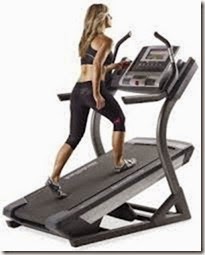
Do not overdo this or you’ll really end up with strained soft tissue.
To get in an good fat-burning workout with a 30 percent grade, you must first make sure your calves and Achilles tendons are adapted. The last thing you want is a strained Achilles.
The Workout
For how long can you walk at 1.5 mph, without holding on, this steep angle before you become quite fatigued? Remember, this is after you’ve developed adaptation in the calves and Achilles.
Are you right now thinking, “What?! Only 1.5 mph?!”?
I have news for you: 1.5 mph at 30 percent incline is no piece of cake. This is about how slow you’d move outside on a real hill at the same grade. In fact, you might even move slower. We’re talking 30 percent here!
Chances are, you’re on a treadmill that has buttons for grades in 3 percent increments.
- At 1.5 mph, press 30 percent and walk one minute.
- Then press 15 percent and walk one minute.
- Then press 27 percent, then 15, then 24, then 15, and so on, until you get to 18/15, all with one minute for each change in incline.
This will be quite a workout and will burn fat. You will really, really feel your legs working. But, you must NOT hold onto the treadmill during any of this (other than to drink water).
Never mind the heart rate; you’ll know it’s elevated. Just swing your arms naturally as you would outside.
Many people who are already trained in aerobic exercise will find this particular workout difficult to sustain.
sustained pace, even at 1.5 mph, at high inclines is a true workout an dwill burn fat.
If you’re upt to it, repeat the cycle, going back to the 30 percent incline, then 15, then 27, and so on for another fat-burning round.
If your legs are “hurting” or you’re getting too out of breath, then start the cycle at 24 percent, and bring the recovery interval down to 9 percent.
Lorra Garrick is a former personal trainer certified through the American Council on Exercise. At Bally Total Fitness she trained women and men of all ages for fat loss, muscle building, fitness and improved health.
.
Top image: Shutterstock/Improvisor
Treadmill Workouts with a Negative Incline
This article explains the benefits of the treadmill’s negative incline and why you should use it.
Many people want to know what the negative incline on a treadmill “is supposed to do.”
There are many reasons to use the negative incline of a treadmill, but it seems as though few treadmill enthusiasts use this function.
Whenever I see a treadmill with a negative incline function, the grade goes only as far down as minus-three.
However, that’s just enough to create a difference in the way the body moves when using the negative incline, versus zero grade.
When a person walks downhill, forces are placed upon the knee that aren’t there when walking up a hill, or on a flat course.
These forces are called “eccentric,” which you may have already heard of in terms of lifting weights (eccentric vs. concentric).
Nevertheless, eccentric training is very important for strengthening the legs.
Have you ever known someone who whips up a steep hill with little effort, but when it’s time to ambulate down, this individual struggles?
Or they complain of knee pain? They have not developed eccentric conditioning.
Walk for 10 minutes, at 3.5 to 4 mph, using a negative 3 percent incline on the treadmill. And swing your arms with some exaggeration.
I see most treadmill walkers holding on, and this unnatural way of walking will oppose any goals that you have.
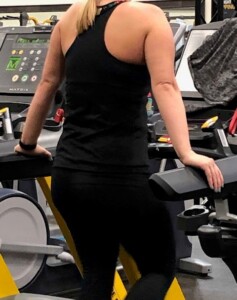
Wrong, wrong and wrong.
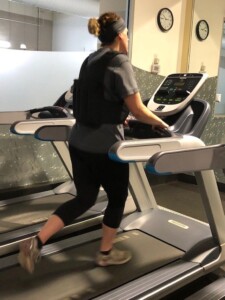
More wrong.
If 3.5 mph is too fast for a walk, then try 3 to 3.2 mph — or even below 3 mph — depending on your fitness level. Just don’t hold on.
Jogging on the negative incline function of a treadmill is also a smart idea, as this will further develop eccentric conditioning, creating a stronger knee joint.
Even if you have a staircase in the house and think your knees are already strong from using the stairs every day, the difference with the treadmill’s negative incline is that you’d be using it continuously for a predetermined amount of time.
Going down a staircase takes 5-10 seconds, and then it’s over. Even if this is repeated throughout the day, it’s still 5-10 seconds at a time, which cannot be compared to 10 nonstop minutes on the treadmill.
For an interesting calve stretch, walk backwards using the treadmill’s negative incline (always at its maximum of 3 percent, since this is a minimal decline).
Now here’s the tricky part, though it actually should not be tricky at all.
Everyone I see who walks backwards on a treadmill holds on. When I was a personal trainer, I had my clients let go and swing their arms.
This makes them upright with square shoulders and a solid gait, because by not holding on for assistance, they are making their entire body work to keep balanced and centered. This neuromuscular recruitment is extremely important.
Start out at 1 to 1.5 mph, and begin walking backwards without holding onto the rails.
You’ll feel that your legs have to work in a unique way, but that’s the whole idea, and you don’t want to snuff out this recruitment by holding onto the rails.
As you feel more comfortable, increase the speed, and swing the arms.
Watch your feet if this helps, or if you feel more at ease focusing on a point straight ahead, then do that.
One need not spend long periods of time using the treadmill’s negative incline to reap a training effect.
Ten minutes of walking on it, and 5-10 minutes of jogging on it, per week, will provide a nice touch to your cardio regimen.
 Lorra Garrick is a former personal trainer certified through the American Council on Exercise. At Bally Total Fitness she trained women and men of all ages for fat loss, muscle building, fitness and improved health.
.
Top image: Shutterstock/YanLev
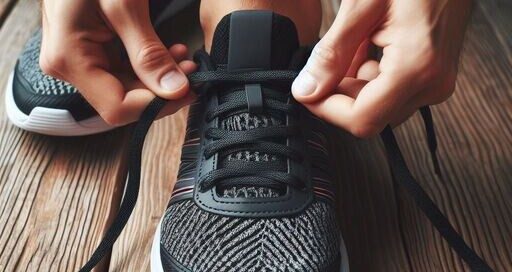
Running Backwards on a Treadmill: Pros and Cons
It’s rare to see someone jogging or running backwards on a treadmill.
But every time I see someone doing this, he or she is holding onto the rails!
This is a key point because when someone jogs, runs or walks backwards on a treadmill, but holds onto the rails, their posture and body alignment will be tossed off-whack.
You need not be a chiropractor to be able to observe this.
The irony is that nearly every person who does this appears to be in their 20s and 30s. So we can’t blame age-related knee pain or balance deficits.
It’s cool to jog backwards on a treadmill — but the whole purpose is defeated when you hold on.
If you choose to run backwards on a treadmill, don’t hold on.
If this means you must first practice at 1.5 mph, then so be it.
If you jog or run backwards on a treadmill without holding onto the rails, your posture will not only be forced to be upright with good body alignment, but it will be near perfect, as this is required to maintain balance and steadiness.
In fact, it would be difficult to run backwards on a treadmill with bad posture if you were not holding on!
I feel like a soldier when I’m trotting backwards because I’m so straight; this will happen to you, too, with the hands-off approach.
One need not be a natural athlete to accomplish this.
I had a client with no past athletic training, who was obese and in her early 50s, walking backwards without holding on.
The only thing that stopped her from jogging was osteoarthritis in her knee joints, in which the cartilage gets so worn down that there’s reduced shock absorption.
Why run backwards on a treadmill?
I sometimes do it to warm up for forward high intensity training.
I also do it to create a different pattern of muscle use. It also strengthens the knees.
I do not do it to burn more calories or emphasize the butt or hamstrings, because it will not accomplish any of these things.
Finally, I do it as part of my agility training.
Research Supports Backward Jogging
A study published in the Journal of Strength and Conditioning Research (Ordway et al, 2016) found that backward running improved forward running economy in trained male athletes, enhancing efficiency without altering VO₂ max or body composition.
Additionally, backward walking has been shown to reduce knee pain and improve balance and gait in people recovering from stroke.
We can easily deduce that for any individual, male or female, trotting or just walking backwards provides benefits, whether on a treadmill or in free space.
If you want to jog or run backwards on a treadmill, give it a try, but proceed very gradually; get used to reverse walking first.
Lorra Garrick is a former personal trainer certified through the American Council on Exercise. At Bally Total Fitness she trained women and men of all ages for fat loss, muscle building, fitness and improved health.
.
Source: nytimes.com/1998/10/13/health/no-gain-in-backward-exercise-experts-say.html
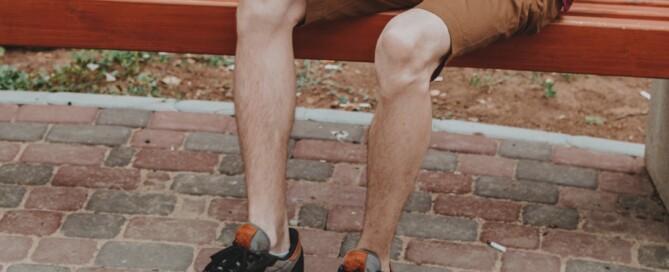
Skinny Calves: Will Treadmill Incline Walking Build Muscle?

Learn what treadmill incline walking can do — or not do — for skinny, puny calf muscles.
If you’re fed up with your skinny little calves, perhaps you’ve decided to give incline walking on a treadmill a try.
If you want to improve heart health, walk the incline on a treadmill.
If you want to build up your calves, you’ll waste your time thinking a treadmill will do the trick.
Look at it this way: If you want to build up your quad muscles, would you walk on an inclined treadmill? Or would you do heavy squats and leg presses?
Calves are muscles too, and to build them, you must lift weights with them.
Why Walking on a Treadmill Incline Won’t Build Calves
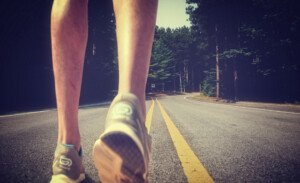
I once saw a man walking the 15 percent incline; he was a personal trainer and did not have skinny calves.
He was holding onto the front of the machine, which was making his body angle back to match the incline angle; the result was that he was, essentially, walking at zero incline due to this mistake.
Below is an image depicting what he looked like.
I asked him what his goal was and he replied he wanted to build up his calves!
You might be thinking that since he was a personal trainer, he was correct with his approach.
He was dead wrong, and the explanation that follows will help you very clearly understand why.
Walking an incline will create a burning feeling in the calves of people new to this kind of walking.
This tricks them into thinking that muscle growth will be stimulated.
But how much something “burns” is not predictive of muscle growth.
Otherwise, holding soup cans over your head for 30 minutes nonstop (which would eventually produce a burn) would build huge shoulder muscles, right?
Of course not!
- To build muscle you need heavier and heavier resistance over time. This is called progressive strength training.
- Walking a treadmill incline is called aerobic training.
There are two kinds of muscle fiber:
1 Slow twitch
2 Fast twitch
Slow twitch is designed for endurance. Walking, jogging steady state or Zumba are endurance based activities and thus, recruit mainly slow twitch fiber.
Slow twitch fiber does not grow in size. It gets more efficient with training, but does not get bigger.
Slow twitch fibers can “hurt” or “burn” — but they do NOT get bigger.
Sprinting and lifting heavy weights recruit mainly fast twitch fiber. Fast twitch will grow in size when challenged enough.
To make the fast twitch in calves grow, you must recruit these fibers.
#1 Calf raises with heavy resistance
#2 Supplement with heavy deadlifts and barbell squats (ever see a man with skinny calves like in the images above deadlift 400 or squat 500?)
#3 Genetics play a big role. Some people were born with well-shaped calves.
The personal trainer I spoke to did not have an understanding of slow twitch vs. fast twitch muscle fiber, and instead … he equated incline walking with hypertrophy.
And plus, he wasn’t even incline walking because his body was tilted back with the incline, netting a zero percent incline.
Still Skeptical?
Ask yourself how you’d get a bigger chest: pushing against a wall while standing for 20 minutes straight (endurance), or lying on your back and bench pressing the heaviest barbell you can do for eight to 12 repetitions (strength)?
If treadmill incline walking indeed made calves bigger, then hiking enthusiasts would have the calves of competitive bodybuilders. So would triathletes and marathon athletes.
Even if you keep your hands off the treadmill while using the incline, you still won’t get bigger calves this way.
Lorra Garrick is a former personal trainer certified through the American Council on Exercise. At Bally Total Fitness she trained women and men of all ages for fat loss, muscle building, fitness and improved health.
Is It Safe to Let Go when Walking a Steep Treadmill Incline?
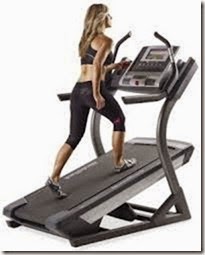
Step-by-step instructions in how to use a steep treadmill incline without holding on to get the most calorie burn and fitness benefits.
Every time I see a person using a high percent incline on a treadmill, he or she is grasping the bar in front or are gripping behind the display console.
This big mistake cancels out the effect of that huge incline.
When using a 30 percent incline and hanging onto the treadmill, the user will report that it’s impossible to walk this level of steepness without “falling off.”
If you’ve been using a steep incline and feel you must hold onto the treadmill, here is my question:
- What is the slowest speed you’ve ever used at this grade?
- My next question is: How slow can the machine be set at?
Think good and hard about your answers. If you stood on the incline but the belt was not moving (the treadmill wasn’t on), would you fall off? No. You’d be standing vertically and stable.
Now, march in place while on the high incline while the belt is still turned off. Do you fall? No.
Now, turn the machine on and set the speed at half a mile per hour and move your feet to keep up with the belt, but do not put your hands on the treadmill.
Keep them at your side, as they were when you were marching or as they’d be if you were walking this pace up a hill outside.
Do you fall? I’m betting you’ll come nowhere near falling off. That’s because your body is vertical and your legs are able to keep up with the very slow moving belt, even though it’s at a high incline.
Now gradually increase the speed, but do not advance it over that threshold to where your legs would not be able to keep up. For most trainees, that will be somewhere around 1.5 mph.
You won’t necessarily get out of breath at 1.5 mph, but unless your lower extremities are trained to move at considerable steepness, the back of your lower legs will fatigue quite quickly and you’ll be forced to take a rest.
What’s the best way to take a rest?
By lowering the incline. You can also increase the speed at this point. The lower incline will relieve your aching calves and Achilles regions.
When you reach the point of too much fatigue at a steep grade, do NOT hold onto the treadmill for the relief!
This “un-duplicates” a natural gait and trains your body to become dependent on an external support.
Instead, reduce the incline, even if this means waiting 30 seconds for the machine to sink down to 10 percent or even zero.
Be patient and wait, as you continue walking with a natural arm swing.
To get used to a 30 or higher percent incline, you’ll need to work it interval style:
Walk at 1 to 2 mph on it for five minutes (or three minutes, whatever it takes to fatigue you), and then reduce the grade to where you can walk comfortably for a few minutes (or three or four minutes; this isn’t engraved in stone). Then raise the incline to 30 again for another round.
- And all the while, your hands are OFF the treadmill.
- This is the only effective way to acclimate to such a steepness.
Over a period of weeks, you’ll note you can increase the speed slightly to achieve the same fatigue, and/or you must walk the high incline for longer and longer to stimulate the same fatigue.
You will never progress as long as you hold onto the bar or console, any more than you’d progress with chin-ups if every time you pulled yourself up, you received assistance from a gravity machine.
Be patient and remind yourself how you’d sustain a walk on a steep hill outside: without holding onto anything, and very slowly.
Intimidation of a “moving floor” is the biggest obstacle to keeping one’s hands off a treadmill. I can’t stress enough the effectiveness of just standing on an unmoving belt set to 30 percent.
Then march in place. Then turn it on to half a mile per hour, and begin walking.
Take my word for it: A 1.5 mph pace at 30 percent, maintained for 20 minutes, without holding onto the treadmill, will provide a nice introductory workout to incline walking.
You may think 1.5 mph is too slow, give this a try and you’ll be surprised!
Lorra Garrick is a former personal trainer certified through the American Council on Exercise. At Bally Total Fitness she trained women and men of all ages for fat loss, muscle building, fitness and improved health.


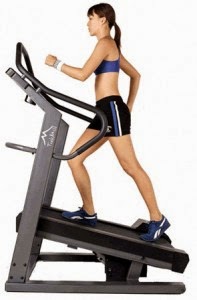
How Fast Should You Walk on an Inclined Treadmill ?
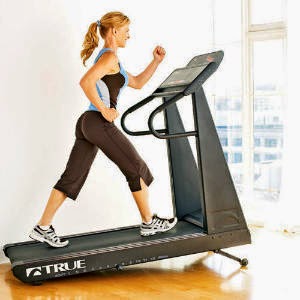
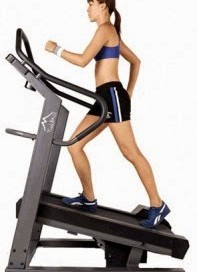
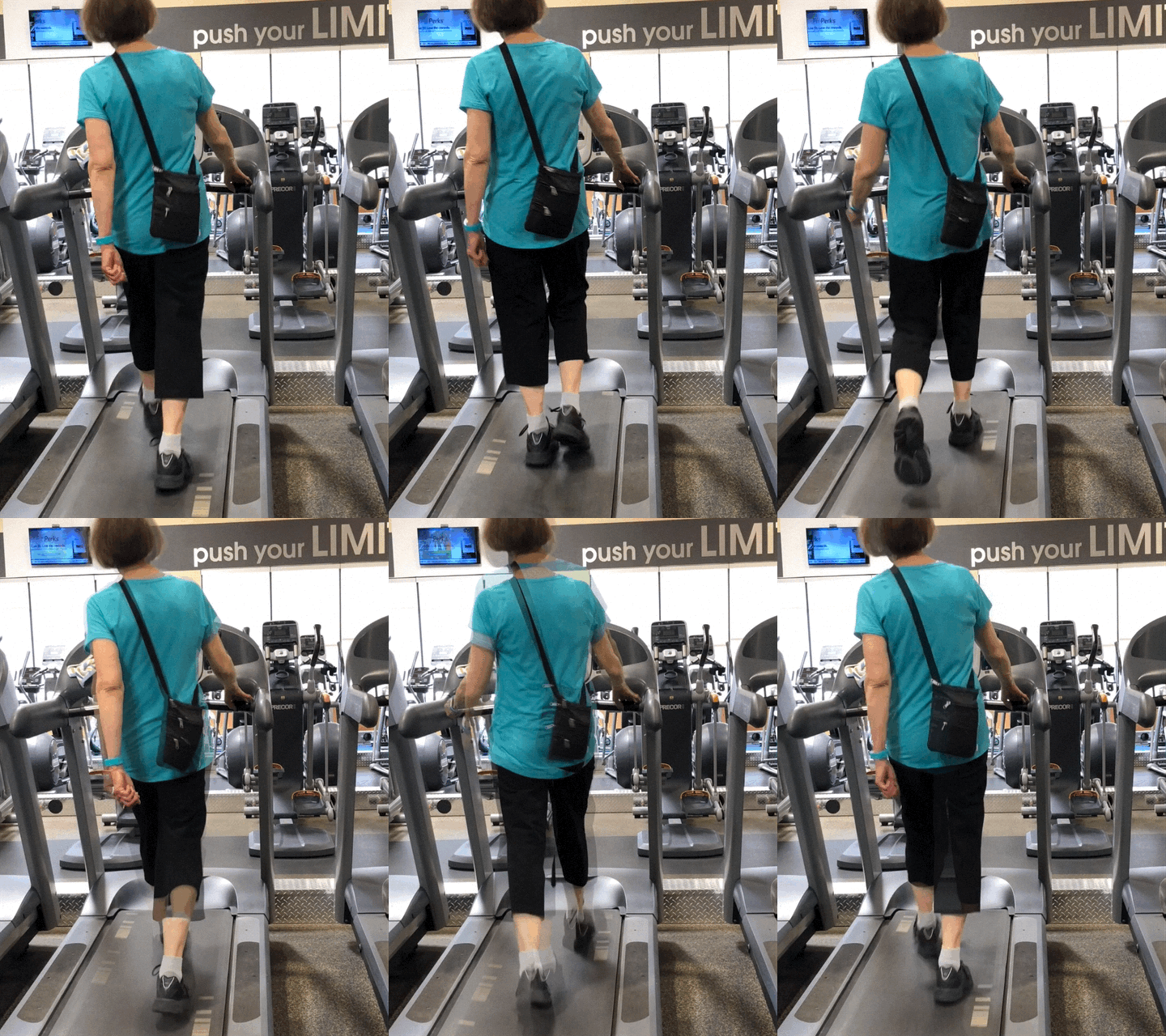
If you’re a treadmill incline devotee, chances are 99 percent you do this wrong, namely, going too fast, and here’s why.
The treadmill incline is perhaps the most incorrectly performed type of exercise because people “walk” way too fast for the selected angle.
I’m a personal trainer and have worked out at many chain gyms in different states; everywhere I’ve ever been, just about every person who uses a treadmill incline goes too fast and clings on, totally negating the intended effect!
How fast should you use a treadmill incline?
I declare with confidence that THE most incorrectly performed exercise involves the treadmill incline: holding onto the machine.
This mistake is angrily defended by those with an assortment of problems such as inner-ear balance issues, dizziness, neuropathy pain, recent knee or back surgery, and other ailments.
It’s not logical to assume that most people who jack up the incline and set the speed to 4 mph, then look like a water skier as they grip the bar, suffer from diabetes neuropathy, vertigo, hip arthritis, herniated disks or inner-ear problems. Many are also young and not overweight.
Many of the people who set the incline to super high and the speed to at least 3 mph are muscled gym rats.
They do superb in other exercises such as the back squat, bench press, chin-up and deadlift.
These are not fragile people. A person who cleanly squats 225 pounds is not likely to have a medical problem that requires them to hold onto a treadmill.
I’ve seen the same people who jack up the incline and speed and hold on for dear life participate in step aerobics and go up staircases without any issues.
So many people commit this error, that it’s illogical to conclude that the vast majority of them have medical problems.
So how fast should the treadmill go at high incline or any incline?
The formula is simple:
Choose a speed that’s similar to what you’d walk up an outdoor hill. How fast to use a treadmill incline mirrors your hiking speed outside.
How fast would you walk up an ongoing hill outdoors? Suppose this hill (assume it’s relatively smooth) is the same angle as the treadmill’s highest incline: 15 percent.
If you normally set the incline at 15 percent and the speed at 4 mph, even 3 mph, ask yourself if you’d be walking this fast up that ongoing outdoor hill.
Suppose that hill goes for miles. Really, would you be maintaining 4 mph, even 3 mph, on that 15 percent grade?
I guarantee it, if you planned on walking that hill for only 10 minutes, you’d naturally set your speed to around 2 mph or less!
What beast maintains a 4 mph walk up a 15 percent trail for 45 minutes?
As an avid hiker and trail runner, I have yet to witness this extraordinary feat. The only people who move this fast up a prolonged grade are trail runners.
How fast should you walk on a treadmill incline?
The same speed you’d move if outdoors on a hike.
You’ll then be able to let go. You don’t hold onto anything while hiking, so why hold onto a treadmill? Because you’ll fall off, right?
No. You won’t fall off if you move at your hiking speed!
Reduce the speed and let go.
This will force your posture to be upright.
If this is too difficult for your legs, don’t hold on. Instead, reduce the speed more.
Pretend you’re hiking outside.
Using a fast speed on a high treadmill incline while holding on subtracts significant workload, burns only a fraction of the calories shown on the console, and can cause repetitive stress injuries in the hips and shoulders.