
Tips for Parents of Tall Girls: Building Self-Esteem

Parents play a key role in whether or not their very tall daughter embraces–or despises–her height.
Here are super tips for building self-esteem in a tall girl.
My niece is 12 and pushing 5-6, and she’s not the least bit self-conscious of her height. My other niece, 17, is 5-9 and proudly wears high heels.
A tall woman posted a very disturbing comment on a tall women’s web site.
The site attracts comments from tall women all over the world, and the comments indicate that the tall women who blame their suffering on height, outnumber the tall women who’ve always loved their height, a ratio of about 8 to 1. Are tall women in general, accurately represented by this site?
I don’t believe so. Maybe only those tall women who feel cheated out of being “normal” are far more inclined to post negative comments about their height.
The confident tall women perhaps bypass the site, which (according to postings) usually gets stumbled upon when tall women are googling keywords for clothing or shoes.
This tall women’s site then shows up in the search engine rankings.
Maybe tall women, unhappy with their height, are more apt to click on the link, and then end up posting disturbing comments.
Meanwhile, confident tall women spot the link, but bypass it and click on the clothes or shoe link. Who knows? Below is the exact entry that I found deeply disturbing, copied and pasted word-for-word:
6’1 1/2″ Rachel wrote (October 23rd 2008) –
I’m 22 years old and have always felt like an outcast for being tall. As it is the same with most of us, it was hard emotionally being tall in school.
I was made fun of ALOT and even dropped out of school because of it.
Now I have found a man that embraces my height and we have an 8 month old daughter.
Sometimes I cry because I know she is going to be just as tall, maybe even taller, as me. Her father is 6’3″. I’m not upset about the fact she is going to be tall, I am upset because I don’t want her to go through the torture of being ridiculed in school.
So Rachel dropped out of school because the ridicule at school was so intense. Rachel refers to the school ridicule as “torture.”
Remember the Columbine school massacre? One of the victims was Isaiah Shoels. Isaiah Shoels wasn’t the best-looking boy at school. Plus, he stood only 4-11 and was 18 years old.
You’d think he’d be the relentless target of “torture” at school. But just the opposite was true, according to an Associated Press article that appeared in the April 30, 1999 News Wisconsin:
Classmates enjoyed Shoels so much that they competed to work with him on group assignments, Principal Frank DeAngelis said. “If Isaiah was in the cafeteria, there was a group of people around Isaiah. People wanted to be around Isaiah.”
Other articles described Isaiah in a similar way; he was very popular. My point? Women are apt to blame being tall on why a girl is “tortured” and ridiculed at school.
But height is only a superficial reason. Isaiah’s personality and self-esteem had been locked in place by a wonderful home life that was highly conducive to developing strong self-worth, and as a result, school was a happy experience.
Logic tells me that Rachel’s childhood upbringing was ripe with sourness and negativity, little praise, weak in the emotional support department, and not conducive to building self-esteem.
When a child has no self-esteem, she (or he) will be a bully magnet at school.
Regardless of height. But if they are tall, tall jokes will abound — and this fuels the victim’s hatred for her height.
It’s a vicious cycle. Similarly, if the victim lets it known she hates her freckles, kids at school will relentlessly make fun of her freckles. Bullies at school will not ridicule a kid for a trait that the child loves.
Rachel carries her self-loathing (and misplaced blame — blaming it all on height) into adulthood, and will transfer it to her daughter. She already has; she admits to crying for the child’s future school experience.
The effect this will have on the daughter will be horrendous. Read the last line of Rachel’s post.
That child is going to spend her school years feeling defective and freakish, courtesy of how her mother fears for her. Mum will be crying for her, worried about her, nervous about her.
This will rub off on the girl; the girl will expect to be ridiculed at school, and when a child expects disaster, things have a funny way of working out to fulfill those expectations!
The girl will be scared to death of her first day of junior high or high school (or maybe her first day of grade school), obsessing about her height, anticipating ridicule, and behaving accordingly: head hanging, painfully shy, afraid to introduce herself, etc. This behavior will attract ridicule!
The girl’s thought patterns will have already been established by her mother.
The girl will already feel like a freak long before she enters high school. She will have internalized her mother’s destructive attitude.
I don’t have a PhD in psychology, but let’s face it: This is Psychology 101 ! Rachel is ALREADY throwing pity parties for her daughter!
I hope Rachel and other women like her read this. Women, take note: Kids are masters at picking up their mothers’ anxieties and internalizing them. This is Psychology 101.
Women, do not doom your daughter from the start, like Rachel is doing.
 Lorra Garrick has been covering medical, fitness and cybersecurity topics for many years, having written thousands of articles for print magazines and websites, including as a ghostwriter. She’s also a former ACE-certified personal trainer.
.
Top image: Shutterstock/Cookie Studio
How to Deal with Thoughtless Comments About Being Tall

Tall women usually have problems finding tall womens clothing.
Cool clothes for tall women may be a rare find, but the bigger problem faced by many a tall woman is the inability to embrace their height, such as “Camilla,” as posted on a site for tall women that I came upon.
Apparently she was a teenager at the time of her post, but many tall women share her misery.
Camilla is 5-10, but keeps trying to convince herself she is not a tall woman and is only 5-9.
She’s a sloucher and hates standing on a bus because her head almost touches the ceiling and makes her feel “insecure.”
I’m 5-8 and when I ride the light rail to the symphony, wearing 3-inch heels, I’m craning my neck and standing like a soldier in an attempt to touch the ceiling.
Camilla says people don’t notice her pretty face, but her height catches their eye.
But 5-10 is only two inches taller than me, and I am by no means a very tall woman.
Camilla has tried to put on weight to appear less tall, and hates being referred to as lanky. She says that a “slight comment” about her height will ruin her day.
It’s okay to want to change a body part.
Again, it’s one thing when a woman wishes that something about her body were different.
For example, I wish my skin were naturally as dark as it got when I was a child in the sun all day long.
But lack of a natural tan does not ruin my day nor cause me anxiety or unhappiness.
I wish I were a very tall woman, but I’m certainly not miserable with my current height. I wish my legs didn’t grow hair so I’d never have to shave again either.
It’s okay for a woman to wish things were different about her body.
But poor Camilla sounds like she’s suffering to high heaven. I wish I could have just five minutes with this teenager.
When a teen girl slogs through every day in a heap of depression and unhappiness over being tall, this clearly indicates that something is lacking in the home.
One need not have a PhD in psychology to figure this out.
Either there’s something awry in the home structure (lack of praise; lack of dream-building; lack of affection; lack of positive attention, marital instability with the parents), and/or teens like Camilla were never taught to deal with life’s little hardballs.
Dumb comments are directed towards women of all sizes, even “normal” sizes.
Whether you are a big and tall woman, short woman, fat woman or look like Pam Anderson, you must learn to go through life fielding dumb comments and stupid questions from people.
I’ve had my share of stupid questions and annoying comments from people; obviously not about my height, but about other things.
A person who’s prone to making annoying comments to tall women will make annoying comments to medium women (about other things than height, of course).
But if the comments and questions you get are always about being tall, then at least you can prepare for some witty responses.
In my case, dumb questions or comments are usually unpredictable, so I have to be especially prepared with a witty comeback. Many would argue that I shouldn’t say anything; just ignore the dope.
But let’s admit it; it feels so good to deliver a witty response to a stupid or rude comment!
But when a tall woman gets a comment about her height, it’s a compliment most of the time.
Tall teens may get ridiculed and called names like Green Giant, but tall women usually get nice compliments (though there is the occasional rude question).
Tall women must convince themselves that the following comments are meant to be complimentary:
“Gee, you’re tall.”
“Wow, you’re so tall!”
“Geez, I thought I was tall!”
“How tall are you?”
“You’re as tall as my boyfriend.”
“How tall are your parents?”
“Were you always the tallest in your class?”
If being tall is such a terrible thing, why is height prized in the modeling industry?
And if you think your face isn’t pretty enough to be a model, then take a good look at runway models. Many aren’t all that pretty.
But models aside, if you’re very tall, consider yourself blessed. OWN IT!
Lorra Garrick has been covering medical, fitness and cybersecurity topics for many years, having written thousands of articles for print magazines and websites, including as a ghostwriter. She’s also a former ACE-certified personal trainer.
.
Top image: Freepik.com/ master1305

How Very Tall Women Can Fight Back at Rude Height Comments

Many very tall women report that all their lives, they’ve gotten rude or less-than-complimentary comments and questions about their height.
Other very tall women have never experienced this problem, and some of them may even find it difficult to believe that this problem exists.
But for some very tall women, it does. Maybe it’s because sometimes, people just happen to end up being around too many small-minded schmucks who lack social graces.
There was a website several years ago where tall women posted their experiences, and most of the posts were quite negative.
These posts cited quite an array of nasty mean comments from strangers, as well as from coworkers, social contacts and even family members.
Here is one such post, copy and pasted off the site. The post was written by 6-1 “Val.”
I’m criticized for wearing heals, called anorexic (I’m fairly thin) and I’m quite often mistaken for a guy. I have broad shoulders and I’m flat everywhere so I get many comments about my manliness xD
Val needs to re-evaluate her choice of whom she hangs with and where.
She seems to gravitate towards negative pockets of people. Maybe she and those like her grew up in negative households.
It’s amazing how rude and callous people can be!
Very tall women who keep getting fed rude, unkind remarks about their height need to get away from these small-minded people. Dump them like garbage.
Of course, if some of this toxicity is coming from family members, it won’t be so easy to toss them out the window.
But one must absolutely make an effort to limit contact with anyone who ridicules something about their body that they have no control of: their height.
It’s unbelievable that very tall women or even “average tall” women can actually be challenged or even criticized for wearing high heels — even by strangers.

Think of high heels as revenge against the clowns who make derogatory remarks about your tallness. Freepik/lookstudio
I can easily picture these rude people doling out criticisms to shorter women about other features such as hairstyle, clothes, makeup application and who knows what else.
Do you really, really wish to continue associating with people who keep trying to pull you down into their hole? Rid them.
But there’s another way that very tall women can fight back at little-minded people who dare to make unkind comments and criticisms:
Wear the doggone five-inch heels and smile at these people; add some confident clare in your eyes.
Now of course, if five-inch heels aren’t comfortable, wear a shorter heel — it’s always important to make sure a shoe fits properly and doesn’t scrunch up your toes, cause pain or make walking difficult.
These days, stylish heeled shoes are offered more than ever in large shoe sizes by various retailers.
Lorra Garrick has been covering medical, fitness and cybersecurity topics for many years, having written thousands of articles for print magazines and websites, including as a ghostwriter. She’s also a former ACE-certified personal trainer.
.
Top image: Shutterstock/ michaeljung

Tall Women Confidence Boosters: Choose Your Best Shoes

Sadly, some tall women hate their height status, totally unaware of just how blessed they are!
It’s amazing how some tall women despise being stared at all the time, yet other women will create “fashion statements” that invite continuous staring, such as tattoos, body piercings, extreme hair colors and provocative clothes.
So why, then, do some tall women hate being stared at?
If I were six feet tall, I’d wear high heels and walk through a crowded area, just to revel in the response.
It would be difficult to keep the smirk off my face, as one person after another stared bug-eyed.
If you’re a tall woman who’s despondent over your height, you’re no doubt thinking that I’m out to lunch with my assessment, because I’ve never been six feet tall and thus, never experienced all the staring.
But I know I’d love it and never get tired of it because, all throughout my growing-up years, I envied the tallest girls in the class, whom, I might add with great interest, WERE NEVER MADE FUN OF.
Plus, there really are very tall women who love the attention they get wearing high heels.

Freepik.com, marymarkevich
The tallest girl throughout my grade school wore glasses and was a straight-A student: a classic geek, and even with that added to the height, STILL, kids never so much as teased her, nor the other tall girls, one of whom was fat.
It’s a proven fact that tall women (who carry themselves with confidence) are more likely than short women to get promoted on the job. Ever see women journalists interviewing professional athletes?
They are practically swallowed up by the athlete and, I must admit, it looks kind of ridiculous, this tiny woman craning her neck up at the big guy, and attempting to compensate for it with a bellowing voice.
Very tall women would have a clear advantage. This advantage would also make its mark in any sales or management position.
Businesses like to hire salespeople (or managers) who create presence.
The shorter woman must work harder to create a presence, and it’s often in the form of an authoritative voice. It also comes in the form of a clomping walk.
Have you ever noticed that many women of average height or short stature, who are in management positions, loudly clomp down the building’s corridors? They are creating their presence.
In fact, the clompiest walkers in public always seem to be short women. I can’t blame them, because, let’s face it, being tall is a huge asset in this world.
As for creating their mark, all a tall women need do is just be there!
As long as she exhibits self-assured posture: no slouching, no slumping, and no ballet slippers! Flats fool nobody, by the way.
And they make a tall woman come across as lacking self-confidence. Flats convey the message that a tall woman is very uncomfortable with her body.
Flats convey the idea that a woman is not her own person.
- Do you really, truly and honestly think those flats are the best looking shoes on the store shelves?
- Aren’t you sick of buying them already?
One of the greatest assets to being very tall is seeing eye-to-eye with most men you ever encounter.
- Why do many tall women find this a negative thing?
- Why would you want to look UP at men? Especially at a man who’s pissed off at you?
- Ever notice that when a man is angry at a woman, he uses his height advantage in an attempt to intimidate her? It’s almost ridiculous sometimes, when men do this. It once happened to me.
I got in an argument with the boyfriend of the girl who roomed next door to me at my college dorm.
Though he was 5-10 (I’m great at estimating heights, and he appeared to be two inches taller than my 5-8), he stood right up to me, and it was so obvious he was trying to exert intimidating authority with his extra two inches.
And there I was, thinking, Gee, I can’t loom over him. Nevertheless, I maintained my spot and refused to retreat, and stared him down. But still, that moment I would have loved to have been six feet!
Very tall women will never become “little old ladies,” because even after age-related bone loss sets in and tall women lose height, they’ll still come out on the tall side.
But me? I’m 5-8 and absolutely dread the day that I get shrunk down to 5-5. At 5-5, there will be nothing I can do to be “equal” to the average man, like there is now: Wear heels.
If tall women really need a confidence booster, I suggest they do a little volunteer work at a hospital full of sick people, who’d give anything to be tall and healthy.
 Lorra Garrick has been covering medical, fitness and cybersecurity topics for many years, having written thousands of articles for print magazines and websites, including as a ghostwriter. She’s also a former ACE-certified personal trainer.
.
Top image: Freepik.com
Do Tall Men Really Prefer Short Women?

I don’t know; maybe a tall woman sees only what she expects to see in the world of meeting men.
Tall women seem to have made this observation more than shorter women, when it comes to meeting men.
You can learn a lot about what tall women think by reading online forums.
My experience is that usually, tall men are with tall women, and…short women are with short men.
In fact, I see this all the time: A short man with an even shorter woman! Even if he’s around 5-5, his woman is almost always shorter!
Quite often I see really tall women with even taller men. However, I have indeed seen tall men with their arms around a pint-sized woman.
According to many tall women who post in forums, tall men have a preference for short women for one notable reason.
Tall men feel threatened by tall women, even if the tall woman isn’t as tall as he is.
A number of posts on a popular site for tall women make this claim. Many of the claims are based on first-hand experience by very tall women who get rejected by even taller men.
The theory is that, for example, a man who’s 6-2 doesn’t quite feel he’s the protector or superior in the relationship, if his woman is only three inches shorter, let alone equal in height.
But his protector instinct really kicks in if his girlfriend is 5-5 or 5-3. But what if she has a black belt in karate or is a competitive power lifter?
Will the tall man feel threatened and go back to that lanky 5-11 woman who asked him out?
Maybe this phenomenon is true in some cases; that the protector instinct is dismantled by a woman who’s as tall as most men.
But what about the possibility that a 6-3 man was drawn to a 5-3 woman because of her smile, eyes and laugh — three items that often draw a man to a woman in the first place?
What if that petite little thing just happens to have common interests with that tall guy? What if there’s chemistry, and the height difference is just a coincidence?
WHAT IF…that tall man, whom the tall women think is theirs, actually judges that short woman by what’s inside her?
According to the posts, some tall women believe that the tall men, indeed, belong to them because it’s very hard for them to get boyfriends; whereas, short women can have their pick because even a short man of 5-7 wouldn’t feel “intimidated” by a woman of 5-3.
As one poster says, “Short women have a sea of men to choose from, and we don’t.”
There is this feeling that the short girls “take” the tall men away from the tall women. I’m 5-8, and I’ll be honest with you: The ideal height for me, in a man, is 6-2.
But this has nothing to do with my height. If I were 5-3, I’d still want him to be 6-2.
If I were six feet (oh, how I wish !), I’d STILL want him to be 6-2, or maybe 6-3.
But 6-4 and over is just too big, not relative to my size, but just in general.
Keep in mind, too, that many men add an inch or two to their height when giving it out.
Visit tallwomen.org for all sorts of resources for the vertically blessed (not “challenged”!) woman.
Lorra Garrick has been covering medical, fitness and cybersecurity topics for many years, having written thousands of articles for print magazines and websites, including as a ghostwriter. She’s also a former ACE-certified personal trainer.
.
Image: Shutterstock/ Bushtiuc Film

Are Men Intimidated by Tall Women?

There are tons of posts out there by tall women reporting that “guys are intimidated by my height.”
This message keeps coming up, over and over.
QUESTION: Men, is this really true ???
At the same time, there are plenty of posts by tall women reporting that “men love my height.”
So when it comes to meeting men, does it come down to how tall a woman is?
I have to believe it’s something else, but some tall women or tall teen girls think it’s their height, because being tall is such an easy thing to pin the blame on.
Or, to put it another way, being very tall is an easy way to explain why something doesn’t work out right when meeting men.
Yes, I’m sure there are men and teen boys who are “intimidated” by tall women. But I think “intimidated” is the wrong word here.
Suppose a man isn’t interested in short women.
Does this mean he’s intimidated by them?
Suppose a man won’t date brunettes, but only blondes or redheads.
Does this mean he’s intimidated by brunettes?
Suppose a man won’t date a woman unless she’s very curvy. Does this mean he’s intimidated by thin women?
What tall women think is intimidation, is more like a preference. Just like a tall woman herself has preferences for the kind of man she’s attracted to, as far as physical traits.
Perhaps a tall woman is absolutely not interested in husky men. Does this mean she’s intimidated by husky men? No. Her desire for slimmer men is a preference.
Thus, a man who’s not interested in tall women is simply acting on his preference, not some intimidation factor.
However, it IS true that a small percentage of men DO feel intimidated or threatened by a tall or taller woman.
It stands to reason that this kind of man would also feel intimidated by an outspoken, strong-willed woman!
Hilary Clinton appears to be only 5-5, yet I’m sure a lot of men would be intimidated by her.
Same with Judge Judy. She’s only 5-1, but a lot of men have no interest in women who are sharp-tongued and not afraid to argue and speak their mind.
The man who’s “intimidated” by a tall woman will also be intimidated by an aggressive, opinionated woman (regardless of her height).
I’ve been told that I’m intimidating, but this is not because of my height, which is 5-8.
I’ve been told it’s because of my eyes! I also believe body language plays a role. A very tall woman can have elegant body language.
A short woman can have masculine or aggressive body language.
A man can be intimidated by a woman simply by the way she holds a cigarette.
If you’re a tall woman who believes your height is scaring off men, you must realize that blaming your height is a convenient way to explain a puzzling situation; it takes the guesswork out.
However, perhaps something else about you is keeping men away. Are you bold and daring? Strong-willed and opinionated? Or maybe you’re TOO shy and slouch ??
Many men LOVE take-charge women who boldly speak their mind. Stop blaming being tall. Some men are intimidated by their own shadows.
Some men are scared of women with broad shoulders or with nicely developed biceps.
Some men are intimidated by women who walk briskly and confidently. A lot of men are intimidated by smart women, too!
But perhaps the biggest turnoff to men is a woman who LACKS SELF-ESTEEM.
So stop blaming your height!
Lorra Garrick has been covering medical, fitness and cybersecurity topics for many years, having written thousands of articles for print magazines and websites, including as a ghostwriter. She’s also a former ACE-certified personal trainer.
.
Top image: Shutterstock/ J Walters

6 Reasons for Tall Women to Date Short Men

Tall women looking for men can be very particular when it comes to meeting men.
According to a website for tall women, a man’s height is a huge issue for tall women looking for men.
Many tall women aren’t interested in meeting men shorter. Conversely, many tall women prefer only short men.
Tall women who date only taller men offer compelling points. And tall women who date only short men offer interesting points.
And some tall women don’t care when it comes to meeting men; it’s what’s inside a man that counts. I decided to summarize reasons tall women prefer shorter men.
If a woman is 5-10, a shorter man is considered short by height standards. But if a tall woman is 6-1, a “shorter” man isn’t necessarily short.

Freepik.com
Tall women who like short men offer these reasons:
One: Tall men have less character development than short men, because tall men have gotten by on their height; being tall creates a presence when you enter the room.
It’s a fact that tall people have better income earning potential and are more likely to be promoted than short people.
Very few U.S. presidents have been under six feet. (My disclaimer: I think tall men can have as good a character as short men; I’m only summarizing the posts on tallwomen.org)
This all means that the short man has been forced to work extra hard on developing his character and charisma, to compensate for not being tall. This extra development can be a plus in a romantic relationship.
Two: A short man must look up to his tall woman. This makes him look more confident, since his chin is up. (Yes, a tall woman actually posted this perspective.)
Three: If a tall woman gets involved with a short man, which then can lead to marriage, this lowers the odds that her children will be exceptionally tall.
A tall woman at 6 feet, for example, is more likely to have very, very tall kids if her husband is 6-3, than if he’s 5-9.
Four: Some tall women think short men are cute and charming.
Five: If a tall woman is really tall, like 6-4, and her boyfriend is 6-6, this may attract more annoying attention than if he’s 6-1 or 6-2, since in the latter case, only one of the couple is extra tall.
Six: Being open minded to shorter men means having more of a choice in searching for an ideal partner, especially if the woman is really tall. How many fish in the sea are there for a tall women, at 6-3, who dates only taller men?
Lorra Garrick has been covering medical, fitness and cybersecurity topics for many years, having written thousands of articles for print magazines and websites, including as a ghostwriter. She’s also a former ACE-certified personal trainer.
.
Top image: Shutterstock/Christian Vinces
Tall Women Should Stop Wearing Flats Because They Are Unflattering!

Flats are very unflattering if the only reason you wear them is because you’re “too tall” for heels.
Seems like 90 percent of the women I see wearing flats are over 5-8. What’s up with this? What’s so bad about being as tall as a man? Is it because you don’t want to appear taller than the man you’re with?
The tall women still asks the man to take out the heavy garbage and unscrew the tough jar lids, so why would a tall woman feel unfeminine, too big or not “protected” by her shorter man?
The tall woman is still built like a woman, so I’ve never understood this thing about “looking funny” with a shorter man.
If a man is short, as in 5-6, then he looks short, whether he’s with a 5-11 woman or a 5-2 woman.
Five-six is five-six is five-six. So once again, the tall woman should feel no shame in wearing heels.
In fact, if anything, when a tall woman wears flats so that her shorter boyfriend or husband doesn’t feel insecure, this can be taken offensively by the man!
It’s as if to say to him, “Hey honey, you look so much like a pipsqueak that I don’t have the heart to wear heels and stand next to you, so I’m going to be condescending and wear my slippers so that you don’t look so short.”
Yes! This is essentially what flats say to a short man when his lady wears them because he’s not so tall!
Suppose you’re naturally six feet and he’s average height, like 5-10. Guess what. Whether or not you wear heels, he still looks 5-10.
So what difference does it make if you’re several inches taller? Your height doesn’t change HIS height.
Also, many very tall women who wear flats are not with men anyways, so not wanting to “intimidate” their boyfriends or husbands, or look “funny” next to a man, would not apply in these cases.
Come on, ladies, it’s time to strut your height! I just got home from a symphony, and I tell you, every woman I saw who appeared to be at least a natural 5-10, had flats!
The place was crowded so I saw a lot of populace, and it is no coincidence that only one flats-wearer was under 5-8.
Here’s another thing I noticed: Wearing flats is far more common among OLDER tall women, than younger tall women.
I see this constantly; some natural 5-11 or six-foot woman, visibly over age 55, wearing flats with a nice dressy outfit.
Every single time. I might mention that I am superb at estimating natural heights, so when I say a woman is 5-11, you can rest assured she’s within one quarter inch of my estimation.
Why is the senior or almost-senior generation of tall women afraid to wear heels?
Is this a residue of way back when, decades ago, where perhaps it was taboo for women to be taller than their husbands, or just tall even without a man at her side?
Ladies, come on, stop being a slave to the times and start wearing heels!
(I see short and medium older ladies wearing heels, so I’m not inclined to believe it’s an orthopedic issue why the tall ones always wear flats.)
Lorra Garrick has been covering medical, fitness and cybersecurity topics for many years, having written thousands of articles for print magazines and websites, including as a ghostwriter. She’s also a former ACE-certified personal trainer.
.
Top image: Shutterstock/ Alexandr Makarov

Why Tall Women Should Wear High Heels & Toss the Ugly Flats

Tall women should wear high heels, unless the reason they refuse to is because of discomfort.
Actually, tall women as well as short women should NOT wear high heels if they hurt or cause foot problems.
But this content is for the tall woman who “can’t” wear high heels because she’s so tall.
And sometimes, that “so tall” is only 5-10. I say “only” because, in the grand scheme of things, 5-10 isn’t that tall for a woman. It’s actually considered marginally tall by the moderator of tallwomen.org.
Many tall women who post on the “tall quotes” page of the site complain they “can’t” wear high heels. None of these tall women cite discomfort as the reason. “I’m too tall,” is the reason.
Yes, the reason is always because they’re already tall enough, or, they worry what other people will think.
Some tall women here have even said that their friends would kind of scold them for wearing high heels.
Some of the tall women say they’ve gotten comments like, “Aren’t you tall enough?” And, “Why do you wear high heels?”
Shame on people who deliver these comments and questions.
If you’re a tall woman who’s ashamed or embarrassed about wearing heels, then my goal is to completely change your mind by the time you’re done reading this.
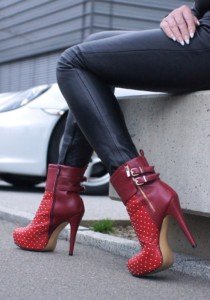
Many women between 5-10 and 6-2 wear a shoe size between 8 and 11. Plenty of attractive high heel shoes come in these sizes.
Specialty stores sell stylish high heel shoes in larger sizes. Have you ever seen really dynamite shoes being modeled in a women’s clothing catalog?
And you thought, “Oh, I love those shoes! But I can’t get them because they have a 3-inch heel!” ?
Well guess what: How tall do you think the model is wearing these shoes?
Chances are she’s at least 5-10! She may even be taller than you! Yet the shoes look great on her! What does this tell you?

Freepik.com, senivpetro
The tall woman’s body looks no different than the shorter women’s body. Height is relative.
You’re tall only when you’re with much shorter people. But suppose you were to dress up and wear those high heels, then be photographed standing next to either nothing or something that does not have standard height.
You would not appear tall. Ultra-long legs? Hey, I’ve seen short women who were all legs, and tall women with relatively short, stubby legs. HEIGHT IS RELATIVE.
But if you’re like most women, you are conscious of the impression you create upon other people.
If a tall woman wears flats with a really stylish dress or skirt, here is the impression she creates:
Hello, folks. I don’t have enough self-confidence to wear high heels because I worry what other people think of me.
Even what complete strangers think of me influences what I wear. The opinions of complete strangers rank higher than my own opinions.
I know this is a hallmark sign of no self-esteem, but I guess I can’t help it. I can’t be my own person.
I am easily swayed by the opinions of strangers, even when I’m not even sure what their opinions are. I slouch and try to look shorter, because complete strangers have preeminence over me.
When a tall woman wears high heels with a really stylish dress or skirt, here is the impression she creates:
Look out world, here I come! I’m confident, goal-oriented, and proud of whom I am. I won’t let anyone hurt me or get in the way of my dreams. I want that job, and I’m gonna get it.
When people are around me, they feel at ease. Though I am a compassionate person, I also think highly enough about myself that I would never let the opinions of strangers get me down.
And instead of just assuming that strangers think I shouldn’t wear high heels, I automatically assume they think I look totally RAD in them!
One of the most wretched ways to live your life is to allow other people’s opinions to dictate your actions!
So if someone thinks I shouldn’t wear high heels, I will deliberately wear them in that person’s face, then chuckle at their reaction.
If I were a manager at some company and looking to hire people, and I had just two applicants for a job that involved dealing with people, and both applicants were six-foot-tall women, with the same qualifications, but one wore flats to the interview, and the other wore high heels…
…I’d hire the one with the high heels, because that tells me she doesn’t worry what others think of her, and she’s not a snoop.
Yes, I said snoop…SNOOP: Suggestible to the Negative Opinions of Other People.
What person in his or her right mind would hire a snoop? A snoop demonstrates very weak self-esteem.
If you think tall women have no business wearing high heels, do you also think that overweight people have no business wearing shorts or sleeveless shirts?
Or perhaps you think that if a woman has spider veins in her legs, she shouldn’t wear shorts?
Or maybe men with skinny legs shouldn’t wear shorts? Or maybe women with big waistlines shouldn’t wear belts?
WEAR THOSE HIGH HEELS !
- They will empower you.
- Do not let strangers or even people you know rob you of your power.
- Take it back by wearing high heels.
- The minute you put on those high heels, you tell the world, “I dare you to push me around ever again.”
Lorra Garrick has been covering medical, fitness and cybersecurity topics for many years, having written thousands of articles for print magazines and websites, including as a ghostwriter. She’s also a former ACE-certified personal trainer.
.
Top image: Shutterstock/HD92
How to Correctly Use a Treadmill Incline

Nearly every person who uses a treadmill incline does it wrong, preventing weight loss and creating a false sense of fitness achievement.
An incline offers a poorly conditioned or obese person — who cannot run or move swiftly — a safe way to challenge the cardiovascular system and burn unwanted fat.
Incline walking is also good for people who can’t move fast for other reasons, such as injury, or who simply want to take a break from running and try something different.
A slow walk on an incline can induce weight loss as well as improved aerobic fitness.
Benfits of Incline Treadmill Walking
– Challenges the cardiovascular system without requiring speed
– Because an incline challenges the heart at a slower walking pace, this means less impact on knees and hips.
– Recruits lower back muscles to keep your body erect
– Provides a stretch to the calves and Achilles tendons
– A great alternative for people suffering from heel pain (plantar fasciitis) because of the minimized heel-strike impact, and the stretching of the foot with each step
– An alternative for people who are getting bored with the same ‘ol flat walking or jogging
How to Correctly Walk on a Treadmill Incline
You will not reap benefits of incline walking if you hold onto the treadmill.
Source: ©Lorra Garrick
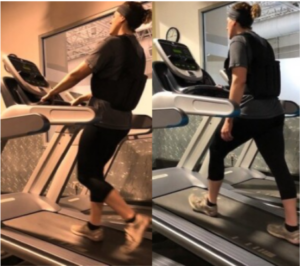
In the left image, as she holds onto the treadmill, her body is leaning back, which is unnatural for walking on an incline. If you were walking up a slope outdoors, would your body be angled back like this? NO.
The angled-back position can also result in repetitive stress injuries to the hips and feet.
In the right image, her arms are free, moving naturally, and hence, her body is vertical and in a natural position.
No help from holding on means more calories burned, even though no matter what you do on a treadmill, the computer calorie readout will always be the same for any given speed and incline.
Do not place your hands on any part of the treadmill other than for momentary balance checks. To continuously hold on will cancel out the effect of the slope, even at faster speeds.
So be sure you swing your arms naturally at your sides, as you would if you were walking up a hill outside.
Illusion of Correction
You might be thinking that untilting your body by clinging onto the console and pulling yourself forward will make things right. WRONG.
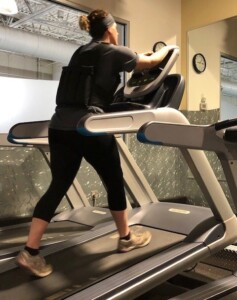
Source: ©Lorra Garrick
In the above image, her very slight forward-lean may seem like a fix to the tilting-backward problem.
But come on, certainly you can see that the holding fast to the treadmill is relieving her core from most of the work it’s supposed to do when walking an incline!
Her entire upper body is frozen, while only her lower body is moving. Her core is getting a free ride. Plus, the posture is not natural.
If you cannot keep up with the tread without holding on, then 1) lower the incline, or 2) reduce the speed.
Some people with lower back issues may feel aching at that location, upon walking a grade without holding onto the treadmill.
But rather than hold on to make the low backache go away, these walkers should REDUCE THE SPEED or LOWER THE INCLINE, to give these weak back muscles a chance to get stronger!
If you’ve been diagnosed with an injury that makes walking on a treadmill induce joint discomfort, then you should stay off the machine — try a stationary bike or elliptical machine — until the injury heals.
Lorra Garrick is a former personal trainer certified through the American Council on Exercise. At Bally Total Fitness she trained women and men of all ages for fat loss, muscle building, fitness and improved health.
.