Is Vaginal Itching Driving You Batty? Causes & Treatments

What causes vaginal itching, and what can be done about this?
Vaginal itching is common and very annoying, and it has an assortment of causes.
The solutions to vaginal itching, of course, will depend on what the cause of this is.
“Vaginal itching is a common problem for many women,” says Dr. Corinne Bazella, OB/GYN with University Hospitals Case Medical Center.
“The common causes include yeast infections, bacterial vaginosis, and contact irritation from hygiene products.”
The vagina normally has a population of “good” and “bad” bacteria.
When the ratio of these bacteria becomes off balance (more “bad” and less “good”), bacterial vaginosis results, and other symptoms of this include odor (usually fishy), burning and a white or grey discharge.
Dr. Bazella says, “The vagina has a delicate balance of good bacteria, or Lactobacillus, that create an environment preventing overgrowth of yeast and odor causing bacteria.
“Many things can interrupt that balance including douching, intercourse, tight clothing, hormonal changes, and hygiene products resulting in itching and discharge.”
If you are troubled by vaginal itching, it would be a smart idea to undergo a pelvic exam from your OB/GYN to rule out any medical causes, or to possibly get a diagnosis, recommends Dr. Bazella.
Pregnant women especially should be examined if bacterial vaginosis is suspected, because BV is associated with premature and low birth weight babies.
Research indicates that untreated BV can increase the risk of premature birth and low birth weight infants (American College of Obstetricians and Gynecologists, 2021).
The imbalance of vaginal bacteria associated with BV can lead to inflammation and infections that may affect the uterus and amniotic fluid, potentially leading to preterm labor.
Additionally, BV has been associated with an increased risk of complications such as miscarriage and postnatal infections (Centers for Disease Control and Prevention, 2022).
If you are suffering from vaginal itching, Dr. Bazella explains, “The second aspect is prevention by avoiding the causes: douching, scented liquid soaps and vigorous washing.”
When you think about it, you will realize that douching is actually a very unnatural thing to do.
Ancient woman never douched; chemicals didn’t exist in those days.
Though douche commercials make the product sound like something very healthy, nourishing and natural, the opposite is true.
Douches contain compounds that are not at all natural to the body, no matter how pleasant their fragrance or pretty their package.
Scented soaps as well contain chemicals, and vigorous washing can irritate the skin around the vagina as well as the actual vaginal opening.
Nevertheless, the vagina should be cleaned daily, but this does not have to be with fancy or scented substances.
Dr. Bazella suggests, “The safest and healthiest way to clean the vagina is to rinse with warm water, avoid washcloths and soaps, and wear cotton breathable underwear.”
Can cancer cause vaginal itching?
Dr. Bazella explains, “Cancer can cause vaginal itching, but that would be a very uncommon first sign.
The usual first sign is unusual vaginal bleeding. This can occur in both cervical and endometrial cancers.”
 Dr. Bazella’s expertise includes abnormal uterine bleeding, adolescent gynecology, contraception and menopausal care.
 Lorra Garrick has been covering medical, fitness and cybersecurity topics for many years, having written thousands of articles for print magazines and websites, including as a ghostwriter. She’s also a former ACE-certified personal trainer.
.
Top image: Shutterstock/Siriluk ok
Can IBS (Irritable Bowel Syndrome) Lead to Cancer or Polyps?
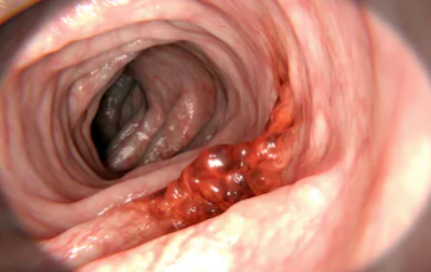
If you have IBS, you may be fearing eventual cancer, wondering if irritable bowel syndrome can lead to or increase cancer risk.
The symptoms of IBS are nearly identical to the symptoms of colon cancer.
Symptoms of IBS can be scary, and include alternating bouts of diarrhea and constipation — which can occur with colon cancer as well.
Abdominal pain is another classic feature of both irritable bowel syndrome and colon cancer.
Ten to 20 percent of the U.S. has IBS; this disorder is diagnosed after other possible causes of the symptoms have been ruled out.
Is there a connection between IBS and colon cancer?
“IBS never leads to bowel polyps or cancer,” says Santosh Sanagapalli, MD, a consultant gastroenterologist, endoscopist, colonoscopist and specialist in esophageal and bowel disorders.
“IBS is a type of functional GI disorder,” continues Dr. Sanagapalli.
“We term it ‘functional’ because in such conditions, the structure of the bowel is completely normal, but there can be abnormalities in the way it functions.
“Hypothetically, if we removed a piece of bowel and looked at it under the microscope, it would appear completely normal.
“However, the bowel may have issues with the way it contracts and relaxes, and may be abnormally sensitive to normal functions of the bowel, e.g., digestion and bacterial fermentation of food contents in the bowel.
“While these abnormalities in function of the bowel can lead to troublesome symptoms, no damage is being done to the bowel or body.
“There is therefore never any risk of needing surgery, and never any risk of cancer developing.”
Why can both IBS and colon cancer cause thin bowel movements?
The abnormal contractions with IBS can result in voiding pencil-thin stools.
In colon cancer, the tumor partially obstructs the anus, so that the stools being squeezed out have a limited space to exit, making them narrow.
Stop Fearing Colon Cancer just Because You Have IBS
A report in the American Journal of Gastroenterology (2010) has reassuring news.
IBS is not a marker or a predictive value for future colon cancer or even precancerous polyps.
The study investigated colonoscopy results of people with IBS.
If you have irritable bowel syndrome and NO alarming symptoms such as unexplained weight loss or blood in your poops, you do not need a colonoscopy.
However, having IBS doesn’t mean you should let your guard down when it comes to colon cancer.
A person with IBS may eventually develop colon cancer, but this development would have NOTHING to do with the IBS! It would just be a coincidence.
If you have an odd change in bowel habits lasting longer than two weeks with other new GI symptoms, consult with a gastroenterologist to rule out colon cancer.
 Dr. Sanagapalli is a gastroenterologist and director of the Esophageal Disorders Center at St Vincent’s Hospital, Darlinghurst. He performs diagnostic and therapeutic endoscopic procedures, and enjoys providing comprehensive and holistic care to patients with a wide variety of disorders affecting the gastrointestinal tract.
 Lorra Garrick has been covering medical, fitness and cybersecurity topics for many years, having written thousands of articles for print magazines and websites, including as a ghostwriter. She’s also a former ACE-certified personal trainer.
.
Top image: Shutterstock/Juan Gaertner
Source: sciencedaily.com/releases/2010/03/100309161842.htm
Should Elderly People Do Deadlifts?
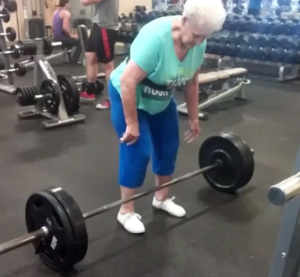
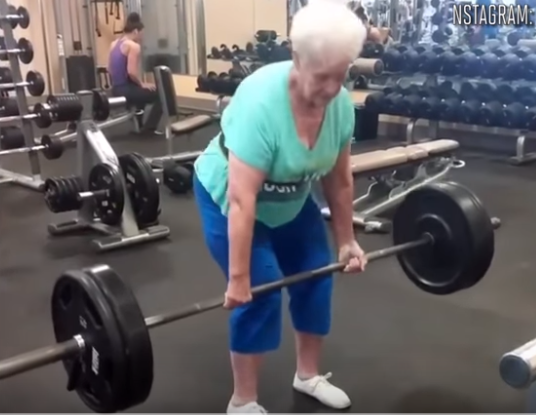
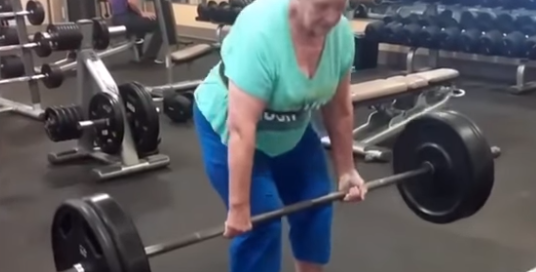
Shirley Webb, 78, from Illinois, can deadlift 225 lbs. for three reps, as of 2016.
If you’re elderly (65-plus), you should do deadlifts.
Deadlifting is a compound (multi-joint) strength training exercise.
When I was a personal trainer, I had my elderly clients doing deadlifts.
But at various gyms I’ve been at, I’ve never seen elderly men or women, other than my clients, performing barbell deadlifts.
This isn’t because they can’t. It’s because the aging population (and so many personal trainers, even) has no idea how valuable the deadlift is to the older body.
“Deadlifts, when done correctly, are beneficial for older adults,” says Monica Charlton, a senior exercise specialist and certified Silver Sneakers/personal trainer out of New Orleans.
“I have my clients do three rounds of eight deadlifts in my weekly Low Impact Class,” continues Charlton.
“We even do single-leg deadlifts if the participant wants a harder option. Obviously, the participant should have clearance from a doctor if they have back issues like bulging or herniated discs and scoliosis.”
So Why Aren’t Elderly People Deadlifting?
Some may think it’s dangerous because it’s a sport associated with huge men bending the bar as they lift.
Another reason why an elderly person will shy away from deadlifts is because he or she might think it’s too difficult to learn.
I have a surprise for you: Every woman who has ever picked up a laundry basket has done a deadlift.
The action of leaning over to pick up a laundry basket or box of Christmas decorations is similar to a deadlift.
The irony is that an elderly person is more likely to get injured (low back) stooping over with incorrect form to pick a pair of shoes or space heater off the floor, than while performing a barbell deadlift with proper form!
Research from the University of Michigan Health System highly recommends compound (multi-joint) strength training for the elderly.
“No matter what age an individual is, they can experience significant strength improvement with progressive resistance exercise even into the eighth and ninth decades of life,” says Mark Peterson, PhD, in the research paper.
Why the Elderly Should Do Barbell Deadlifts
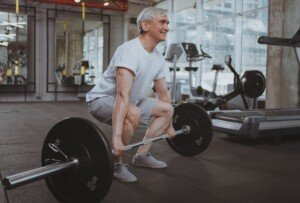
Shutterstock/ Ihor Bulyhin
Charlton explains, “Deadlifts are a great exercise because when done properly they work your quads, glutes, hamstrings, lats, traps and delts, just to name a few muscle groups.” It also works the lower back, abdomen and arms.
The elderly should perform deadlifts because this motion has applications in everyday living, such as in bending over to pick things up, including grandchildren, pets, your bowling ball in the back of the closet, etc.
How Can Elderly People Learn to Do the Deadlift?
“When doing deadlifts, you want to make sure to keep your spine neutral,” says Charlton.
“Otherwise, the weight will put a lot of pressure on your spinal discs causing injury.”
- Never let your back become rounded.
- Shoulders should always be higher than the hips.
Don’t let this advisement scare you away. By incorporating deadlifts into your exercise regimen, you will MUCH LESS LIKELY suffer injuries from the tasks of daily living including gardening, yardwork, shoveling snow, housework, and picking a potted plant or toddler off the floor.
Elderly people can learn to master the form. All you have to do is practice the movement at home … using only your own body weight against gravity. And then you can progress from there.
“But the guy in the picture looks like he’s been deadlifting for years!”
You need not lift as much weight as a Senior Games competitor to reap the rewards.
“For seniors who have been lifting [in general] for many years, doing a deadlift with a spotter, and starting with a lower weight depending on the health of your body, can be beneficial,” says Charlton.
Elderly men and women can practice the deadlift without holding any weights, or by holding a broom stick or even the laundry basket.
What about senior age people who’ve never strength trained at all and do very little exercise at all?
Charlton explains, “For those just starting to strength train, deadlifts are not an ideal exercise to begin with.
“Instead, a beginner should focus on squats [body-weight or with dumbbells] and lat pull-downs because they’re a lot easier on the body when it comes to mastering the correct form.
“Seniors should always talk with a personal trainer before they attempt any strength training to get help on the proper form so they end up reaping the benefits of training, not causing severe injuries.”
Novices should faithfully stick to strength training to eventually begin doing the deadlift. Many gyms provide five- and 10-pound bars for beginners.
The Great Mimicker
The deadlift mimics what you do in real life. As an elderly person becomes stronger from deadlifting, they will notice a big improvement in many everyday actions:
- Getting in and out of cars and deep chairs
- Lifting grocery bags out of the trunk and setting them on countertops
- Even walking up stairs.
The instructions for safely performing a deadlift apply to the elderly as much as they apply to any novice of any age.
 Monica Charlton’s personal training services include fitness/body composition assessments, nutrition planning, running programs and customized programs for clients with disabilities or injuries, as well as older and mainstream clients.
 Lorra Garrick is a former personal trainer certified through the American Council on Exercise. At Bally Total Fitness she trained women and men of all ages for fat loss, muscle building, fitness and improved health.
Source: sciencedaily.com/releases/2011/03/110331163539.htm
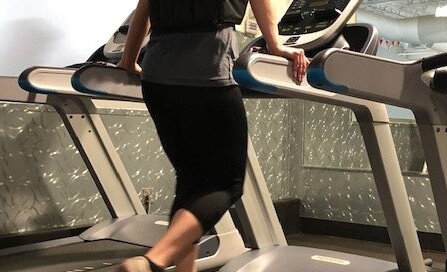
Holding on Treadmill: the Shoulder Bob & Why It’s Wrong
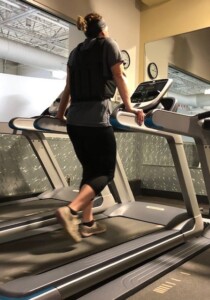
When I was a personal trainer I made sure that all my clients learned to walk properly on a treadmill.
It’s amazing how many people have this all wrong. But the problem is actually easy to fix.
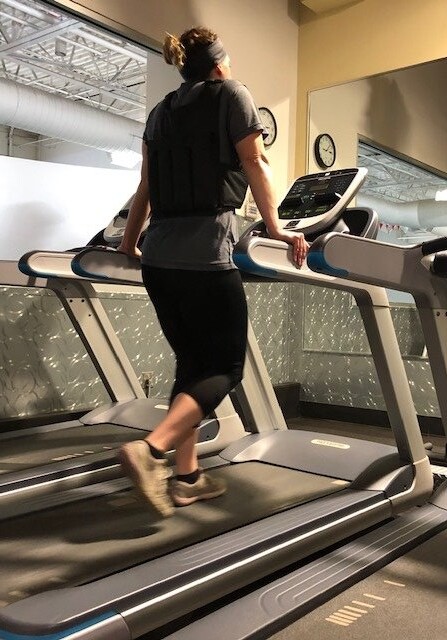
Though fear of falling off is a leading reason for why people hold onto a treadmill, there’s something about that shoulder bob that tells me that fear of falling off isn’t relevant to why they do this.
The shoulder bob seems to be more habit than safeguarding—a habit that in many walkers gets carried away over time—their shoulders bob up and down, like buoys in choppy water.
What kind of walking is this, anyways? It’s not how people walk when they’re not on a treadmill. I’ve never seen the shoulder bob off a treadmill.
The locking up of the arms totally throws off the gait, transforming it into something very artificial.
It’s unreal walking. Fake movement—fake in that it has no carryover once the walker steps off the machine.
People who do this are fooling only themselves. They may never find this out, though, as long as they don’t have to ever do brisk and/or prolonged real walking for extended periods off the machine.
At a gym I used to train at, I’d always see this one particular man—he was in his 50s or 60s—and his shoulder bobbing was so pronounced that it hurt just to watch him.
His posture was crazy (which included a hyperextended back) and his feet barely made contact with the tread because his locked-out arms were supporting so much of his weight.
The Shoulder Bob Can Injure the Shoulders
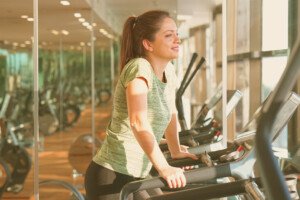
Shutterstock/lunopark
“This pushes the humerus up into the acromion and can lead to rotator cuff impingement and pain,” says says Joseph Ciotola, MD, orthopedic surgeon at The Orthopedic Specialty Hospital at Mercy Medical Center.
In other words, the upper arm bone gets pushed into a small space in the shoulder joint–there’s not enough room for this to happen–and the tip of the bone ends up pressing against a nearby tendon, irritating it.
Over time, this contact can cause “fraying” of the tendon: painful impingement.
Of all the ways to hold onto a treadmill, the shoulder bob subtracts the most body weight.
The side positioning of the arms and hands puts the walker in a position to literally lift their weight off the tread and “lip synch” their walking.
Yes, the shoulder bob is the lip-synching of treadmill walking. It’s feet-synching.
If shoulder bobbers have difficulty walking without so much support, then they should slow down. Often, this type of walker has the speed set at around 4 mph, sometimes 4.5, and walk-synchs this.
Reduce the speed to 3 mph and take your hands off. If this is difficult, I hope by now you know why.
Walk-synching is so far-removed from real walking, that it does nothing to improve your ability to walk without subtracting your weight. It does nothing to improve aerobic capacity.
Reduce the speed enough so that you can actually do real walking (arms moving naturally at your sides) without becoming overwhelmed with fatigue.
 Dr. Ciotola is dedicated to providing his patients the best orthopedic care possible for their hip, knee or shoulder pain.
Lorra Garrick is a former personal trainer certified through the American Council on Exercise. At Bally Total Fitness she trained women and men of all ages for fat loss, muscle building, fitness and improved health.

Abdominal Aortic Aneurysm Screening if You Don’t Have Symptoms?

Should people who are symptom-free still be screened for an abdominal aortic aneurysm if they have risk factors such as being a man over age 70 or a smoker with high blood pressure?
Whom should get screened for an abdominal aortic aneurysm even in the absence of symptoms?
This information comes from Peter Gloviczki, MD, Roberts Professor and Chair, Emeritus, Division of Vascular and Endovascular Surgery, Mayo Clinic.
That you’ve found this article highly suggests you know what an abdominal aortic aneurysm is and that if it ruptures, death could result in minutes.
Men 65 to 75 who smoke or are former smokers should be screened for an abdominal aortic aneurysm even if they have no symptoms.
The screening is done with an ultrasound.
However, a sharp medical practice will screen all men in this age group, which is why my father gets this region checked as part of his annual echocardiogram — the technician simply brings the ultrasound transducer down to his abdominal area to get the image/readings of the aorta after she gets the image/readings of his heart.
Having a family history of abdominal aortic aneurysm is another risk factor, even if the patient has no symptoms, and this includes women.
The Society for Vascular Surgery recommends that men who smoke, with no symptoms of abdominal aortic aneurysm, should begin getting screenings at 65. Screenings should start at 55 if there’s a family history.
Dr. Gloviczki says that people with COPD, heart disease, hardening of the arteries or high cholesterol should discuss screening with their doctor.
An AAA is diagnosed mainly with imaging: ultrasound, CT scan and/or MRI.
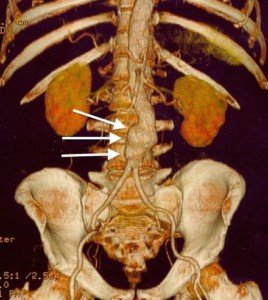
Source: Bakerstmd
What are the symptoms of an abdominal aortic aneurysm?
Typically there aren’t any. “The problem is patients don’t know they have an abdominal aortic aneurysm and they don’t act expeditiously,” Dr. Gloviczki says. “If you know you have one, you will get to an emergency room.”
He urges people to “react immediately to any new-onset abdominal or back pain,” or even a fainting spell.
Get to an ER ASAP. If you’re in the ER with severe abdominal pain, you should have your abdominal aorta images with an ultrasound—which is much faster than a CT scan or MRI.
When my mother was brought into the ER complaining of agonizing abdominal pain, the ultrasound machine was whisked over to her bed and a doctor wasted no time running the transducer along her abdomen (her aorta was normal).
Treatment for an Abdominal Aortic Aneurysm
The treatment depends on the risk of a rupture, says Dr. Gloviczki. At least one of three requirements = a need for surgical repair: 1) size of at least 5.5 cm, 2) rapid growth, and/or 3) symptoms.
Symptoms of an abdominal aortic aneurysm can include, though rarely, leg pain and blood clots in the arteries of the legs.
If none of these situations are present, the watchful waiting approach is utilized.
Endovascular Surgical Repair of an Abdominal Aortic Aneurysm
More than 70 percent of procedures are done via endovascular, in which a stent is fed through the groin and deploys a graft to reinforce the damaged site.

Lorra Garrick has been covering medical, fitness and cybersecurity topics for many years, having written thousands of articles for print magazines and websites, including as a ghostwriter. She’s also a former ACE-certified personal trainer.
.
Source: sciencedaily.com/releases/2014/07/140716112248.htm
Holding onto a Treadmill Is Like Using a Walker, Will Make You Older
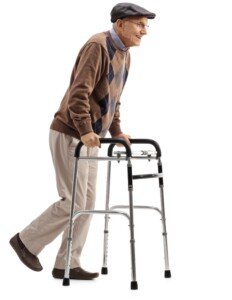
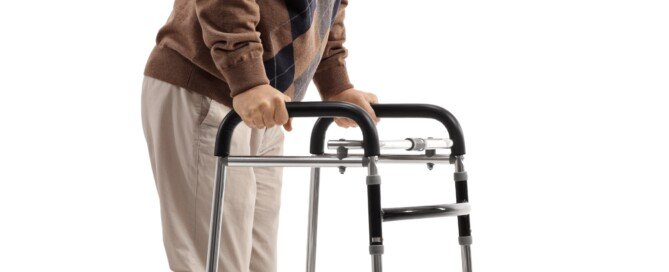
Did you know that holding onto a treadmill while walking is virtually the same as using a walker?
If you want to train for the Walker-Assistance-Device Olympics, I recommend that you hold onto the treadmill during your walking sessions.
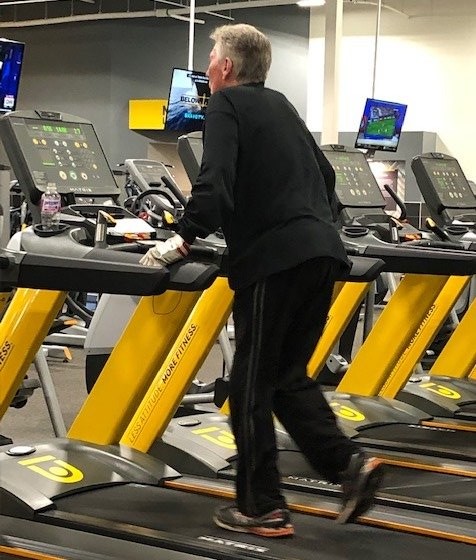
The body positioning of the people below is remarkably similar to that of the man above.
Shutterstock/lunopark
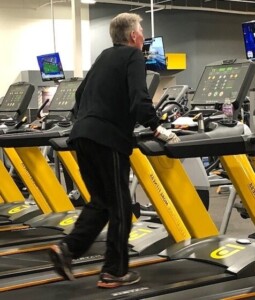
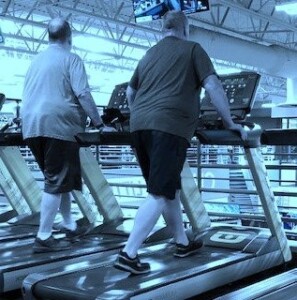
I say this not only as a former personal trainer, but also just from basic common sense.
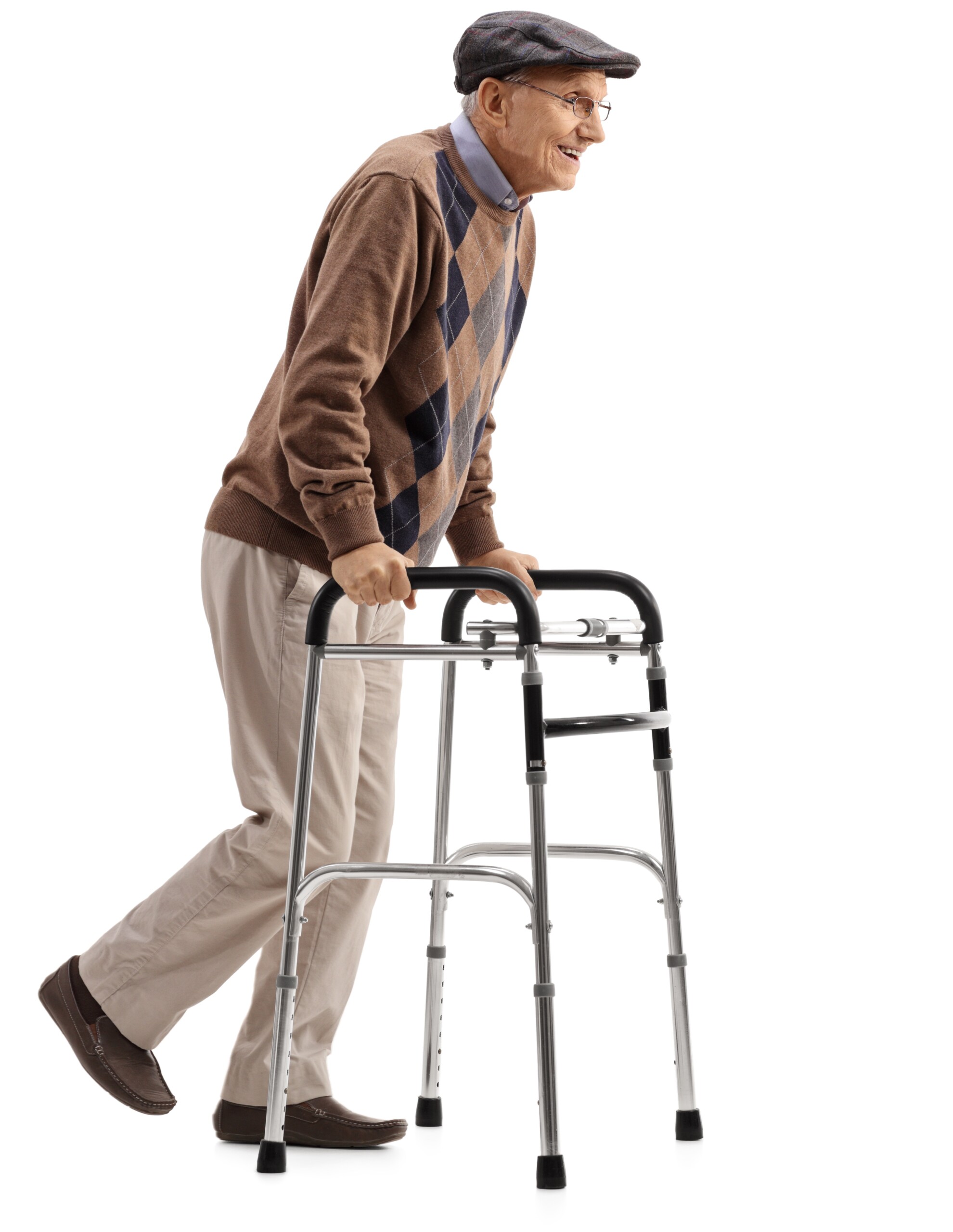
Observe someone using a walker (the rolling type, not the kind that’s lifted off the floor with each step), such as the man in the top-most image.
The man in this photo shows the exact posture that occurs when someone holds onto a treadmill while walking.
The taller the walking person is, the more pronounced is the forward posture, because the person must lean forward to connect their hands to the treadmill’s front bar or side rails.
This doesn’t mean that holding onto the treadmill isn’t a bad idea for short people.
A short person is more likely to do the “shoulder bob” – that is, press their hands on the side rails, arms locked out straight, and push their bodyweight off the tread as they “walk.”
This article deals with a specific type of posture and gait that occur when taller people hold onto the front or side of a treadmill.
This mimics using a walker (the rolling type).
So if you go from walking around in daily life without holding onto anything for support, and then step onto a treadmill — only to hold onto it while you walk — what exactly do you believe you’ll accomplish?
Essentially, you’ll be going from walking around normally (arms swinging or carrying something) to using a walker for getting in some exercise. This makes no sense.
Holding onto a treadmill is a downgrade from the walking you do in daily living — even if the speed is faster than your normal, casual walk around town, at stores, on the job, etc.
Holding on, especially for older people, “causes problems with our spinal alignment, weakening our lower back muscles,” says John Whyte, MD, board certified internist in Washington, DC, and author of “Is This Normal? The Essential Guide to Middle Age and Beyond.”
Dr. Whyte continues, “It is horrible for good posture, as well as developing our core. If you are interested in improving balance as you get older, holding onto the treadmill doesn’t help.
“Rather, walking naturally on the treadmill with arms at sides will help to create better balance.”
People also have a tendency to grip tighter at faster speeds. However, even a light grip compromises the efficacy of the intended purpose, which is to improve fitness and health via walking.
If you don’t use a walker for the activities of daily living, there’s no reason to hold onto a treadmill and mimic using an assisting ambulation device.
People lean on walkers for support, and that’s exactly what you do when holding onto a treadmill — especially if you’re tall—because, as mentioned, the tall individual must lean their bodyweight into the machine to connect their hands to the rails or bar!

Dr. Whyte is the chief medical officer of webmd.com. Prior, he was the chief medical expert for almost a decade at Discovery Channel.
Lorra Garrick is a former personal trainer certified through the American Council on Exercise. At Bally Total Fitness she trained women and men of all ages for fat loss, muscle building, fitness and improved health.
.
Top image: Shutterstock/Ljupco Smokovski
Senior Age People Walking on Treadmill Should NOT Hold On
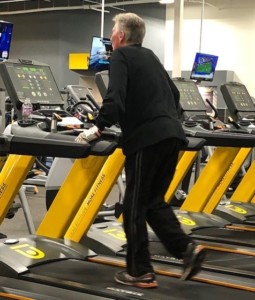
Did you know that if you’re of senior age you should not hold onto a treadmill during your walks?
I once told a senior woman that she should walk without holding onto the treadmill. She asked if I was a cardiologist.
Heart health is not related to proper walking form. A fitness professional is not trained to interpret an EKG or figure out what they’re hearing through a stethoscope, but one thing they know very well is how to walk properly.
Cardiologists aren’t trained in proper treadmill use, and I explained to the senior that walking without holding on would promote better breathing and better spinal alignment.
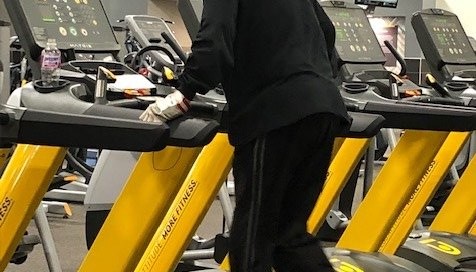
I pointed to the other seniors on other treadmills and said, “Describe their posture.”
“The main issue with an older person holding on is going to be balance,” begins Dr. Charles J. Pelitera, assistant professor of kinesiology and also coordinator of the Health/Wellness Program at Canisius College, NY.
“An exercise program for an elderly patient should be designed with two thoughts in mind,” continues Dr. Pelitera.
“The program should be designed to prolong their quality of life and to further enhance their quality of life.
“It is preferred that elderly people walk hands-free to not only benefit their cardiovascular fitness but also to continue to stimulate neurotransmitters involved with balance and proprioception.
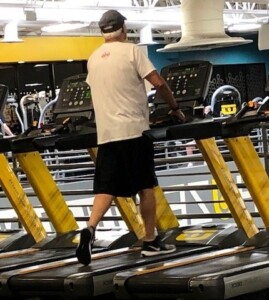
It’s unlikely his goal is weight loss. Even if it’s just to get the heart rate elevated, his holding on is skewering his posture and teaching his body to rely on external support for balance while walking. This will NOT come in handy as he gets older.
“There have also historically been some problems with some senior citizens holding on and it affecting circulation to the hands.
“This could possibly lead to numbness in the hands and in a worst case scenario the possibility of some type of peripheral neuropathy.”
Look at the senior age people in the photos above, which I discreetly took; the men were not posing. Notice their poor posture and walking gait.
The forward lean is very prevalent wherever treadmills are, especially among senior walkers.
Look at the pictures again. You can’t really believe this is the correct way to walk — even for a senior.
When that senior steps off the treadmill…what will support them then? Their hips, low back structures, knees, etc., will be faced with doing all the work of walking, balancing, keeping upright.
This is an UPGRADE from what they just came from: holding onto the treadmill. That’s because holding on is a DOWNGRADE.
The last person who should do downgrade-type walking is the older person.
Holding onto a treadmill will promote less efficient walking, because it does not mimic real movement in space.
It will not improve the golf game, bowling game, walking at shopping centers, walking around in the garden, walking the dog, walking anywhere.
Straightening out the posture will not correct this blunder, because no matter where you hold on (front bar, rails, console) and how straight you position your body — it’s still a downgrade.
Older people should hold on only for occasional balance checks, but then do the majority of their walking in the most natural way: without holding on.
Seniors should set the speed slow and take their hands off the treadmill.
Machines go as slow as 0.5 mph, so it’s not logical to fear falling off — assuming that the individual gets around in everyday life without assistance — which is the demographic that this article is directed to.
Start with a slow speed, and increase it little by little. Before you know it, you’ll be smokin’.
 Dr. Pelitera is the owner of Pelitera Fitness Consultants, which specializes in athletic training, weight loss and strength training.
Lorra Garrick is a former personal trainer certified through the American Council on Exercise. At Bally Total Fitness she trained women and men of all ages for fat loss, muscle building, fitness and improved health.
Best Way for Obese Children to Walk on a Treadmill
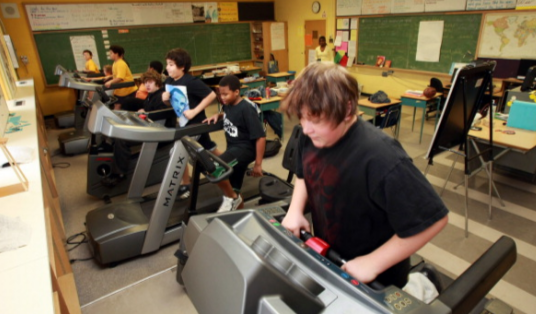
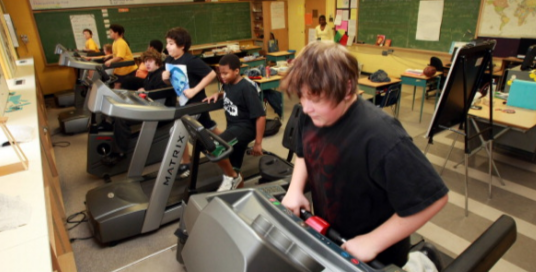
Look at the photo above of the overweight boy on a treadmill.
This appears to be a non-posed shot, versus models being told to take specific positions instructed by a photographer.
The first boy is overweight (though not a lot), and appears to be tightly holding onto the treadmill as part of his jogging, rather than taking a momentary heart rate check.
I doubt that a child this young (looks around 11 or 12) is going to be thinking about heart rate.
So it’s safe to assume he’s holding on for the duration of his jog. This overweight child appears to be jogging due to his hair’s appearance.
Overweight children, even if they’re in poor shape, should not hold onto a treadmill when jogging or when walking.
When I was a personal trainer I had my adult clients (regardless of age or weight) walking and jogging without any holding on. The reasons for this apply to kids, even overweight ones.
“Obese children should be encouraged not to hold on while walking on a treadmill,” explains Dr. Charles J. Pelitera, assistant professor of kinesiology and also coordinator of the Health/Wellness Program at Canisius College, NY.
“The chances are that one of the reasons that they are obese to begin with is that they had never been mentored in exercise or in the proper use of exercise equipment.
“Right at the beginning I would try to instill good positive habits such as keeping the hands free while walking on a treadmill.”
In a situation OFF the treadmill, in which the boy in the photo would be running (soccer, basketball, football, outdoor play, chasing around in the schoolyard, etc.), would there be anything for him to hang onto? NO.
What is he training his body to become efficient at by holding on?
Nothing. This is an unnatural way to move and will not make him better at running in a real situation, be it sports, play or running from harm.
You can clearly see what the gripping is doing to his posture and shoulders. This is poor running/jogging form.
It also won’t do much for facilitating weight loss or stamina.
Kids don’t know better, and it’s up to the adults supervising to correct this mistake.
Note the third boy down (don’t try to figure out what the second boy is doing; he appears to be momentarily placing his hand on the treadmill rail as he sits on a stationary bike).
The third boy appears to be a little overweight, but he’s jogging on the treadmill correctly.
Look at the fourth boy in yellow. He appears overweight and is holding onto the side rails. Note his forward posture.
If he were to swing his arms, his posture would straighten. You need not be a chiropractor or personal trainer to see how wrong holding on is.
I doubt these boys fear falling off. It’s more likely that they just don’t know better. They see the bar and rails, and thus, reflexively hold onto them.
Perhaps they’ve seen adults doing this and are mimicking them. Maybe the supervisor told them to do it because that person doesn’t know better.
But regardless of the reasoning, overweight kids should not hold onto a treadmill when walking or running.
- It burns significantly fewer calories (the calorie readout is a function of the settings, not the person, and hence can’t tell if someone’s holding on or not).
- It does not replicate walking or running in real life (sports, play, escape).
- It can cause repetitive stress injuries to the hips, feet, knees and shoulders.

Whether overweight or not, when a child holds onto a treadmill, it distorts their gait and may result in sore shoulders or back discomfort. Learning to swing the arms will utlimately result in a much more comfortable walk. Depositphoto.com
Overweight kids who fear falling off should start at a slow-enough pace that makes them feel comfortable, and then the speed can be gradually increased.
Having children hold onto a treadmill will do absolutely nothing to empower them or make them feel confident.
Dr. Pelitera is the owner of Pelitera Fitness Consultants, which specializes in athletic training, weight loss and strength training.
Lorra Garrick is a former personal trainer certified through the American Council on Exercise. At Bally Total Fitness she trained women and men of all ages for fat loss, muscle building, fitness and improved health.
Veiny Woman’s Arm vs. Skinny Eating Disorder Arm
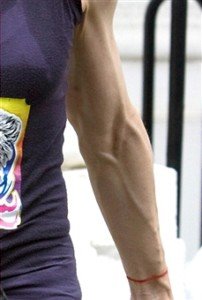
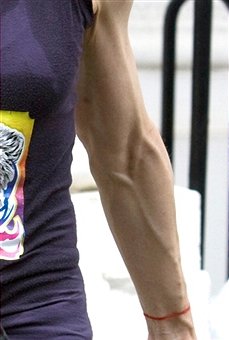
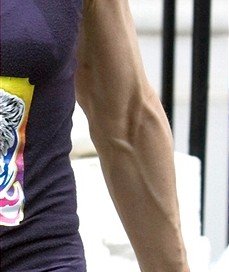
Remember when Madonna was criticized for having an eating disorder because a photo showed her veiny arm?
The photo above generated a lot of negative feedback for Madonna, because people thought that the prominent bulging veins meant she was underfed, and they called her too thin. What’s actually going on is that Madonna is a physique enthusiast.
If you’ve ever seen photos of female physique athletes on stage, you would have noticed the vascularity in their arms.
Yet these women are hardly underfed, though they DO strictly diet for several weeks prior to a competition.
However, a woman can maintain veiny arms year-round. Undereating is NOT how this is done.
As a former personal trainer and physique enthusiast myself, I know what it takes to get this kind of arm.
If bulging veins in a woman’s arm mean she has an eating disorder or is too skinny, then why don’t you see this kind of vascularity in every runway model?
Look again at Madonna’s arm. What else do you notice? I see well-developed muscle. Look at the forearm.
I see two distinct, compact regions of trained muscle. And that’s just the forearm—a notoriously difficult part of the body to build up.
Though her arms aren’t bulky, they are solid with muscle — from lifting weights.
How can anyone say these arms are skinny? Intense strength training keeps the veins perked up.

Shutterstock/By Nicholas Piccillo
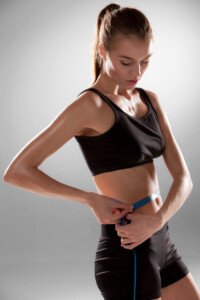
They become visible due to a low bodyfat percentage — but this doesn’t mean malnourished, undereating, an eating disorder or anorexic. The two images below show truly skinny arms. Where are the veins?

Shutterstock/Just dance
Freepik.com master1305
The reason runway models don’t have veiny arms is because their bodies are “skinny fat.”
They don’t do serious strength training, and hence, their veins are — for lack of a better word — flaccid.
Another thing you must realize about Madonna’s arms is that the photo was taken while she was carrying something of weight.
If her arms were relaxed, hands holding nothing, the veins wouldn’t be as prominent.
This same principle applies to the physique athlete. When she is standing with both arms at their sides, relaxed, the veins don’t pop out so much.
When they are prominent — she’s at a low-enough body fat percentage that they can show even when she’s relaxed.
Or, she’s tensing her muscles for a photoshoot or is photographed while lifting heavy resistance.
BUT — she is not skinny or underweight!

Shutterstock/Lyashenko Egor
Vascularity in the arms is a physique athlete’s dream, and the goal for contests is to get as vascular as possible.
In fact, this is one of the components that the judges look for.
Veiny arms do not necessarily signal an eating disorder like anorexia nervosa, inadequate food intake or malnourishment.
Lorra Garrick is a former personal trainer certified through the American Council on Exercise. At Bally Total Fitness she trained women and men of all ages for fat loss, muscle building, fitness and improved health.
Tiny Waistline Does NOT Always Mean an Eating Disorder
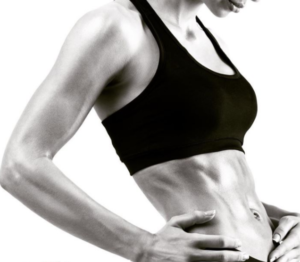
A tiny waist should not automatically mark a woman as having an eating disorder or anorexia nervosa.
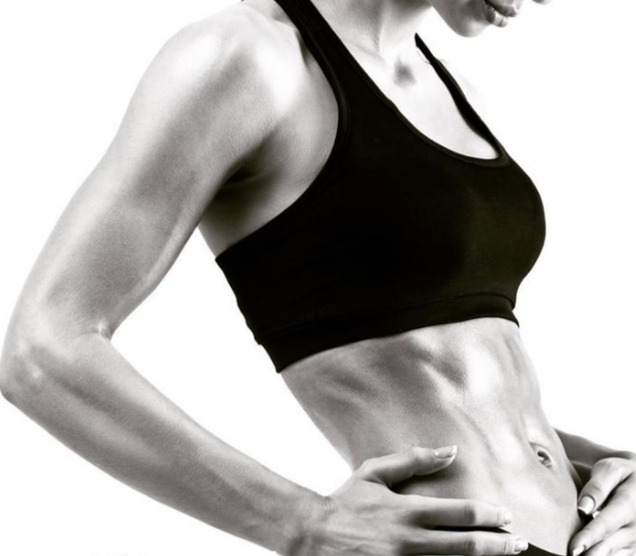
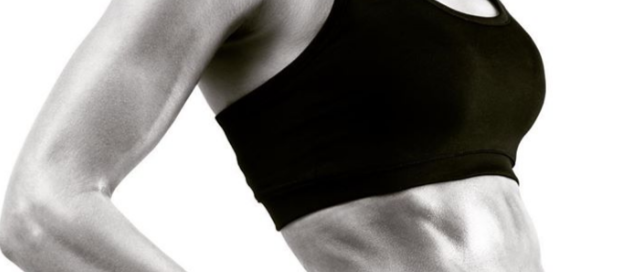
Look at the waist of the woman above; it’s what would be considered tiny or “too skinny.”
However, why isn’t this same criticism applied to male physique athletes?
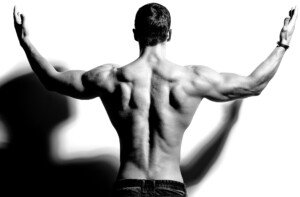
Freepik.com, halayalex
If a woman like the one above doesn’t have an eating disorder or is not underfed, then what makes her waist so tiny?
Note her muscle development. In no way does this woman have scrawny arms.
Those arms and shoulders look like they can bench press at least 100 pounds.
Her waist and entire abdominal section is actually thinner than a runway model’s.
Yes, I realize that the angle of the model creates the illusion of an even smaller waist, but this does not change the popular belief that a tiny waist probably means an eating disorder or not getting enough to eat.
When I was a personal trainer at a gym, I enjoyed explaining the following to my overweight clients:
Fierce weight workouts (plus a sensible diet) siphon nearly all the fat out of one’s midsection.
Yes — order for this to happen, the athlete must keep their diet controlled.
This doesn’t mean starvation. In fact, in order for a woman to develop muscle, she needs to get an adequate amount of protein and carbohydrates.
She can’t build muscle on an anorexic’s diet or the diet that some malnourished looking Hollywood starlets seem to be on.
Building muscle — and maintaining that muscle — requires plenty of energy.
This must come from food, as well as adequate rest in between workouts.
Muscle feeds off of body fat for sustenance, though it also thrives on high quality sources of protein and complex carbs.
The fat that the trained muscle mass feeds off of includes any fat that tries to accumulate in the waist.
Just because a woman has a super small waist doesn’t mean she’s underfed, anorexic or has an eating disorder.

Is it really fair to pass judgement on a woman’s health just because her waist is tiny? Freepik.com/master1305
Lorra Garrick has been covering medical, fitness and cybersecurity topics for many years, having written thousands of articles for print magazines and websites, including as a ghostwriter. She’s also a former ACE-certified personal trainer.
.