Pills Stuck in Esophagus vs. Perception of Being Stuck

Is there a way to tell if a pill is actually stuck in your esophagus vs. it just feels that way? Not necessarily.
Pill Stuck Feeling in Esophagus
“This is a something that is not well-understood,” says Jay Desai, MD, who specializes in colon cancer screening, upper endoscopy and consultative gastroenterology with New York Gastroenterology Associates.
Dr. Desai continues, “Feeling like something is stuck in your esophagus when it isn’t is called globus sensation.
“The perception of a stuck pill may be related to what we call motility disorders, which are disorders of the muscles and the nerves of the esophagus and the coordination of those muscle contractions.”
So why does it seem that pills, more often than food the same size (such as beans, peas, raisins and chunks of carrot, celery and nuts) get stuck behind the breastbone (sternum)?
“Pills tend to get stuck in the esophagus because the consistency is denser, whereas food tends to be on the softer, more pliable side,” says Dr. Desai.
“If there are certain lesions, such as rings or webs, which are common structural abnormalities in the esophagus, then solid items that cannot slip past these will get stuck.
“Certain pills are more dangerous if caught in your esophagus, such as antibiotics, specifically tetracycline — which is taken to help reduce acne, and common medications for osteoporosis.
“These medications are more concerning because if these pills do get stuck, they have the potential to cause life threatening ulcers.”
What about the mere sensation of a stuck pill in the esophagus or behind the breastbone?
What can lead to this feeling or perception?
“There are many conditions that can cause the globus sensation,” begins Dr. Desai.
“First, any mechanical narrowing of the esophagus, such as rings or webs, which are common structural abnormalities in the esophagus, can cause this sensation.
“Second, motility disorders, which are conditions where the muscles of the esophagus do not work properly and fail to push food down well, also create the sensation of a stuck pill.
“And finally, achalasia, a condition where the valve at the bottom of the esophagus doesn’t relax or open properly, causes pills/food to get stuck.”
Proper Swallowing
You can lower the chances of something getting trapped in the “food pipe” by swallowing pills, tablets and capsules with your head slightly downward.
This seems counterintuitive, but this positioning helps keep the passageway open more.
Think of how you swallow food to get it down. You don’t throw your head back, do you?
In fact, if you’re eating while reading, your head is down while you’re swallowing.
Apply this same concept to swallowing pills for medications or supplements.
They’ll go down easier and will help prevent that stuck sensation.
And don’t lie down for at least two hours after swallowing them.

Board certified in internal medicine and gastroenterology, Dr. Desai provides a wide range of GI services including for bacterial overgrowth, constipation, acid reflux and GERD, IBS, incontinence and small bowel disease. Twitter handle: @NYGADocs
 Lorra Garrick has been covering medical, fitness and cybersecurity topics for many years, having written thousands of articles for print magazines and websites, including as a ghostwriter. She’s also a former ACE-certified personal trainer.
.
Top image: Shutterstock/Prostock-studio
Can GERD Cause ONLY Excess Saliva?
If your only symptom is excess saliva, can this be caused by GERD (gastroesophageal reflux disease)?
Excess saliva can be quite a scary symptom if you know that it’s a symptom of Bulbar-onset ALS.
But you have to realize that excess saliva not only results from the inability to efficiently swallow (caused by ALS), but the over-activity of the salivary glands — which is not caused by ALS but often by anxiety.
There is yet another mechanism that produces what a patient might describe as “a lot of saliva in my mouth.”
GERD’s Connection to Excess Saliva
Excess saliva can be caused by a number of conditions, but can this symptom be the only presentation of acid reflux?
“GERD is a condition that causes an abnormal amount of acid to reside in the esophagus,” says Jay Desai, MD, who specializes in colon cancer screening, upper endoscopy and consultative gastroenterology with New York Gastroenterology Associates.
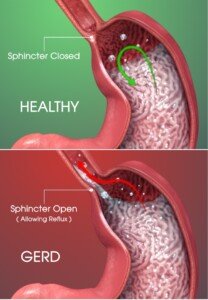
Scientific Animations, Creative Commons/BY-SA/Attribution-ShareAlike 4.0 International
Dr. Desai continues, “Some patients will not experience the classic sensation of burning.
“However, they may still have acid exposure in the mouth and esophagus which could manifest as excess saliva, coughing or a hoarse voice. It’s important to note that the mechanisms for this are unclear.”
Have you found that severe, ongoing anxiety causes excess saliva?
The anxiety actually triggers acid reflux, and hence, you have the annoying but benign symptom of the excess “saliva.”
However, in this case, the situation has nothing to do with the salivary glands becoming overly active.
At any rate, it’s a harmless symptom, and when the anxiety diminishes, you’ll notice that the symptom goes away.
Drinking water or herbal tea may provide some relief while the issue runs its course.
Board certified in internal medicine and gastroenterology, Dr. Desai provides a wide range of GI services including for bacterial overgrowth, constipation, acid reflux and GERD, IBS, incontinence and small bowel disease. Twitter handle: @NYGADocs
Lorra Garrick has been covering medical, fitness and cybersecurity topics for many years, having written thousands of articles for print magazines and websites, including as a ghostwriter. She’s also a former ACE-certified personal trainer.
Top image: Shutterstock/sirtravelalot
Sources: nyga.md
Facebook: facebook.com/NYGastroenterologyAssociates

Why Can GERD Cause the Esophagus to Narrow?

A narrowed esophagus can be caused by gastroesophageal reflux disease (GERD).
This narrowing may be the reason why you’ve been burping a lot lately or experiencing an unpleasant taste in your mouth.
“Long-term acid exposure at the bottom of the esophagus can cause scarring due to constant inflammation; this is called a stricture,” says Jay Desai, MD, who specializes in colon cancer screening, upper endoscopy and consultative gastroenterology with New York Gastroenterology Associates.
“However, this is much less common today because of the use of more effective antacid medication than in the past, such as omeprazole.”
Though long-term acid reflux is a risk factor for causing the esophagus (“food pipe”) to narrow, there are other risk factors as well for stricture.
These include diverticulosis (pouches in the colon), pain drugs including aspirin, prior surgery to the esophagus, skin diseases and scleroderma.
Symptoms of a Narrowed Esophagus
A narrowed esophagus can lead to a variety of symptoms that affect daily comfort and health.
One common symptom is heartburn, which is often described as a burning or abrasive sensation in the chest or upper abdomen.
In some cases, it may present as a more generalized aching sensation without the typical burning feeling.
Another sign of esophageal narrowing is a bad or bitter taste in the mouth, particularly noticeable in the morning or during the night.
This can occur as stomach acid backs up into the mouth.
Additionally, individuals may experience burping without an obvious cause, such as after drinking carbonated beverages, and frequent hiccups.
Unintentional weight loss might occur as well, which can be attributed to difficulty eating or absorbing nutrients.
However, weight loss may also have other causes, such as untreated type 2 diabetes.
Pain or trouble swallowing. Keep in mind that many unrelated conditions can cause issues related to swallowing.
Board certified in internal medicine and gastroenterology, Dr. Desai provides a wide range of GI services including for bacterial overgrowth, constipation, acid reflux and GERD, IBS, incontinence and small bowel disease. Twitter handle: @NYGADocs
Lorra Garrick has been covering medical, fitness and cybersecurity topics for many years, having written thousands of articles for print magazines and websites, including as a ghostwriter. She’s also a former ACE-certified personal trainer.
.
Top image: Shutterstock/Chayatorn Laorattanavech
Sources:
facebook.com/NYGastroenterologyAssociates
drugs.com/cg/esophageal-stricture.html

How Does GERD Cause a Trapped Food Feeling in Throat?

Acid reflux or GERD can cause the sensation of food being trapped in the throat.
GERD stands for gastroesophageal reflux disease.
“Acid reflux, or GERD, is a condition where an abnormal amount of acid is exposed to the esophagus,” says Jay Desai, MD, who specializes in colon cancer screening, upper endoscopy and consultative gastroenterology with New York Gastroenterology Associates.
“This may cause many different symptoms but usually includes a burning sensation in the pit of the stomach that travels up the chest towards the mouth.”
Additional symptoms may be a persistent daytime cough, overnight cough, chest pain, burping and waking with a foul taste in the mouth.
Food Stuck in Throat Feeling
“One condition that can cause food feeling stuck in the throat is called PPI-responsive esophageal eosinophilia,” says Dr. Desai.
“The acid exposure in the esophagus can cause certain types of blood cells, called eosinophils, to migrate to the esophagus; these cells can cause inflammation and interfere with normal swallowing of food.
“This then can lead to the sensation of food feeling trapped in the [upper] esophagus. The treatment of this condition is with antacid medication.”
Board certified in internal medicine and gastroenterology, Dr. Desai provides a wide range of GI services including for bacterial overgrowth, constipation, acid reflux and GERD, IBS, incontinence and small bowel disease. Twitter handle: @NYGADocs
Lorra Garrick has been covering medical, fitness and cybersecurity topics for many years, having written thousands of articles for print magazines and websites, including as a ghostwriter. She’s also a former ACE-certified personal trainer.
.
Sources facebook.com/NYGastroenterologyAssociates
Top image: Shutterstock/9nong
Can Nutritional Supplement Pills Irritate the Esophagus?

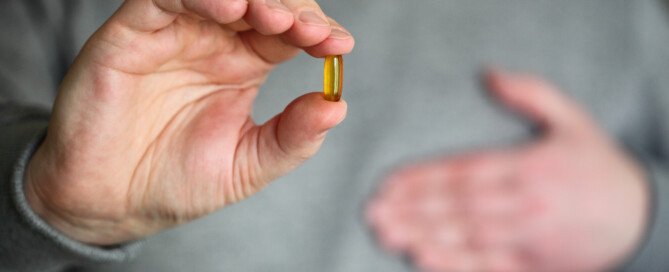
You’ve probably read about medications and irritation of the esophagus, but what about nutritional supplement pills, tablets and capsules?
Can these nutritional supplements, too, irritate the “food pipe”?
“Certain supplements such as iron, vitamin C and potassium pills can irritate or cause ulcers in the esophagus that prevent pills from passing into the stomach,” says Jay Desai, MD, who specializes in colon cancer screening, upper endoscopy and consultative gastroenterology with New York Gastroenterology Associates.
“To avoid ‘pill esophagitis,’ make sure you take these pills with a full glass of water and avoid lying down for at least two hours after swallowing them.”
In addition, have your head slightly downward when taking the supplements — and any other kind of pill, for that matter.
Tossing your head back when swallowing doesn’t allow maximum opening for the passageway.
When you swallow food, you don’t tilt your head back.
So when you think about it, why tilt back your head when you swallow supplements or medications?
Sure, it’s something we see in TV shows for dramatic effect.
But it is not mechanically necessary to effectively swallow a pill, tablet or capsule.
Dr. Desai also says, “If you develop chest pain after swallowing these pills, and it does not resolve shortly, contact your physician.”
Board certified in internal medicine and gastroenterology, Dr. Desai provides a wide range of GI services including for bacterial overgrowth, constipation, acid reflux and GERD, IBS, incontinence and small bowel disease. Twitter handle: @NYGADocs
Lorra Garrick has been covering medical, fitness and cybersecurity topics for many years, having written thousands of articles for print magazines and websites, including as a ghostwriter. She’s also a former ACE-certified personal trainer.
.
Top image: Shutterstock/Flying object

Constant Burping After Eating: Causes, Solutions
Do you find that after eating, you burp or belch a lot and it’s so embarrassing and frustrating?
Many people assume that burping during or after eating is a sign of poor table manners.
And in many cases it certainly is. Some people even see who can generate the loudest burp.
Then soon after other people will be burping, trying to outdo the previous belch.
This hardly sounds like an underlying medical cause.
However, there are times when what sounds like a “good” belch actually has to do more with what’s going on inside your body than a mere lack of table manners.
A Lot of Burping After Eating
It’s too simplistic to just chalk the cause of frequent burping after eating to gulping air when eating and drinking, or eating too much too quickly.
“Constant burping can be a sign that the valve at the bottom of the esophagus is weak,” says Jay Desai, MD, who specializes in colon cancer screening, upper endoscopy and consultative gastroenterology with New York Gastroenterology Associates.
“There are certain foods and activities that have been known to weaken this muscle, including caffeine, alcohol, tobacco and being overweight.
“There are also certain diseases where the muscle at the bottom of the esophagus doesn’t function properly, such as when patients have a hernia of the stomach.” Surgery is a treatment option for hernias.
Solutions to Constant Burping after Eating
“In addition to healthy lifestyle interventions [such as exercising and healthier eating to lose weight], we recommend drinking less carbonated beverages in these situations and avoiding talking while eating to minimize the amount of air swallowed during consumption,” says Dr. Desai.
Board certified in internal medicine and gastroenterology, Dr. Desai provides a wide range of GI services including for bacterial overgrowth, constipation, acid reflux and GERD, IBS, incontinence and small bowel disease. Twitter handle: @NYGADocs
Lorra Garrick has been covering medical, fitness and cybersecurity topics for many years, having written thousands of articles for print magazines and websites, including as a ghostwriter. She’s also a former ACE-certified personal trainer.
.
Top image: Shutterstock/TunedIn by Westend61
facebook.com/NYGastroenterologyAssociates
Can GERD Cause Sharp Pain just Below the Sternum?
A sharp pain below the sternum is likely to have a cause other than GERD (gastroesophageal reflux disease).
This includes costochondritis (inflammation of the cartilage at the sternum and rib junction), a skeletal muscle spasm and an esophageal spasm—all benign situations.
A broken rib can easily cause sharp pain below the sternum (you’d likely make this connection due to a recent trauma in that region), as well as pleuritis.
These last two situations, when causing sharp pain under the sternum, often cause more pain upon inhaling.
“GERD is a condition of abnormal acid exposure in the esophagus; the classic symptoms include burning in the pit of the belly that regurgitates up to the mouth,” explains Jay Desai, MD, who specializes in colon cancer screening, upper endoscopy and consultative gastroenterology with New York Gastroenterology Associates.
“It can certainly cause pain below the sternum that can commonly be confused as a heart attack.
“If patients are at a high risk for cardiovascular disease, we recommend that they be seen by a cardiologist even if they have acid reflux disease. Typically the pain is vague and not specific to a size.”
“Size” refers to the perceived surface area of the pain or discomfort. A person with a heart problem can also, by coincidence, experience acid reflux.
Make sure that cardiac problems have been ruled out.
Unfortunately, sternum pain from GERD can be severe enough to make a person think they’re having a heart attack or a heart related episode such as angina from clogged arteries.
A tip-off that it’s a heart problem is that whenever the sternum pain occurs, you’re exercising or physically exerting yourself, and it disappears when you stop the activity.
A tip-off that it’s related to GERD is that it usually occurs, for instance, overnight when you’re lying in bed (and vanishes when you sit up), or shortly after a meal.
If you’re having sternum pain that’s related to GERD (your doctor has ruled out cardiac problems), then pay attention to when it occurs to see if there’s a pattern.
In fact, eating too rapidly can cause discomfort in the chest (arising from the esophagus).
Finally, a sudden but extremely brief “pain” in the chest or sternum region can actually be caused by the motility of bowel movements (the large colon is located close enough to the chest area for this to happen).
Board certified in internal medicine and gastroenterology, Dr. Desai provides a wide range of GI services including for bacterial overgrowth, constipation, acid reflux and GERD, IBS, incontinence and small bowel disease. Twitter handle: @NYGADocs
Lorra Garrick has been covering medical, fitness and cybersecurity topics for many years, having written thousands of articles for print magazines and websites, including as a ghostwriter. She’s also a former ACE-certified personal trainer.
.
Top image: Shutterstock/sukiyaki

Can GERD Cause Blood in Your Saliva?

If your only symptom is excess saliva, can this be caused by GERD (gastroesophageal reflux disease)?
Excess saliva can be caused by a number of conditions, but can this symptom be the only presentation of acid reflux?
“GERD is a condition that causes an abnormal amount of acid to reside in the esophagus,” says Jay Desai, MD, who specializes in colon cancer screening, upper endoscopy and consultative gastroenterology with New York Gastroenterology Associates.
“Some patients will not experience the classic sensation of burning; however, they may still have acid exposure in the mouth and esophagus which could manifest as excess saliva, coughing or a hoarse voice. It’s important to note that the mechanisms for this are unclear.”
Have you found that severe, ongoing anxiety causes excess saliva?
The anxiety actually triggers acid reflux, and hence, the excess “saliva.”
However, this has nothing to do with the salivary glands becoming overly active.
At any rate, it’s a harmless symptom, and when the anxiety diminishes, you’ll notice that the symptom goes away.
Board certified in internal medicine and gastroenterology, Dr. Desai provides a wide range of GI services including for bacterial overgrowth, constipation, acid reflux and GERD, IBS, incontinence and small bowel disease. Twitter handle: @NYGADocs
Lorra Garrick has been covering medical, fitness and cybersecurity topics for many years, having written thousands of articles for print magazines and websites, including as a ghostwriter. She’s also a former ACE-certified personal trainer.
.
Top image: Freepik/stefamerpik

If Housework IS Exercise, Shouldn’t Maids Look Like Fitness Gurus?

“There has been a marketing trend propagated to convince people that everyday chores like cleaning a house is exercise,” says Steve Cotter, Director, International Kettlebell and Fitness Federation (IKFF).
Cotter continues, “It’s an attractive concept because, while not fun, housework is not fear-inducing the way doing pushups or squats might be.
Usually these types of proclamations are combined with some pill or otherwise ‘quick-fix’ solution when the truth is, only consisted hard work over time will accomplish the goal of being fit.
“Housework is low intensity, meaning there is very little caloric output. So if that is the only ‘exercise’ a person does, without any changes to eating and activity habits, there will be no body-toning qualities at all!
“Nothing worth accomplishing is easy; there has to be effort, and the sooner people can be honest about that, the better able they can achieve something real, positive and lasting.”
I’ve noticed that those who insist that housework counts as exercise never have hard, fit-looking physiques like the woman in the photo below.
You simply cannot look like the women below and NOT be physically fit.

Freepik/yanalya
As a fitness expert, I’ll admit that there are people who don’t look like this but are very physically fit from a cardiovascular standpoint: e.g., marathon runners and avid hikers.
But the marathon runner does not have overall fitness. A marathon runner wouldn’t last long shoveling snow or helping a friend move heavy furniture.
Overall fitness encompasses cardiovascular health plus musculoskeletal health (strong dense bones, tough joints and strong muscles, muscle stamina and flexibility).
Body composition is also a crucial factor. A high ratio of fat to muscle is not healthy. Looks are very telling.
You need not be “ripped” to be in top physical condition, either. But there are certainly tell-tale signs of fitness vs. being in poor physical condition.

Shutterstock/RomarioIen
So if housework counts as good exercise, or a good way to get fit, then it stands to reason that people who clean homes for a living, or who do housekeeping duties in buildings like hospitals, would have outstanding physiques—or at least—bodies that appeared physically fit.
I have seen many housekeeping personnel over the years in various settings (e.g., hotels, hospitals, schools, business buildings). Few ever looked like they might work out.
Most appeared quite out of shape. This doesn’t necessarily mean overweight, though the majority of female cleaning crew I’ve ever seen over the years was overweight, often clinically obese.
But the thinner ones appeared “skinny fat.” No muscle tone. Flabby soft arms, weak-looking upper bodies, sagging breasts, excess fat in the midsection but scrawny looking limbs.
They do housework for a living yet look this way. How do the “housework counts as exercise” proponents explain this?
There is a powerful correlation between physical fitness and appearance.
But to be fair, I’ll point out that the 250 pound, 5’6” woman who can hoist a 200 pound barbell over her head is still carrying dangerous levels of fat in her body.
She’s at risk for type II diabetes, high cholesterol and heart disease down the road.
But one need not be able to perform extraordinary feats of strength to be in tip-top physical condition.
A 300 pound, 5’10” man who can bench press 400 pounds is not what I’d consider physically fit—a man like this would flounder at running, step classes, hill dashing — it’s a sure bet he’d be winded after trotting up just a few flights of stairs. I’d hate to see how much fat surrounds his heart.
However, again, lifting super enormous amounts of weight is not the criterion for tip-top fitness.
So what is? There’s a number of ways to predict all-cause mortality and mortality in the near future.
One of them is the sit-and-stand test: Can you stand up, from the floor, without your knees or hands touching the floor in the process?
Another is heart rate recovery. And yet another is the ability to do pushups. There are more.
People who can perform these tasks or have great heart rate recoveries tend to have a particular physical appearance. They tend NOT to have a particular physical appearance.
Housework won’t get you passing the sit-and-stand test. Housework will not grant you a good heart rate recovery. If all you do is housework for “exercise,” you’re fooling yourself big-time.
“If a custodian is very muscular and fit, it is because they are doing some other more vigorous activities outside of the cleaning work itself,” says Cotter.
 For 30+ years Steve Cotter has promoted body-mind fitness around the world through martial arts, qigong, mobility, flexibility and kettlebell training.
Lorra Garrick has been covering medical, fitness and cybersecurity topics for many years, having written thousands of articles for print magazines and websites, including as a ghostwriter. She’s also a former ACE-certified personal trainer.
.
Top image: Freepik/cookie_studio wonder
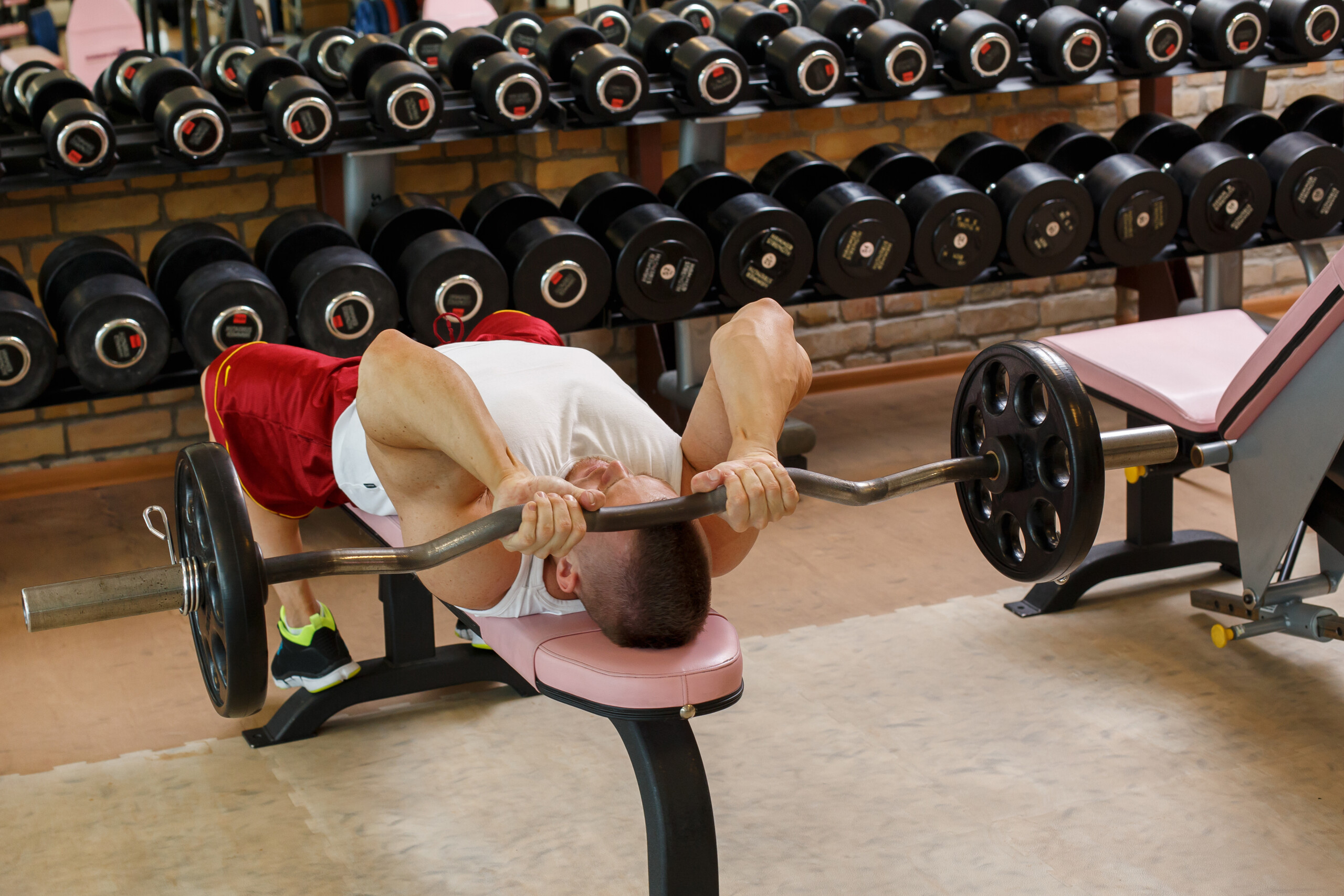
Lying Triceps Extension for Big Arms
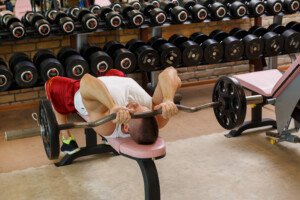
It’s strange that many trainees who desperately want big arms focus a lot of time on building the biceps and pay little mind to the triceps, not knowing about the lying triceps extension for big arms.
For those wanting huge arms, don’t forget about what you can’t see: the triceps! The triceps compose two-thirds of one’s arm.
If you’ve ever seen a guy with huge arms and thought, “I want arms like that!” recall exactly what it was you saw, and you’ll realize that most of the mass was behind the arm, not in front.
To grow big arms, consider the lying triceps extension. Even the weakest person can do these, unlike dips in which beginners will often struggle with just bodyweight only.
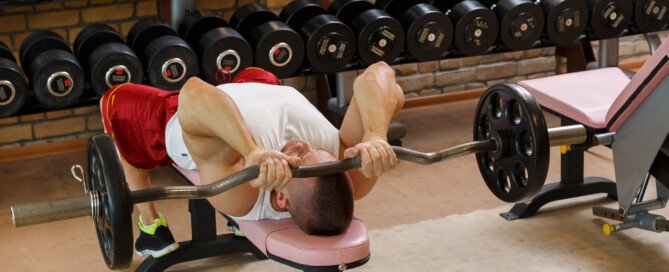
The lying triceps extension is the same exercise as the “skull crusher.”
How To Get the Big Triceps
Place an EZ bar behind a bench where your head will be once you lie on the bench.
Start out with a weight that you think won’t really challenge your triceps, but will be heavy enough to give you a firm idea of what this exercise is all about.
This is an introduction set; you can always use heavier weight in subsequent sets.
Lie on the bench. Feet may be on the floor or on the bench. Grab the bar where you find it most comfortable, as EZ bars provide a choice in hand placement.
Raise the bar out in front, arms straight and vertical. The grip should be overhand, palms facing away from you.
Do not let the elbows splay outward; they should be tucked in. This is the start position.
Lower the bar using elbow flexion only: The forearms bend while the upper arms remain vertical. The elbows stay in one place. This is crucial to isolate the triceps.
Bring the bar so that it barely makes contact with your forehead; don’t rest it there.
Now, return to the starting position. This can be thought of as a triceps press-down, except that your body is angled back 90 degrees.
You are pressing the weight back up, keeping upper arms vertical, moving only the lower arms: elbow extension. This is one repetition. Do as many reps as necessary to get the feel for this exercise.
Guidelines
As you begin using heavier weights, it may be better to have a partner hand you the bar, though it’s also possible to self-load heavy weight. If it feels like a hassle to do this, though, use a partner.
A common mistake is to shift the upper arms towards the face as one lowers the bar.
The upper arms must always stay vertical. Have a partner watch for this if you’re not sure you’re keeping the upper arms perpendicular to the bench.
By allowing them to drift towards your head, this de-isolates the triceps and gets more of the shoulders involved.
Remember, this is essentially a “triceps push-down” angled back by 90 degrees.
Another potential error is letting the wrists flop as the bar is lowered. The hands should always be aligned with the forearms. For greatest recruitment of the triceps, use the narrowest grip possible.
Variations
Regular bar and cable. The lying triceps extension for big arms can also be done with a regular bar and with a cable machine, though with a cable machine it may be somewhat of a hassle to get in the right position.
Single dumbbell. This exercise can also be done with a dumbbell, hands clasped one on top of the other on the underside of the top portion of the dumbbell as it hangs length-wise over you.

Don’t let this version lure you into letting the upper arms drift forward; the shoulder joint does not move in any version of this exercise. Only the elbow joint moves.
Double dumbbell. Yet another variation is with a dumbbell in each hand. The dumbbells can be held horizontally parallel to each other in their start position, so that their tops meet up with the trainee’s forehead at the bottom of the movement.
The other way is to hold them end to end, so that at the bottom of the movement, the back of the trainee’s hands come towards the forehead.
Stability ball. Instead of a bench, use a stability ball. This will require some core engagement (lower back and a little ab work). Lighter weight than what one normally uses with a bench will be required as well.
45 degree angle placement of upper arms. This is perfectly acceptable, as long as this angle is maintained throughout the entire set. The trainee should then lower the weight to behind the head, below face level.
Alternate grip on the EZ bar for a superset.
A superset is an intensity technique. The EZ bar has two choices for where to place hands: One is narrow width and one is medium.
A superset can be done by doing a set with first the narrow hand placement, and then immediately switching to the medium hand placement.
With this second set, do as many reps as possible to muscle failure. A superset can also be done by using the wider hand placement for the first set, and then finishing off to failure with the narrow grip.
Remember the lying triceps extension for big arms. Once a person can perform this exercise confidently without breaking form, it’s time to increase the weights and figure out how much resistance is needed for the desired rep range maxes.
 Lorra Garrick has been covering medical, fitness and cybersecurity topics for many years, having written thousands of articles for print magazines and websites, including as a ghostwriter. She’s also a former ACE-certified personal trainer.
.