
Throwing up in the Mouth While Asleep: Benign Cause, Solutions

Throwing up in the mouth while asleep or overnight is not a literal vomiting up of contents from the stomach in the way you would after eating bad meat or from a bad reaction to a drug. (more…)

Why You Have Constipation after Gallbladder Surgery

Constipation after removal of the gallbladder is actually common, and is not an indication that something went wrong during the surgery.
For the procedure, an anesthetic is required to paralyze the bowel so that the gallbladder can be removed.
The paralysis of the bowel (sounds worse than it actually is) is what may cause constipation following gallbladder removal.
This side effect may last a week or more.
An indirect cause of constipation following gallbladder removal “is a side effect of anesthesia or pain medications one takes after an operation,” says Dr. Baig.
If the patient is on narcotic painkillers such as Percocet or Vicodin, these may cause slower movement of the bowel — leading to constipation.
To combat backed-up stools or stools that are hard and difficult to void, the patient can take Colace, Metamucil or milk of magnesia.
In addition they can drink a juice that contains fiber — such as apple, prune, carrot, papaya and orange (with pulp — to improve bowel movements.
 Dr. Baig’s specialties include gastrointestinal cancers and liver disease, plus gallbladder, biliary tract and pancreatic disorders. He is an assistant clinical professor of medicine at the University of Medicine and Dentistry of NJ/Robert Wood Johnson Medical School.
 Lorra Garrick has been covering medical, fitness and cybersecurity topics for many years, having written thousands of articles for print magazines and websites, including as a ghostwriter. She’s also a former ACE-certified personal trainer.
.
Top image: Shutterstock/nhungboon
Source: oregonsurgical.com/patient-info/instructions/gallbladder-removal/

Labyrinthitis vs. Brain Tumor Symptoms Comparison

Yes, there’s overlap with the symptoms of labyrinthitis and a brain tumor.
A brain tumor can cause so many more symptoms than what is typically described in pamphlets.
The vast array of symptoms that a brain tumor can cause is why there’s a symptom overlap into so many other conditions — including very benign.
This fact is frustrating to no end for people suffering from health anxiety and even those without HA.
The labyrinth is an inner ear structure that helps control one’s balance.
“Itis” means inflamed, so labyrinthitis is inflammation of this tiny structure.
Symptoms of Labyrinthitis (Vestibular Neuritis)
• Vertigo: sudden sensation of the room spinning or moving, which can make you unsteady on your feet. In severe cases walking is not possible.
• The vertigo can cause nausea and even vomiting.
• Hearing loss
• Tinnitus (“ringing” in the ears; persistent high frequency pitch, tone or hissing sound)
• Visual problems
• Difficulty with concentration
• Symptom onset is usually sudden—so much so that it’s common for alarmed sufferers to head to an ER or see their doctor the day of the sudden onset.
• After a flash-in-the-pan onset, the symptoms gradually dwindle, but the vertigo can become chronic on a lower scale if there was damage to the vestibular nerve—giving the patient a persistent feeling of feeling not very well.
Labyrinthitis normally resolves on its own, taking several weeks, when caused by a virus (most cases are). When bacteria is a cause, antibiotics can be prescribed.
Now here’s the first problem when it comes to comparing labyrinthitis or vestibular neuritis to a brain tumor:
There is no specific test for diagnosing labyrinthitis. Like the vexing condition of irritable bowel syndrome, the diagnosis is one of exclusion.
Thus, the physician must eliminate differentials or other possible causes of the symptoms.
This includes a brain tumor and even a stroke, side effects of drugs and anxiety.
This is nerve-racking for the patient, because initially, they may have figured that some in-office test would quickly confirm vestibular neuritis.
But they will walk out of the initial doctor’s visit without a confirmed diagnosis of this benign condition, and will still be fearful that “it” might be a brain tumor.
Brain Tumor Symptom Overlap with Labyinthitis
• Vertigo
• Trouble walking due to balance issues
• Nausea, vomiting
• Hearing loss
• Tinnitus (ringing in the ears)
• Visual problems
• Difficulty with concentration
Some Considerations
You’re going to like this: The type of brain tumor that classically causes hearing loss and tinnitus – and may also cause issues with vertigo and balance – is benign! It cannot metastasize.
It’s called acoustic neuroma and can be easily confirmed with an MRI. When it causes troublesome symptoms, there are several options for treatment including transcanal removal.
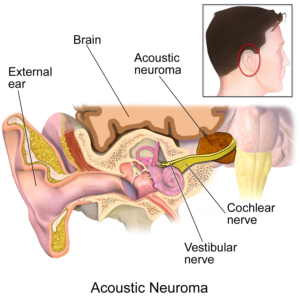
Source:: Blausen.com
A common feature of labyrinthitis that is not common in brain tumors is a sudden onset of marked symptoms.
A person with a malignant brain tumor isn’t going to be feeling great all along, then awaken next day with multiple severe symptoms.
Typically, symptoms from a brain tumor are gradual in progression, rather than suddenly you’re vomiting, can’t stay steady on your feet, have trouble seeing and can’t concentrate — all in one big bang.
As for the other overlapping symptoms, there’s no way around it: Brain tumors are notorious for causing nausea, vomiting and of course, visual disturbances and trouble concentrating.
A thorough workup is required to uncover the causes of these symptoms.
If the patient is experiencing all or even most of them, there’s an increased possibility that two conditions – unrelated to each other – are present.
Lorra Garrick has been covering medical, fitness and cybersecurity topics for many years, having written thousands of articles for print magazines and websites, including as a ghostwriter. She’s also a former ACE-certified personal trainer.
.
Top image: Shutterstock/aleks333
Sources
vestibular.org/labyrinthitis-and-vestibular-neuritis
webmd.com/brain/tc/labyrinthitis-topic-overview#1
mayoclinic.org/diseases-conditions/brain-tumor/symptoms-causes/dxc-20117134

Causes of Tar Black Vomit: It’s Old Blood, but Why?

If your vomit is tarry black, there’s more than one disease that can cause this, but the black itself is old blood.
Vomiting blood is always bad news and requires immediate medical attention. (more…)
Can Diabetes Cause Toenails to Turn Black?
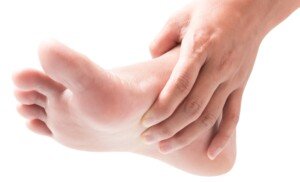
If you have diabetes and are wondering if it’s related to an unsettling black patch on your toenail, you’ll want to head straight to a dermatologist first rather than to your diabetes doctor.
A slowly growing and increasing blackness or very dark area on a toenail may be a sign of melanoma skin cancer.
However, that is not the most likely cause. But what if you DO have diabetes?
An infection called paronychia affects the nail fold and can be chronic (longstanding) or acute (sudden).
This infection is not caused by diabetes, but is more common in diabetics.
When it’s chronic, the damage to the cuticle can lead to a distortion in the underlying nail tissues.
This will then cause a space that is vulnerable to infection.
One of the microbes that can infect this space is called Pseudomonas aeruginosa.
It is this microorganism that has the potential to give the nail an almost black (more likely a blue-black) color.
Another microbe, Fusarium, can cause a blackish patch in a toenail.
“Black toenails in a diabetic can happen when the foot has suffered a lack of oxygenated blood and necessary nutrients,” says J. Mark Anderson, MD, DABFM, of Executive Medicine of Texas and who is board certified in family medicine.
“This causes the toenail to die,” adds Dr. Anderson. “While red can be a sign of acute infection, brown and black are often a sign of permanent damage.”
Melanoma Can Turn a Toenail Black
“In rare cases, a black toenail, not related to the above listed conditions or to trauma (bruising), can be due to skin melanoma [below] that is actually under the nail bed,” says Dr. Anderson.
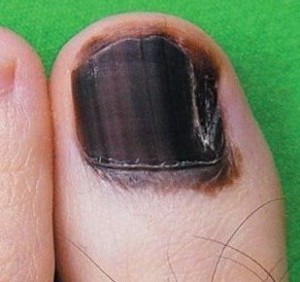
Typically, though, it’s not the entire nail, but can be most of it (below).
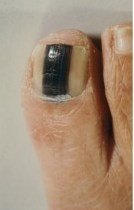
A hematoma (blood collection) can result in a “black” toenail.
Normally this is caused by either a blunt trauma (something falling on the foot) or prolonged sport or exercise activity such as hiking downhill in footwear that’s not as roomy as it should be.

Hematoma. Shutterstock/mortalpious
The darkness begins developing within a day or two of the trauma.
“Diabetics should always take time to look at their feet,” says Dr. Anderson.
“The color of feet, toes and even toenails can be a sign of uncontrolled diabetes which leads to organ damage and circulatory issues.
“Diabetes is not the only cause of black toenails. Liver, kidney and non-diabetic circulatory disease can also lead to this problem.
“Black toenails are not normal, and if you experience this issue you should seek medical attention, including a complete physical examination with bloodwork to uncover the underlying cause.”

Dr. Anderson is coauthor of the award-winning book, “Stay Young: 10 Proven Steps to Ultimate Health,” and host of the nationally syndicated Staying Young Show which goes to podcast as Staying Young Show 2.0.
 Lorra Garrick has been covering medical, fitness and cybersecurity topics for many years, having written thousands of articles for print magazines and websites, including as a ghostwriter. She’s also a former ACE-certified personal trainer.
.
Top image: Shutterstock/MRAORAOR
Sources
medicinenet.com/nail_discoloration/symptoms.htm
practicaldiabetes.com/wp-content/uploads/sites/29/2017/08/Ldr-Hillson-lsw.pdf
cincinnatifootcare.com/black-toenails-running-affects-toes-can/
ncbi.nlm.nih.gov/pmc/articles/PMC2987777/
Just How Do Panic Attacks Cause Chest Pain?

How panic attacks cause chest pain are due to several ways, including a few that involve the heart.
What’s quite fascinating is that the body mechanisms involved in a panic event may work in concert with each other rather than independent of each other. (more…)
How Do Thin People Who Exercise Get Type 2 Diabetes?

Is it possible for a thin person who regularly exercises to develop type 2 diabetes? Though 20% of type 2 diabetics are not overweight, what about their exercise habits?
Let’s take that a step further.
Of the non-overweight people with type 2 diabetes, how many have intense exercise regimens?
Misleading Journalism
The mistake that many writers make is that of implying that thin or non-overweight people necessarily engage in kickass workouts or have healthy diets.
One such misleading article title starts out as: Eat healthily and exercise regularly? You can still get Type 2 diabetes.
The first paragraph in that clumsy article is, “It is typically associated with eating too much and exercising too little – but one in ten people diagnosed with type 2 diabetes is a perfectly healthy weight.”
Do you immediately see the flaw? The follow-up line to the first sentence speaks only of “healthy weight” and makes NO mention of exercise.
In fact, nowhere in the rest of that article does it state anything about how normal-weight people who exercise “too little” are at risk for type 2 diabetes. The article talks only about WEIGHT.
So this circles back to the question: Can a non-overweight or “thin” person who does strenous workouts get type 2 diabetes?
Apparently there are no studies investigating this very specific question — that of strenous exercise, rather than more common forms of exercise.
Nevertheless, being of a normal body weight, in and of itself, does not guarantee immunity to type 2 diabetes.
The Development of Type 2 Diabetes
In type 2, the pancreas produces insulin, but — as one type 2 diabetic man once said — “the body doesn’t know what the hell to do with it.”
There’s an impairment in the transport system: insulin shuttling blood sugar to insulin receptor sites on muscle cells.
“As far as ‘normal’ weighted people developing type 2 diabetes, I will say diet and genetics are playing some role,” says Reena Patel, MD, a board certified family medicine physician who treats patients at Garnet Health Urgent Care in NY.
“Genetics play a greater role in certain races. The black, Native American and Asian community have the highest rates of diabetes, and this will continue to vary by each ethnicity.”
Muscle Protective Against Type 2 Diabetes
“We can also compare overall fat percentages even in a slim person,” says Dr. Patel.
“Belly fat, even if smaller, is worse than fat carried in other parts of the body, as it directly relates to increased insulin resistance.”
That’s a very compelling point, because a “healthy weight” person might also have the so-called skinny fat body, in which the body fat percentage is higher than what it should be for optimal health.
“The more muscle you have the greater your uptake of glucose into the cells,” says the Joslin Diabetes site.
More muscle means more insulin receptor sites.
Take a look at the two women below. They appear to be able to wear the same dress size, but the woman on the left clearly has more body fat.

Below is an accurate depiction of what two men with the same body fat percentage, but different physiques, might look like.
The man on the right is at higher risk for type 2 diabetes because he’s short on muscle mass. This means fewer insulin receptor sites. 
This doesn’t guarantee future type 2 for this body build, but it’s a risk factor. Who needs a risk factor for this disease?
“There is a general recommendation from the American Heart Association for a minimum of 150 minutes of exercise per week,” says Dr. Patel.
“This should be moderate or higher intensity and should get your heart going.
“Diet has also been compared between races living in different nations.
“A Western diet that is not controlled and contains high amounts of processed foods, sugars and fat can lead to type 2 diabetes.
“Overall research has shown genetic involvement is present but not huge, so I would focus on diet in a specific person as well as exercise per AHA guidelines — not for weight loss but for overall well-being from a cardiovascular and insulin standpoint.
“It appears aside from weight the same levels of inactivity and poor oral intake contribute the most towards the diagnosis.
“What else matters? Your lifestyle does! Excessive alcohol consumption, poor sleep, poor stress management and illegal substance abuse can contribute to insulin resistance.”

In addition to treating many chronic conditions, Dr. Patel treats urgent conditions that affect every part of the body. Instagram: That_dr_next_door
Lorra Garrick has been covering medical, fitness and cybersecurity topics for many years, having written thousands of articles for print magazines and websites, including as a ghostwriter. She’s also a former ACE-certified personal trainer.
.
Source: blog.joslin.org/2014/05/thin-and-type-2-non-obese-risk-factors-for-developing-diabetes

Bad Pain in Back of Head from Squats: Causes Include Serious

Suffering from intense pain in the back or other part of the head during or after you complete barbell squats? This could be serious.
First off, if you get a sudden headache in the middle of a squat set, never attempt to finish out the set.
Immediately cease, if for no other reason that struggling to continue the set can result in a form break, causing a back injury.
If you suffer from exercise-induced headaches, you should see your doctor.
When exercise is the cause, they are sometimes referred to as exertional headaches. But don’t self-diagnose; that’s a doctor’s job.
The Exercise Headache
“Usually a pulsing headache affecting both sides of the head,” says Dr. David Beatty, MD a retired general practitioner with 30+ years of experience and an instructor of general medicine for 20+ years.
“Thought to be due to dilatation of blood vessels in the brain. More common in hot conditions and at altitude.
“Also more likely with a history of migraine. Dehydration or low blood sugars may play a part.”
The type of exertion most likely to bring on this kind of headache stems from straining on a big compound move, such as the back squat, deadlift, leg press or bench press.
This is why you don’t hear about weightlifters getting exertional headaches from a set of biceps curls, cable triceps moves or dumbbell side lifts.
Squat Head Pain from Other Causes
Your head pain isn’t necessarily a mere exercise headache.
One’s heaviest squats should not cause pain in the head.
This is never a normal response no matter how much the athlete is straining.
The only “pain” you should feel when squatting is the burn in your legs and glutes, and some tension in your core.
There are two other not-so-serious causes of head pain when doing the squat.
Migraine. “Classically this will cause a throbbing pain on one side of the head,” says Dr. Beatty.
“It can be preceded by a visual aura, when the person sees flashing lights or zig zag lines in the visual field.”
Cervicogenic headache. “Typically affects the back of the head and is caused by nerves arising from the neck being pinched by muscle tension and spasm, or by the vertebrae or a protruding disc in the cervical spine,” says Dr. Beatty.
A protruding or herniated disc may sound like a serious matter. But compared to the next two possible causes, it’s nothing to lose sleep over.
More Serious Causes of a Squat Headache
Subarachnoid hemorrhage. “This is a severe life-threatening emergency which requires immediate hospital care,” begins Dr. Beatty.
“The person develops a sudden severe headache over the back of the head.
“It’s described as like being kicked in the head or hit over the back of the head with a bat.
“There may be neck pain, neck stiffness, nausea, confusion, loss of consciousness, seizures, sensitivity to light or a stroke-like picture with loss of power or feeling in one side of the body.
“It’s caused by bleeding from an aneurysm in the brain.
“An aneurysm is a swelling or dilation arising from one of the arteries.
“If there is only a small leak, the symptoms may not be so obviously worrying.”
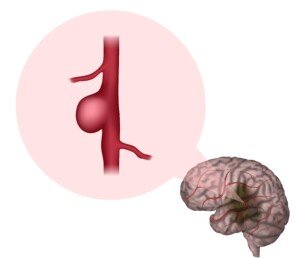
Bulging blood vessel in the brain. Shutterstock/Veronika Zakharova
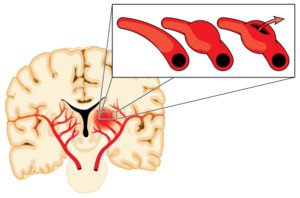
When a brain aneurysm ruptures, it’s called a hemorrhagic stroke. Shutterstock/Blamb
Brain tumor. “Tumors sometimes contain lots of blood vessels and, if these leak, it can produce a similar picture,” says Dr. Beatty.
“If I was getting a significant headache after exercise I would want a brain scan.”
More on Brain Aneurysms
If over a period of weeks, you’ve been getting headaches during or after sets of squats, you do not have an aneurysm with a major rupture.
That’s because once a full-blown rupture occurs, you’ll die without immediate medical treatment.
With a major rupture, you simply will not be able to function. You have minutes to get emergency help.
However, the sudden expansion of a brain aneurysm, without bleeding, can cause a headache.
 Dr. Beatty has worked in primary medicine, surgery, accident and emergency, OBGYN, pediatrics and chronic disease management. He is the Doctor of Medicine for Strong Home Gym.
Lorra Garrick has been covering medical, fitness and cybersecurity topics for many years, having written thousands of articles for print magazines and websites, including as a ghostwriter. She’s also a former ACE-certified personal trainer.
.
Top image: Shutterstock/KDdesignphoto
Sources
onlinelibrary.wiley.com/doi/10.1111/j.1526-4610.1983.hed2304193.x/full
sciencedirect.com/science/article/pii/S0196064482800486
tandfonline.com/doi/abs/10.1080/00913847.1985.11708903i

What’s the Youngest a Child Can Get Colon Cancer?