
Can Stress Worsen Seborrheic Dermatitis or Even CAUSE It?

Some of your flares of seborrheic dermatitis can be made worse by stress, but stress can actually cause this condition as well. (more…)
Multiple Sclerosis Mimickers: 44 Including Cancer

You may fear you have multiple sclerosis only to learn that it’s actually cancer; there are over 100 mimickers of MS and here are 44 of them. (more…)

How Well Can a CT Scan Detect Pancreatic Cancer?

When pancreatic cancer is suspected, a CT scan is the first imaging study done.
There are three types of CT scan for pancreatic cancer detection.
Pancreatic cancer is one of the most vicious cancers because by the time symptoms start presenting, the disease is in an advanced state – making prognosis very grim.
Furthermore there’s no way to screen for this disease, which takes out about 36,000 Americans every year.
Effectiveness of CT Scan for Pancreatic Cancer Detection
“A CT scan is able to detect pancreatic cancers that are two cm or greater, in about 90 percent of the cases,” says Jordan Winter, MD, a hepato-pancreatic-biliary and oncology surgeon and Chief of the Division of Surgical Oncology at University Hospitals Cleveland Medical Center.
“It is the best available test for assessing pancreatic cancer,” adds Dr. Winter.
“It is best performed with IV contrast to delineate nearby blood vessels.”
But in some cases, non-contrast (minus the chemical dye) CT is used.
The non-contrast is done on people who have compromised kidney function (the dye would injure the kidneys) or who are allergic to the dye.
Using the dye is very important because it enables visualization of the tumor.
A CT scan without the contrast dye will yield poor sensitivity for pancreatic cancer masses.
No contrast material also means poor specificity for these masses.
CT with intravenous (IV) contrast. The dye is used with a multidetector CT (MDCT), which provides high resolution and very thin “slices” or cross-sections of the patient’s abdomen.
MDCT, then, generates good visualization of an adenocarcinoma – good enough to assist with early detection of pancreatic cancer and even staging of the mass (i.e., how progressed it is).
Due to its level of effectiveness, the multidetector CT scan with dye is the imaging study of choice for the preliminary diagnostics of a patient who’s suspicious for pancreatic cancer – unless, of course, they have kidney failure or a history of allergic reaction to the dye.
MDCT sensitivity?
The multidetector CT scan has a sensitivity ranging from 76 to 92 percent for diagnosing pancreatic cancer.
A misdiagnosis can occur due to the visualized mass seemingly blending in with surrounding functional tissue.
MDCT with contrast dye ha an 80-90 percent accuracy rate at assessing infiltration of a malignant tumor as well as whether or not it can be surgically removed.
But it has limitations at identifying any spread to the liver or lymph nodes, though it’s possible it can achieve this.
Again, people with compromised kidney function or a history of allergy to the dye are not suitable candidates for MDCT with dye.
CT angiography. Also known as pancreatic protocol CT, this helps identify staging and whether or not surgery would be an effective option.
This technology involves several sets of CT scans taken over several minutes.
In short, a CT (computerized tomography) scan can show the pancreas pretty clearly and is a trusted modality when pancreatic cancer is suspected.
 In addition to surgical management of pancreatic and related cancers, Dr. Winter treats other upper gastrointestinal malignancies and abdominal tumors. He has authored over 100 peer-reviewed articles, many on pancreatic cancer.
 Lorra Garrick has been covering medical, fitness and cybersecurity topics for many years, having written thousands of articles for print magazines and websites, including as a ghostwriter. She’s also a former ACE-certified personal trainer.
.
Top image: ©Lorra Garrick
Sources
cancer.org/cancer/pancreatic-cancer/detection-diagnosis-staging/how-diagnosed.html
ncbi.nlm.nih.gov/pmc/articles/PMC3397617/

Can Carpal Tunnel Syndrome Cause a Weakened Grip ?

If you’ve been noticing a weaker grip lately, this doesn’t necessarily point to carpal tunnel syndrome, though this condition CAN cause a weakened grip.
In fact, carpal tunnel syndrome can weaken the grip enough to cause difficulty picking up small objects, making a fist or conducting tasks that require a good solid grip.
“CTS can definitely cause a weakened grip because the median nerve innervates the muscles on the thumb side of the hand — and the thumb is extremely important in all grip types,” says Logan Thomas, PT, DPT, based in Muncie, IN.
Dr. Logan adds, “When a nerve is compressed, it decreases the strength of the signal that reaches the muscles.”
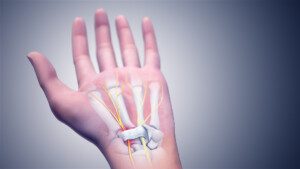
Median nerve compression in carpal tunnel syndrome. Scientific Animations
Other Conditions that Can Weaken the Grip
• ALS. Unlike the conditions listed below, this disease will progress to other parts of the body, eventually weakening and paralyzing the entire body.
A grip that’s been weak for months on end, with NO other symptoms, is likely one of the conditions below.
• Pronator syndrome. Think of carpal tunnel syndrome but a little higher up.
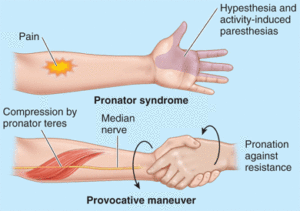
Pronator syndrome
• Cervical radiculopathy. The problem originates in the nerves located in the neck, which branch down and ultimately reach the hand.
A “pinched nerve” in the neck can weaken the grip.
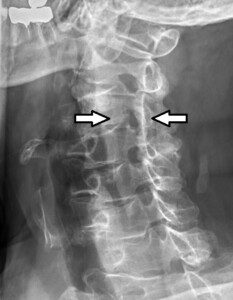
Cervical radiculopathy. Mikael Häggström, CC0, via Wikimedia Commons
• Medial epicondylitis (golfer’s elbow). The weakness is not inherent in the hand or wrist; rather, the pain in the elbow prevents full gripping action.
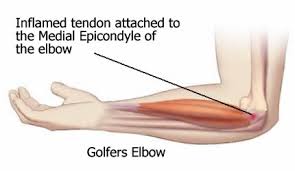
Golfer’s elbow
• Ulnar nerve palsy (e.g., cubital tunnel syndrome). The ulnar nerve is the “funny bone” nerve in the elbow.
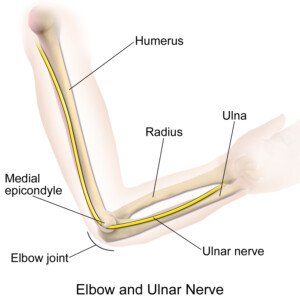
Ulnar nerve. BruceBlaus
• Brachial plexus injury/disorder. The brachial plexus nerves that arise in the neck and feed down to the hand can be subject to injury.
• Median nerve palsy. The median nerve runs the length of the arm.
• Radial neuropathy. The radial nerve runs the length of the arm.
There are many nerve conditions aside from the above that can weaken the grip, but they will also affect other parts of the body.
Carpal tunnel syndrome classically also causes pain in the wrist, plus tingling and numbness in the thumb, index and middle finger and part of the ring finger.
 Dr. Thomas a physical therapist, and strength and conditioning coach who is passionate about patient education. He believes the most important and often overlooked step in the process to becoming pain-free is understanding the anatomy and biomechanics of your body.
Lorra Garrick has been covering medical, fitness and cybersecurity topics for many years, having written thousands of articles for print magazines and websites, including as a ghostwriter. She’s also a former ACE-certified personal trainer.
.
Top image: Shutterstock/ LI Cook
Sources:
medstarwashington.org/our-services/orthopaedics/conditions/hand-and-elbow-conditions/#q={}
ninds.nih.gov/Disorders/Patient-Caregiver-Education/Fact-Sheets/Carpal-Tunnel-Syndrome-Fact-Sheet
healthhype.com/hand-weakness-weak-hand-grip-causes-and-normal-strength.html
Hard Lump Inside Nose: Many Causes Including Cancer

Your suspicion is correct:
A hard lump inside your nose can be cancer — and there are numerous different kinds of cancers that can cause a self-detected lump or bump inside the nose. (more…)
Do Sinus Headaches Always Come with Nasal Mucus?

You may be wondering if a sinus headache is necessarily accompanied by excess mucus from your nose.
Perhaps the absence of mucus has you worrying that your “sinus feeling” headache is actually a brain tumor. (more…)

Can Cancer Cause a Burning Feeling Inside the Nose?

Though a burning feeling inside the nose isn’t all that uncommon, neither is the No. 3 killer of Americans: cancer.
So it stands to reason that one might wonder if cancer can cause a burning feeling in the nose. (more…)

Can Muscle Twitching Be Caused By Gluten Intolerance?

Chronic muscle twitching (fasciculations) at various locations of the body can actually be caused by a gluten intolerance, and the effective treatment could be an elimination of gluten. (more…)

Botox: Effective Treatment for Benign Fasciculation Syndrome

The botulinum toxin type A, aka Botox, has been shown to be effective at treating benign fasciculation syndrome (BFS). (more…)







22 Diseases that Mimic ALS Symptoms, Can Lead to Misdiagnosis

There are far more conditions that mimic ALS than you can imagine: at least 22.
“Potentially curative treatments exist for certain ALS mimic syndromes,” states a report in the Iranian Journal of Neurology (April 2016), “but delay in starting these therapies may have an unfavorable effect on outcome.”
ALS Mimic Syndrome
ALS mimic syndrome refers to a group of medical conditions whose clinical presentation resembles those of ALS in the latter’s early stages.
The IJN points out that there have been only a few studies published regarding ALS mimic syndrome.
According to population based studies, nearly 10 percent of people diagnosed with ALS have actually had a different medical condition.
Diseases that Mimic ALS and Their ALS-Like Symptoms
• Adrenomyeloneuropathy – lower leg stiffness and partial paralysis
• Adult polyglucosan body disease – progressive muscle weakness and stiffness
• Allgrove AAA syndrome – atrophy, muscle weakness, movement problems
• B12 deficiency – muscle weakness, problems with walking
• Benign monomelic amyotrophy – atrophy and weakness of one limb; fasciculations; possibly reduced reflexes
• Celiac disease – atrophy, weakness, fasciculations
• Creutzfeldt-Jakob disease – atrophy, fasciculations
• Inclusion body myositis – asymmetric weakness, difficulty swallowing
• Isaac’s disease – atrophy, weakness, fasciculations, diminished reflexes
• Isolated neck extensor myopathy – weak neck muscles
• Kennedy’s disease – atrophy and weakness of facial, bulbar and limb girdle muscles; tremor; fasciculations near the mouth
• Lyme disease – weakness, fasciculations
• Mitochondrial disorder – atrophy, weakness, fasciculations
• Multifocal motor neuropathy with conduction block – focal weakness; fasciculations
• Multiple sclerosis – limb weakness, unsteady gait, slurred speech
• Myasthenia gravis – muscle weakness, trouble chewing and swallowing
• Oculopharyngeal muscular dystrophy – bulbar weakness
• Overactive thyroid – weakness, fasciculations
• Paraneoplastic encephalomyelitis – unsteady gait leading to paralysis; slurred speech; trouble swallowing
• Post-polio syndrome – atrophy, weakness, problems swallowing
• Syringomyelia – atrophy and weakness
• Transthyretin familial amyloid neuropathy – tongue atrophy and fasciculations
Considerations
All of the aforementioned conditions present with at least one symptom that is seen with ALS.
Some of the conditions eventually present with symptoms totally unrelated to neuromuscular function, and in other cases may present with those symptoms right from the get-go.
So nothing’s engraved in stone here; variability is high.
The mimicking nature of these disorders is apparent mostly in their early stages before the more non-relevant symptoms start popping up such as bowel and bladder dysfunction, rapid heart rate, vision problems and cognitive impairment, to name a few.
As mentioned, there’s much variation involved. For instance, in oculopharyngeal muscular dystrophy, the eyelids are usually affected – but in ALS they are not.
But there are cases of oculopharyngeal muscular dystrophy in which eyelid involvement is minimal, and most of the weakness is seen in the bulbar region, making this disease a potential mimicker of bulbar-onset ALS.
Another consideration is that the more progressed the above disorders become, the less they resemble ALS, especially ALS in its early stages.
The longer the time lapse, the more apparent the differences become in symptoms and clinical presentation.
- For example, some of the diseases have a very slow progression.
- Another example is benign monomelic amyotrophy: The pathology remains in just one limb.
Benign fasciculation syndrome mimics ALS more so in the petrified mind of the patient rather than to the neurologist.
The Iranian Journal of Neurology goes on to point out that fasciculations with motor neuron disease are asymptomatic and that the patient is unaware of them until the physician detects them.
“They are diffuse and rarely are the presenting symptom,” states the paper.
“Muscle fasciculation without weakness should be considered a benign phenomenon,” continues the Journal, “although follow-up (sometimes 6 months or more), might be required to confirm benign nature of that.”