
After Years of Lip Picking, Can Lips Ever Be Normal Again?

Relentless lip picking is a habit of anxiety, as is nail biting.
However, people will usually notice lips a lot more than nails when they interact with you. (more…)

Best Way to Get Rid of Acne Scars from Picking

Frequent picking of acne scars will do a number on your skin — and a very unsightly one.
Is there any hope ?
Even if you don’t have the money or insurance to pay for the cost of acne treatment — the last thing that you’ll ever want to do is pick at the blemishes!
Picking will just make the scene worse, creating unsightly scars.
And then what? These scars will never just go away on their own. You’ve dug a deeper hole. But … there is a way to fix this situation.
How to Get Rid of Scars Caused by Picking at Acne
“The only way to get rid of acne scars is with office treatments that resurface the skin,” says Estee Williams, MD, a board certified medical, cosmetic and surgical dermatologist and assistant clinical professor in dermatology at Mount Sinai Medical Center.
“Most skin resurfacing treatments involve creating controlled wounds in the skin, thereby turning on the body’s healing response which makes new skin,” explains Dr. Williams.
“Wounding — or resurfacing — can be accomplished via needles (‘microneedling’), lights (lasers), acids (‘chemical peels’).”
What does microneedling involve?
The microneedling procedure involves a microscopic needle (yes; do not picture the big needle that doctors use for injections) that creates puncture wounds – and it’s these very tiny wounds that kick up your body’s natural healing response: new collagen and skin.
“Focal tiny ice pick scars can be treated with TCA CROSS, a procedure using high strength acid,” continues Dr. Williams.
“Indented scars can be filled with Belafill filler.
“My favorite acne scar treatments are Fraxel [non-invasive laser therapy], microneedling and Belafill.”
Average cost of laser skin resurfacing?
According to the American Society of Plastic Surgeons, the average cost for this procedure, as of 2016, was about $2,330.
Note: This is an average.
Cost will very quite a bit depending on where the procedure is performed.
Keep in mind that if you have a medical coverage plan, it probably will not cover the cost, since the removal of acne scars is considered a cosmetic procedure.

Dr. Williams strives to be at the forefront of her field, being active in local, national and international medical and cosmetic dermatology conferences.
 Lorra Garrick has been covering medical, fitness and cybersecurity topics for many years, having written thousands of articles for print magazines and websites, including as a ghostwriter. She’s also a former ACE-certified personal trainer.

Mole Removed Long Ago, Area Healed, but Now Is Itching

A mole gets removed, then a long time later it starts itching like mad.
One woman feared this meant a few mole cells were left behind and turned into cancer.
And that the cancer was causing the itching.
So what’s really going on when the area where a mole was removed begins itching a long time later?
“Scars are often itchy,” begins Estee Williams, MD, a board certified medical, cosmetic and surgical dermatologist and assistant clinical professor in dermatology at Mount Sinai Medical Center.
“A mole removed many years ago, and diagnosed by a pathology report as a normal mole, is rarely a concern,” continues Dr. Williams.
“If there is clearly regrowth of the mole, with brown pigment appearing in the scar or around the scar, it should be checked.
“But often moles do regrow since they are removed only partially and roots are left behind.
“If there is nothing to see, and just the symptom of itch, there is no need to re-biopsy right away.
“If the itching continues unexplained and brown pigment appears, it should be evaluated again.”
If you have many moles and find it grueling to inspect every one of them every month for signs of cancer, and you’re thinking of having some pre-emptively removed, there’s a better alternative:
Serial Digital Dermoscopy
It’s one thing to have a mole removed for cosmetic reasons, but “de-moling” a bunch of moles out of fear of melanoma is not the way to go.
Dr. Williams’ clinic provides the state-of-the-art technology of serial digital dermoscopy.
With SDD, all the patient’s moles are “mapped” photographically and fed into a computer database where they are rated on a suspicion index for melanoma.
Every year the same moles are photographed. The computer as well as the doctor’s naked-eye scrutiny of the magnified images of the moles on the computer screen make a comparison to past images to detect any changes.
Dr. Williams strives to be at the forefront of her field, being active in local, national and international medical and cosmetic dermatology conferences.
Lorra Garrick has been covering medical, fitness and cybersecurity topics for many years, having written thousands of articles for print magazines and websites, including as a ghostwriter. She’s also a former ACE-certified personal trainer.
Top image: Shutterstock/CHAjAMP
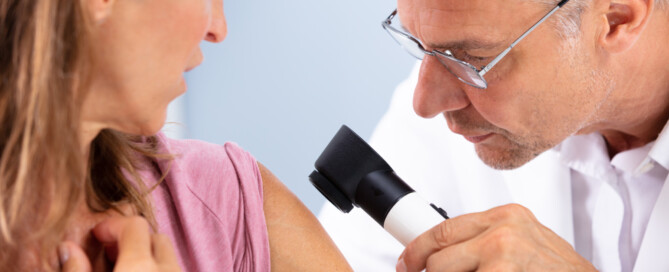
Mole Bleeds After Scratching: Melanoma Risk or IS It Melanoma?

Rather than worry that scratching a mole raises melanoma risk, you should be concerned that a mole that bleeds from the lightest scratch IS melanoma.
However, this is not likely since often, scratching can cause a little bleeding. (more…)
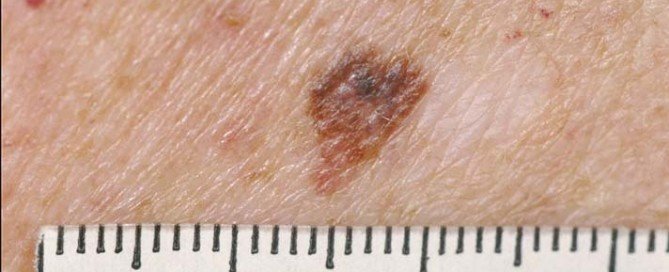
You Know You Should Get that Suspicious Mole Checked When…
At what point should you stop waiting and waiting and finally get a suspicious looking mole checked by a dermatologist?
It’s easy to just say, “You know you should get that suspicious mole checked when you begin feeling uneasy about it.” (more…)
What Relatives of Person with Brain Aneurysm Should Have MRI?

Do you have a relative just diagnosed with a brain aneurysm and are wondering if you should get a screening MRI every year?
There is a type of brain aneurysm called familial aneurysm. And it’s called that for a reason: It tends to run in families. (more…)

Sciatica Calf Pain vs. DVT Pain: Key Differences
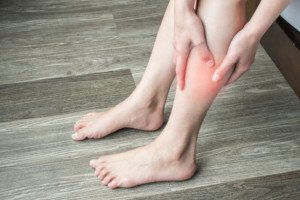
Both sciatica and deep vein thrombosis can cause a lot of calf pain.
What’s troubling is that not all DVT pain comes with visible symptoms that strongly point towards this condition.
So the patient is left wondering, “Is my calf pain from a DVT or a flare-up of my sciatica or new-onset sciatica?”
Can the calf pain from a DVT feel identical to that from sciatica?
Well, calf pain from DVT is typically described as being a soreness, tenderness or cramp, including a really bad cramp, a la “Charlie horse.”
Calf pain from sciatica is typically described as shooting, stabbing, sharp and can be very severe.
Sciatica and DVT pain often come with other symptoms that can point heavily in one direction or the other.
But if just the symptom of pain is isolated and then compared, leaving out the consideration of other accompanying symptoms, it seems to be a situation of cramping or tenderness vs. sharp and shooting.
“Leg pain can mean very different things,” says J. Mark Anderson, MD, DABFM, of Executive Medicine of Texas and who is board certified in family medicine.
“When assessing and reporting leg pain, first make note of the place where the pain occurs,” continues Dr. Anderson.
“Is it worse with exercise?
“Is it sharp or dull?
“Is the leg hot or swollen?
“Where does it start and where does the pain end?
“The answers to these questions are very important in determining if the pain is associated with a serious condition known as deep vein thrombosis (DVT) or something painful, but less serious, like sciatica.
“DVT pain is often felt in the calf or in a specific region of the leg. It’s often worse with exercise and described as a burning or constant pain or cramp.

Shutterstock/TANAPAT LEK.JIW
“Since DVT is due to a blood clot, the leg is often warm to the touch at the spot where it hurts the most.
“DVT is a serious condition and medical attention should be sought immediately.
“Sciatica is pain that generally radiates from the buttock area and ‘shoots’ down the leg.
“It’s often described as a sharp pain that comes and goes. It can be made worse with certain standing or sitting positions.
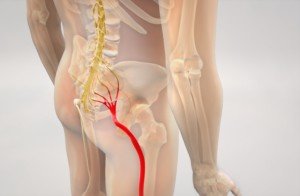
The sciatic nerve. Shutterstock/Nathan Devery
“Some people experience foot or leg numbness or weakness due to sciatic nerve irritation, the cause of sciatica.
“Sciatica generally goes away with conservative treatment such as anti-inflammatories.”
Key Features of Sciatica Calf Pain
• Often described as shooting down the back of the thigh before reaching the calf.
• The same pain may be in both legs.
• There may be spasms in the calf.
• Sitting or standing may aggravate the pain.
• Lying down and even walking or jogging may relieve the pain somewhat.
• Possible accompanying symptoms are pain in the buttocks, thigh and foot; weakness in the calf or foot; and tingling or numbness in the thigh, calf or foot.
Key Features of DVT Calf Pain
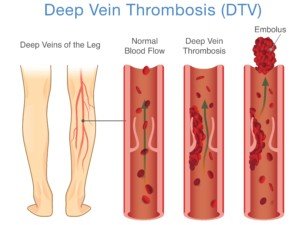
Shutterstock/solar22
• Cramp-like, burning or sore; may resemble a pulled muscle.
• Continuous; will not disappear with rest or keeping the leg still.
• Does not get better with sitting or lying down.
• Often worse with exercise
• Bending the foot so that the toes point upward may aggravate the pain.
• Possible accompanying symptoms are warmth and/or redness/pink in the painful area, and/or swelling. But remember, some DVTs present with only pain.
• Very recent history of risk factors increase suspicion of DVT such as recent very long trip cramped in an airplane or vehicle seat with minimal and especially zero intermissions of being up and around; prolonged bed rest; joint replacement or abdominal surgery.
If you suspect a DVT, a visit to the emergency room is strongly advised over making an appointment with your general practitioner — as the latter may not be able to see you right away and may not have access to ultrasound equipment (which can show a DVT).
An ER will have fast access to ultrasound and if you’re diagnosed, can immediately get you started with treatment.
If this article provided you with helpful information or reassurance, please consider supporting my work through Ko-fi. Donations help me continue writing detailed medical content that’s easy to understand.

Dr. Anderson is coauthor of the award-winning book, “Stay Young: 10 Proven Steps to Ultimate Health,” and host of the nationally syndicated Staying Young Show which goes to podcast as Staying Young Show 2.0.
Lorra Garrick has been covering medical, fitness and cybersecurity topics for many years, having written thousands of articles for print magazines and websites, including as a ghostwriter. She’s also a former ACE-certified personal trainer.
Top image: Shutterstock/Boyloso
Sources
mayfieldclinic.com/PE-Sciatica.htm
webmd.com/fitness-exercise/features/sciatica#1
sciatica-pain.org/sciatica-in-the-calf.html
everydayhealth.com/news/how-do-you-know-if-its-deep-vein-thrombosis/
mayoclinic.org/diseases-conditions/deep-vein-thrombosis/symptoms-causes/dxc-20336850

Can Gallbladder Removal Cause Chronic Diarrhea? Solution?

Frequent diarrhea can result after gallbladder removal and persist for months.
But there is no clear answer as to how common this problem is, especially the longer the time lapse following the surgery. (more…)

Can a Radical Prostatectomy Make Food Taste Funny?

It’s not unheard of for a man to wonder if the change in the way food tastes is somehow connected to his recent radical prostatectomy.
The patient needs to make sure that this is not just a timeline coincidence. (more…)

Diarrhea After Abdominal CT Scan: Cause, Solution

Do not put off having a CT scan if your doctor wants this done just because you fear getting diarrhea.
The diarrhea after a CT scan happens to many people, a well-documented side effect of the contrast dye.
The Contrast Dye
This is required so that certain structures can be more easily viewed or visualized.
This agent really makes a big difference when compared to non-contrast CT scans.
It works by altering the way X-rays pass through the body, and this allows for clearer and more detailed images for doctors to see.
“For CT, the type of contrast most often given is IV contrast (intravenous),” says Resham Mendi, MD, a renowned expert in the field of medical imaging, and the medical director of Bright Light Medical Imaging.
Common types of contrast agents include iodine based solutions, which are frequently used for their ability to absorb X-rays and improve the contrast of the images.
“Diarrhea would not be a common side effect of IV contrast for CT,” says Dr. Mendi. But it does happen to some people.
“For some CT, oral contrast is given. Mild diarrhea can be a result of the oral contrast, but should resolve relatively quickly.”
Diarrhea is never fun, but looking at the bigger picture, you should think, “Gee, what’s the big deal with some diarrhea when I have something else going on with my body that warrants a CT scan to figure it out?”
If you’ll be having a CT with dye done, you will be given instructions regarding the latest you can eat prior to the procedure, which is typically that you don’t eat anything three hours prior to the scan.
After the scan you can resume eating and drinking as normal.
But if you’re having diarrhea, you’ll want to back off on high fiber foods.
Fiber can increase the bulk and frequency of stools, which might worsen diarrhea.
Instead, focus on low-fiber foods like bananas, white rice and toast, which are gentler on your digestive system and can help firm up your stools.
You should notify your doctor or nurse if the diarrhea persists.
Rather than diarrhea, some people will get constipation following a CT scan — due to the dye.
Drinking plenty of fluids, eating high-fiber foods and staying active can help alleviate constipation.
Discuss these possible outcomes with your medical team if they are worrisome for you.
But really, they should not be concerning other than for the annoyance and inconvenience.
Diarrhea or constipation following an abdominal CT scan are not indicative of the efficacy of the procedure.
Plus, these are transient side effects and should subside with home treatment.
If this article provided you with helpful information or reassurance, please consider supporting my work through Ko-fi. Donations help me continue writing detailed medical content that’s easy to understand.





Dr. Mendi has published several articles in radiology journals and has expertise in MRI, women’s imaging, musculoskeletal, neurological and body imaging.
Lorra Garrick has been covering medical, fitness and cybersecurity topics for many years, having written thousands of articles for print magazines and websites, including as a ghostwriter. She is also a former ACE certified personal trainer.
.