

Toothache for Several Days but Suddenly Goes Away

If you’ve recently suffered from a toothache but then it suddenly went away, this can actually mean something potentially serious.
You need to see your dentist promptly. (more…)
Numb Tongue Days After Dental Treatment: Cause and Solution

If your tongue is still numb days following dental treatment, this is not normal and you need to contact your dentist. (more…)

Can Eye Pain Be Caused by Teeth Problems?

Gradual-onset eye pain, and sudden acute eye pain, have a variety of causes. (more…)
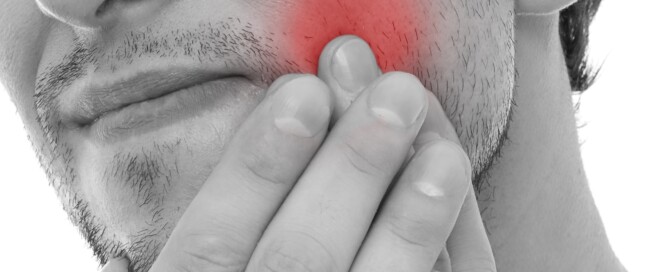
Emergency Room or Dentist for a Dental Emergency?

The pain of an infected tooth or gum can be alarming enough to incapacitate a person.
Should you go to an emergency room or dentist? (more…)
The Best Way to Walk on a Treadmill if You’re Plus Size

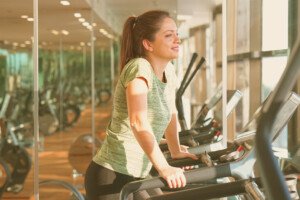
The treadmill is an inviting piece of exercise equipment for plus size men and women, and it can work wonders – but only if it’s used correctly.
I’ve been a personal trainer and lifelong fitness enthusiast, and one of the phenomena I’ve observed – no matter which gym I was ever in – is that people of plus size usually hold onto a treadmill.
This is a very peculiar phenomenon, because walking is the most fundamental movement of the human body that typical people learn to master by the time they’re one year old and even younger.
The idea of something moving under one’s feet can throw off a person’s confidence at maintaining balance, so their instinct is to hold onto the treadmill.
You’re plus size; what are your goals?
When it comes to correctly walking on a treadmill, it doesn’t matter what your goals are.
You simply should not hold on – unless you’re taking a momentary heart rate or you need to do something like wipe away sweat, sip water or turn to listen to someone.
If you walked into the gym without assistance, there’s no reason to hold onto the treadmill.
I’ve spoken to many plus size people about this, and the fear of falling off is only one of the reasons they hold on.
Believe it or not, I’ve heard, “Everyone else does it, so I thought that’s what you should do.”
In Order for Walking to Yield Results, It Must Be Done ABOVE Baseline
Many overweight men and women walk on the treadmill at a pace similar to their everyday walking pace (on the job, while shopping, etc.). In addition, the incline is set at zero.
But they are holding onto the treadmill. This means that the only element that’s above baseline is the extra time spent walking. This isn’t enough to yield results, particularly weight loss.
The most important element is effort or intensity, which should be well-above baseline.
In fact, just 20 minutes of interval walking – without holding on – is significantly more effective than two hours’ nonstop of walking at a moderate pace while holding on.
• So it’s not about spending a lot of extra time walking.
• It’s about getting the biggest bang for your buck: much LESS time on the treadmill, but with more intensity – and correct use (hands off the machine).
Why Plus Size People Should not Hold onto a Treadmill
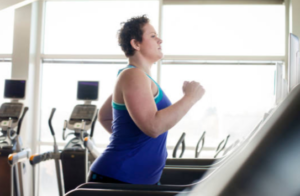
• It reduces the body’s ability to be efficient at balance and agility on one’s feet during everyday movement.
• It may result in repetitive stress injuries to the shoulders, hips and feet.
• It burns at least 20 percent fewer calories than what the readout displays. The readout is based on the machine’s settings.
Ask yourself how a machine can tell the difference between a 250 pound, 6’3 young male bodybuilder and a 250 pound, 5’3 middle age woman. Yet the calorie readout will be the same for them!
• Holding onto a treadmill encourages poor walking posture.
• It reduces workload to the core and lower back.
• Because of all of these issues, holding on is a very ineffective way to achieve good cardiovascular health and stamina.
• Can I also add that it looks really silly?
Even if you’re holding on at a fast pace and high incline, the tendency will be to grip the machine TIGHTER.
So don’t think for a moment that you can cancel out the negative effects of holding on by setting the speed to super fast and the incline to super high.
The user will hold on as tightly as necessary to maintain what I call “fake walking.”
No matter how obese my clients were (even 300+ pounds), and no matter how new they were to sustained walking, I forbad them from holding on – other than to steady themselves while drinking water or if they felt a little off-balance.
But once they were re-steadied, it was HANDS OFF, even if this meant a very slow speed to get the body used to walking on a moving surface.
When a plus size person has been walking on a treadmill without holding on, they will acquire increased stamina for walking in everyday life.
Moving your feet to keep up with a moving tread, without holding on, will also improve your everyday balance.
How do plus size men and women learn to let go of the treadmill?
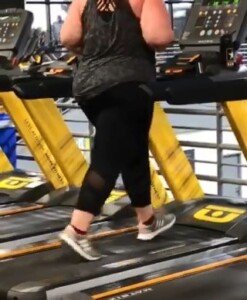
Start out at zero grade and a normal walking speed, and just let go. Swing your arms naturally.
If you feel awkward or even “dizzy,” this is because you’ve trained your body to do something incorrectly.
Just keep walking, moving your arms naturally, and you’ll be surprised at how quickly your body will get used to natural walking rather than fake walking. Over time, increase the speed and/or incline.
How to Get a Better Treadmill Workout in 20 Minutes
• Find a setting that’s too difficult to maintain for longer than a minute – without holding on, of course.
• Now do that for one minute.
• Then change the setting to an easy, very slow walk – one that feels relaxing because it’s so easy. This is your recovery interval to catch your breath.
• After a few minutes, return to the difficult setting and again do that for one minute.
• Switch back and forth like this until 20 minutes are up.
• DO NOT HOLD ON unless it’s to momentarily steady yourself.
• At the end of each difficult interval, you should be too winded to speak to the person next to you.
• Do this twice a week and you’ll start feeling amazing changes in your body.
Be sure that your intensity setting is truly something that you cannot sustain for longer than a minute!
This is called interval training, and plus size people will benefit tremendously from it.
Prior to beginning this regimen, an overweight person should get medical clearance. Here are guidelines for that by a doctor.
 Lorra Garrick is a former personal trainer certified through the American Council on Exercise. At Bally Total Fitness she trained women and men of all ages for fat loss, muscle building, fitness and improved health.
.
Top image: Shutterstock/Aaron Amat
How to Properly Do the Side Shuffle on a Treadmill: Hands Off!
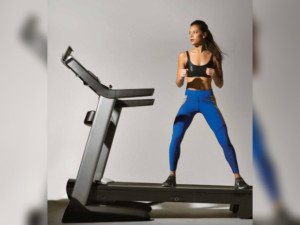
What’s the point of doing a side shuffle on a treadmill if you’re holding onto the rail?
Why do able-bodied people feel they must hold on just because they’re walking sideways? (more…)
Can I Get a Bigger Butt Holding a Treadmill & Leaning Forward?
Many women want a bigger butt and would rather get one by walking on a treadmill and leaning way forward while holding on than by intense weight training. (more…)
Can Holding Onto a Treadmill Build Up Skinny Legs?
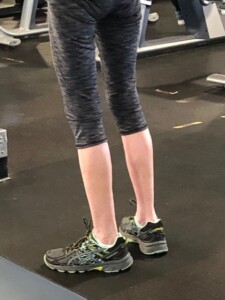
Those who are tired of their skinny legs will try anything that comes to mind to build up some mass.
Holding onto a treadmill allows one to “walk” at a high incline and fast speed for sustained periods. (more…)

Pulled Muscle in Chest or Angina? Symptom Comparison

A pulled chest muscle or one that’s suddenly in spasm can hurt a lot or a little – but angina, too, can come in different flavors, ranging from a muffled ache to a sudden severe pain. (more…)
Angie J. of “600 Pound Life” Makes Jeanne Look Like an Angel
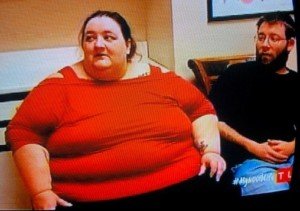




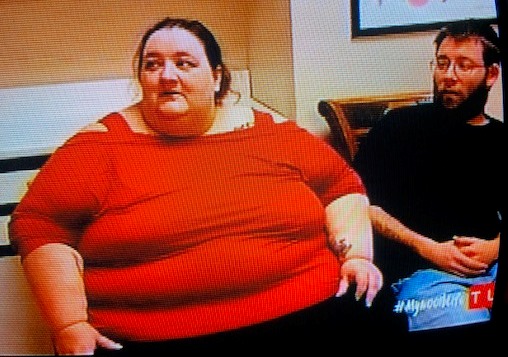
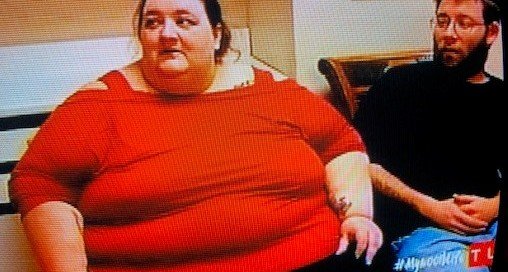
Just when you thought Jeanne took the cake (no pun intended) for the Nasty Award on “My 600 Pound Life,” Angie J. comes along & makes mincemeat out of her.
Poor Daisy, Angie Johns’ granddaughter. Will this three-year-old repeat the cycle of self-destruction?
After all, the preschooler lives with her smoking, morbidly obese mother and her smoking, super morbidly obese grandmother (Angie) who stuff themselves with junk food and argue and cuss at each other.
Poor Daisy. She looks innocent now (preschoolers are quite resilient), but don’t be surprised if by the time she’s 15 she’s 300 pounds, smokes and is pregnant by a 22-year-old.
Don’t Dr. Now’s patients ever watch the show?
Angie J. is in the seventh season (2019) of “My 600 Pound Life.” Certainly she’s seen enough episodes to know how Dr. Now’s program works.
Hasn’t she seen other patients with serious attitude problems — like Jeanne and Penny?
Certainly she thought, while watching those very difficult people, “Gee, I’d never be like that if I was on Dr. Now’s program.”
How do you get on “My 600 Pound Life” without first knowing how things are supposed to work?
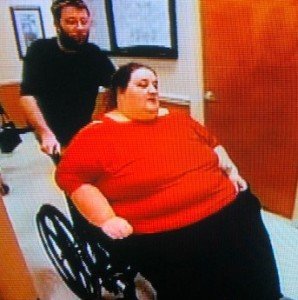
I guess Angie J. never watched “My 600 Pound Life” more than once by the time she decided to get on.
How can Angie J. blame a scale for being wrong when it showed a weight gain?
How dare she accuse Dr. Now of “punishing” her with another weight loss goal?
How dare she call her husband (the only man in her life who apparently hasn’t mistreated her) “pathetic” and a “loser” just because he won’t go to the store in an unfamiliar town and buy her food?
Deranged Childhood Begets Super Morbid Obesity
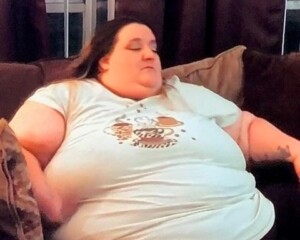
We all know that Angie Johns had a horrible childhood.
Even though (reportedly) her parents didn’t physically abuse her, she stated that when she told her mother that a family friend had molested her, drug-addict Mama didn’t even defend her. That would cause much more damage than a belt whipping.
But there comes a point in time when a person, who grew up without love, praise, structure and healthy food, must take accountability.
At only 13, Angie slept (with consent) with a 27-year-old and got pregnant (eventually giving the baby away).
Many will say that a 13-year-old should not be blamed for such decisions, being that up to that point, she’d been living in a highly dysfunctional home.
And furthermore, the perv who slept with her got away with it. Angie talked about this “first, real relationship” as though it was perfectly normal for a 27-year-old to have sex with a 13-year-old.
Again, there comes a point when an individual, despite growing up in a painful, train wreck household, must take some responsibility so that her future children don’t suffer – like Desiree (Angie’s daughter) – who’s had two out-of-wedlock kids by age 21.
Angie J. at one point says that she won’t allow her husband, Justin, to be a caregiver because otherwise he’d “cross over” from being a husband.
But go ahead, heap the caregiving duties on Desiree (whose face tells a lifetime of pain) so that she crosses over from daughter to caregiver.
Angie had the money all along to move to Houston.
She whined to Dr. Now over the phone she didn’t have money to move to Houston (which she eventually somehow obtained).
My first thought was, “Stop buying cigarettes and so much food, and you’ll have plenty of money in no time!”
Enablers Fear the Wrath of Angie
Desiree and Justin are enablers, bringing the nearly-bedbound Angie large quantities of junk food.
Being that three-year-old Daisy is living in such an environment, it’ll be easy to understand if one day she’s on the 30th season of “My 600 Pound Life,” referring to the weight loss program as “bullshit,” just like her grandmother did.
Remember Jeanne? She was just nasty. Who didn’t think there could be a worse patient?
Well, Angie J. takes the cake for that. She’s even worse than Steven Assanti. In some ways, anyways.
Each time Angie was given another chance by Dr. Now, she admitted to slipping up on the diet.
But then, during her last chance, she said she had to starve herself and eat only salads (though two slices of bread were sitting nearby) because the diet had not worked.
Angie kept making one excuse after another, ultimately blaming Dr. Now for her failure.
What’s really provoking is that many body positivity influencers insist that you cannot tell a person’s health by their size.
Not only can a person’s size be highly indicative of their health, but so can their voice!
Dr. Now detected drug use simply by Angie’s voice over the phone – and toxicology tests later on confirmed this.
Angie is not only a compulsive overeater, but she’s a heavy smoker (according to the toxicology test) and is on the narcotics bandwagon, also admitting to smoking pot.
She was offered a rehab program by Dr. Now, but rejected even that.
Dr. Now stated that Angie J. will die soon if she continues on her current path.
And because tormented generations tend to repeat themselves, daughter Desiree will continue subjecting her kids Daisy and Karson to a deranged home life.
And if we see Desiree on the 15th season of “My 600 Pound Life,” we won’t have to wonder how she got that way.
Update on Angie J
In the April 14, 2021 airing of “My 600 Pound Life,” Angie’s husband Justin left her — after they had an argument over his relapsed drug problem.
She appears to be of less weight than when she started the program, but has not made any true strides at weight loss.
Because Angie J is now alone in an apartment and has mobility impairment (essentially bound to a wheelchair), she is not able to care for herself, but still wants to be on Dr. Now’s program.
Her neighbor David invited her to stay with him and eventually the two became an item. But oddly, he then booted her out of his home — yet continued maintaining his status as her boyfriend.
The only thing that makes sense is that she was being too demanding and possibly verbally abusive towards him, and he could no longer take it. Nevertheless, David was keeping Angie company in a park while she stayed there with no place to live.
The big question is, why doesn’t Angie check into a homeless shelter? Homeless shelters do not turn people down just because they weigh 500 pounds.
Another big question is why doesn’t her best friend Mandi take her in?
Amazingly, finally, Angie agreed to rehab as recommended by Dr. Now (whom she verbally assaulted while lying in a hospital bed not long before that), for her substance-abuse.
Surprise! Angie was detoxed and was approved for weight loss surgery.
At some point soon after the surgery, David dumped Angie. However, just in the nick of time, a former neighbor of Angie’s, James, invited her to stay at his place for about a month.
For a few months following the surgery she reported feeling ill and unable to hold much food down. She lost 33 pounds during that time, but continued feeling sick, and underwent some tests.
The tests were all negative, and eventually, and she moved to Ohio to stay with her brother, where she reported that she was now beginning to feel normal.
Her final recorded weight was 310. In fact, at the very end of the show, Angie was noticeably smaller than her daughter Desiree — who appeared to be bigger than ever.
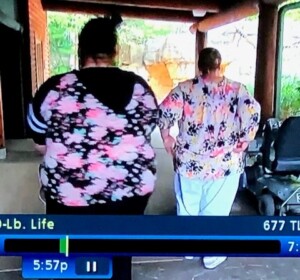
Angie is on the right. That’s her daughter Desiree on the left.
Maybe with the massive loss of weight, Angie will also experience a massive loss of her arrogant attitude.