Autistic and terrified of aging? There’s ways to combat the fear of aging even if money is limited; here’s what to start doing NOW.
Autism doesn’t mean you must age painfully instead of gracefully.
I’m autistic and 63. Functionally, I’m half that age, even though 63 seems “old” to even people in their 40s.
You CAN age gracefully and still be in tip-top form come your 60th birthday, even if you have major sensory issues or are short on money.
I was inspired to cover this topic when I came upon a Facebook post by an older autistic woman who said there should be a formal program in place for aging people with autism.
“Rose” replied: said she was 60 and “terrified of getting older.”
It stands to reason that a 60-year-old who’s fit and strong from workouts wouldn’t think this way.
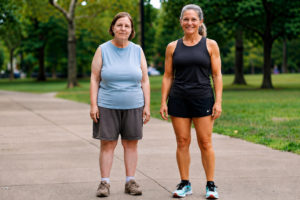
I know Rose. I first met her four years ago at an autism support/social group. She was 56 or 57.
I’ve had a lifelong deep interest in exercise and fitness, and it was only natural for me to compare myself to a fellow autistic woman who was close to my age (59 at the time).
I couldn’t help notice her poor physical condition, which included a walk that looked very uncomfortable.
My default assumption is to always assume that someone who appears to be in poor shape is that way due to a lifelong absence of a workout regimen.
Few people can’t work out. I’ve known people with notable physical disabilities (since birth or from later injury or illness) who worked out like bosses – and looked like it.
So when I see someone who “looks like they’ve never worked out” but is otherwise able-bodied, it’s a safe bet that what I’m seeing is the result of an absence of regular and robust exercise.
- Most people (neurodivergent and neurotypical) do not regularly strength train.
- Strength training is the Fountain of Youth.
At the meeting, Nancy was in her late 50s and so was Michael. All three moved like “old people” and appeared as though they’d never seen the inside of a gym nor even did home yoga exercise, for that matter.
Every time I saw Rose after that, her ambulation was worse. Then one day she had a cane and said it was for arthritic knee pain. She has visibly aged in only four years.
- It does not have to be this way.
- Remember, the absence of exercise is very detrimental to the body and becomes exponentially relevant once you hit middle age.
Anyone will benefit from exercise, but the younger you start, the better the long-term results will be.
You don’t want to wait till you reach a point of no return, such as shot knees, degeneration of the low back vertebrae, osteoporosis (brittle bones that can make you hunch forward and lose height) and other maladies.
No Money? Clumsy? Fat? Skinny? No Problem
Though you don’t need a gym membership to get a strong, resilient body, it’s the best place to achieve this…
But — I’ll first cover extremely effective exercises you can do at home.
- Even clumsy people can strength train, including bodyweight workouts.
- Workouts need not be fancy or complex; don’t let the stunts of fitness influencers fool you.
- Body size is NEVER a reason to avoid exercise.
Stool for a Strong Body
Below is a short video that shows 56 ways you can use a stool that’s designed for exercise. These sturdy stools are sold on Amazon and start at a 12 inch height. The video shows 18 inches, but either height works.
Before viewing this excellent video, keep the following in mind:
- The exercises are in no particular order. You’ll see very easy ones mixed with very difficult ones and everything in between — all randomly. Do NOT get discouraged if you see a move that makes you think, “What?! I can’t do that!”
- Out of 56 moves, you’ll surely see some that will have great appeal.
- You don’t have to do all 56!
- If any that appeal to you look too difficult, you can always modify them to be easier, and then build up your ability from that point over time.
Aerobic Exercise
You can buy an effective pair of cardio workout footwear from Walmart. Never do aerobics in sandals or flip flops.
Your neighborhood is your gym. Get out there and start trotting, or alternating trotting with walking, or walking briskly.
If your autism makes brisk walking or jogging outdoors uncomfortable (e.g., sunlight, wind, encountering other people), you can buy used cardio equipment for fairly cheap.
I’ve seen dirt cheap cardio machines at Goodwill.
- Never, ever think you get adequate cardio exercise from housework.
- Never, ever think you get enough aerobic exercise from walking on the job.
- Cardiovascular exercise needs dedicated time slots.
- Don’t develop a thought pattern that will take you down Rose’s road.
Dumbbell Workouts
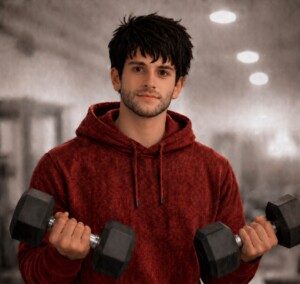
A gym has dumbbells starting at 2 pounds. For those on tight budgets, see if thrift shops sell dumbbells. I’ve seen dumbbells at several thrift shops.
Otherwise, you can buy used dumbbells via Facebook Marketplace, or new ones off Amazon.
Dumbbell workouts will make you fitter and stronger so that you age gracefully, not in a terrified way with a weak body and a slumped-over walk by the time you’re 58.
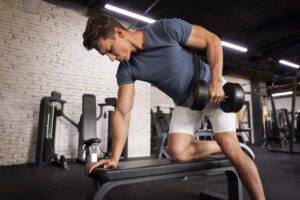
The bent-over dumbbell row: works not just the arms, but the back. Imagine the boosted confidence an autistic man would have if he had a body like this. This body doesn’t just look great, but it functions great. Freepik
The Deadlift: King of Exercises
We also can’t assume that the only reason any given Autistic doesn’t go to a gym is due to sensory issues or lack of money. That would be stereotypical thinking.
Many don’t go for the same reason so many neurotypicals don’t go: Fitness isn’t a priority (but it should be!).
If you want to join a gym but find the lighting or noise unbearable, you can try sunglasses and earplugs, or:
- If possible attend the gym during quieter periods.
- If possible set your workout station up in a quiet corner. This is a common practice, in which someone (autistic or not) grabs some favored equipment such as a few pairs of dumbbells, a kettlebell and a stepping platform, and works out in a corner.
As for money, see if local gyms offer sliding membership fees. You may also find a cheap one that fits your budget.
The deadlift is done at a gym — unless you’re up to investing money, and have the home space, for an Olympic-size bar and various weight plates.
The deadlift works the entire body, and when done with good form, is among the best things you can ever do for your back. And mind.
If you can deadlift impressive amounts of weight at 60, you’re less likely to be “terrified” of getting older.
Below is what the deadlift looks like.
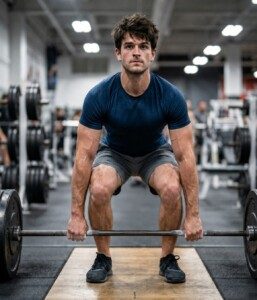
Start position of the deadlift — which is a fantastic exercise for women as well.
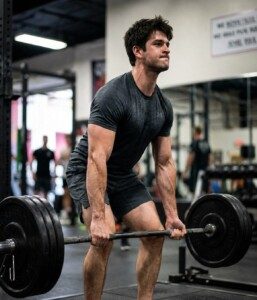
Pull the weight off the floor, keeping your arms straight and your lower back with an arch. Straighten your body to a fully erect position. Never round your back. Begin with just the bar itself. An Olympic bar weighs 45 pounds. Get used to the movement and make sure your form is spot-on before you add plates.
There are so many other ways to work out, but I just want to drive home the importance of working out, period.
You might be thinking, “What’s the point? We’re all going to grow old no matter how efficiently we exercise.”
That is true. But if you make cardio and strength training a lifelong habit, you’ll more likely live pretty much to the end in a decently functioning state, even physically independent, then maybe pass peacefully in your sleep without years of frail living preceding it.
Whereas, if you’re like Rose, Nancy or Mike — you’re at much higher risk of being sick and in pain for many years before you die.
This could involve multiple surgeries, having to use a walker, eventually needing a scooter or a wheelchair that someone pushes for you, and having a poor quality of life.
Furthermore, there’s the functionality component. At 63, I just love being able to effortlessly move quickly, dash up a staircase like a teenager, get up from deep seats or out of cars without a single hitch, and never have to ask a man to lift or carry something for me.
The decision is yours: What will you be taking two at a time of when you’re 60? Stairs or pain pills?
What type of stick will you be buying at 70? A golf club or a cane?