
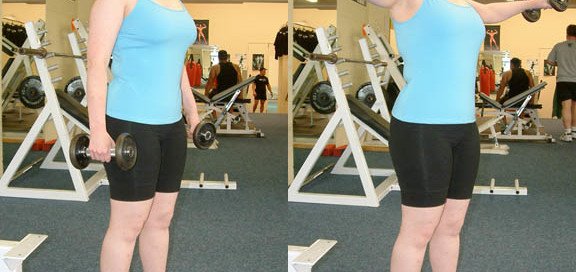
Lateral Raises (Dumbbell Side Lifts) Injury Prevention
Here’s how to make lateral raises, a.k.a., dumbbell side lifts, safe to avoid injury.
Lateral raises can be done safely without threat of injury, by following my guidelines. There are different ways to do lateral raises.
The most common way is with a dumbbell in each hand, with the palms facing downwards, or partially downwards and partially towards your front.
Subtle differences in body position can increase, or decrease, risk of injury from doing lateral raises, which target the deltoid (shoulder) muscles.
If you have a good pair of shoulders (solid tendons), it’s not likely that lateral raises will cause injury.
The lateral raise is a relatively safe routine, but this doesn’t mean it can’t create problems in someone who has a pre-existing problem with their shoulders.
If you have pre-existing rotator cuff issues, then yes, lateral raises can be a problem.
To minimize rotator cuff pain, and to minimize getting any first-time rotator cuff problems, keep your hands in either neutral position (palms completely facing towards your front while holding the dumbbells), or in a supine position (facing ceiling while holding dumbbells).
If you choose the supine position, make sure not to bend your elbows too much; this might happen instinctively.
But doing this will take recruitment away from the shoulders and transfer some of it to the biceps.
Another way to minimize injury is to do lateral raises not completely laterally, but rather, slightly angled towards the front.
Imagine the lateral line as the 90 degree mark, and imagine that directly in front of you is the zero degree mark.
Raise your arms so that they are smack in between these two imaginary markings — at 45 degrees. This is not quite a lateral raise, but not quite a frontal raise, but rather, a fusion of the two.
But to get more of the lateral aspect of the raise, you can lift your arms out at between the 45 degree and 90 degree mark…say, at about 70 degrees.
This modification of the angling will take some stress off the rotator cuff tendons.
Another way to make lateral raises safer is to use a lateral raise machine, rather than dumbbells. However, I don’t mean use this apparatus the way it’s “meant” to be used.
The way it’s designed is for the user to lift with the upper part of the arms, while their lower arms are bent, forming a 90 degree angle at the elbow joint, the lower arms parallel with floor at the top of the lateral raise movement, palms facing floor at this point also.
(Depending on the machine, your hands may be gripping handles.) This indeed is a lateral raise, but this kind of arm position can be hard on someone with rotator cuff problems.
Do this instead: Lift the pads with biceps against the pads. This means that at the start, your palms will be facing the ceiling. If the machine has handles, don’t use them.
Nobody says you must grip these handles. Minimize the bend at the elbow joint. Now lift.
You will immediately feel less strain on the shoulders, yet at the same time, you will feel your shoulder muscles getting worked.
Keep lifting till your upper arms are parallel or a little past parallel with the floor.
You just did a modified lateral raise that is much easier on the rotator cuff tendons.
Another variation of the lateral raise is to use a dual pulley system.
The negative segment is much easier on shoulder tendons, though the positive phase can be quite challenging.
When doing standing lateral raises, always keep feet flat on the floor, legs slightly bent and shoulder width or so apart. Keep shoulders as relaxed as possible; don’t tense them.
 Lorra Garrick is a former personal trainer certified by the American Council on Exercise. At Bally Total Fitness she trained clients of all ages for fat loss, muscle building, fitness and improved health.
.
Top image: GeorgeStepanek

Is the Deadlift Dangerous for Obese People?

Getting into position for the deadlift.
Obese people should perform the deadlift (above) to burn fat.
The deadlift is one of the best fat-burning exercises a person can do, yet extremely few obese people do this exercise.
If you were to round up all the clinically obese people who perform deadlifts, the vast majority of them would be football linemen, wrestlers (fake or real) and competitive powerlifters.
Hardly any of the obese men, and especially women, who do deadlifts are your average very overweight people who are not involved in competitive sports in which size can be an asset.
If only obese men and women knew how much fat-burning power the deadlift has.
It has a potent fat-burning effect because #1, it works practically the entire body all rolled up into one movement, and #2, the nature of the movement allows you to lift a considerable amount of weight.
Because so many muscles work at once in the deadlift, a hormonal response is generated that triggers fat-burning for hours.
But the weight moved must be heavy enough to induce this effect. Heaviness is relative; it must be heavy to that particular person.


Many obese people believe that lifting heavy weights will make them bigger.
Lifting weight, of any amount, will NOT make your fat cells bigger! Intense weight lifting works marvelously to reverse obesity. Handling light and easy weights will not shear off body fat.
When a beginner starts out with the deadlift, one should practice with a light barbell to master the form.
For many obese exercisers, this movement is no more dangerous than for skinny people.
What makes the deadlift potentially unsafe is bad form, which can be committed by someone of any size. So form must first be mastered before moving on to challenging loads.
Once form is mastered, you should gradually increase the amount of weight that you can lift for 8-12 repetitions. Increases will come slowly. Do not hurry.
By being consistent, you can increase the amount lifted quite a bit, over time.
And why try to keep increasing the amount? Because this progressive resistance will build lean, sleek muscle, which will eat away at excess stored body fat — even for the morbidly obese.
Muscle tissue is demanding and hungry, and will feast on stored fat in your stomach, thighs, hips, wherever it’s stored in excess.
Those 8-12 reps should be done with a load that’s difficult but not to the point where you must strain.
You should be breathing heavily at the end of a set.
Perhaps you’ve seen huge people deadlifting tons of weight. I won’t lie: In order to deadlift enormous loads, big muscles are usually required.
However, the average obese person who wants to lose significant amounts of body fat doesn’t have to worry about one day deadlifting 500 pounds!
That’s because enormous strength, and the massive muscles that come with it, don’t happen by accident.
The average woman who’s never strength trained before can deadlift only about 75 pounds for 8-12 reps.
An obese person should do deadlifts twice a week, 4-5 sets excluding a few light warm-ups.
Trust me on this: Deadlifting will do far more for slashing fat in an obese individual’s midsection and legs than will the inner and outer thigh machines and the crunch machines.
Lorra Garrick is a former personal trainer certified through the American Council on Exercise. At Bally Total Fitness she trained women and men of all ages for fat loss, muscle building, fitness and improved health.

Rid Belly Fat Fast, Cut Heart Disease & Cancer Risk

The faster you get rid of belly fat, the faster you will cut your risk of heart disease and cancer.
Excess abdominal or belly fat means a higher risk of cancer and heart disease.
A report in the Journal of the American College of Cardiology (July 2013) explains that where you carry extra fat makes a big difference, and excess fat in the stomach poses a greater threat of cancer and heart disease than if it’s concentrated in the thighs.
The JACC study used CAT scans to measure abdominal fat. The body mass index (BMI) does not differentiate location of excess fat.
This study sought a link between location and risk factors for cancer and heart disease.
Even after adjusting for other risk factors, the researchers found that excess belly fat was linked to higher incidence of cancer and heart disease.
The paper states that the presence of excess belly fat improved the predictability of cardiovascular disease.
Why Excess Belly Fat Is Linked to Heart Disease

Depositphotos.com
“Belly fat/waist size is part of the criteria for metabolic syndrome which has clear association with both diabetes and cardiovascular risk,” says Yaser Elnahar, MD, a cardiologist with Hunterdon Cardiovascular Associates in NJ.
“Associations in medicine is very common. Proving direct causality is obviously not as easy.
“Hence, not every obese person has heart disease, and likewise, not every skinny person has a normal heart. It doesn’t work that way.”
Another way to look at this is that the obese person who has a normal heart is still at much increased risk for acquiring heart disease in the future, especially if there’s a lot of fat in the midsection.
Dr. Elnahar explains, “Belly obesity is associated with metabolic syndrome/DM [diabetes mellitus], which means you have a higher chance of developing diabetes.
“DM is considered a coronary artery disease risk equivalent. Meaning, if you have DM, you have a similar risk of developing heart disease when compared to someone who has already known heart disease.”
Best Way to Lose Belly Fat
When I was a personal trainer at a gym, one of the most common questions I was asked was: “What’s the best way to lose belly fat?”
The first way is high intensity interval training instead of steady state aerobics.
The second way is to strength train — intensely — and to do mostly exercises that target the legs, back and chest, such as the squat, deadlift and bench press, respectively.

Incline bench press. Freepik.com
By targeting the body’s biggest muscles, you will create the biggest energy deficit (for post-workout recovery).
When the body is in an energy deficit, it pulls from fat reserves — as long as you don’t overeat and as long as you DO stick to a plant-based diet and control your portions, which is the third way to lose belly fat.
 Dr. Elnahar has publications in the Journal of Atrial Fibrillation, the Journal of Clinical Medicine and Research, Reports in Medical Imaging, and more.
Lorra Garrick is a former personal trainer certified by the American Council on Exercise. At Bally Total Fitness she trained clients of all ages for fat loss, muscle building, fitness and improved health.
.
Top image: Freepik.com, yanalya
Source: sciencedaily.com/releases/2013/07/130710182944.htm

Can You Build Muscle Clapping Between Pull-ups?

How can something as difficult as clapping pull-ups NOT build muscle?
After all, the clapping increases the recruitment of fast-twitch muscle fiber, which has the potential to grow in size.
It makes sense that if jumping (feet) exercises (not jumping jacks but drills involving high stools, boxes, hurdles, etc.) are encouraged for muscle-building athletes as an adjunct to their weight lifting, then why not also do jumping from the upper portion of the body for a similar recruitment of fast-twitch muscle fiber?
In order to clap, imagine how strong the back must be to pull this off. Forces are amplified as the hands return to the pull-up bar.
The top position, then, of the pull-up is intensified and requires more strength when it follows a clap, when compared to just simply rising up there and then lowering.
You can have all the agility in the world, but in the end, strength and muscle power are needed to perform the clapping. When you build strength and power, you build size.
Another way of looking at the whole entire pull-up concept is that, as mentioned, this action is not what our body is designed to do, so imagine the shock to your muscle fibers when they are forced to do something so unnatural.
They have no choice but to get hard, thick and big. Ever notice that anyone who can knock off every pull-up variation in the book has spectacular back musculature?
The wider the grip, the more latissimus recruitment. The narrower the grip, the more arm recruitment. Regardless of grip, the lats (and other back muscles), arms and shoulders play a big role.
And by the way, if you’ve been wondering why your biceps haven’t been growing despite vast amounts of time spent doing concentration curls, preacher curls, cable curls, spider curls, etc., start doing some pull-ups (include a lot of chin-ups and neutral hand placements to recruit more of the biceps).
And then over time, as you get stronger with the pull-ups, see what happens to your biceps.
In fact, ever notice the bulging biceps of Olympic male gymnasts, who do tons of pulling-from-hanging positions?
You need not train like a gymnast to grow impressive biceps, but the point is clear:
Pulling from hanging positions will not only stimulate back growth, but biceps growth, especially when you add some clapping.
 Lorra Garrick has been covering medical, fitness and cybersecurity topics for many years, having written thousands of articles for print magazines and websites, including as a ghostwriter. She’s also a former ACE-certified personal trainer.
.
Top image: Freepik.com/ Racool_studio

How to Make Your Kids Stockholm-Proof

Are there certain ways to raise a child such that they’d be highly resistant to getting Stockholm syndrome if ever taken hostage as a teen or adult?
I asked the following questions to Dr. Nancy Zarse, associate professor in the Forensic Department, The Chicago School of Professional Psychology, whether or not parents can train their children to be resistant to Stockholm syndrome.
Is there a correlation between how close a parent is to a child, and whether or not that child would ever develop Stockholm syndrome? Assume the child, at time of abduction, is at least 10 years old.
Dr. Zarse: Stockholm syndrome has more to do with conditions of the hostage situation than with the relationship with the parent.
Stockholm syndrome reduces injuries and death, so professionals would rather deal therapeutically with the victims following their release than encourage hostages to resist forming a bond that might save their lives.
What can a parent do to make the parent-child bond as powerful as possible so that no abductor could put a dent in it?
Dr. Zarse: It is both the bond with the hostage taker and fear of greater injury or death that prevents an escape.
The bond between hostages and their family may well sustain them in the darkness of their captivity, giving them strength and hope to endure.
Further, the love of family may be exploited by the hostage taker who threatens to harm or kill loved ones as a means to control hostages.
Are kids who are “brainwashed” by their own parents to subscribe to the following principles, at much higher risk for Stockholm syndrome? Children should be seen and not heard; Always be respectful to adults; Never talk back to an adult; You have no rights until you’re an adult.
Dr. Zarse: Children who are taught to be respectful of adults are not more likely to develop Stockholm syndrome.
The formation of Stockholm syndrome is more about the conditions of the hostage situation than with the personality of the hostages.
Are kids who are encouraged by their parents to express their feelings, show disapproval, carry on a debate, stand up for themselves, be assertive, take on challenges, and not be afraid to disagree with adults, at much lower risk for Stockholm syndrome?
Dr. Zarse: The personality of the hostage will influence the relationship that is formed with the hostage taker, and thus the possibility of Stockholm syndrome.
However, Stockholm syndrome decreases injury and death, so it has a positive outcome.
In a hostage situation, the danger and emotional volatility are extreme, so survival is more important than expressing anger at the hostage taker.
A hostage who is unpleasant, obnoxious or threatening to the hostage taker may well be killed.
Survival is key — we can deal professionally after the release of the hostages with the emotional scars.
But isn’t a gamble involved, then, on the part of the parent? On one hand, teaching kids resistance to Stockholm syndrome can ultimately lead to an escape when the captor is absent.
On the other hand, teaching kids that Stockholm syndrome may save their lives may produce an outcome where the parent never sees their child again because the child spends years as a sex slave, and come adulthood, is too psychologically damaged to make contact with the long-lost family (it’s interesting to speculate if Jaycee Lee Dugard would have ever contacted her family, had Phillip Garrido never confessed his crime.).
Dr. Zarse: A hostage situation is a frightening and confusing possibility for a parent. Although you want to encourage your child to escape, that same action might endanger the child’s life.
Teach your child not to actively cooperate, but also not to agitate or anger the hostage taker.
Teach your child to hold onto the image of your loving face, to do what is necessary to survive and that you will never cease in your efforts to find and save your child.
Reassure your child that you will work together, upon release, to get the professional help needed to address any damage suffered at the hands of the offender.
What about teaching kids (if old enough) to PRETEND to bond with the abductor?
And a hostage (older child) with his or her wits would never behave obnoxiously towards the abductor, but instead would con them (this is often depicted in movies and TV).
Are there real-life examples where the victim pretended to bond with the captor; tricked the captor into lowering his guard; and successfully escaped?
Dr. Zarse: Most people do not actively encourage development of Stockholm syndrome. Any hostage is highly encouraged to act in such a way as to diffuse the intense emotions of the hostage taker and minimize anger.
There are instances in which captives escaped after long periods of being held hostage, so do not give up hope.
Are “bratty,” outspoken or bully-like kids more resistant to Stockholm syndrome?
Dr. Zarse: Stockholm syndrome does not develop because the hostage likes the hostage taker; it forms out of complete dependence, lack of control and terror.
You cannot compare a hostage situation to any other kind of interpersonal situation, because of the traumatic nature of the hostage situation.
It’s explained that Stockholm syndrome occurs when the abductor isolates the victim and makes them dependent for bare essentials.
But why does the victim feel dependent upon the abductor, if there is opportunity to escape?
“Escape” opportunities could range from climbing the fence in the middle of the night; dashing away from the abductor while in public; yelling out to a nearby neighbor; actually visiting the neighbor; and alerting people via e-mail and phone, to which some abduction victims have access.
Dr. Zarse: Stockholm syndrome does not form merely because of basic necessities like food and water; it is also borne out of feeling unable to control the situation and dread.
The hostage taker uses threats against the hostages and their families to control even when not present.
What specifically can parents do to inoculate their kids from acquiring Stockholm syndrome? Of course, the older the child, the more effective any method would be.
Dr. Zarse: Stockholm syndrome reduces injury and death, so is not necessary to protect against.
In fact, in training to groups at higher risk for being taken hostage, strategies are taught to increase the possibility of forming an attachment to the hostage taker to minimize the risk of harm to the hostages.
Are there cases where a juvenile hostage was murdered as the result of an escape attempt?
Dr. Zarse: I do not know of any such instances, but we know of young people being murdered by their abductors, so it is a reasonable assumption.
How successful can parents be at convincing older kids that if they’re ever taken hostage, that the captor is bluffing when he says, “I’ll kill your parents if you ever escape”?
How many captors have ever followed through on their threats? I’m specifically referring to men who kidnap kids/teens, versus a man who beats his wife, then kills her parents when she leaves him.
Dr. Zarse: There is an assumption in this question that the hostage taker is bluffing when threats to harm the hostage’s family are made; this is a dangerous assumption. It is risky to teach potential hostages that threats may be unfounded.
If the hostage feels the potential of injury or death in the threat to be real, chances are good that the hostage will act accordingly to protect loved ones.
If physical and/or sexual assaults accompany such threats, the possibility of harm to others is made much more real by virtue of the actual and immediate injury to self.
How much of an anti-Stockholm syndrome effect would it have, for parents to begin teaching their children about this at an early age?
After all, parents are encouraged to talk to their grade school kids about drugs, sex, “good touches” and “bad touches,” etc.
Seems to me that the more well-versed a child is in the mechanics of Stockholm syndrome, the less likely he or she will develop it.
Dr. Zarse: Parents certainly need to teach their children to resist harm, but there are extreme circumstances in which being aggressive might increase possibility of injury or death, so one must be very cautious.
An escape attempt increases the emotion of the hostage taker, thereby heightening danger for the hostage.
Stockholm syndrome reduces injury and death, so it would not be wise to teach methods to prevent its formation.
Isn’t it true that if enough “anti-Stockholm syndrome” is drilled into a child from an early age by a parent, that the parent can effectively “brainwash” that child so that the learned material cannot be overridden by a captor (depending on child’s age)?
Dr. Zarse: Parents need to teach their children to protect themselves from harm, but a hostage situation is unique and dangerous so caution is recommended. Remember, Stockholm syndrome is not about a weak personality type; it is about extraordinary conditions of complete debility, dependence and dread, and surviving.
 Dr. Zarse served as Chief Psychologist at two federal prisons, and as the Director of Inmate Administration at the United States Disciplinary Barracks at Fort Leavenworth.
Lorra Garrick has been covering medical, fitness and cybersecurity topics for many years, having written thousands of articles for print magazines and websites, including as a ghostwriter. She’s also a former ACE-certified personal trainer.
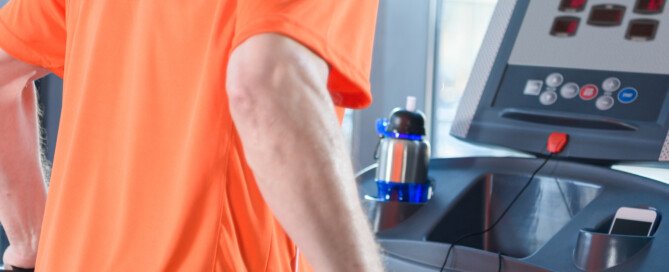
Should You Hold onto a Treadmill if You’re Over 55?

If you’re over 55 and walk on a treadmill, do you normally hold on?
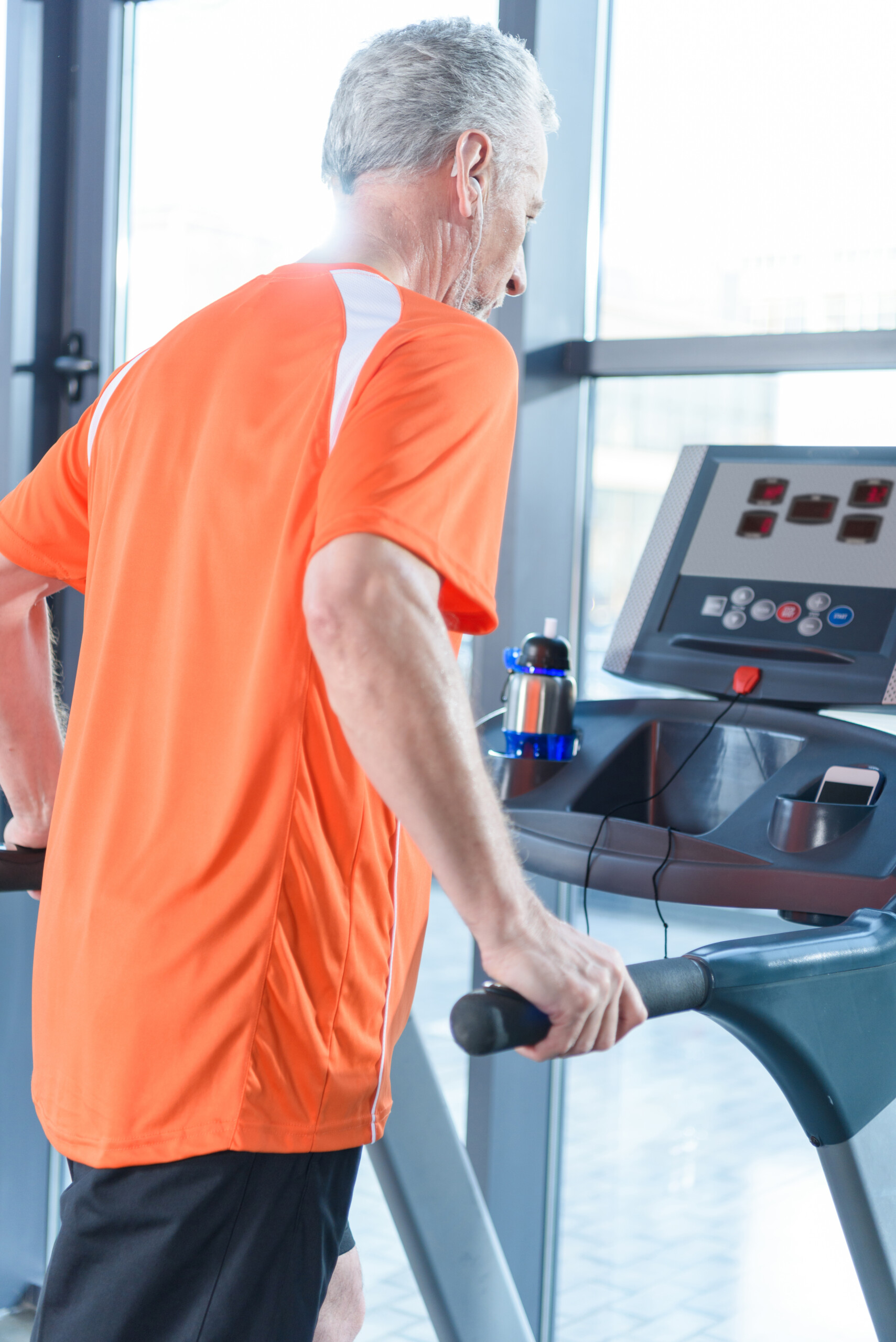
The man pictured here, walking on a treadmill, appears to be between 55 and 65, and he’s doing it wrong.
There is the smart way to use a treadmill for those 55+: Do not hold onto the rails or the front.
The man in the photo appears to be posing for the photographer. For all we know, the tread motor isn’t even running.
Or maybe he told the model, “Just turn on the machine and start walking and I’ll take some shots.”
Either way, one thing is for sure: The way this man is positioned is highly representative of what the vast majority of people age 55-plus do when they walk on a treadmill.
So whether he’s posing still or walking for real, he’s demonstrating what I’ve seen for years as a personal trainer at gyms all over:
People holding onto the treadmill while walking. This is wrong. Even if you’re past 55.
Look at his posture. Does it look correct to you? Does his gait look smart? His back, his “core” and lumbar area, are clearly being supported by his arms as his hands hold onto the rails.
This has absolutely NO transference to real-life walking, where there’s nothing to hold onto for support.
For example, suppose this man plays golf.
There’s a lot of walking on a golf course, including inclined terrain.
How will holding onto a treadmill, leaning on the hands, slightly stooped over, carry over to all the walking that one does on a golf course?
Good posture is vital, and as people get older, it becomes increasingly crucial.
Holding onto a treadmill may at first seem like the smart thing for the person age 55-plus to do, but give this some thought and you’ll realize how detrimental this fake walking really is—even for people who’ve been sedentary all their lives.
One of the problems that can result involve the feet.
“Holding onto the side or front rails on the treadmill will actually alter the gait pattern, possibly changing the biomechanics of the foot, joints and motion, thereby increasing the likelihood of injury or problems that occur with repetitive stress,” explains Alan L. Bass, DPM, Medical Director, NEMO Capital Partners, LLC.
“Acute injuries such as ankle injuries, or even chronic ones such as the development of bunion problems from repetitive stress on the forefoot when altering the biomechanics.”
Again, take a good hard look at this man’s posture. Yes, he may be a professional model just posing, but his body position is precisely what goes on at every single health club and gym.
This is such an unnatural way to walk and will do you no good. Take your hands off the treadmill. Otherwise, holding on mimics using a walker.
 Dr. Bass is with Central Jersey Foot & Ankle Care, and is a Fellow of the American College of Foot and Ankle Orthopedics and Medicine.
basspodiatry.com/our-foot-doctor
Lorra Garrick is a former personal trainer certified through the American Council on Exercise. At Bally Total Fitness she trained women and men of all ages for fat loss, muscle building, fitness and improved health.

German Shepherd Skin Allergy Causes Dry Skin: Solutions

Here are solutions to a German Shepherd’s allergy-caused dry skin.
I have found that my German Shepherd’s skin and coat condition are indicative of overall health.
When he is in good health his coat shines, and when he is suffering from a food allergy, the skin reacts with patches of what I can only describe as dandruff, in dog form.
If left untreated, he will attempt to scratch and bite at the area, causing distress.
Medicine Cabinet Solution to Dry Itchy Skin
I transitioned my German Shepherd’s kibble to a different type of dry dog food and within a month he was suffering from dry, itchy skin.
In the long term I wanted to transition back to original dry dog food, but in the short term I needed to address the discomfort he was feeling.
I found that baby oil was effective in addressing the topical itching.
Moving his hair aside and getting the oil directly on his skin seemed to offer immediate relief.
I massaged the dry, itchy area with baby oil, and the German Shepherd’s relief was palpable.
The residual baby oil seemed to treat the affected area for a few days without needing to be reapplied.
Topical Solutions
Another excellent option was to use Vaseline externally to address the dry patches.
The advantage of applying Vaseline to the irritated skin was that it was less messy, and it was easier to localize the treatment without it spreading over a large area.
My German Shepherd’s skin and coat health seems to communicate if he is suffering from any allergies or is reacting to changes in environment.
The baby oil and Vaseline offer immediate relief from him attacking his own flesh in fits of scratching.
These are non toxic solutions that offer immediate relief.
Both are excellent solutions to a temporary problem.
Lorra Garrick has been covering medical, fitness and cybersecurity topics for many years, having written thousands of articles for print magazines and websites, including as a ghostwriter. She’s also a former ACE-certified personal trainer.
.
Top image: Freepik/senivpetro

German Shepherd Refusing to Eat: Recipe Solutions

Home recipe solutions for older German Shepherds that need a boost in appetite.
As my German Shepherd ages he becomes less interested in food and at times requires some inspired recipes to make food seem more appealing.
The challenge is to come up with recipe ideas that are both nutritious and appetizing.
Recipe Solutions, Starches and Stocks
When my German Shepherd became disinterested in food I had to come up with a food solution that would kick-start appetite without filling him with fatty dog treats.
My first attempt at coming up with a nutritious recipe was to add chicken stock to rice, making a watery, starch mixture.
The protein in the stock seemed to smell appealing to the dog and he ate with renewed interest.
The starch and carbohydrates in the rice filled his belly and seemed to get his stomach active again.
The ratio of liquid to rice is double what would normally be cooked, ensuring the runny consistency.
In the short term, my old German Shepherd had a great deal more energy once the starchy carbohydrates were introduced to his diet. I had equal success with pasta cooked in chicken or beef stock.
The added starch in the pasta proved to be especially beneficial when I added it to normal kibble.
I mixed the watery rice or pasta concoction into the kibble for a few meals, and suddenly he was back to eating like himself again.
This is a tried and true recipe to re-establish my German Shepherd back to a regular eating routine.
Recipe Cautions
When cooking the rice or pasta I am careful to buy low sodium stock, or I heavily dilute the stock with water to reduce the German Shepherd’s sodium intake.
Kidney failure sometimes plagues an old dog, so keeping sodium to a minimum is beneficial to overall health.
Lorra Garrick has been covering medical, fitness and cybersecurity topics for many years, having written thousands of articles for print magazines and websites, including as a ghostwriter. She’s also a former ACE-certified personal trainer.

Dog Sprayed by Skunk, Stinky: Home Remedy Solution

Here is a simple home remedy to rid the stink on your dog after it gets sprayed by a skunk.
And here is what NEVER to do should your dog get stunk up by a skunk.
Skunks seek refuge in urban centers, under decks, porches, in back sheds, and under any tiny space that provides shelter and potential food supply in the form of garbage.
When my German Shepherd was a puppy he was exploring some shrubbery when he startled a skunk and her family.
Before I could call the puppy away, he was sprayed by the adult skunk. The dog had no idea what had hit him.
The young German Shepherd beat a hasty retreat away from the skunk and towards his home.
I put a quick stop to his entrance to the house and kept him in the garage until I could ascertain a solution to the stink.
Neutralizing the Skunk Smell on Your Dog

Shutterstock/Aaron Amat
I found a website that proposed a neutralizing concoction that would eliminate the odor entirely.
I was skeptical, but I had nothing to lose. I reasoned that if I could at least remove some of the stench, I could buy myself time to get to the vet or pet store to find a long-term solution.
Household Ingredients offer the Solution
Fortunately, all of the ingredients needed in the neutralizing solution are household ingredients: hydrogen peroxide, baking soda and blue Dove dish soap.
This miracle elixir saved the day. It did not just mask the odor; it truly neutralized the smell in a way I never would have imagined.
Pet stores do sell products that assist in eliminating the strong skunk odor, and from my experience the products do not completely eliminate the smell.
This home remedy concoction offers a solution that is nontoxic and it really works.
Don’t Do THIS if Your Dog Gets Skunked

The final thing I wish to point out is what you should never do upon learning your dog was just sprayed by a skunk.
This mistake was committed by my sister when she was home from school break.
She had let my parents’ dog out, through the patio door, to do her business in the yard.
At some point I heard a little bit of commotion and my sister exclaiming that the dog had encountered a skunk.
She was a bit panicky and not thinking clearly, and very hastily let the dog come back INTO the house, through the patio door.
She hurriedly led the dog, by grabbing her collar, into the garage.
This meant that the dog went through several rooms of the house to get to the garage.
As a result, the whole house quickly took on the stench of skunk.
My sister should have kept the dog outside and led her into the garage via outside.
So if you discover your dog has just been sprayed by a skunk, keep it outside; step outside and THEN come up with your plan to deal with the unexpected situation.
Lorra Garrick has been covering medical, fitness and cybersecurity topics for many years, having written thousands of articles for print magazines and websites, including as a ghostwriter. She’s also a former ACE-certified personal trainer.

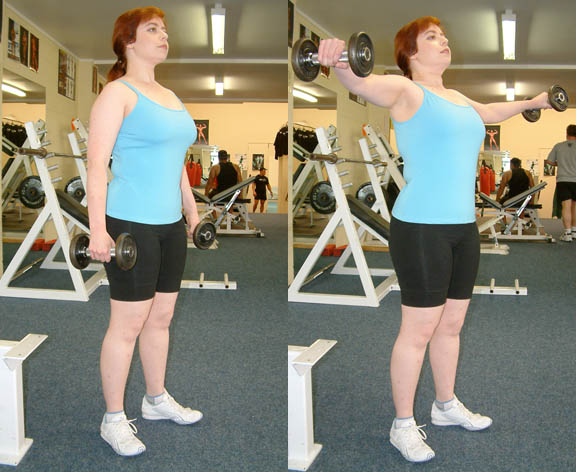







How to Prevent Ice Buildup on Your Dog’s Feet During Walks
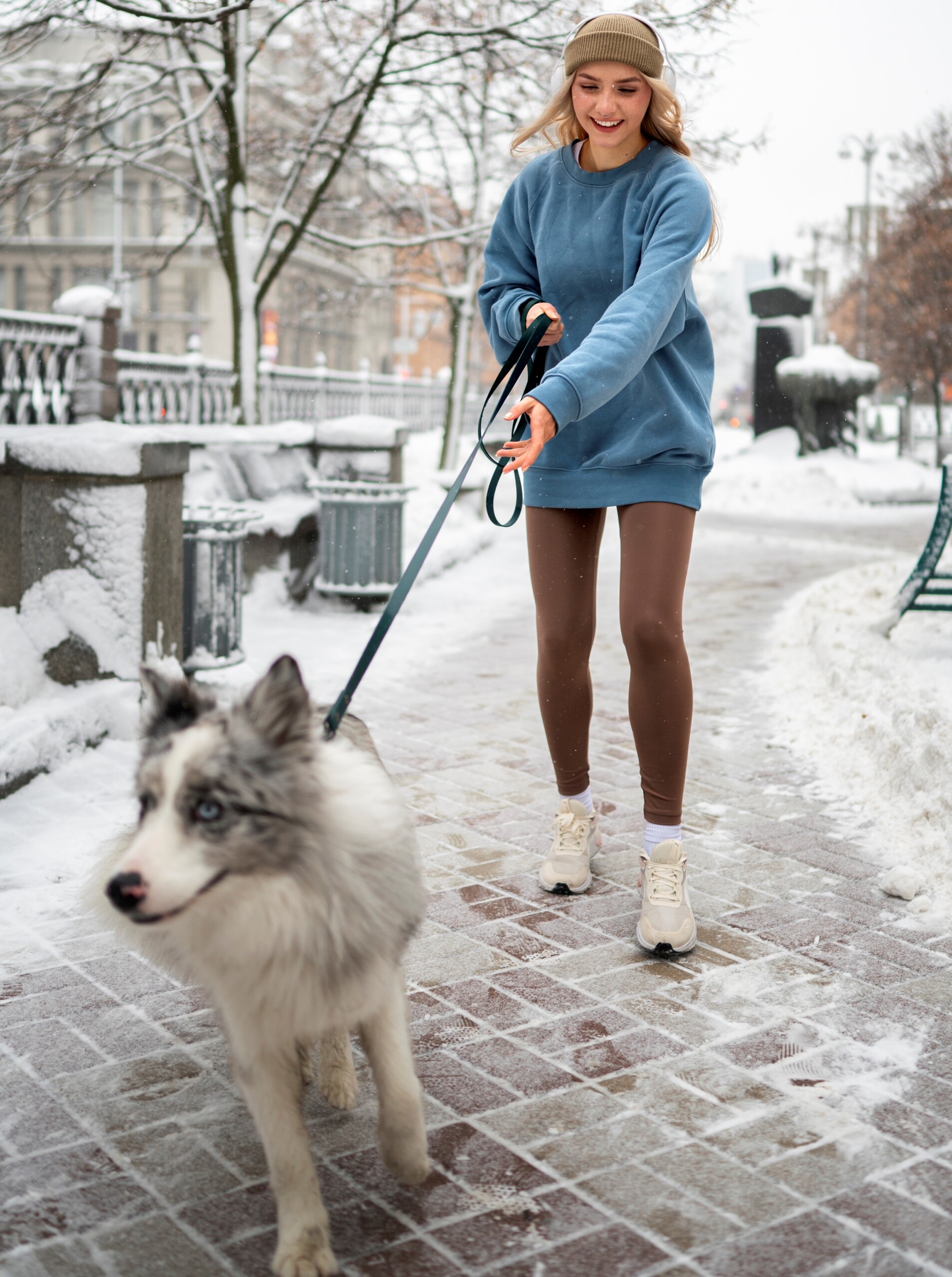
Here is a simple remedy for preventing ice buildup on your dog’s paws, whether your companion is a German Shepherd, Havanese or a size breed in between.
Dogs notoriously love the snow; they are passionate about snow in ways that humans struggle to appreciate, and the hazard of long walks through sticky snow is the potential for ice balls developing in the pads of their feet.
These ice balls can be very painful for a dog if they are not removed and can cut the pads and leave raw abrasions.
How do you keep ice from forming on your dog’s paws?
On sub-zero days, my German shepherd will suddenly stop short and will drop to the ground to chew at the pads of his feet.
What I have discovered is that he is trying to chew the ice balls that have developed between his pads.
The ice balls appear to irritate his feet and make it difficult to carry on walking without giving attention to these icy nuisances.
Vaseline, Ice Ball Solution
Rather than dealing with the constant stopping to clean the painful ice from my German shepherd’s feet, I found that putting a small dollop of Vaseline on each paw helps deter the ice from forming in the first place.
Surprisingly a small smear of Vaseline on each paw, spread through the hairs, with particular attention being paid to the pad surface, stops the ice from forming.
This quick and inexpensive solution saved my dog from having to deal with the discomfort of the abrasive ice stopping him from enjoying long walks in the snow.
A word of caution: ensure you wipe your dog’s feet prior to coming into the house.
The Vaseline will continue to leave an oily residue on floor surfaces, even after a lengthy walk.
Consider carefully wiping between the dog’s pads to ensure no greasy messes linger on floors.
Vaseline is a wonderful solution for preventing ice buildup on your dog’s feet.
Lorra Garrick has been covering medical, fitness and cybersecurity topics for many years, having written thousands of articles for print magazines and websites, including as a ghostwriter. She’s also a former ACE-certified personal trainer.
.