
Best Type of Exercise for Improving Ejection Fraction
Not all exercise is the same when it comes to improving ejection fraction in heart failure patients.
There is a certain type of exercise that research has shown to improve one’s ejection fraction remarkably well, even if it’s very low. It’s called interval training.
The first report is titled “Superior Cardiovascular Effect of Aerobic Interval Training Vs. Moderate Continuous Training in Heart Failure Patients” (journal Circulation).
“Continuous training” refers to a fixed pace, or a pace-based session, such as 20 minutes of nonstop level (non-incline) walking at 2.5 mph (give or take very minor fluctuations in speed).
This nonstop speed, though slow from the viewpoint of fit people, can be quite fatiguing to many heart failure patients.
To convert 20 minutes to an interval training session, the patient might go just one minute at 3.2 mph and then three minutes at 1.8 mph, and keep alternating this way till 20 minutes are up. This second approach is superior to the first approach.
For this Norwegian study (Wisløff et al), 27 people with an ejection fraction of 29 percent were assigned to one of three groups.
The first group was continuous training (also known as “steady state”) at 70 percent of highest heart rate.
The second group did interval training (95 percent of highest heart rate).
The third group was the control. The aerobic sessions were done for 12 weeks, 3x/week.
For only the interval training group, the interval training report states: LV ejection fraction increased 35%.
The conclusion says that intensity of exercise was an “important factor” for improving aerobic capacity and reversing left ventricular (LV) remodeling.
The second study (Meyer et al) pits HIIE against MICE.
- HIIE stands for high intensity interval exercise
- MICE stands for moderate intensity continuous exercise.
This report is heavily detailed, but the conclusion states: HIIE is more effective than MICE to improve VO2peak in patients with heart failure and reduced left ventricular ejection fraction.
Studies of aerobic exercise on people with congestive heart failure (who of course, have the compromised ejection fraction) have the patients either walking or pedaling a stationary bike.
Why don’t more cardiologists push the idea of interval walking for their chronic heart failure patients?
“It’s important to know that it’s overall a very small sample size of only 27 total patients,” says Sendhil Krishnan, MD, referring to the first study.
“I think the obvious reason that this is very difficult to implement in the general population is really that time involved and commitment necessary to get patients on a scheduled aerobic interval training that is required,” explains Dr. Krishnan, a board-certified adult general cardiologist with advanced subspecialty training in interventional cardiology.
“Remember, these patients were trained at 95 percent of the target heart rate, three times a week for 12 weeks.
“That level of exercise program can only be achieved with a dedicated trainer or at a dedicated cardiac rehabilitation facility.
“Patients are also at different functional levels. Some may have limiting arthritis, back or hip or joint pain that limits their mobility, and obviously the older they get the less functional they’re going to be.
“So while in theory I certainly would recommend interval training to all my patients (regardless of having CHF), the reality may be that only a very few patients are able to maintain this degree of exercise training.”
Keep in mind that the very person who goes on to develop chronic heart failure that impairs quality of life is also the very person who – in his or her younger days – never felt a need to permanently commit to a serious exercise regimen.
It’s thus no surprise that committing to one (even if it’s non-strenuous) later in life would be an unrealistic expectation.
What about the patient who actually commits to a plan?
The treadmill is ideal because speed and time lapse can be easily observed.
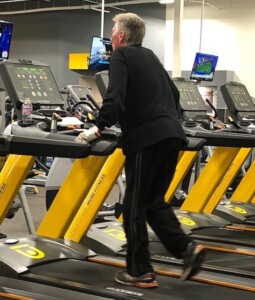
Holding onto a treadmill is wrong other than for a momentary balance check. Look how it warps this man’s posture and creates a false sense of accomplishment. This is not how we walk once we’re off the treadmill. Heart failure is no excuse for holding on.
Intensity can also be introduced with an incline for those whose knees don’t like brisk walking.
• Do not hold onto the treadmill. This negatively alters gait and posture.
• It also mimics using a walker.
• Holding on teaches your body that it needs external support for walking.
• A natural arm swing encourages good posture and activates the body’s balancing mechanism.
• Start out at a slow speed to get used to walking on a tread without holding on.
• Hold on only for brief, momentary balance checks such as when you’re drinking water.
If you prefer a stationary bike, that’s fine too, as interval training can be done with any piece of cardio equipment.
In summary, interval training simply means brief periods of exertion alternating with brief periods of casual pacing.
 Dr. Krishnan is with Pacific Heart & Vascular, where you can view his videos on heart disease and healthy living. He has numerous publications and often speaks at local and regional events.
 Lorra Garrick is a former personal trainer certified through the American Council on Exercise. At Bally Total Fitness she trained women and men of all ages for fat loss, muscle building, fitness and improved health.
.
Top image: Shutterstock/Blamb
Sources:
circ.ahajournals.org/content/115/24/3086.short
fondationepic.org/site/images/stories/2013_Meyer_P_HIIT_in_CHF_REVIEW.pdf

WHY Does Acid Reflux (LPR) Cause Throat Lump Feeling?

You already know that the “lump in the throat” can be caused by LPR or acid reflux, but here’s WHY this occurs.
LPR is actually acid reflux that makes it up to the throat.
A well-established symptom or result of LPR is the sensation of a lump in the throat.
But what is it about LPR that makes the patient experience this “feeling”?
“One can feel like they have a mass in the throat, and it is hard to swallow and food is getting stuck,” begins Dr. Stacey Silvers, MD, of Madison ENT & Facial Plastic Surgery in NYC, who is board certified in otolaryngology—the specialty of the ears, nose and throat. ENT physicians deal a lot with LPR (laryngeal pharyngeal reflux).
“That feeling of a lump in the throat is a physical swelling from irritating-stomach acid reaching up into the throat.
“If all patients with acid reflux presented with heartburn and indigestion, the diagnosis would be easy.
“As a result patients would take over the counter reflux medication for their uncomfortable ‘classic’ reflux symptoms.”
But not all patients have the classic symptom of heartburn from their acid reflux.
The symptoms can bypass the stomach and chest area and be felt only in the throat.
LPR Scares Many Patients
“The fear in most is that this lump is a tumor,” says Dr. Silvers.
“The area in the throat that is inflamed and swollen is at the opening of the esophagus which sits behind the vocal cords at the level of the thyroid cartilage in the neck.
“As a result of this swelling, other associated symptoms like hoarseness, shortness of breath, post-nasal drip, cough and throat-clearing are also common symptoms.”
Dr. Silvers adds that this area requires examination with a fiberoptic scope.
Typically a patient will come into the doctor’s office and be diagnosed with allergies or asthma, especially if they complain of shortness of breath or a sensation that not enough air is getting through when they inhale.
“But allergy medications and asthma inhalers are not working,” says Dr. Silvers.
“In most cases the diagnosis is not correct, and the underlying cause of all of the symptoms is missed.”
LPR is also known as “silent reflux” because, as mentioned, it bypasses the classic symptoms that millions of people feel in their chest and upper stomach, and presents as various throat symptoms, including that lump feeling.
Here are Dr. Silvers’ recommended natural and drug treatments for LPR relief.
 An NYC expert in ear, nose and throat care, Dr. Silvers has been named among America’s Top Physicians and Surgeons in facial plastic surgery and otolaryngology numerous times since 2003. Dr. Silvers is an expert in the field of minimally invasive rhinology, resolving patients’ breathing and sinus problems with simple in-office procedures.
 Lorra Garrick has been covering medical, fitness and cybersecurity topics for many years, having written thousands of articles for print magazines and websites, including as a ghostwriter. She’s also a former ACE-certified personal trainer.
.
Top image: ©Lorra Garrick

LPR: Natural + Drug Treatment Guidelines from ENT Doctor

Here is what an ear, nose and throat doctor recommends for the relief of LPR symptoms.
LPR causes an assortment of symptoms, and in some patients, this condition can be chronic, frequent, sporadic or something that has happened just a few times—as was the case with me.
LPR Treatments for Relief
For those with the ongoing or frequent symptoms (such as the lump in the throat feeling, difficulty inhaling and constant coughing), “You can start by cutting out acidic foods in your diet, elevating the head of bed when you sleep at night and avoiding eating three hours before bedtime,” explains Dr. Stacey Silvers, MD, of Madison ENT & Facial Plastic Surgery in NYC.
Dr. Silvers is board certified in otolaryngology—the specialty of the ears, nose and throat. ENT physicians work a lot with patients who have LPR (laryngeal pharyngeal reflux).
Acidic foods include:
Corn, blueberries, bread and any other white-flour-based food like pasta, oatmeal, rice, wheat, beans (black, pinto, red), butter, cheese, cashews, peanuts, walnuts, beef, pork, salmon, cod, tuna, turkey, lamb, canola oil, olive oil, sunflower oil, sugar, soda, wine, cocoa, pepper, coffee and vinegar.
Alkalizing foods include:
Green beans, cruciferous vegetables, carrots, onions, tomatoes, mushrooms, apples, bananas, grapes, lemons, oranges, peaches, grapefruit, strawberries, watermelon, almonds, whey protein powder and millet.
As you can see, cutting back on acidic foods won’t be easy, but try it for 30 days and see if it provides relief of your LPR symptoms.
What if cutting down or out on acidic foods, and not eating three hours prior to sleep, don’t help with LPR symptoms?
“If this alone does not manage your symptoms then a trial of an OTC reflux medication may help, taken first thing when you wake up,” says Dr. Silvers.
“Follow up with your doctor if symptoms persist or you become dependent on medication for symptom resolution.
“When you have these symptoms and you are frustrated with misdiagnosis, ask your ENT if you have ‘silent’ reflux.
“The proper diagnosis and treatment can be very helpful and life changing for many.”
An NYC expert in ear, nose and throat care, Dr. Silvers has been named among America’s Top Physicians and Surgeons in facial plastic surgery and otolaryngology numerous times since 2003. Dr. Silvers is an expert in the field of minimally invasive rhinology, resolving patients’ breathing and sinus problems with simple in-office procedures.
Lorra Garrick has been covering medical, fitness and cybersecurity topics for many years, having written thousands of articles for print magazines and websites, including as a ghostwriter. She’s also a former ACE-certified personal trainer.
Top image: Shutterstock/Josep Suria
HIIT on the Elliptical Machine for Killer Fat Burn
Here’s how to do HIIT with the elliptical machine for a killer fat burning workout.
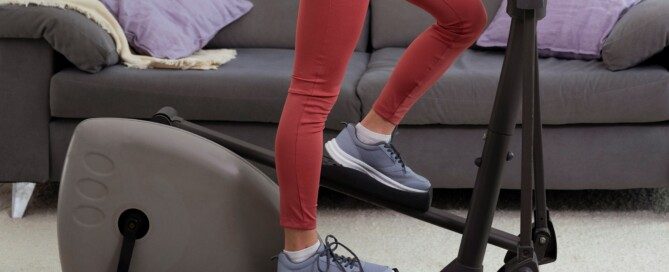
Don’t let the smooth pedaling motion of this machine fool you into thinking that this device can’t crush a lot of fat via high intensity interval training.
The elliptical machine for HIIT is useful for people who are not able to run full force, either due to poor physical condition, overweight, or knee problems.
Such individuals can still put forth a gigantic HIIT workout on the elliptical machine and thus burn much fat.
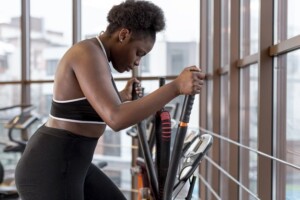
The most effective way to do HIIT on the elliptical trainer is to choose a model that does not have the arm bars — which are shown below.
Freepik.com/jcomp
For significant fat burn, you want your legs and buttocks to do all the work, since these are the body’s largest muscle groups.
Forget the arm bars and instead just move arms in a synchronized fashion at your sides, as your legs pedal away on the machine.
These just get in the way and create a distraction. You will NOT burn more calories or fat with this particular model. Your legs make the arm bars move, not your arms or shoulders.
The arm bar mechanism and the pedals are one and the same, and do NOT move independently of each other.
I do not endorse holding onto the elliptical aside from just a very light, minimal contact with the fingertips to the machine to keep posture in check.
I’ve seen people gripping the elliptical console and rails, which creates poor posture and may lead to back strain.
Keep your body straight and in correct posture as you pedal, and place fingertips lightly on the rails ONLY if you feel like you are going to fall off.
For optimal fat-burning using the elliptical machine, keep your hands off the equipment entirely — unless it’s time for that balance check.
As with any HIIT session, warm up first on the elliptical.
Freepik.com/jcomp
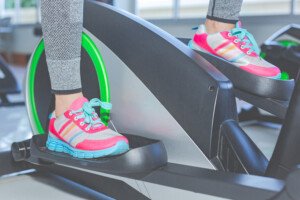
HIIT segments should be 30 seconds, and can be done in a variety of ways, such as light pedal tension and very high RPMs, as fast as you possibly can, forwards or backwards.
Or, you can use heavy pedal tension and still try to go as fast as possible, with the understanding that you will not be able to pedal nearly as fast as with a light tension.
Whichever combination you choose, your HIIT interval should be so fierce, that it should take 90 seconds to two minutes before you are ready to perform another one — 90-120 seconds of gentle, relaxed pedaling at a light tension for heart rate recovery.
An example would be level 7 at 300 RPM for the high intensity component; and level 7 again at 80 or so RPM for the recovery.
Another example of a work interval would be level 12 at 150-200 RPM. You can also vary the pedal angle.
Don’t blow off the elliptical as an effective HIIT tool for burning fat. When you really pump your hardest on this equipment, you will get a significant fat-burning effect.
A good HIIT session with the elliptical machine should last 25-30 minutes, excluding warm-up and cool-down.
Lorra Garrick is a former personal trainer certified through the American Council on Exercise. At Bally Total Fitness she trained women and men of all ages for fat loss, muscle building, fitness and improved health.
.
Top image: Freepik.com

Can Aortic Aneurysm Growth Be Slowed with Losartan?

If you have Marfan syndrome and a thoracic aortic aneurysm, you’ll be very interested in Losartan, which may potentially slow the expansion of the diseased area.
Marfan syndrome is a connective tissue disease, typically treated with beta blocker drugs which lower blood pressure.
Lowered blood pressure is very desirable in the Marfan patient, to reduce stress on the inner wall of the aorta.
In Marfan, the aorta becomes enlarged and can dissect, causing instant death.
A study report (Braverman et al) from 2014 hails Losartan as a possible alternative to beta blockers for slowing the growth of an aneurysm.
Even if you don’t have Marfan syndrome but nevertheless have a thoracic aortic aneurysm, the study’s findings will interest you.
• The study (published in The New England Journal of Medicine) involved 608 people with Marfan syndrome from six months of age to 25.
• All the subjects had enlarged aortas.
• Half the subjects were given the beta blocker Atenolol while others were given Losartan.
• The Atenolol was given in higher than usual doses.
• The subjects were followed for three years.
The patients were followed for three years, and the results in both groups were the same as far as aortic growth rate, tear rate of the aorta, number of surgeries to repair torn aortas and number of deaths.
Losartan may be considered in patients who experience adverse side effects from beta blockers which can include nausea.
Losartan Today
As of 2019, we must wonder where Losartan fits in with the management of thoracic aortic aneurysm. So I asked Michael Fiocco, MD.
“For decades we have used lower blood pressure to theoretically reduce aneurysm growth,” says Dr. Fiocco, Chief of Open Heart Surgery at Union Memorial Hospital in Baltimore, Maryland, one of the nation’s top 50 heart hospitals.
“Although Losartan is used to lower blood pressure (classified as ARB or angiotensin receptor blocker), in this case it is thought to modify the cellular matrix of the aortic wall and inhibit expansion.
“This is in the experimental stage and I am not aware of any human clinical studies.
“Also, the studies to date relate to Marfan aneurysm but not the host of other types.
“This work continues with other ARBs, anti-inflammatory agents and even statin drugs in hopes of modifying the walls of these diseased aortas to inhibit expansion.”

Dr. Fiocco specializes in treating artery disease, valvular disease and aortic aneurysm. His heart care expertise has earned him recognition by Baltimore Magazine as a Top Doctor in 2010, 2011, 2013, 2016 and 2017.
 Lorra Garrick has been covering medical, fitness and cybersecurity topics for many years, having written thousands of articles for print magazines and websites, including as a ghostwriter. She’s also a former ACE-certified personal trainer.
.
Top image; Shutterstock/traveliving
Source: sciencedaily.com/releases/2014/11/141118125441.htm
Do You Need Gloves to Hold onto a Treadmill?
Some people use gloves when holding onto a treadmill, but there’s something they should know about this practice.
And that is:
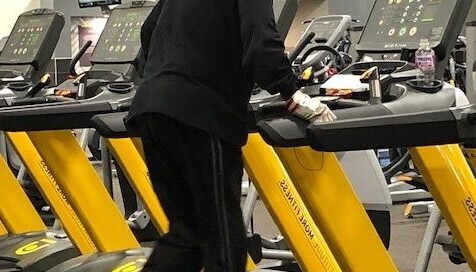
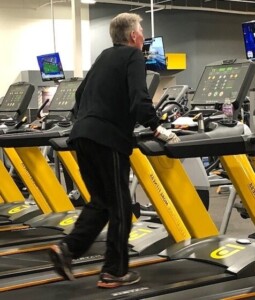
It’s wrong. I don’t mean the part about using gloves to hold onto a treadmill. I mean the part about holding on, PERIOD. It’s wrong.
As a personal trainer, I forbid all of my clients from holding onto a treadmill.
The only exception was a 70-year-old man who needed a walker to get around anyplace, and I had him holding on—only as much as he absolutely needed to—to the side rails.
I eventually got him off the walker he’d been using for years and to a four-pronged cane—a step-up in control.
But when you see people wearing gloves while they hold onto a treadmill—these are able-bodied women and men, and the gloves are for increased traction or gripping efficiency.
A secondary reason might be to prevent their sweat from getting onto the rails, bar, or wherever they’re holding fast to.
You don’t need gloves to hold onto a treadmill, because you shouldn’t be holding on in the first place.
The exception is to place your hands on the machine to keep from falling off—WHEN you feel you’re about to lose your footing as a result of turning around to greet someone or a shoelace becomes untied.
Another valid reason is when you’re changing the settings, taking water or checking heart rate.
But these actions are transient, very temporary, so that when you’ve completed them, your hands should detach from the treadmill and move naturally.
Gloves can encourage tight holding, and I’ve actually witnessed this.
The user was a man, and his machine was set at 15 percent incline and 4 mph. Now that’s a pretty stiff setting, and if you try to walk this without holding on, you’ll end up stepping off the machine—unless you’re an Ironman athlete or experienced trail runner.
A smarter, more logical approach is to set the speed at 1.5 mph (yes, one and a half miles per hour) and keep your hands off.
Now before you laugh at this, ask yourself what speed you’d walk outside on a similarly inclined trail.
Think about this. You’d be moving at about 1.5 mph, maybe even slower. Imagine a very long stretch of inclined trail, extending endlessly up a mountain.
There is NO way you’d be booking up there at 4 mph—unless, as mentioned, you’re a veteran trail climber with very impressive fitness.
Go ahead, try it before you dismiss it: Walk 1.5 mph at 15 percent incline on a treadmill without any holding on. Go for 20 minutes.
I guarantee it, you’re going to feel a workout that you just won’t get with holding on at 4 mph.
This is because holding on, even at a fast speed, creates a fake movement pattern that’s based on external support. It doesn’t mimic the real thing.
The real thing—outside on a trail—comes without anything to hold onto. Now, fitter people will find that 1.5 mph doesn’t quite challenge them. If this describes you, try 2 mph.
If you can maintain a 2 mph walk at 15 percent without holding on—for 20 minutes—you’re in good shape. Don’t assume these slow speeds are too slow. Try them. For 20 nonstop minutes. No holding on.
The point at which holding onto a treadmill is necessary to prevent dropping off is not determined by a difference of one-tenth of a mile per hour.
I’m betting that you can handle something in between 1.2 and 1.5 mph, while at the same time, feeling a good workout.
There’s also a possibility that 1.2 mph will be too difficult for longer than 10 minutes or even five.
I’ve seen very poorly conditioned people doing the 4 mph, 15 percent, holding-on-with-gloves routine. Just one mph would exhaust them.
That’s okay – go to 0.8 mph, or lower the incline. It doesn’t have to be 15 percent, you know.
You should now know why you don’t need gloves to hold onto a treadmill.
A very slow pace, without holding on, delivers much better results and a far stronger training effect, than does holding on at fast speeds, even with gloves.
Once you’re off the treadmill—there’s nothing to grab onto. So how can holding on improve your fitness or balance? Or cause weight loss? Ditch the gloves and let go of the treadmill.
Lorra Garrick is a former personal trainer certified through the American Council on Exercise. At Bally Total Fitness she trained women and men of all ages for fat loss, muscle building, fitness and improved health.

Should Older People Lean Over the Stair Stepper Machine?
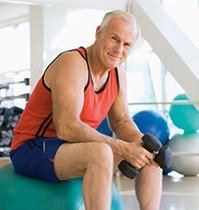
Are you an older person who hunches way forward, leaning into the stair stepper machine, supporting your body weight with your arms?
Look at the older man in the photo. You don’t have to be a chiropractor to clearly see that this is bad for the back.
Look at how his upper back pokes out. Look at his neck, relative to the spinal column. This can’t be good on the shoulders, either.
If a senior aged person’s objective is to improve any component of their body, then leaning over and into the stair stepping machine will not get them to their goal.
Though I’m a personal trainer, I don’t even have to draw upon fitness expertise to see what goes on when a person, especially a senior, slumps forward into the stair stepping equipment. Come on, look again at the image.
I see this huge mistake all the time at the gym, and it’s not just seniors committing it.
Many people in their 20s and 30s lean into cardio equipment, supporting their body weight on their forearms, butt sticking out. This is very impractical and has no carry-over to real life movement.
When you walk up a flight of stairs, even if your hands are on the rails, your body is erect, for the most part. It certainly isn’t as slumped forward as the man is showing in the photo.
There are several reasons why an older person may want to use a stair stepping machine.
One is to improve cardiovascular fitness, in combination with a preference for this type of cardio equipment over a treadmill or stationary bike.
Another is to just be fitter and have more energy, which overlaps with the first reason.
Of course, weight loss is a common goal. Other goals include lowering blood pressure and improving glucose metabolism.
Regardless of the reason, leaning into the machine and supporting one’s body weight with the arms is a very inefficient, non-efficacious way to exercise—even if you’re of senior age.
Stand straight on the machine, as you would if you were walking down your street.
Just stand straight. If you can’t do the stepping unless you’re leaned into the machine with your butt sticking out and using your arms for support…then you have the steps moving too fast and/or the tension is too rough.
Set the speed slower so that you can stay upright; upright spine, good alignment with your neck to your vertebral column: an erect posture, not a folded-in posture. Reduce the stepping tension.
Adjust the machine to a good-postured body, rather than maim your body’s posture to adjust to difficult settings on the machine.
Maintaining the best posture possible is of utmost importance to seniors when they do cardio exercise.
Lorra Garrick is a former personal trainer certified through the American Council on Exercise. At Bally Total Fitness she trained women and men of all ages for fat loss, muscle building, fitness and improved health.

Why Women Should Do Farmer’s Walks

Why don’t more women do farmer’s walks?
Though women in strongwomen competitions do farmer’s walks, you’ll rarely, if ever, see a woman performing farmer’s walks at a gym or health club.
Why is this?
I don’t even see personal trainers having their female clients doing farmer’s walks.
And that’s really strange, because this physical activity is probably the easiest strength training routine out there.
The farmer’s walk is easy because this routine does not require special form, balance or coordination.
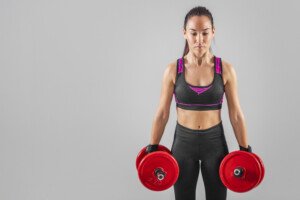
All you do is walk around carrying weights in both hands, arms straight. How easy is that?
Freepik
There is no bending or unnatural positioning in this exercise.
There is an exceedingly low risk of injury, and minimal strain on the joints.
And there is no jarring, no jumping, no impact.
Farmer’s walks are very safe, and women should do them. The question is simply the amount of weight that should be used.
The weight should be heavy, so that the exercise is difficult right from the beginning.
The weights should be heavy enough so that going just 100 feet, or 1-2 minutes nonstop, is strenuous.
Farmer’s walks will strengthen a woman’s shoulders, back and legs.
This exercise will translate to daily living, in that carrying luggage will become much easier.
So will carrying weighty groceries – the kind of bags that you carry with handles and straight arms.
Do farmer’s walks on a regular basis, and carrying anything heavy straight-armed will become significantly easier.
Any kind of weight can be used for this exercise.
This means dumbbells, of course. But a woman can also hold onto weight plates.
Some makes of rubber-coated weight plates have openings that make holding them a lot easier than the non-rubber-coated weight plates.
Kettlebells can also be used. And of course, a woman can use barbells.
However, barbells will be cumbersome and require more room and an element of balance.
You can try sticking with the dumbbells, plates or kettlebells — even though there are also contraptions that are meant for the farmer walk. It really boils down to personal preference.
Start out with lighter weights first.
What’s your biceps curling dumbbell weight? Add 10 pounds each side and do a farmer’s walk for two nonstop minutes with this weight.
So if you normally curl 20 pound dumbbells for 12 reps max, then do a farmer’s walk with 30 pound dumbbells for a nonstop two minutes.
If this wasn’t that difficult, or if you know you could have gone longer than two minutes, then increase the dumbbell weight. Or use weight plates.
Farmer’s walks will not give women hulking shoulders, even though it will feel that way as you move around with a heavy weight load.
It is exceedingly difficult for women to build up their trapezius muscles.
Farmer’s walks won’t do much to change a woman’s appearance, but they will sure make a woman a lot stronger.
Lorra Garrick is a former personal trainer certified through the American Council on Exercise. At Bally Total Fitness she trained women and men of all ages for fat loss, muscle building, fitness and improved health.
.
Top image: Shutterstock/DisobeyArt

Why Slow Walking Is Bad for Body Health

Slow walkers may seem more relaxed, but this habit is hazardous to one’s health.
Habitual slow walking, regardless of reason, is bad for your health.
This doesn’t mean that if you decide to move slowly while walking your new puppy or while sightseeing, that something bad will happen to your body.
What it means is that habitually walking slowly, concurrently with no cardio exercise to offset this bad habit, can shorten lifespan.
This conclusion comes from University of Pittsburgh researchers who analyzed nine studies involving about 35,000 participants 65 years or older.
For each increase in speed of gait of one meter per second, came a correlating 12 percent reduction in risk of death.
Translation: Faster walkers live longer.
Subjects who walked slower than 1.36 mph had an increased risk of mortality.
Those who walked faster than 2.25 mph lived longer.
This is scary news for elderly people as well as younger people who habitually walk slowly.
It’s easy to blame slow walking on advanced age.
But look around you: You’ll see 20-somethings moving like turtles – everywhere.
Watch crowds of people crossing a street. Most are not senior citizens, yet the crowd crawls, whether there’s five people, 10, 15 or 30.
Even pairs of people lethargically move. How often do you observe even a solitary person briskly walking across a street? It’s a rare sight, even if they’re wearing sneakers.
You’ll find slow walkers all over shopping parking lots – ranging from 20-something to 50-something. This slow walking continues into their senior years.
How well can you walk 400 meters?
In study subjects 70-79, those who couldn’t walk one-fourth a mile were less likely to still be around six years later, and more likely to suffer disease and disability prior to death (Journal of the American Medical Association, 2006).
Another study showed that men 71-93 who could walk two miles a day had 50 percent the risk of heart attack of men who could only cover one quarter mile or less.
Maybe it’s too late for your great grandma to put some spring in her step, but how did she get this way in the first place?
Lack of structured cardio exercise is sure in her history.
It’s not far fetched to expect the next generation of “old elderly” to be able to walk with a perk, being that more and more people in their 70s and 80s are completing long-distance walking and running events!
I’ve been on backcountry hikes exceeding five miles with people over age 70.
So certainly, the sooner you make fast walking a habit, even if it’s just going from your car to the store entrance, the more you’ll lengthen lifespan.
How to Become a Fast Walker

Shutterstock/sirtravelalot
Simply make the decision to. However, as a former personal trainer, I recommend the following:
- Make sure your shoes are comfortable. Wear walking footwear as much as possible in public.
- Swing your arms more when you walk.
- At least once a week, spend a little time on a treadmill at a walking pace that’s faster than what you’re used to. Walk this pace for 10-15 minutes at a level incline. DO NOT HOLD ONTO THE TREADMILL.
Lorra Garrick has been covering medical, fitness and cybersecurity topics for many years, having written thousands of articles for print magazines and websites, including as a ghostwriter. She’s also a former ACE-certified personal trainer.
Source: pittsburgh.cbslocal.com/2011/01/05/study-walk-fast-live-long/






Why Fat People Can Bench Press So Much Weight
Find out the truth behind why it seems that fat people can bench press more weight than smaller individuals.
On a general Q & A site, someone asks, “At my school, the people who bench press the most are the fat people — why is that?”
I’m a former personal trainer, and I have the answers.
There are several reasons why it seems that fat people can bench press more weight.
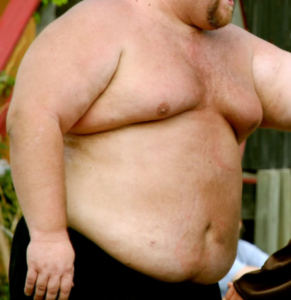
If you believe that, in general, being fat makes people strong so that when it’s time to bench press, they can out-lift leaner folks, I must urge you to take a closer look at these big guys (and gals).
Are they just blobs of fat, or does there appear to be a lot of muscle under all that adipose tissue?
If a person overeats and thus has a lot of excess bodyfat, this will not stop them from gaining muscle (and thus strength) if they work out.
The muscle mass is there, hidden under the excess fat — but not entirely hidden. Look again.
Compare these individuals to the average “fat” person you see on the street, at Walmart, at the county fair, at Burger King, at Costco.
I guarantee it, if you randomly select a fat person from Walmart or the cotton candy line at the amusement park and put them at a bench press station, they’re not going to be lifting very much.
But what if they train?

Shutterstock/LightField Studios
Won’t they gain strength at a faster rate than a 170 pound person? If you’ve never trained before, you need adequate calories to gain muscle.
If you’re skinny and start a strength building program, you’re going to need more calories.
If you don’t increase your caloric intake to accommodate the training, you will make slow progress.
Even a skinny guy who eats like a horse has to adjust his diet if he wants to pack on muscle.
A fat person already gets the calories needed to gain muscle. He has a headstart when training.
So it’s not the obesity that directly gives him the edge; it’s the caloric surplus that’s already in place, though for best results, he or she should replace the junk food with healthy calories.
Powerlifting vs. Bodybuilding
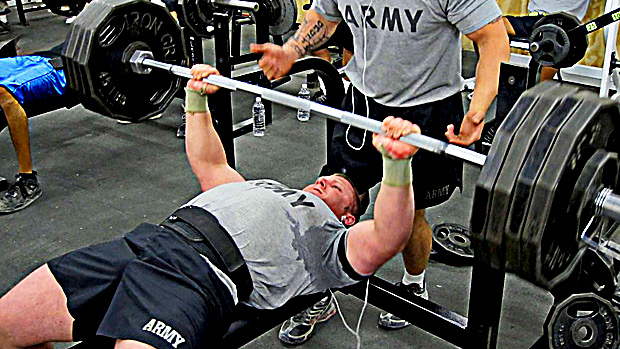
The next reason why fat people seem to bench press more than leaner individuals is that often, the hefty trainees at a gym who are very strong are training for powerlifting competitions.
Or, they are more interested in simply being a strong powerlifter, whereas the smaller but chiseled, lean guys with the fitness model physiques train for appearance first, and trying to break a personal best record in the bench press is secondary.
The 180 pound lean man probably has a different training scheme than the 280 pounder who easily puts up 285 lbs. for 10 reps with the bench press.
If you want muscle mass and a lean, sculpted physique, focus on an 8-12 rep max and a clean, controlled diet.
Those who are gunning for maximal strength rather than a chiseled physique and have done their homework know that a four or five rep max will get them there.
In fact, many non-competitive powerlifters, unlike bodybuilders (yes, there’s a striking difference in these disciplines) will concentrate on a 2-4 rep max.
Another Reason…
Also — realize that a fat, slow-moving individual may find the bench to be quite enticing.
After all, he gets to lie down while exercising, doesn’t have to use his legs, jar his knee joints or huff and puff, and knows that he’s on an even playing field with the thinner, fitter guys he envies.
He becomes hooked on the bench press and runs with it.
Multiply this scenario over and over, and it creates the illusion that “fat people can bench press more weight.”
Range of Motion Advantage
Perhaps this is the biggest reason why fat people apparently can bench press more than leaner people; we must consider range of motion!
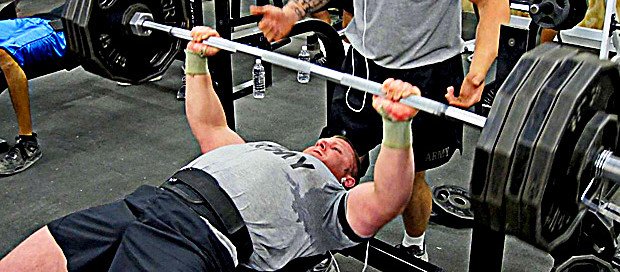
Watch a fat person bench press. What immediately jumps out at you?
If they’re fat enough, they only need to lower the bar about three-quarters as far down, to get it right on their chest, when compared to a skinny person! The excess fat cuts short their range of motion.
A proper bench press means bringing the bar down to your chest but not resting it there.
If your chest sits up high because there’s a lot of fat there, you’re bringing that bar down a shorter distance and then pushing up from that point.
This is akin to a skinny person bringing the bar down only “half-way” for every repetition, which allows for a much heavier bench press.
A fat person cannot bring the bar down further than where his or her chest rises up to.
As a result, their arms may be bent at only 90 degrees by the time the bar reaches their chest.
A thin person, to get the bar to his chest, must bend their arms considerably, such that their elbows are much closer to the floor, and then push ALL the way up from that point.
“Mass Moves Mass”
This may seem like the case with the bench press, but it’s actually more of the case with the deadlift and back squat due to the incredibly stable support base that a very heavy body provides during the pull.
A support base to the floor does not apply to the bench press.
Final Thoughts
To put it simply, it’s a heck of a lot easier to push 285 pounds 12 inches than it is 18 inches!
But even then, the average “blob” type of fat individual off the street won’t be much stronger, if at all, than the average medium weight person off the street.
As a fitness professional, I don’t believe for a second that I can randomly choose a fat person at Walmart, stick them under a 200 pound bar, and watch them bench press it even once, even with their much shorter range of motion.
How much a person, fat or lean, can bench press is very multifactorial (I haven’t even covered anthropometrics here).
I’ve seen many lean or only moderately overweight individuals bench press enormous amounts of weight, and have also witnessed very portly men and women benching unremarkable amounts of weight.