

Sudden Tiny Brown Spot Under Lip Likely Clogged Pore
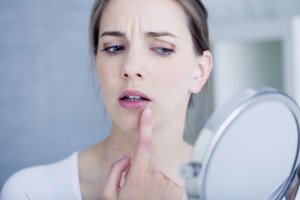
Have you noticed the seemingly sudden appearance of a very tiny brown dot under (not on) your lip? And you wipe and rub it, and it remains? And it just doesn’t go away?
One day I noticed a very, very small brown dot under my lip.
I aggressively rubbed it with the tip of a finger and it didn’t budge, so I quickly ruled out a speck of grime.
I had an appointment already scheduled with a dermatologist for a routine skin exam, so I knew that soon, I’d be getting a dermatologist’s assessment.
I’ll admit, I was worried, because I just couldn’t figure out what benign thing this very tiny spot could be.
It certainly did not resemble any of the solar “age spots” on my face; those were lighter brown and less dense.
It also didn’t resemble the beginnings of the benign seborrheic keratosis (those need to begin from something, right?). This tiny little spot under my lip, as teeny as it was, looked dense.
If you’ve noticed something like this, stand under very good lighting and stretch your lips into a “smile,” and look closely at the stretched skin around the little brown dot.
What I eventually noticed was that this spot’s location fell neatly into the location of neighboring pores.
During previous inspections, I had not noticed the surrounding pores because I had not stretched my lips out and angled my face in such a way that the light illuminated them.
But this time I did, and voila, lots of visible pores, like a field of them, and this tiny brown speck was neatly part of the field. A clogged pore, I wondered.
I also had noticed that it strongly resembled a few of the clogged pores on my nose. I held out hope that this was what the dermatologist would tell me.
And she did. She took no time, after viewing it, to tell me that it was a clogged pore.
So if you notice something like this near your lip, you now have a benign explanation of what it could be.
However…I would urge you to get it checked by a dermatologist just to be sure. DO NOT PICK IT WITH A PIN.
It may make you feel relieved to “get rid of it,” but then if you do—you’ll never know what it really was.
 Lorra Garrick has been covering medical, fitness and cybersecurity topics for many years, having written thousands of articles for print magazines and websites, including as a ghostwriter. She’s also a former ACE-certified personal trainer.
.
Top image: Shutterstock/ Image Point Fr
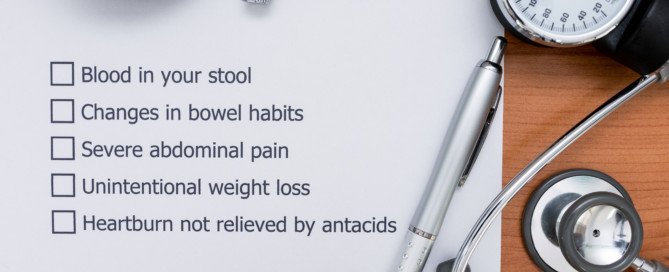
COLON CANCER: STOOL CHANGES, Symptoms, Detection: Answers

If you’re worried about colon cancer and can’t find answers online, you just might find the answers to your questions in the articles below.
Bowel movements or “stools” form as food is digested and nutrients are absorbed in the small intestine, leaving waste material.
This waste has to be expelled, so it then enters the large intestine. This tract is where colon cancer can occur.
It’s also where water is absorbed, and gut bacteria break down remaining substances, forming stool.
The rectum stores stool until signals from nerves trigger the urge to “go.”
Muscles in the rectum and anus then expel your BMs.
Stool consistency depends on diet, hydration, gut health and transit time through the intestines.
The consistency can also be affected by an obstruction in the colon or rectum. That obstruction could be hardened fecal matter (constipation), a colon polyp, or, colon cancer.
A symptom of colon cancer that nearly health concsious person has heard of is that of narrow, or thin BMs. Sometimes they’re described as like a pencil or ribbon.
But colon cancer isn’t the only cause of elongated thin stools.
Just what goes on inside the body that causes stools to come out in ribbons or like pencils anyways?
The problem doesn’t always exist at rectal level.
Here’s how colon cancer can make BMs narrow and long.
Another symptom that’s relatively well-known is that of “tarry” or black bowel movements.
However, food or medications can also very much darken stools.
But there are differences.
Symptoms of IBS and Colon Cancer Nearly Identical
You should never assume that your new-onset digestive symptoms are “probably just IBS.”
The signs of IBS greatly overlap those of colon cancer.
However, the diagnostic process for each are completely different.
So if you’ve been having the classic signs of irritable bowel syndrome, you still need to get this confirmed by a gastroenterologist to rule out colon cancer; the symptoms are too similar to ignore.
And by the way, if you’re younger than middle age, this doesn’t make you immune to cancer of the colon.
This disease can strike even someone in their 30s.
Lorra Garrick has been covering medical, fitness and cybersecurity topics for many years, having written thousands of articles for print magazines and websites, including as a ghostwriter. She’s also a former ACE-certified personal trainer.
.
Image: Shutterstock/Bangkoker

Is a Lot of Bleeding During Menopause Something to Worry About?

If you’re bleeding a lot during menopause — and a doctor has confirmed menopause — then something may be very wrong.
For this post I asked Dr. Gino Tutera, an OB/GYN and a specialist in bioidentical hormone replacement therapy, if heavy bleeding could be normal during menopause.
“No,” begins Dr. Tutera. “But this is the answer if the woman is fully into menopause — as would be evidenced by laboratory testing or having no menses for a full year.”
Obesity can cause menstruation to stop — including for 12 months in a row.
So if you’re of menopausal age and have not had a period in 12 months — BUT are obese (particularly severely obese) — you should have laboratory testing done to confirm the presence or absence of menopause.
If you’re bleeding from your menstrual cycle, then this contradicts going through the menopause, as by definition, the menopause is the end of your menstruation.
So if you’re going through menopause but are also experiencing heavy bleeding — the cause is certainly not your period — and you had better get this checked out promptly by a gynecologist.
If you’re experiencing heavy bleeding during menopause, this is not a normal part of the process.
During the perimenopausal years leading up to menopause, it’s common to experience irregular periods and varying flow, but once you have officially entered menopause, bleeding should cease altogether.
Therefore, any unexpected heavy bleeding after this point is a cause for concern and warrants prompt medical attention.
While it could be related to hormonal fluctuations or changes in the uterine lining during the perimenopausal phase, heavy bleeding could also be a sign of more serious underlying conditions.
Don’t be afraid to get an exam; early detection of a serious problem certainly means a much better outcome.
But are you sure you’re even going through menopause in the first place?
A woman, close to the start of menopause, may go several months without a single period.
Then she starts bleeding heavily—and she assumes that this is another period.
However, if the bleeding doesn’t resemble her typical menstruation, maybe she IS in menopause.
As mentioned, lab testing (a blood test) can show if a woman is in menopause.
“During the transition into full menopause,” says Dr. Tutera, “it is very common to have significant variations in the timing of periods and amount of bleeding. The ovaries are just not functioning consistently day to day.”
What could bleeding heavily during menopause be caused by?
Causes include: benign uterine or cervical polyps, endometrial thickening or thinning, cancer of the uterus, vagina or cervix, or a cervical infection.
This list of causes, including the cancers, is not complete.
Dr. Tutera initially specialized in obstetrics and gynecology and then moved on to treating hormonal imbalances in women. He passed away in 2015.
Lorra Garrick has been covering medical, fitness and cybersecurity topics for many years, having written thousands of articles for print magazines and websites, including as a ghostwriter. She’s also a former ACE-certified personal trainer.
.
Top image: Shutterstock/Chinnapong

Can Discharge from Vaginal Atrophy Resemble Cervical Mucus?

Is cervical mucous even present when there’s vaginal atrophy?
Atrophic vaginitis (vaginal atrophy) is the result of menopause, when a woman’s estrogen levels drop so much that her vagina literally dries out or loses its natural lubricant.
According to Mayoclinic.com, one of the possible symptoms of moderate to severe vaginal atrophy is “vaginal discharge.” Does this resemble cervical mucous?
“The answer is absolutely no,” says Dr. Gino Tutera, an OB/GYN and specialist in bioidentical hormone replacement therapy.
Dr. Tutera explains, “Cervical mucous is quite different than the natural moisture from a normally functioning vagina.
“Cervical mucous consistency varies considerably based on the woman’s level of estrogen.
“Vaginal atrophy is caused by lack of estrogen, so there will be very little, if any, cervical mucous.”
Dr. Tutera initially specialized in obstetrics and gynecology and then moved on to treating hormonal imbalances in women. He passed away in 2015.
Lorra Garrick has been covering medical, fitness and cybersecurity topics for many years, having written thousands of articles for print magazines and websites, including as a ghostwriter. She’s also a former ACE-certified personal trainer.
.
Top image: Shutterstock/sasha2109
Source: mayoclinic.org/diseases-conditions/vaginal-atrophy/basics/symptoms/con-20025768

How Does Colon Cancer Increase Mucous Production?

Yes, colon cancer can increase the amount of mucous in your stools.
And this is what’s so scary, because this substance in the stools is actually a normal occurrence.
The reason for the normal mucous production that appears in one’s bowel movements is so that the transit of the fecal matter through the digestive tract can be smoother; think of the mucous as lubrication.
So naturally, a little bit of this white goop will sometimes make its way into the toilet bowl with your stools.
However, colon cancer can also result in mucous appearing with your stools.
“Villous tumors can secrete mucous,” says gastroenterologist Sander R. Binderow, MD, FACS, FASCRS, with Atlanta Colon & Rectal Surgery.
“They can be malignant or benign. A large villous tumor can still be benign and make large quantities of mucous.”
Get to know what’s normal for your bowel movements.
If you’ve been taking note of what’s normal—over a long period of time—then something out of the ordinary will be more obvious.
On the other hand, if you’re new to getting to know your poops, and you just happened to notice some white goopy stuff in them the first time you decided to inspect them, this could be unnerving—because you don’t know if that’s normal for you.
It’s also important to point out that the white goop that a woman sees with her BMs isn’t necessarily from her digestive tract; it could be normal discharge from her cervix or vagina that coincided with the bowel movement.
Look closely at the mucous whether you’re a male or female to see if there’s any blood in it.
It may have a tinge of orange-brown—that’s normal, from the fecal matter that contacts it.
Another thing you can do is to take a stool sample test at home with Cologuard.
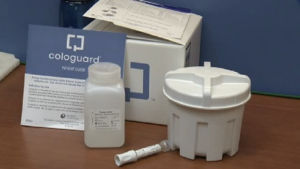
Cologuard is by prescription only.
It uses advanced DNA technology to detect abnormal cells in your stools, and if this test turns out positive, the next step would be a colonoscopy as a diagnostic test to look for colon cancer.
 Dr. Binderow performs minimally invasive, robotic and laparoscopic surgery for Crohn’s disease, ulcerative colitis, colon cancer and other colorectal conditions. Adept at routine procedures, he also sees patients with complex, atypical maladies.
 Lorra Garrick has been covering medical, fitness and cybersecurity topics for many years, having written thousands of articles for print magazines and websites, including as a ghostwriter. She’s also a former ACE-certified personal trainer.
.
Top image: Shutterstock/Africa Studio

Can Colon Cancer Increase Amount of Stools?

Regarding colon cancer, we need to be careful with addressing this question, because reputable sites state that the “frequency” of bowel movements may change (including increase per day).
But this article is not about frequency as much as it is about total amount of stools come end of day.
Benign conditions can cause the frequency of bowel movements to increase.
And colon cancer, too, can increase the frequency that one must void.
An example of how colon cancer might lead to this is that the patient normally has one bowel movement every day, then for no known reason (i.e., no change in eating habits), the person is now having three bowel movements a day.
“Colon cancer RARELY increases the amount of stool,” says gastroenterologist Sander R. Binderow, MD, FACS, FASCRS, with Northside Hospital in Georgia.
So don’t become alarmed if lately you’re having more bowel movements than usual BUT the total volume looks to be the same.
Dr. Binderow adds, “A colon cancer mass can cause an obstruction which would decrease stool.”
This article refers to formed stools, not diarrhea.
Dr. Binderow also says, “Rarely a mass blocking the rectum would lead to diarrhea.”
Get familiar with how much stool you normally produce on days that you have bowel movements.
And when you think about it, even from a layperson’s perspective, there’s really no reason why colon cancer would increase the amount of stools.
Stools are not created out of thin air, and are the body’s way of ridding wastes.
There’s a correlation between how much a person eats and total volume of BMs they have every day.
Certainly, a Sumo wrestler is going to be voiding a lot more stools than is a ballerina.
To improve your colon health, add raw chia seeds to your diet. The great thing about chia seeds is that one tablespoon contains four to five grams of fiber, and these tiny seeds can be mixed into so many foods without you even noticing.
Add a tablespoon to your fruit smoothie or protein shake (mix very well), or to rice and salads.
But don’t just rely on what you see and what you eat for colon health. Cologuard uses the latest in DNA technology to identify abnormal cells in your stools.

The Cologuard kit is simple to use and can be done at home. If the cells turn out abnormal, it would be recommended that you undergo a colonoscopy.
Dr. Binderow performs minimally invasive, robotic and laparoscopic surgery for Crohn’s disease, ulcerative colitis, colon cancer and other colorectal conditions. Adept at routine procedures, he also sees patients with complex, atypical maladies.
Lorra Garrick has been covering medical, fitness and cybersecurity topics for many years, having written thousands of articles for print magazines and websites, including as a ghostwriter. She’s also a former ACE-certified personal trainer.
.
Top image: Shutterstock/Marta Design

Can PVCs in a Structurally Normal Heart Mean Danger?

Are you experiencing premature ventricular contractions but recently underwent an echocardiogram that yielded normal results?
“When PVCs occur in people with structurally normal hearts, they are usually considered benign,” explains cardiologist Dr. Pam Marcovitz, MD, an internal medicine cardiologist with Frankel Cardiovascular Center in MI.
“However, even in normal hearts, when many PVCs occur in a row (the so-called runs), they may become a ventricular arrhythmia — which can be potentially harmful,” adds Dr. Marcovitz.
From time to time, some people with normal hearts may perceive what seems to be a run of three or four PVCs in a row.
Maybe even five: ba …BOOM, ba …BOOM, ba …BOOM, ba …BOOM, ba …BOOM.
If this is occasional, without other symptoms such as feeling faint or chest pain, and especially if it correlates to acute anxiety, then the patient shouldn’t worry.
If this is frequent, especially with other symptoms, or you’re occasionally getting runs of, say, eight or nine PVCs in a row, see a cardiologist.
“When many, many PVCs occur, up to several thousand in a 24 hour period, the lack of synchronized heartbeat can cause a temporary reduction of the heart’s pumping function.”
This isn’t necessarily a dangerous situation, however, but it also shouldn’t be ignored, either.
This situation can be treated with catheter ablation.
With catheter ablation, a thin, flexible tube is inserted into the heart, and targeted areas of tissue causing irregular electrical signals are destroyed to restore a normal heartbeat.

Dr. Marcovitz has 40+ years of experience in helping people improve their heart health.
Lorra Garrick has been covering medical, fitness and cybersecurity topics for many years, having written thousands of articles for print magazines and websites, including as a ghostwriter. She’s also a former ACE-certified personal trainer.
.
Top image: Shutterstock/CHAIYARAT

Can PVCs Occur Often Enough to Cause Heart Damage?

“When many, many PVCs occur, up to several thousand in 24 hours, the lack of synchronized heartbeat can cause a temporary reduction in the heart’s pumping function,” explains cardiologist Dr. Pam Marcovitz, MD, an internal medicine cardiologist with Frankel Cardiovascular Center in MI.
“Fortunately, this is almost always reversible with catheter ablation.”
If you suspect that you’re having thousands of PVCs a day, then speak with your cardiologist about being set up with an at-home device called a Holter monitor.
You wear it around your torso and it records your heartbeats, including premature ventricular contractions, for 24 hours. The data will include how many PVCs you had in that period of time.
If you believe that your thousands of PVCs occur only some days out of the week, or even with less frequency, but still within any given month, then you can be set up with an event recorder for 30 days.
That all said, be assured that PVCs will not damage your heart tissue.
If you want to know what will damage your heart, it’s white sugar, high fructose corn syrup, trans fats and smoking, not to mention lack of exercise.
Dr. Marcovitz has 40+ years of experience in helping people improve their heart health.
Lorra Garrick has been covering medical, fitness and cybersecurity topics for many years, having written thousands of articles for print magazines and websites, including as a ghostwriter. She’s also a former ACE-certified personal trainer.
.
Top image: Shutterstock/Andrey_Popov

Can Stress Cause PVCs During Calmer Periods?

Can the stress of your life actually cause spontaneous PVCs during those periods when you’re in a more relaxed mood?
“PVCs may be caused by overall life stress, but are rarely caused by having a ‘bad day.’” says cardiologist Dr. Pam Marcovitz, MD, an internal medicine cardiologist with Frankel Cardiovascular Center in MI.
In other words, your bad hair day probably will not cause a premature ventricular contraction.
So if you occasionally have the so-called “one of those days,” this isn’t sufficient enough to trigger a run of PVCs.
However, if you have “one of those lives,” that is, an existence defined by ongoing stress and anxiety…then yes, this can bring on PVCs in a major way.
PVCs can result from acute anxiety, such as checking your phone for messages and seeing that one of the messages is from your doctor to tell you what your biopsy results are for that strange mole.
Your ponytail not turning out right is nothing compared to this.
Here come the premature ventricular contractions as you call the doctor back.
But where were they the evening prior when you were baking chocolate chip cookies with your young niece?
“PVCs may occur with too much caffeine, energy drinks or some medications that contain stimulants such as albuterol inhalers,” continues Dr. Marcovitz.
“They may also occur with alterations in blood electrolytes or abnormal magnesium levels. They may occur with anemia or sleep apnea.
“While PVCs may occur more frequently with life stress, there is rarely a direct relationship between the number of PVCs and having a bad day.”
Dr. Marcovitz has 40+ years of experience in helping people improve their heart health.
Lorra Garrick has been covering medical, fitness and cybersecurity topics for many years, having written thousands of articles for print magazines and websites, including as a ghostwriter. She’s also a former ACE-certified personal trainer.
.
Top image: Freepik/stefamerpik

How Can PVCs Cause Chest Pain?








Are you convinced that your premature ventricular contractions are causing you chest pain? You may want to rethink this idea.
“PVCs or premature ventricular contractions are ‘extra’ heartbeats coming from the bottom chambers of the heart,” explains Dr. Pam Marcovitz, MD, an internal medicine cardiologist with Frankel Cardiovascular Center in MI.
“They occur earlier than the normal heartbeat which comes from the top of the heart.
“The extra beat occurs in the pumping chamber and travels up to the top of the heart in backwards fashion from the normal heartbeat.
“Most of the time, PVCs are harmless, especially if they only last a second or two. PVCs are usually not associated with chest pain.”
If you’re feeling chest pain that seems to come right after one of your PVCs, this is most likely from anxiety over the PVCs in the first place.
Experiencing that sudden “ba-BOOM” from your heart may cause you to tense up, triggering an adrenaline surge — and some of that tension could be in your chest muscles.
Relax, premature ventricular contractions are not a harbinger of heart attacks.
Dr. Marcovitz has 40+ years of experience in helping people improve their heart health.
Lorra Garrick has been covering medical, fitness and cybersecurity topics for many years, having written thousands of articles for print magazines and websites, including as a ghostwriter. She’s also a former ACE-certified personal trainer.
.