

Do PVCs Make Your Heart Skip a Beat or Is It an Illusion?
When you have PVCs, does your heart literally skip a beat, or does it only seem this way?
That “skipped” beat has been known to frighten many people, making them think that a heart attack is imminent or will occur in the near future.
So to find out what’s really going on with premature ventricular contractions, I asked cardiologist Dr. Pam Marcovitz, MD, an internal medicine cardiologist with Frankel Cardiovascular Center in MI. Her explanation applies to both women and men:
“Because the extra heartbeat happens earlier than expected, the heart’s normal beat senses the extra beat and pauses a few milliseconds before delivering its next beat,” explains Dr. Marcovitz.
“This pause is followed by a stronger heartbeat, and may be sensed as a skipped beat, a thump or a pounding sensation in the chest. Your doctor refers to this as a palpitation.”
Even a pause of just a few milliseconds can be perceived by the individual experiencing a premature ventricular contraction.
When you then feel that “thump!” that’s the stronger heartbeat, to compensate for that pause.

Shutterstock/Orawan Pattarawimonchai
So with PVCs, there is no skipped heartbeat, only a very slightly delayed heartbeat. Premature ventricular contractions do not indicate an increased risk of a heart attack.
To lower your risk of heart attack, there are many things you can do, including:
Don’t let sodium (salt) consumption exceed 1,500 mg daily.
Drastically reduce consumption of processed foods.
Eliminate as much as possible processed carbohydrates.
Eat at least 25 g of fiber a day.
Sleep seven to eight hours a day.
Eat red grapes, berries, dates, almonds, walnuts, seeds, wild game and wild caught fish.
If you eat meat, limit it to grass-fed or wild game only.
Take the following supplements: green tea extract, turmeric and garlic.
Do both interval cardio training and strength training.
PVCs or the sensation of a skipped heartbeat are not a risk factor for heart disease.
So instead of stressing about that, pay more attention to how many hours a day that you spend in a chair.
Prolonged sitting is linked to a myriad of health ailments including cardiac related.

Dr. Marcovitz has 40+ years of experience in helping people improve their heart health.
 Lorra Garrick has been covering medical, fitness and cybersecurity topics for many years, having written thousands of articles for print magazines and websites, including as a ghostwriter. She’s also a former ACE-certified personal trainer.
.
Top image: Shutterstock/Y Photo Studio

Pencil Stools Return to Normal: Can Still Be Colon Cancer?
If colon cancer is causing your stools to be pencil thin, this doesn’t mean that the stools cannot return to normal.
So if you’ve been noticing pencil thin stools and fearing colon cancer, do NOT feel reassured if this appearance at some point returns to what is normal for your bowel movements.
This returning back to normal does not rule out cancer of the colon.
The return back to normal-appearing bowel movements would simply be due to the tumor shifting position.
“Narrow stools can result from a very low rectal cancer or an anal cancer that is partially blocking the exit of bowel movement,” says gastroenterologist Sander R. Binderow, MD, FACS, FASCRS, with Atlanta Colon & Rectal Surgery.
He continues, “Stool size, however, is a very non-specific finding and does NOT confirm or refute the presence of a colon cancer.
“Most stool size and consistency is due to the environment (diet, amount of liquids, stress, etc.) and not due to colon disease.”
This is why narrow, pencil thin stools have numerous causes other than colon cancer.
Dr. Binderow explains, “Patients with diarrhea disorders, such as Crohn’s or ulcerative colitis, tend to have a thinner, looser stool.
“The inflamed colon cannot absorb water as well, nor gently distend to store stool. It comes out quicker and with less form.”
So what should you do if your BMs have become as narrow as a pencil?
There is a home screening test that you can take for colon cancer.
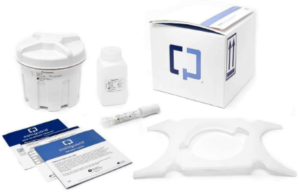
It does not diagnose this disease, but it uses the latest in DNA technology to detect cells that are abnormal.
The test is called Cologuard.
If the sample that you take from home is determined to contain abnormal cells, then a colonoscopy would be recommended.
Signs of Colon Cancer to Be on the Lookout For
Of course, you know that colon cancer can cause long, pencil-like bowel movements.
Or, with this disease, a bowel movement can come out resembling ribbons.
What would really increase the suspicion for colon cancer are additional signs such as blood in your stools, abdominal pain unrelated to BMs, and unexplained fatigue and weight loss.
Colorectal cancer can also cause a sensation that you still have BMs that need to come out, even though you just had a bowel movement.
Sometimes this is normal, and very soon after, you have another movement, and all is fine.
But colon cancer may create this sensation because the tumor itself is positioned in a way that makes a person feel as though they did not fully evacuate — even though they actually did.
- Blood in the stools — can be red or dark
- Old blood in the stools can appear black or like a tarry substance.
- Stools that are like ribbons or pencil-thin
- A feeling of incomplete voiding after a bowel movement
- Unexplained constipation or diarrhea that persists
- Alternation between constipation and diarrhea
- Odd changes in bowel habits
- Abdominal pain or gas
- A feeling of bloating or cramping in the abdomen
- Unexplained weight loss
- Unexplained fatigue
- Unexplained back pain
 Dr. Binderow performs minimally invasive, robotic and laparoscopic surgery for Crohn’s disease, ulcerative colitis, colon cancer and other colorectal conditions. Adept at routine procedures, Dr. Binderow also sees patients with complex, atypical maladies.
Lorra Garrick has been covering medical, fitness and cybersecurity topics for many years, having written thousands of articles for print magazines and websites, including as a ghostwriter. She is also a former ACE certified personal trainer.
Top image: Shutterstock/dizain
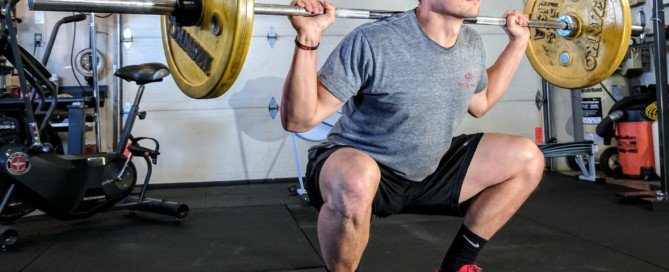
Image Lets You Change Femur Length to See How It Affects Squat
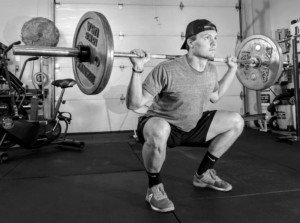
For critics who think long femurs don’t matter in the back squat, play around with this virtual squat application and find out the truth!
Whether you want to believe it or not, femur length relative to torso length is a major determinant in a person’s ability to efficiently perform a back squat.
It’s puzzling that many muscle builders dismiss the long femurs excuse as poppycock, when the physics of this are actually quite easy to conceptualize.
I found an incredible site that has an interactive squat application, where you can alter the body’s femur length while maintaining the length of all the other body parts and overall height.
Before you visit the site (hyperlink coming), don’t blow it off as just an illustration and not the real thing.
It’s a very accurate depiction of what happens during the back squat relative to the athlete’s femur length as it relates to torso length and body height.
Believe me, as a personal trainer, I have poured over this fascinating phenomenon and size up the anthropometrics of all of my clients.
This interactive squat will be great for people who find it difficult to visualize the effect of varying femur lengths on a person’s squat. Conceptualizing this comes extremely easy to some people, but tricky to others.
Athletes who can draw the human body should find it a breeze to conceptualize the effect of lever lengths on the squat exercise.
I myself have been illustrating the human figure since early childhood as a hobby, so it’s very easy for me to “draw” out all the possibilities and animate them in my mind.
But you need not be an artist to understand “levers” and how they apply to movement…
Here is the link to the virtual squat. Have fun playing around with this; it is SO cool!
Just move the little button left or right to alter femur length, then drag on the man’s hip to make him squat! Drag slowly or else he’ll pop back up to standing.
The interactive tool will not allow you to get him into an unnatural squat position, such as ridiculously forward knees to compensate for the long femurs (try doing that and watch what happens!).
The interactive squat allows you to create crazy long femurs as well as crazy short thighs. This virtual tool will put to rest any of the rants by the critics.
Now, before you insist that the low and high end of the tool’s adjustment for femur length shows unrealistic proportions, keep in mind that even if that button goes just a LITTLE bit towards the long femur end (or short end), this makes a notable difference in squat mechanics.
Plus, there actually are people who have thighs so long (or so short), that this is a noticeable feature of their physique. Some people are self-conscious of their “long-ass femurs” or “stubby thighs.”
Though the guy with the short legs (including very short femurs to tibia ratio) and super long torso may be envied for his potential squatting ability, it’s important to know that no one body type can excel in all physical feats.
You’ll be quite hard-pressed to find any short legged, long-torso athletes in the Olympic sprint lineups.
Lorra Garrick is a former personal trainer certified through the American Council on Exercise. At Bally Total Fitness she trained women and men of all ages for fat loss, muscle building, fitness and improved health.
.
Source: athleticdesign.se/athletics/squat_article_1_english_page2.html#application1
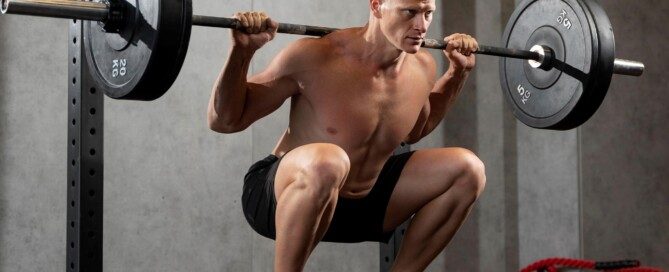
Long Femurs vs. Short Shins when Trouble Squatting
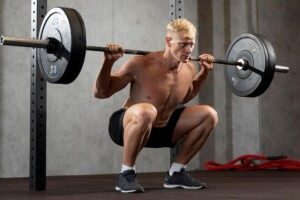
Maybe it’s not your long femurs, but your short shins that make squatting troublesome.
There’s a lot of stuff out there about femur to torso ratio when discussing the back squat.
The “bad levers” of femurs longer than the torso for squatting (including for Olympic style lifting) get a lot of attention in training forums, but something gets very much overlooked: femur to shin ratio.
As a former certified personal trainer, I’m always looking for this trait in people, but it’s quite uncommon.
See the diagram below. Though crude, it clearly shows the disadvantage of having a short shin to longer femur ratio.
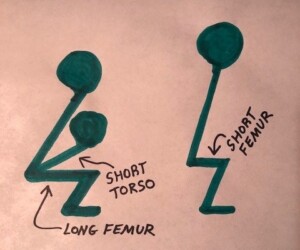
What happens when they parallel squat?
The figure with the short shin can’t get his feet under his hip bones. There just isn’t enough shin length to act as a “pedestal” for his squatting body.
Because his shins are so short, his feet are displaced far forward of his hips, requiring him to have an excessive forward lean — even though his femurs may be the same length as his torso or even shorter.
The second figure has no problem sitting down into a squat while his back stays closer to upright than folded over.
Because there is more length in his shins, his feet are more under his hips.
This means he doesn’t have to lean that far forward to get his shoulders over his feet. Think of his super long shins as supportive pedestals to just sit on.
The long femur in relation to short shin is a proportion that is not determined by overall body height.
Thus, a very short person can have femurs several inches longer than their tibias, and a very tall individual can have shins four inches longer than their femurs.
Conversely, a 5’4” athlete can also have short stubby femurs, such that most of the leg is tibia, and a 6’7” athlete can be mostly femur.
- Overall body height is not a factor in the femur-to-shin ratio.
- Torso length will vary and is not related to femur-to-shin ratio.
So if your femurs aren’t longer than your torso yet you fall backwards as your squat nears parallel, it could be due to not having long enough “pedestals” to support your body.
Short shins prevent the feet from getting far enough under the hips — the feet are displaced too far forward. So to get the shoulders over the feet, you may need to practically fold in half.
So how does someone with these levers do a back squat without folding in half?
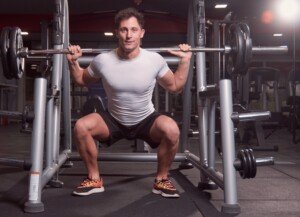
Widen the stance (this will take getting used to and increasing the hip flexibility) until you no longer must double over.
Shutterstock/HD92
The knees must track over the feet when squatting with a wide stance.
Pointing the feet outward to 20-30 degrees will make the squat even more doable for someone whose shins are disproportionately short for the rest of their body.
Lorra Garrick is a former personal trainer certified through the American Council on Exercise. At Bally Total Fitness she trained women and men of all ages for fat loss, muscle building, fitness and improved health.
.
Top image: Freepik
High Intensity Interval Training for Overweight People

There is no medical reason why an overweight person cannot or should not do high intensity interval training (HIIT).
However, the modality of the exercise would certainly come into play for an extra heavy body.
- High intensity interval training doesn’t have to be speedy or fast in order to be effective.
- The ability to run is not required.
Many people associate high intensity interval training with sprinting and jumping.
Though fitter, swifter people who want to do HIIT will be drawn to sprinting and jumping as the modes, this does not mean that slow movement can’t be effective for a HIIT workout.
Effort Is the Key
High intensity interval training is about effort, not speed.
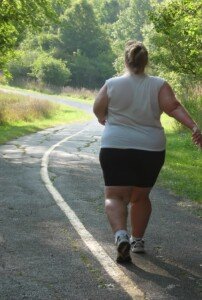
An effective HIIT session for a very overweight man or woman could be their fastest walk — absolute fastest — up a slight hill in a road.
After about 30 seconds, they can then walk slowly and comfortably in the opposite direction back to where they began, catching their breath all the way.
After a minute or two, they can then power walk — truly as quickly as possible — once again down the road.
Though this isn’t a speedy workout, it’ll be quite effective for a very heavy person whose body is only used to slow movement.
At an all-out effort of charging up that slight hill, this will be enough to really exhaust the overweight body, even though running or high speeds are not involved.
Staircase charging is another option. For a plus size individual, briskly marching up steps can be grueling — and very effective at burning fat.
Other than Walking
Walking as fast as possible is but one of many modes for HIIT.
Other options for an obese man or woman include quickly stepping up and down the first stair of a staircase, and cardio equipment such as an elliptical machine and stationary bike.
This means pedaling for about half a minute at your maximal speed, relative to the pedal resistance.
Following that would be an easy pedal for one or two minutes.
Then after your recovery interval, you repeat the sprint pedaling.
The bottom line is that the settings for that 30 second segment are such that 30 seconds leave you nearly breathless.
You can also try HIIT using varied work intervals if they work better for you, such as 15 or 20 seconds for the exertional phase, or a little longer than 30 seconds for the hard effort.
Lorra Garrick is a former personal trainer certified through the American Council on Exercise. At Bally Total Fitness she trained women and men of all ages for fat loss, muscle building, fitness and improved health.
.
Top image: Shutterstock/Africa Studio
Glucerna Ingredients Include Soy & Artificial Sweeteners
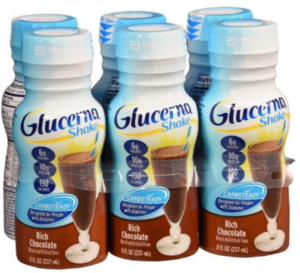
Is Glucerna really healthy for people with diabetes, since these products are so highly processed?
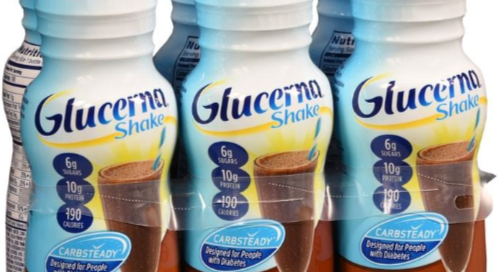
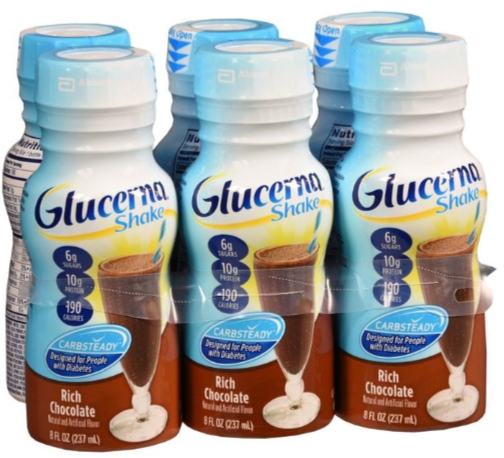
The Glucerna trademarked slogan is “Smart nutrition for people with diabetes.” Perhaps you’ve seen TV commercials for Glucerna, and if diabetic, have concluded that these products are super healthy for the human body.
Below are the ingredients for Glucerna’s “snack shake,” chocolate — and these ingredients are similar to those of Glucerna’s chocolate bars.
Water, corn maltodextrin, fructose, milk protein concentrate, glycerine, high oleic safflower oil, cocoa powder (processed with alkali), less than 1% of: sodium caseinate, canola oil, soy protein isolate, fructooligosaccharides, soy fiber, cellulose gel, natural and artificial flavors, sodium chloride, magnesium phosphate, potassium citrate, calcium phosphate, soy lecithin, cellulose gum, choline chloride, ascorbic acid, carrageenan, acesulfame potassium, potassium chloride, gellan gum, sucralose, and the remaining ingredients are vitamins and minerals, though ascorbic acid is vitamin C.
A health conscious person, whether diabetic or not, will notice several ingredients in Glucerna’s products.
These would be the soy, canola oil, artificial flavors, sucralose (an artificial sweetener), acesulfame potassium (another artificial sweetener) and fructooligosaccharides (yet another artificial sweetener).
Canola oil contains hexane and trans fats. Though this oil has some redeeming features, it makes sense that a health conscious person would want to avoid ingesting hexane and trans fats.
And soy — the unfermented kind — has been linked to some health issues, and its effect on the body is debatable as far as beneficial vs. potentially harmful. Plus, some people are allergic to it.
Processed soy in a bottle is not the same as tempeh or miso soup.
Need I say anything about artificial sweeteners? Well, one thing’s for sure: Scientists are divided on the safety and risks of artificial sweeteners, even though animal studies are quite compelling.
A diabetic may figure that controlled blood sugar trumps any possible harm linked to canola oil, soy or artificial sweeteners.
Final Verdict About Glucerna for Diabetes
The carbohydrates in Glucerna’s products are designed to be more slowly absorbed into the bloodstream, something that would appeal to diabetics for blood sugar management.
As far as strictly blood sugar absorption, a serving of Glucerna chocolate products are much better for a diabetic’s glucose metabolism than would be, say, a chunky piece of Betty Crocker devil’s food cake.
Both items are highly processed, but Glucerna is more preferable when you look at the overall picture.
So when you compare it to Duncan Hines, Betty Crocker or Walmart’s chocolate baked goods, Glucerna is the best option, relatively speaking.
The Glucerna “snack shake” is gluten- and lactose-free, and an 8 ounce can offers: 140 calories, 5 grams fat, 230 mg sodium, 19 grams carbohydrates, 3 grams fiber and 7 grams protein.
 Katie Tomaschko, MS, RDN, has a master’s degree in nutrition & dietetics and has studied nutrition for 12+ years. She owns a private practice where she conducts 1:1 private nutrition counseling. She is also the owner and contributing writer for sportingsmiles.com.
 Lorra Garrick has been covering medical, fitness and cybersecurity topics for many years, having written thousands of articles for print magazines and websites, including as a ghostwriter. She’s also a former ACE-certified personal trainer.
Sources hsph.harvard.edu/nutritionsource/2015/04/13/ask-the-expert-concerns-about-canola-oil/
thewholesoystory.com/index.php?pageID=Media

Childless Adults Qualified to Give Parenting Advice

After you read this, you’ll be convinced that sometimes, childless people are heavily qualified to dole out parenting advice!
But first, are you one who believes that people who’ve never had children are out of line for giving parenting advice?
According to this line of reasoning, any person who’s raised kids is qualified to give parenting advice. But come on, we know this is so far from the truth. Would YOU take parenting advice from Britney Spears, Kate Gosselin, Mama June or Bobby Brown?
Think of one of the most selfish, narcissistic, impatient and uncaring adults you know. Does that person have kids? What kind of parenting advice do you think they’re capable of giving?
Good parenting advice will come from loving, clever, creative, patient, affectionate and rational people.
And bad parenting advice will come from bitter, emotionally distant, self-centered individuals, especially those with anger management problems.
It doesn’t make any difference if this latter group has raised 10 children. This quantity simply means they’ve imposed their crippling traits on 10 kids, not zero.
“A person does not have to have walked in another person’s shoes in order to give them advice,” says Stacy Kaiser, a southern California-based licensed psychotherapist and relationship expert with a special interest in the topic of bullying.
“You do not have to have been an alcoholic to have suggestions for someone who drinks too much,” continues Kaiser with this analogy. “Similarly, you do not need to have a child to offer up parenting suggestions.”
Or as the saying goes, One need not be wearing your shoes to see that your shoelaces are untied.
It’s important to note that Kaiser says that “having lived the experience of being a parent, one does pick up tools and ideas that they may not have had,” in the absence of parenthood.
You may know of someone who has five kids and want parenting advice from them simply based on this.
- What if you learned that this adult was prone to temper outbursts and had little patience?
- What if you learned this individual never read to her children when they were very young?
- Never tucked them in bed?
- And when her daughter goofed up during a piano recital, the mom shamed her afterwards?
- Would you still want this woman’s parenting advice?
My brother sought parenting advice, prior to having children, from a psychiatrist who had no children.
My brother’s three kids are among the most self-confident, emotionally stable human beings I’ve ever met. They are what you’d say are “going somewhere big in life.”
Still think people without kids have no business telling others how to raise theirs?
Whom would you want as your young child’s nanny?
A 45-year-old narcissistic, impatient, arrogant, high-strung woman who’s quick to criticize over every little thing—but has raised four children?
Or a same-age woman who’s never had kids—but, is very tender, calm, patient, warm and cozy to be around, is quick to praise and is fun-loving and kind-hearted? The answer is a no-brainer.
Sometimes, a childless person is in a prime position to give parenting advice simply because they are skilled at creative problem solving. Sometimes they simply have common sense.
Sometimes it’s because their parents made enormous mistakes. An example might be a man named “Rob” giving advice to a buddy, “Steve,” who has a 13-year-old son on how to handle the son’s complaints that he’s getting bullied at school.
Maybe Rob was brow-beat by his father for being a “wimp” at school, and this made him even more vulnerable to the bullies, feeling more powerless.
This poor guy, as an adult, may very well have stellar advice for Steve that could lead to empowering the 13-year-old.
Isn’t it funny that the criticism of, “What do YOU know? You don’t have kids!” never applies to when the childless person gives advice that the parent actually agrees with? Now that’s something to really reflect upon!
An adult is either a bad person or a good person. Having kids usually will not alter that status.
With so many parents out there “screwing up” their children, how can anyone denounce the concept of childless people giving parenting advice?

With over 100 TV appearances on major networks including CNN, NBC, CBS and ABC, Stacy Kaiser brings a unique mix of provocative insight to many topics such as anger management, office relationship issues and parenting.
Lorra Garrick has been covering medical, fitness and cybersecurity topics for many years, having written thousands of articles for print magazines and websites, including as a ghostwriter. She’s also a former ACE-certified personal trainer.

Why Parents SHOULD Try to Be Popular with Their Kids!

There are reasons why you SHOULD try to be popular with your kids, including teens!
How many times have we all heard, “Parenting is not a popularity contest”? What this refers to is the observation that parents try to get their kids to “like” them, or are upset that their children or teens seemingly don’t “like” them.
They are reminded by other parents that being a parent isn’t a popularity contest.
But actually, it should be. Now think about that for a moment: If you’re popular with your kids…you’ll be the first, or at least one of the first, people they will come to for advice and counsel.
If you’re NOT popular with your children and teens, then gee…why on earth would they ever trust YOU with the big problems in their life (and by “big,” I mean not only what seems monumental to them, and what truly is monumental)?
So yes, parenthood should be a popularity contest.
The issue, then, is how to be popular with your kids. This is where some parents get off track.
But just because they get off track doesn’t mean it’s a mistake to try to be popular with your children or teenagers.
It’s simple: They won’t come to you for guidance if they don’t like you. They won’t listen to you if they don’t like you. They will tune you out if you’re not popular with them.
And I don’t mean technical guidance, such as how to cook something, how to do something on the computer, how to work with your phone’s new app, or help with some story problems in math.
I’m talking about life advice. Parents who are popular with their kids will be the first picks when it comes to life advice.
- If your children like you, they will take your lead and admire you.
- They will trust you.
- They will talk to you.
- They will listen. And isn’t all of that what you want?
Would YOU ever seek counsel from another adult—if you didn’t like that person?
Of course not! Imagine how uncomfortable you’d feel if you tried to pour out your troubles and worries to someone whom you did not like. Think about that.
And even if they offered good advice, you’d be hearing it through a skewered lens, and thus would miss its merit.
Now imagine how difficult it would be for someone whose brain isn’t even finished developing to share their concerns and anxieties with someone they didn’t like.
As a parent, your goal should be to get your kids to like you—and this is accomplished by making them feel they can come to you about anything without facing ridicule, criticism, judgment or anger.
You cannot buy your child’s trust and admiration.
So why do some parents scowl at the idea of being “popular” with their kids?
Other than the fact that some parents believe that in order to be “popular” with their children, they must spend a lot of money on the coolest gadgets and clothes for them (wrong, wrong, wrong!), the issue may very well be semantics.
“I prefer to say that parents want to be well-connected and close with their children than using the word popular,” says Stacy Kaiser, a southern California-based licensed psychotherapist and relationship expert with a special interest in the topic of bullying.
Kaiser continues, “Parents who are well-connected with their kids typically end up having children who are open with them, who will share things with them, and who will go to them for advice.
“As a parent, it is very important to always maintain the parental role. While we can be close with them and have a friendship with them, we must always remember that there is a hierarchy and that we are a parent.”
With over 100 TV appearances on major networks including CNN, NBC, CBS and ABC, Stacy Kaiser brings a unique mix of provocative insight to many topics such as anger management, office relationship issues and parenting.
Lorra Garrick has been covering medical, fitness and cybersecurity topics for many years, having written thousands of articles for print magazines and websites, including as a ghostwriter. She’s also a former ACE-certified personal trainer.
.
Top image: Freepik.com
Convincing a Doctor Dense Breasts Are a Serious Cancer Risk

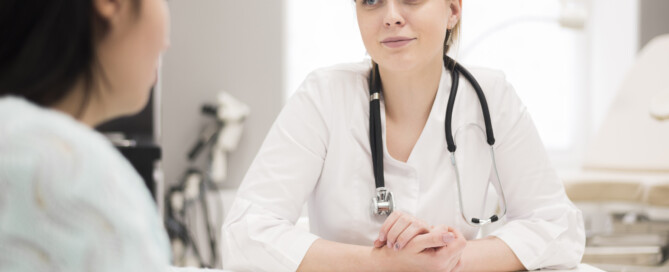
Not all doctors are on board with the studies that clearly show dense breasts are a significant risk factor for breast cancer.
If your doctor isn’t convinced, here’s material you can present to your doctor.
The issue of high breast density as a significant increase in the risk of breast cancer, and as something that makes it more difficult to be identified on a mammogram, is right about where the issue of smoking was about, say, 60 years ago.
At some point, maybe in the 1950s or 1960s, a lot of doctors began raising concerns about the dangers of smoking.
This hardly caught on like wildfire. It took many years for the entire medical establishment to catch on and have a universal consensus about the hazards of smoking.
We’re seeing this very slow spread of the truth with the breast density thing. Some gynecologists and gynecological nurses take this issue quite lightly and even recommend AGAINST the additional screening tools such as the ultrasound, for women with extremely dense breasts. They are WAY BEHIND the research.
They act as though, ho hum, it’s no big deal that a woman has extremely dense breast tissue.
Never mind that extreme breast density comes in third place for non-modifiable risk factors (after family history and BRCA mutations, in middle-aged women for whom advanced age is not yet a significant risk factor).
If you have such a physician or gynecological nurse who is in denial over the mounting evidence, below is information you can present to that individual. It will be very difficult for him or her to deny it:
We hope this study raises awareness that dense breast tissue is a risk factor for breast cancer and that alternative technologies, including automated whole-breast ultrasound and contrast-enhanced mammography, are available to aid in screening women with dense breasts.
Haatal B. Dave, MD, M.S., resident physician at Yale University School of Medicine in New Haven, Conn
sciencedaily.com/releases/2012/11/121127003317.htm
As far as screening programmes are concerned, it is already known that breast density is a risk factor for the occurrence of breast cancer and that it decreases the sensitivity of mammograms.
Our study confirms the importance of taking breast density into account in the screening setting.
Dr. Louise Eriksson, MD, Stockholm South General Hospital
ncbi.nlm.nih.gov/pmc/articles/PMC4010151/#:~:text=Although%20it%20remains%20the%20gold,dose%2C%20cost%20and%20patient%20anxiety.
Although mammography remains the gold standard for breast cancer screening, there is increasing awareness that there are subpopulations of women for whom mammography is limited because of its reduced sensitivity based on an individual’s breast density and other factors.
Jennifer S. Drukteinis, MD, assistant member in Moffitt’s Department of Diagnostic Imaging
news-medical.net/news/20130405/Researchers-say-breast-cancer-screening-requires-a-personalized-approach.aspx
Increasing age and high breast density are among the strongest risk factors for the disease.
Karla Kerlikowske, MD, a professor of medicine at UCSF and a physician at the UCSF-affiliated San Francisco VA Medical Center
ucsf.edu/news/2013/03/13682/biennial-mammograms-best-after-50-even-women-dense-breasts
The sensitivity of mammography is inversely proportional to breast density.
Blaise P. Mooney, MD, an assistant member in Moffitt’s Department of Diagnostic Imaging
moffitt.org/newsroom/press-release-archive/2013/moffitt-cancer-center-researchers-discuss-new-frontiers-in-breast-cancer-screening/
Clinical literature says that mammography eventually finds 85% of breast cancers, but for women with dense tissue, it’s often too late by the time the cancer is detected. MRI is near 100% sensitive for finding cancer in dense breast tissue. It’s the exam we’ve been waiting for, and it’s been available all along.
Dr. David Strahle, president of Regional Medical Imaging in Flint, MI
auntminnie.com/index.aspx?sec=ser&sub=def&pag=dis&ItemID=105131
“Women with radiologically dense breasts (heterogeneously dense or extremely dense in the terminology of the Breast Imaging Reporting and Data System [BI-RADS]) have a threefold to six fold increased risk of breast cancer compared with women who have fatty breasts.”
webmd.com/breast-cancer/tc/overview-risks-breast-cancer?page=3
Women with dense breasts are four to five times more likely to get BC, say these sources:
– Boyd NF, Guo H, Martin LJ, et al. Mammographic density and the risk and detection of breast cancer. N Engl J Med. 356(3):227-36, 2007.
– Yaghjyan L, Colditz GA, Collins LC, et al. Mammographic breast density and subsequent risk of breast cancer in postmenopausal women according to tumor characteristics. J Natl Cancer Inst. 103(15):1179-89, 2011.
“Tumors also are dense tissue and appear as solid white areas on the mammogram. This can make it more difficult to detect a tumor in dense breasts because it looks a lot like the dense tissue that surrounds it.”
Lorra Garrick has been covering medical, fitness and cybersecurity topics for many years, having written thousands of articles for print magazines and websites, including as a ghostwriter. She’s also a former ACE-certified personal trainer.
.
ocregister.com/articles/breast-540118-dense-cancer.html
Top image: Freepik


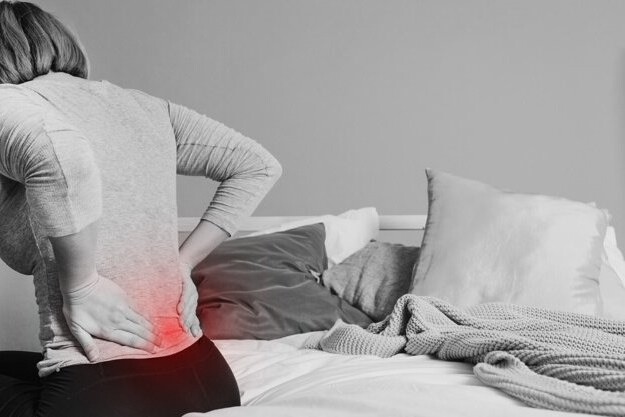
Low Back Pain in the Morning: Causes & Solutions
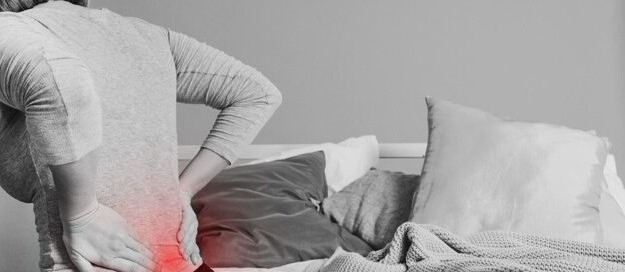
If you’re fed up with morning back pain, a chiropractor explains the causes and how to treat this problem.
“When low back pain predominantly begins in the morning, the source is often from arthritic facet joints and degenerative changes,” begins Dr. Jeff Langmaid, DC, Founder/owner of The Evidence Based Chiropractor, LLC, in Florida, a research-based marketing and practice growth company that serves thousands of chiropractors across the world.
“Often, patients will tell their health care provider that it takes them a while to ‘get their engine going,’ or sometimes it takes a few minutes before they are able to stand up without fear of a painful episode.
“Others will say that they have to take a hot shower before ‘things loosen up’ enough to get moving throughout the day.”
Cause of Morning Back Pain Explained in Detail
Dr. Langmaid says, “When we go to sleep at night, the capsules around the facet joints of our spine essentially shrink because we don’t move as much at nighttime as we do during the day.
“When we wake up in the morning, it can take a little bit of time to get the blood pumping to the surrounding muscles and tissues to lubricate those facet joints.
“This is the same for any degenerative spine condition that creates stiffness or pain that predominantly takes place in the morning.
“As we go through our normal ranges of motion, it pumps blood to the area and creates a more dynamic environment as we get our day started.”
Solutions
“Common solutions are to take a hot shower, which will increase the blood flow to the area and can loosen up that tissue as you start your day,” says Dr. Langmaid.
“Some of the other things that can be extremely helpful are going through a stretching routine that is approved by your health care practitioner.
“One thing that I think has been of great value to some of the patients I have had in the past is to perform a stretching routine before you go to sleep at night.
“Many people report waking up with less pain, stiffness and dysfunction when they’re able to do some stretching before they go to sleep at night and when they wake up in the morning.”
 Jeff Langmaid, DC
Lorra Garrick has been covering medical, fitness and cybersecurity topics for many years, having written thousands of articles for print magazines and websites, including as a ghostwriter. She’s also a former ACE-certified personal trainer.
.