

Back Cracks During Sit-Ups: Causes & Solutions

Find out from a chiropractor, not a layperson or “fitness expert,” why your back cracks during sit-ups and what to do about this annoying and to some people, unnerving response to the exercise.
A personal trainer is perhaps not the best person to explain why your back makes cracking sounds when you do sit-ups.
“Back cracking during sit-ups, or during any activity, is commonly caused by the facet joints gapping or spreading,” explains Dr. Jeff Langmaid, DC, founder/owner of The Evidence Based Chiropractor, LLC, in Tampa, FLA, a research-based marketing and practice growth company that serves thousands of chiropractors across the globe.
Dr. Langmaid continues, “The facet joints are load-bearing joints on the posterior, or the backside, of the spine.
“As they go through their range of motion, they can release gas, causing a ‘pop,’ ‘click’ or ‘cracking’ sound — similar to a knuckle.
“Most often that sound does not indicate pain, but on occasion, it certainly can.”
The cracking sound is due to the release of gas bubbles from the synovial fluid which helps lubricate the joints.
So when your back cracks while you do sit-ups, this is normal as long as there is no pain, and it’s nothing to worry about. However, for some people it can be annoying.

Source: myupchar. com
Dr. Langmaid explains, “In terms of solutions to eliminate back cracking, one option would be to not extend into that full range of motion, as cracking often occurs when the joint is stretched.”
The stretching can make one of those gas bubbles pop.
“Occasionally, cracking can be accompanied by pain,” says Dr. Langmaid.
“Not going through the full range of motion and staying in a safe and controlled range of motion can prevent the joint from fully gapping and reduce the snapping, popping, clicking or cracking sound.
“Additionally, when performing sit-ups, it is imperative to use proper technique.
“This will allow you to maximize the workout and gain optimal muscle strength without placing too much stress on your spine.”
Proper Technique for Sit-Ups
To perform a sit-up correctly, start by lying on your back with your knees bent and feet or heels flat on the floor.
Place your hands behind your head, at its side or across your chest, making sure not to pull on your neck or head.
Engage your core muscles and slowly lift your upper body towards your knees without rounding your back, ideally keeping your lower back pressed to the floor.
Exhale as you come up and pause briefly at the top before lowering your back down with control.
Finally, you should avoid using momentum or jerking movements.
Proper technique with the sit-up is not a guarantee that your back won’t crack, but at least now you know that it’s just a normal occurrence when bubbles form in the synovial fluid and they get popped.
 Jeff Langmaid, DC
 Lorra Garrick has been covering medical, fitness and cybersecurity topics for many years, having written thousands of articles for print magazines and websites, including as a ghostwriter. She’s also a former ACE-certified personal trainer.
.
Top image: Shutterstock/wavebreakmedia

What REALLY Happens when a Mole “Appears” Overnight
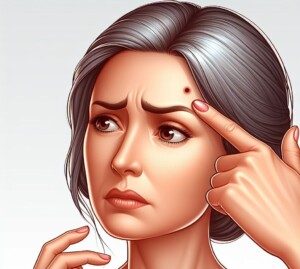
So you’ve discovered a “new” mole that has appeared overnight; however, things aren’t always as they seem.
“There really isn’t such a thing,” says Gary Goldenberg, MD, of Goldenberg Dermatology, and assistant professor of dermatology and pathology at Mount Sinai School of Medicine.
“People often talk about something appearing overnight, but it’s not possible,” he continues.
“There are some tumors that grow rapidly, such as keratoacanthoma, but even these take several weeks on average.
“Most growths appear over time, but the person may not notice these, and then all of a sudden notices the lesion and thinks it appeared overnight.”
Don’t Get Caught off Guard
Here’s what you should do to ensure that you aren’t caught off guard by a mole that seemingly develops overnight: Create a mole map of your body.
This won’t be practical if you have a high number of moles, but even then, you may want to construct a map of perhaps one portion of your body that isn’t heavily peppered with moles.
Or, you can map out specifically those moles that are bigger.
Look at various parts of your body and, with a large sketch pad and a pencil, indicate the location of the moles (it helps to be able to draw, but even if you’re not skilled in this area, do your best; it will certainly help you get to know your moles).
If you find this task too daunting, you may want to consider serial digital dermoscopy, a technology for tracking suspicious changes in moles over time.
There are various apps available as well that can help track changes in moles.
These apps are not meant to diagnose. They are only meant to provide a visual guide to any changes in a pigmented lesion over a course of time.
You should also be consistent with monthly or at least, every two months, self-exams of your skin, including awareness of areas that don’t have any moles.
Keep in mind that a very tiny scab can pass as a mole that appears overnight.

Dr. Goldenberg of Goldenberg Dermatology provides comprehensive care in medical and cosmetic dermatology, including melanoma and other skin cancer, moles, psoriasis, eczema and acne. He is the medical director of the Dermatology Faculty Practice, NY.
 Lorra Garrick has been covering medical, fitness and cybersecurity topics for many years, having written thousands of articles for print magazines and websites, including as a ghostwriter. She’s also a former ACE-certified personal trainer.
.
Top image: ©Lorra Garrick

Dark Spot on Lip Can Be Melanoma

A new appearing dark spot on your lip can be melanoma, the most serious form of skin cancer, says a dermatologist.
But a new appearing dark spot on the lip can have benign causes.
The older you are, the more concerning a new appearance of any kind of “freckle” or “mole” is.
Dr. Janet Prystowsky is a board certified dermatologist in New York, NY, with 30+ years’ experience.
She says that a dark spot on the lower lip usually is not a melanoma, but at the same time, you should have a dermatologist obtain a biopsy.
“Lip cancers metastasize [spread] more readily than other skin cancers,” says Dr. Prystowsky. A melanoma on the lip, therefore, “has a much higher risk of causing death.”
Do not let fear of a scar from a biopsy stop you from getting this procedure done.
A dark spot on the lip is suspicious for melanoma if it has the following features, says Dr. Prystowsky.
It’s new, rather than always having been there for as long as you can remember. As mentioned, concern is heightened the older you are.
“Has it been growing or changing in some way?” she questions. If the answer is affirmative, this could signal a problem.
Bleeding is another factor. If you pick at a benign lesion, it could bleed, but in melanoma, the bleeding comes more readily.
“Does it have an irregular appearance or border?” asks Dr. Prystowsky.
If you bisect it from any point, are the sides notably unequal?
Does the border look serrated or erratic?
Is it more than a few millimeters, and especially, has it been getting bigger over just a few months?
Does this dark spot on your lip have one or more other colors in it? For instance, is part of it blue, white or red?
Don’t try to self-diagnose.
Though the absence of some features may bring reassurance that the dark spot on your lip is not a melanoma, only a biopsy could rule it out for sure, though the benign “venous lake” (blood vessel concentration that forms a dark spot) can be diagnosed without a biopsy. A “melanocytic macule” is also benign.

In combination with her focus on early skin cancer detection and removal, Dr. Prystowsky provides a wide range of revitalizing and rejuvenating treatments.
Lorra Garrick has been covering medical, fitness and cybersecurity topics for many years, having written thousands of articles for print magazines and websites, including as a ghostwriter. She’s also a former ACE-certified personal trainer.
Top image: Shutterstock/New Africa

Small White Itchy Bumps on Palms: Explanations

The good news is that cancer does not cause little itchy white bumps on the palms.
The not-so-great news is that it may not be easy to find out what’s causing this very annoying symptom.
There are several possible causes of small, itchy white bumps appearing on your palms, says Dr. Janet Prystowsky, board certified dermatologist in New York, NY, with 30+ years’ experience.
She explains, “Small white bumps on your palms are usually flat warts, although they may not itch.”
Warts are caused by a viral infection with the human papillomavirus (HPV).
These warts are typically smooth and only slightly elevated, making them less noticeable compared to other types of warts.
Flat warts, which can appear in clusters, are common and can spread through direct contact with infected surfaces or from person to person.
“Dyshidrotic eczema commonly occurs on many people’s palms,” continues Dr. Prystowsky.
“It is a collection of fluid-filled bumps that look like tiny, flesh-toned blisters.”
The little bumps of dyshidrotic eczema may also have a slight pinkish tinge.
These can itch like mad and may also appear on the edges of one’s fingers, toes and the bottoms of the feet.
The image below shows dyshidrotic eczema on a finger.
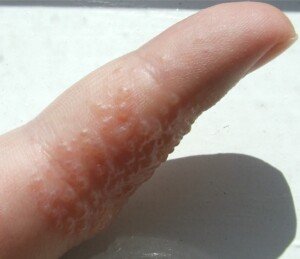
dyshidrotic eczema, Maslesha,CC BY-SA
Dyshidrotic eczema — which you should never scratch — has no cure but it’s manageable with proper care. The condition is not contagious.
If the situation with your palms can accurately be described as “lots of very small white-flesh, flesh-toned or flesh-pink colored bumps that itch,” then it’s a good bet that you have dyshidrotic eczema.
A dermatologist can easily make the diagnosis.
Dr. Prystowsky adds, “Contact allergen may also cause fluid-filled, flesh-toned bumps on the palms and sides of your fingers.”
Take inventory of any chemicals that might be coming in contact with your hands throughout the day. This includes household cleaners.
If you’re wondering if the problem is poison ivy, Dr. Prystowsky says, “Poison ivy rashes, however, do not usually cause a reaction on the palms or soles.”
It’s important to see a dermatologist to get the precise diagnosis.
Don’t Make the Itching Worse
The itching could be quite annoying with these conditions — but it can’t be said enough: Do not scratch!
When you scratch an itch, it activates certain nerve endings in the skin, which can initially provide temporary relief by interrupting the itch signal.
However, this action also stimulates additional nerve receptors and increases the release of inflammatory substances such as histamine.
The more you scratch, the more those small, white bumps on your palms will itch, regardless of their origin.
Additionally, scratching can damage the skin, leading to further inflammation and irritation, which can intensify the itch.
In combination with her focus on early skin cancer detection and removal, Dr. Prystowsky provides a wide range of revitalizing and rejuvenating treatments.
Lorra Garrick has been covering medical, fitness and cybersecurity topics for many years, having written thousands of articles for print magazines and websites, including as a ghostwriter. She’s also a former ACE-certified personal trainer.

6 Excuses Parents Make for Their Out of Control Children

Classic Statements that Parents Make that Are Code for “I can’t control my kids!”
Parents who can’t or won’t control their children almost always hide behind age-old statements in an effort to get off the hook.
Over the years, I’ve heard these half-baked statements, and I’m sure you have too, that parents make when they’re in denial that they have no control over their kids.
Remember, it’s never the young child’s fault. People call out-of-control or rude kids “brats” and other not-so-nice names, but the way that children behave is directly the result of how their parents are raising them. So cut the young ones some slack.
“Kids will be kids.”
This is as old as the hills. Funny thing, though, when parents use this line, they’re very selective about it.
If they truly believe that kids will be kids and therefore, let’s let them get away with doing whatever they please — then why not let them eat whatever they want? Ice cream for dinner and never any vegetables, for instance?
And let them get filthy from playing in a mud puddle and let them put glue in their hair while you’re at it. After all, kids will be kids!
“You obviously don’t have kids.”
This remark comes from parents who believe that every parent on earth thinks exactly as THEY do, and anybody who disagrees is childless. This is binary thinking and totally lacks logic.
The message with this defense is that in order to recognize that a child is out of control or behaving badly or inappropriately, the observer absolutely must have children of their own.
The funny thing is, is that often, this defense is directed towards people who do, indeed, have children—simply because most adults have kids!
“She’s just a free spirit.”
Letting your child be a free spirit is great (think running in the park flying a kite), but being permitted to dash all about a restaurant like a pinball and shriek and holler, disrupting diners’ eating experience, doesn’t qualify as free spirited.
That’s like calling your child a “free spirit” when they decide to splatter paint on your new $500 sofa.
“You know how little boys are.”
How are they? Are they supposed to trample the neighbor’s flower bed?
Are they supposed to chase each other in and out of store aisles, nearly colliding with customers?
“It’s good to let kids express themselves.”
True, so that’s why wise parents will buy their children implements for expressing themselves such as art supplies, musical instruments, a diary and sign them up for various classes like clay working, water color painting, jewelry making, woodworking, dramatic arts, etc.
But running haywire through a health club while people are working out? This is an out-of-control child whose parents have their head in the sand.
Otherwise, why not give this same excuse to adults who are wild and loud?
What if your adult neighbors are hollering and whooping it up at 10 pm on their porch, the heavy metal music cranked up?
What if when you asked them to tone things down a bit, they responded, “We’re just expressing ourselves!”?
“I suppose YOUR kids are perfect?”
The behavioral nature of the critic’s children is not relevant to the matter at hand.
It’s not relevant to, for example, someone’s five-year-old shrieking and bouncing all over the lobby at the DMV because the child’s mother has her thinking it’s a playground.
Allowing the little girl to behave this way is wrong, whether the critic’s own five-year-old trampled the neighbor’s garden yesterday or not.
“Sometimes parents will minimize their children’s behavior by saying things like, ‘He was just playing when he hit her,’ or, ‘She watches a lot of television and that is where she learned to swear,’” says Stacy Kaiser, a southern California-based licensed psychotherapist and relationship expert with a special interest in the topic of bullying.
Kaiser explains, “Oftentimes, parents will just throw up their hands and imply that they have no control over their children and they simply do not know what to do.
“This is a way of denying responsibility and acting as if their child is outside of their control.”

With over 100 TV appearances on major networks including CNN, NBC, CBS and ABC, Stacy Kaiser brings a unique mix of provocative insight to many topics such as anger management, office relationship issues and parenting.
Lorra Garrick has been covering medical, fitness and cybersecurity topics for many years, having written thousands of articles for print magazines and websites, including as a ghostwriter. She’s also a former ACE-certified personal trainer.

Is Laughing AT Children by Adults Harmful to Self-Esteem?

Ever notice how adults always laugh AT young children whenever the little kids are answering a question or explaining something?
Have you ever noticed that on any kind of talk show in which a child is being interviewed or asked questions, the audience laughs at the child’s response, or at the way they explain things?
This happens only when the youngster is under the age of 9 or so. I’ve never witnessed this phenomenon when the child appears to be older than 9.
Why do the adults in the audience laugh?
(I’ve also witnessed this phenomenon plenty of times in person, so I certainly don’t mean to imply it occurs only in live studio audiences.)
It’s one thing if the child is telling jokes and delivering punch lines as part of a comedy act, or obviously trying to elicit chuckles from listeners.
But this is not what I’m referring to.
The child is simply answering questions about a variety of topics, for whatever reason he or she is on the TV show for.
Why do adults feel a need or compulsion to laugh (and it often sounds “canned”) just because a young child is answering questions or explaining something?
- Yes, we all know that young children aren’t very articulate.
- Their vocal mannerisms and inflections can be quite quirky.
- Their voices may fluctuate among different tones and pitches.
- They may contort their faces and mouths while speaking.
But is this any reason to laugh at them?
Why is it so hard for adults to just sit tight and silently as young kids talk?
These same men and women wouldn’t dare laugh out loud AT another adult talking about the same topic!
Imagine what some 5-, 6-, or 7-year-old must feel like, hearing all this laughter erupt, after they explain something or answer some questions.
Might this reaction from adults make a little boy or girl feel inept, weird or like an oddball?
“The answer to this depends on several factors,” begins Stacy Kaiser, a southern California-based licensed psychotherapist and relationship expert with a special interest in the topic of bullying. They are as follows:
– The closeness of the relationship, if any, between child and adult
– Child’s maturity level and awareness of what’s taking place
– “Culture in the child’s family when it comes to humor,” says Kaiser
– Child’s self-esteem
– Intent behind the laughter
Kaiser explains, “Some children can be very perceptive and know what is underlying an adult’s laughter. The question is – is the child being laughed at or laughed with? If the child is able to determine the difference it could impact his or her self-esteem.”
This article, as already mentioned, deals specifically with laughing AT. Watch any talk show in which a boy or girl under age 9 is a guest.
But TV aside, you’ll see this phenomenon universally in any setting in which a young child is talking to adults — regardless of topic.
Again, I do NOT mean little kids deliberately hamming it up while wearing a crazy wig or while imitating a funny cartoon character.
I’m referring to when young kids are engaged in conversation with adults or answering questions.
I’ve witnessed hurt on the faces of ADULTS who are laughed AT by other adults.
I wonder if these same “hurt” adults laugh at little children who are merely answering a question or describing a situation.
Suppose adults engage you into conversation, and you quickly notice they are laughing AT you as you describe — without trying to be comical — your day or some event.
Chances are pretty high that the self-consciousness would begin kicking in.
If you already have a less-than-robust baseline of self-esteem, you’ll begin wondering what your shortcomings are in social situations that make people laugh AT you.
Other adults, with a stronger baseline, won’t give a hoot if listeners are laughing AT them.
And yet a third demographic will stop talking and snap, “What’s so funny?”
Adults who laugh AT children claim it’s because they’re cute, adorable and charming.
“No one likes to be laughed at,” says Kaiser.
“However, if a child has been raised in a family where people tease one another or laugh at one another, he or she is more likely to be able to withstand someone laughing at him.”
But if you laugh at kids you don’t know well, then you don’t know what kind of family structure they have, do you?
There are people who believe all of this laughing is perfectly okay; otherwise we’d be raising kids with weak backbones.
Ironically, it’s a fair bet that these very critics are often the first ones to become very defensive when someone gently criticizes them or even makes a little suggestion!
If you don’t want your child to grow up to be “weak,” then enroll them in martial arts, encourage them to speak their opinions (without swearing or yelling), and give them plenty of opportunities to figure things out for themselves and make choices (within age-appropriate parameters).
These three approaches are part of the recipe for becoming a very successful, self-confident, rock-solid adult.
“If a child is uncomfortable or self-conscious because they are being laughed at, it could impact their self-esteem, make them turn around and make fun of others, or make them withdraw and even isolate completely,” says Kaiser.
For those who believe it’s perfectly okay to laugh AT little kids, here’s a few questions:
- Why do you impose an age cut-off where you’d no longer do this?
- Is it because any child over the age of 9 can’t be adorable and cute?
Again, imagine you’re explaining something at a business meeting, and you begin hearing this chuckling and muffled laughter coming from several co-workers.
How would you feel? Imagine asking them why they were laughing at you, and they say it was because you were cute and charming. Would you buy this?
So why should a child be any better at processing being laughed at?
With over 100 TV appearances on major networks including CNN, NBC, CBS and ABC, Stacy Kaiser brings a unique mix of provocative insight to many topics such as anger management, office relationship issues and parenting.
Lorra Garrick has been covering medical, fitness and cybersecurity topics for many years, having written thousands of articles for print magazines and websites, including as a ghostwriter. She’s also a former ACE-certified personal trainer.

Causes of Red Spots on Your Inner Thigh

Red spots on the inner thighs are annoying, whether you’re at the beach in a bikini or even at home lounging around by yourself.
There are four causes of red spots on the inner thighs that deserve some attention, says Dr. Janet Prystowsky, board certified dermatologist in New York, NY, with 30+ years’ experience.
Irritation of Hair Follicles — First Possible Cause
“If your thighs rub together, your red spots could be irritated hair follicles,” says Dr. Prystowsky.
Weight loss will help remedy this problem.
Here is the wrong way to trim “fat” inner thighs: inner thigh machine at the gym.
Please, don’t bother. When used correctly, this apparatus (also called seated hip adduction) will firm the muscles of the inner thigh.
But it will not shear off fat and thus, it will not alleviate the rubbing.
The only way to lean out the inner thighs is to lose overall body fat.
And the best way to do that is a combination of portion control, interval cardio and compound strength training.
Strength training exercises such as the deadlift (shown below), squat variations, overhead press with kettlebells, dumbbells or a barbell, the seated row and various chest press routines will trigger fat burning throughout your entire body.
This will include the excess fat between your thighs that causes them to make contact and lead to those red spots and irritated hair follicles (you may not necessarily be able to see actual hairs in that area).

Freepik..com
Molluscum Contagiosum
Dr. Prystowsky continues, “You can get rashes from molluscum contagiosum (a virus). A viral wart can look red.”
Molluscum contagiosum is caused by a viral spread through skin contact, shared objects or sexual contact, leading to small, painless bumps.
Insect Bites or Poison Ivy
Insect bites or poison ivy, says Dr. Prystowsky, are the next two possible causes of red spots on your inner thighs.
With insect bites, it’s not likely that there will be a peppering of red spots, but rather, just a few here and there.
The aforementioned four causes of red spots can also occur elsewhere.
For instance, hair follicle irritation can occur under the arms.
Red spots on the inner thigh have additional causes, such as angiomas — which can occur nearly anywhere, are harmless and don’t itch.
Here is a large list of possible causes (including cancer) of red spots, dots or specks on any part of your body.
In combination with her focus on early skin cancer detection and removal, Dr. Prystowsky provides a wide range of revitalizing and rejuvenating treatments.
Lorra Garrick has been covering medical, fitness and cybersecurity topics for many years, having written thousands of articles for print magazines and websites, including as a ghostwriter. She’s also a former ACE-certified personal trainer.
.
Top image: Shutterstock/GBALLGIGGSPHOTO

Red, Itchy Bumps All Over Your Body Come from WHAT?

A dermatologist gives five possible causes of itchy red bumps all over your body…
Dr. Janet Prystowsky, board certified dermatologist in New York, NY, with 30+ years’ experience, describes five possible causes, in no particular order.
She explains, “Hives are an outbreak of pale, red, itchy bumps caused by an allergic reaction.
“Contact dermatitis, like the rash you get from poison ivy, occurs when you touch something that you are allergic to as well.”
It may prove to be challenging to figure out just what it is you’re allergic to, if this is the cause of your symptoms.
Dr. Prystowsky continues, “Erythema multiforme is an immune reaction to an infection, drug, or hormones.
“A form of cutaneous T cell lymphoma can cause red, itchy bumps. Widespread red itchy bumps would rarely signify cancer. However, in the case of cutaneous T cell lymphoma, this does represent cancer.”
Finally, bug bites can cause this symptom, but more likely than not, you’ll know if you’ve been bitten by bugs, such as during sitting outside in the evening, you have to keep swatting away mosquitos and feel them “biting” you.
Most Common Causes
“Most common causes of red bumps are allergy reactions to medications, plants or insects,” says Dr. Prystowsky.
In combination with her focus on early skin cancer detection and removal, Dr. Prystowsky provides a wide range of revitalizing and rejuvenating treatments.
Lorra Garrick has been covering medical, fitness and cybersecurity topics for many years, having written thousands of articles for print magazines and websites, including as a ghostwriter. She’s also a former ACE-certified personal trainer.
.
Top image: Shutterstock/pathdoc
4 Causes of Black Spot on Lower Lip, Says Doctor
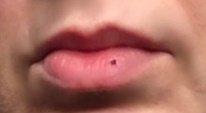
If that black spot on your lower lip is scaring you, a dermatologist explains four possible causes including cancer.
Keep in mind that what appears to be black may actually be a deep dark purple, or, if the speck is small enough, you may notice upon very close inspection that it’s actually medium brown.
The benign melanocytic macule can be medium brown, but so can the dangerous melanoma.
Dr. Janet Prystowsky is a board certified dermatologist in New York, NY, with 30+ years’ experience.
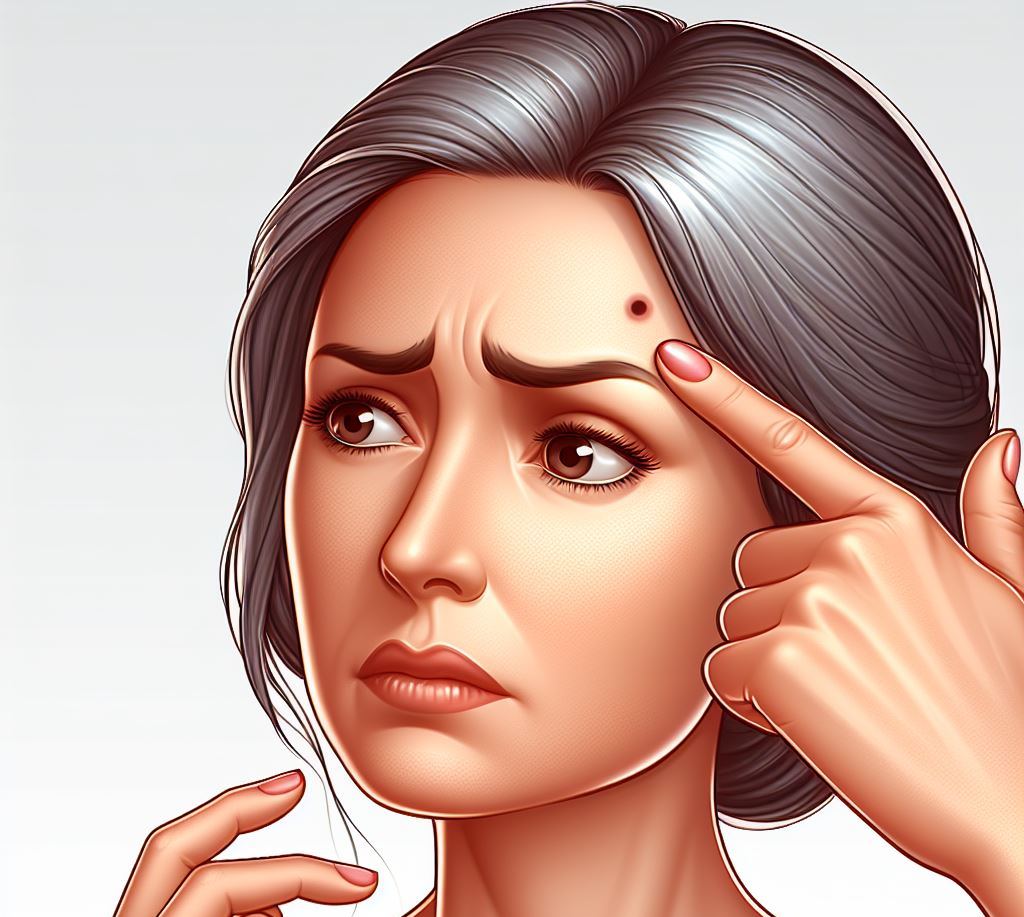
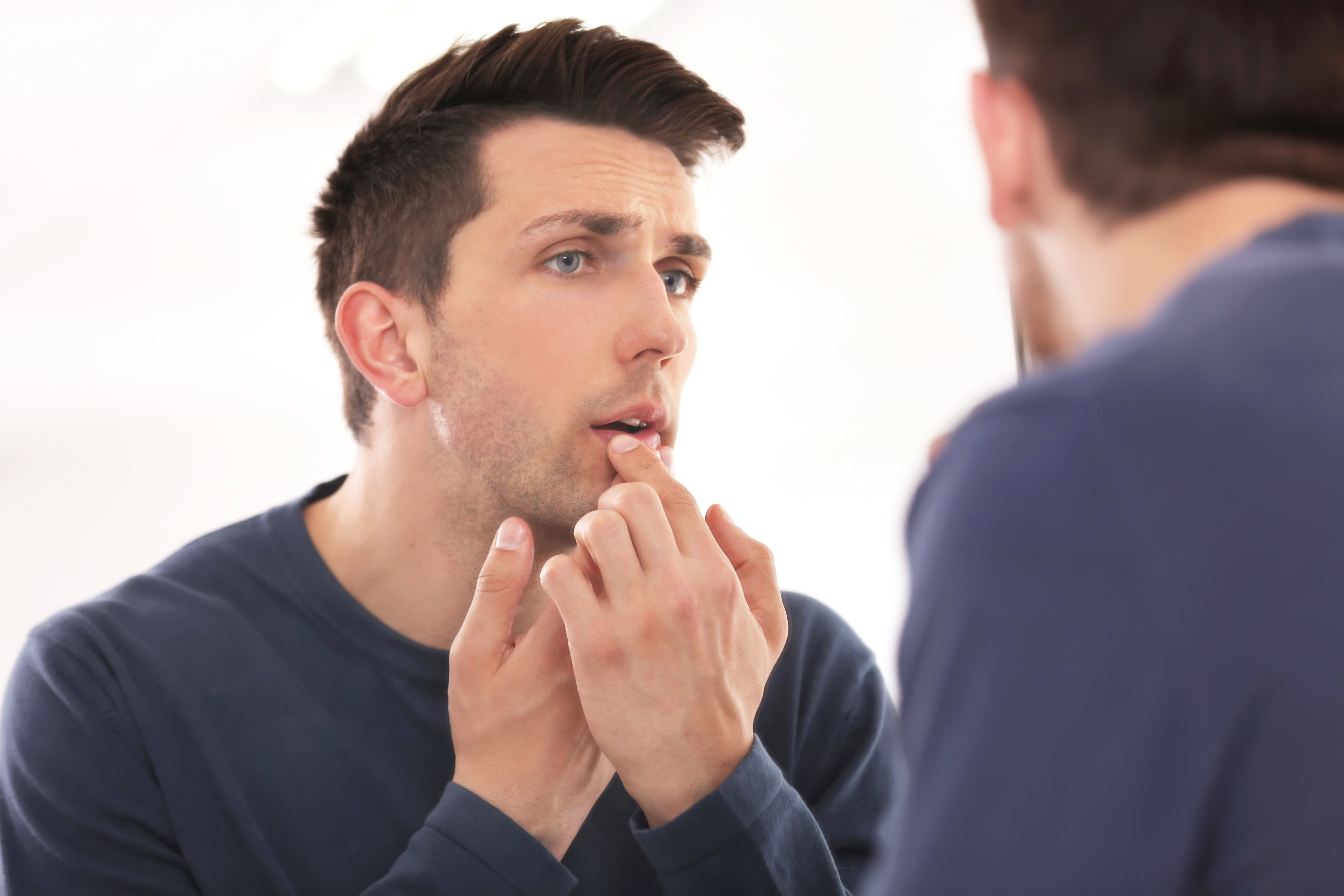
Dr. Prystowsky explains, “A black spot on the lower lip could be a freckle, a mole, a melanoma, or a blood vessel lesion such as a venous lake.”
Melanoma is the most serious form of skin cancer. Lips are part of the skin.
A “freckle” or “mole” that starts appearing on your lower (or upper) lip in later adulthood is more concerning than if it begins appearing if you’re under age 25, and especially under age 18.
“It is worth getting a professional’s opinion of the spot because a melanoma would be important to diagnose and treat,” says Dr. Prystowsky.
“Even though it is uncommon for a black spot on the lower lip to turn out to be melanoma, lip cancers metastasize more readily than other skin cancers.
“That means a melanoma on your lip has a much higher risk of causing death. An experienced dermatologic surgeon can do a lip biopsy without leaving you with a terrible mark/scar.”
Are there tell-tale signs of a black spot on your upper or lower lip that are more indicative of cancer (melanoma) vs. a benign lesion?
Dr. Prystowsky says, “Things to make you worry about having a melanoma on your lip include:
1) is it a new lesion?
2) has it been growing or changing in some way?
3) does it bleed readily? 4) does it have an irregular appearance or border?
4) is it large – over a few millimeters in diameter?
5) does it have multiple colors in it? i.e., white, blue, black, red.”
Scab on Lip that Won’t Go Away
This can be a type of cancer called squamous cell carcinoma. Though it may not look like a “black spot” in the true sense, it can still be dark and appear like a scab or tiny smudge, as shown below.
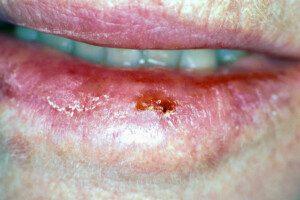
Squamous cell carcinoma cancer on the lip. Coronation Dental Specialty Group, CC BY-SA 4.0/creativecommons.org
What about this venous lake?
“For the lesions that are caused by a blood vessel, removal usually improves your appearance significantly,” says Dr. Prystowsky.
The venous lake is a benign cause of what appears to be a black spot on the lip.
If a dermatologist identifies the black speck as a freckle, be sure to keep an eye on it, says Dr. Prystowsky, in case it begins getting bigger, changing in size, shape, color or texture.
If this article provided you with helpful information or reassurance, please consider supporting my work through Ko-fi. Donations help me continue writing detailed medical content that’s easy to understand.
In combination with her focus on early skin cancer detection and removal, Dr. Prystowsky provides a wide range of revitalizing and rejuvenating treatments.
Lorra Garrick has been covering medical, fitness and cybersecurity topics for many years, having written thousands of articles for print magazines and websites, including as a ghostwriter. She’s also a former ACE-certified personal trainer.








Why Your Legs Keep Itching: 4 Reasons by a Doctor

Find out by a doctor why your legs are ALWAYS itching and driving you mad.
Having itchy legs can drive you up a wall, especially if you’re at a desk and need to get work done.
The itchiness and the scratching that comes with this situation is distracting and aggravating, to say the least.
Dr. Janet Prystowsky is a board certified dermatologist in New York, NY, with 30+ years’ experience.
She says there are four possible explanations for why your legs are itching all the time or frequently on a chronic basis.
“This is usually due to dry skin,” begins Dr. Prystowsky. “Our lower legs produce very little natural oil, so bathing with soap can strip that little bit of natural oil off, leading to dryness.
“This is usually the worst during the winter, when air has low humidity.
“Another cause for itching is if the lower legs/ankles are chronically swollen due to poor circulation,” says Dr. Prystowsky.
“This causes water to accumulate in the tissue, making the skin have to stretch to accommodate the increase in volume.
“It occurs in the lower legs, ankles and feet because gravity pulls excess tissue water down.
“The skin reacts by getting small cracks in the surface which leads to itching, redness, and scratching causes further damage, increasing the symptoms.
“If this is not addressed in a timely fashion, cellulitis, a soft tissue infection, may set in requiring antibiotics and sometimes a hospital admission.”
If you have poor circulation in your legs, there’s one of multiple causes; see your primary care physician for an initial assessment.
Poor circulation in your legs, also known as peripheral artery disease (PAD) or peripheral vascular disease, can result from narrowed or blocked blood vessels that restrict blood flow.
Symptoms may also include pain, cramping or heaviness in the legs during physical activity, which often improves with rest.
Other signs can include numbness, tingling or coldness in the legs, as well as sores or ulcers that heal slowly.
The tingling may also feel like itching.
Poor circulation can be caused by various factors, including atherosclerosis (buildup of plaque in the arteries), diabetes, high blood pressure and smoking.
Over time, reduced blood flow can lead to more serious complications such as infections or tissue damage.
Dr. Prystowsky continues, “Lower legs may also chronically itch because of a fungal infection.
“A fungal infection from your toenails can get on your foot skin and gradually creep up your leg.
“A proper diagnosis is required so that antifungal creams and/or pills may be prescribed.
“Flat warts may also lead to itching on a chronic basis, as they are hard to get rid of.”
In combination with her focus on early skin cancer detection and removal, Dr. Prystowsky provides a wide range of revitalizing and rejuvenating treatments.
Lorra Garrick has been covering medical, fitness and cybersecurity topics for many years, having written thousands of articles for print magazines and websites, including as a ghostwriter. She’s also a former ACE-certified personal trainer.
.