
Many events and programs for autistic adults have an age cap, or, the descriptor says “for young adults.” Older autistic adults are dismissed as though we don’t exist.
This not only is prevalent in my state, but I’ve come upon this ageism and avoidance of inclusion in other states as well.
I even posted about this on a Facebook page that was promoting an autistic young adults monthly social event. Needless to say, the ageist weasels behind the event never responded.
It’s as though the organizers of these events and programs believe that people outgrow autism by their mid-30s, or that autistic people are dead by 40. Or simply don’t matter.
- Only those between 18 and 25 matter.
- And sometimes, up to 35.
- Shame on these organizers for being EXclusive.
In addition to general socializing, this disturbing phenomenon also applies to dating events, job skills workshops and onsite job training programs.
Below is one of countless examples that are very easy to locate with simple googling.
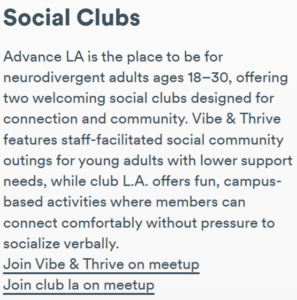
In my state there’s a new club for young (yes, the promos state “young” and “18-30”) autistic individuals interested in dating.
What – those over 30 are all married or lost their interest in romance?
The organizer recently put out a flyer for a “friendship social.” Again, only for those 18-30.
I sent her an eloquently composed rebuttal to this ageistic approach and recommended she rethink it.
Needless to say, the event promo remained unchanged, and she gave me a few suggestions on where to find age-open social events (all of which I was already aware of, such as on the “Meetup” site).
Autism Is Outgrown by Age 40
Is there some assumption that by age 35 or 40, autistic individuals no longer need support or no longer desire social venues through which to meet like-minded people?
I had explained to the friendship event organizer that even though I knew she wouldn’t have turned me away had I showed up at her event, that’s beside the point.
The promotion of “young adults 18-30” would pretty much guarantee that I’d be the only middle-ager there, or maybe one of two or three, among a bunch of young adults.
Though I’m perfectly fine mingling with adults young enough to be my offspring, it’d still be mighty awkward to be the oldest person there BY FAR. I’m 63!
I’d be like the “granny of the group,” or that “older lady.” Who the bloody hell wants this label?
I dress young. I wear my hair in a totally badass ponytail. My body has the spring of a teen’s (I work out like a warrior). But my face still looks all of at least 55.
Thus, I’d stand out in a young adult group in a way that I’d never want to.
It’s high time that this grossly overlooked topic be aggressively tackled.
Over the past four and a half years since my ASD diagnosis, I have observed a blatant dismissal of autistic adults over 40.
Sure, we are welcome at many general autism socials, such as those arranged by the Autism Society of whichever state a person resides — but exclusivity is rampant at many other events, including more unique ones.
I pitched this topic to Psychology Today’s online publication. They rejected it within 24 hours.
This is hardly a saturated topic. It’s extremely under-saturated. How could Psychology Today turn it down? I guess they’re ageist too.
I’ve seen the marketing for various support programs, such as job development and life skills – with that age cap.
I just don’t get it. What harm would there be with keeping the age open?
There are plenty of middle-age Autists who need these kinds of programs. I’m not talking about Medicaid-funded day programs.
I’m referring to independently run workshops that may either be free or have a modest fee, that would attract Autistics with low support needs but who just need some extra assistance or simply want the cameraderie of being around similar neurotype individuals.
Now, many of us are 100% independent and may be in professional lines of work that you’d never think an autistic person could succeed in.
I’ve met in person or corresponded online with attorneys, medical professionals, teachers, a school nurse, an architect, an Amazon driver, a karate school owner, mental health practitioners and a former combat medic – all on the Spectrum.
But no matter how successful we are in our professional and adulting life, many of us would still love to attend social events just for Autistics. But that damn age cap stands in the way.
And there are also Autistics who, despite living independently since their early 20s and holding down a professional job for 20+ years, who’s to say they can’t benefit from some sort of workshop in social or dating skills?
Why am I the only person beefing about this blatant ageism? Why are Autistics over 40 considered invisible and matterless?
Don’t preach inclusivity when you then implement an age limit for your events and workshops.
Oh, and by the way, if you’re thinking of how I myself should start an “all ages” social event for Autistics, I’m ahead of you. I’ve posted about this several times on at least two autism-dedicated Facebook pages — and got no takers.
You might be thinking that maybe people with autism over 35 just aren’t interested.
Well, why don’t we test out that theory instead of shutting this age group out at so many events?
And if they’re not interested, then so what? Many young adults with ASD don’t attend these events, either.
Let the age be OPEN so that whoever wishes to show up will show up! This isn’t rocket science!