

Twinlab Omega-3 Cardio Krill Oil Review: Bad Fish Odor

Warning Review: Twinlab’s Omega-3 Cardio Krill Oil has a really bad fishy smell!
The fishy odor of Twinlab’s Omega-3 Cardio Krill Oil is REALLY BAD. I advise against buying this product because the capsules reek of old fish you might find in the trash. Even just opening the bottle releases the smell of garbage-can fish.
There is no excuse for this, because at least one other brand (NOW) carries a krill capsule supplement that’s odorless. Yes, odorless.
The reason I didn’t buy the NOW brand is because I can’t find it at any of the Whole Foods stores in the city, and I had run out of the supply I had bought online.
So I decided to go the cheaper and more convenient route when I spotted the Twinlab Omega-3 Cardio Krill Oil at a Sprouts store.

I figured, Okay, it’s right here in front of me, no hassle with online ordering. But boy, was I in for a very disappointing surprise when I opened the bottle and took out one of the very stinky capsules.
These krill capsules smell so bad that I threw out the bottle after taking about 15 of the capsules (one a day).
Shame on Twinlab for not using the technology that the NOW brand uses. I will be buying the NOW krill capsules from now on.
Do not buy Twinlab’s Omega-3 Cardio Krill Oil capsules unless you want a whiff of dead beached fish every time you take one of the capsules.
 Lorra Garrick has been covering medical, fitness and cybersecurity topics for many years, having written thousands of articles for print magazines and websites, including as a ghostwriter. She’s also a former ACE-certified personal trainer.
.
Top image: Shutterstock/pathdoc

Neurological Cause of Numb Toes when on the Elliptical Machine

Here’s a neurologist’s explanation for what causes numb toes when you use the elliptical machine.
What a nuisance: One or more toes go numb whenever you pedal on the elliptical machine at the gym.
The numbness may have tingling and persist for a while after you get off the machine.
If you suffer from health anxiety, you may be apt to wonder if this means multiple sclerosis.
“This is not very scientific, although several factors probably play a role,” begins Bonnie Gerecke, MD, director of the Neurology Center at Mercy in Baltimore.
“When on the elliptical machine, there is more pressure placed on the toes and forefoot compared to the hindfoot,” she continues.
“There are small digital nerves in the toes that are likely being compressed when the feet are on the pedals, and this in part causes the toes to go numb.”
This does not mean anything is wrong with your nerves or muscles.
The mechanics of this are akin to wearing a tight pair of high heeled shoes, cramming in your toes; your toes will probably go numb pretty quickly.
Dr. Gerecke continues, “There is also increased swelling in the feet during exercise, and this can also cause numbness. Tight fitting shoes are probably also contributory.”
How to Prevent Toes from Going Numb on the Elliptical Machine
Freepik
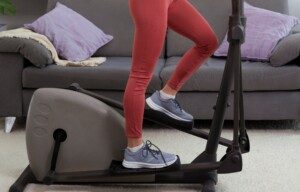
“One can wear slightly larger shoes than normal, although too much room could cause blistering,” says Dr. Gerecke.
“Pedaling backward intermittently for brief spurts can also help. Alternating with other exercises is also helpful.”
In addition, place your feet a bit away from the edge of the pedaling platform so that the toes don’t jam up against it when you pedal.
“While experiencing toe numbness while using the elliptical is common, if there is prolonged or severe numbness or tingling, one should seek the attention of a health care provider for an evaluation.”

Dr. Gerecke has a special interest in ALS, myasthenia gravis, myopathy/muscular dystrophy, peripheral neuropathy and radiculopathy. She is board certified in general neurology and neuromuscular medicine.
 Lorra Garrick has been covering medical, fitness and cybersecurity topics for many years, having written thousands of articles for print magazines and websites, including as a ghostwriter. She’s also a former ACE-certified personal trainer.
.
Top image: Freepik.com/jcomp

Stop Examining Your Tongue for Bulbar ALS

Here is why you have to STOP, once and for all, inspecting your tongue for bulbar-onset ALS. This destructive obsession has got to go.
Do you realize how rare bulbar-onset ALS actually is? It’s about 0.1 per 100,000 people. That’s one-tenth of one in 100,000.
But maybe that doesn’t matter to you, because you’re going by what you see in the mirror every time you examine your tongue—and this obsessive inspecting consumes a lot of your time…every day.
“Bulbar onset ALS is rare,” says Bonnie Gerecke, MD, director of the Neurology Center at Mercy in Baltimore.
“Moreover, patients who develop this condition experience dysarthria (slurred speech), dysphagia (trouble swallowing) and potentially other symptoms such as emotional lability, dyspnea (shortness of breath) and facial weakness.”
Some people who obsess about their tongue and ALS also begin believing they have slurred speech. They may hear or sense that they are slurring their words.
Slurred speech in bulbar ALS is the result of inadequate electrical conduction of nerve cells; the muscle fibers that these cells fire to receive impaired signals; hence, slurred speech (speech is controlled by muscles).
This nerve damage does not come and go. Once a person with bulbar ALS develops slurred speech, this symptom is there to stay.
So if what you perceive as slurred speech comes and goes…this heavily points away from bulbar ALS.
“Examining one’s tongue in the absence of any symptoms is not helpful, as there is no reason that the tongue should be affected clinically in the absence of any symptoms,” says Dr. Gerecke.
But what if you’re thinking that the twitching that you see in your tongue is only the first symptom of bulbar ALS, and that soon, more will follow? After all, wouldn’t there have to be a first symptom?
By the time a person with bulbar ALS sees their tongue twitching from the disease, the patient already has the symptoms (or some of) that Dr. Gerecke pointed out already.
And the tongue fasciculations of bulbar ALS look more like a bunch of worms squirming under the tongue, not the “twitching” that a healthy person sees in the mirror.
Dr. Gerecke has a special interest in ALS, myasthenia gravis, myopathy/muscular dystrophy, peripheral neuropathy and radiculopathy. She is board certified in general neurology and neuromuscular medicine.
Lorra Garrick has been covering medical, fitness and cybersecurity topics for many years, having written thousands of articles for print magazines and websites, including as a ghostwriter. She’s also a former ACE-certified personal trainer.
.
Top image: Shutterstock/sirtravelalot
Can ALS Twitching Come Before Muscle Weakness?
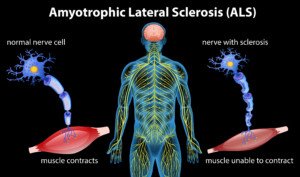
A neurologist says that ALS twitching CAN come BEFORE muscle weakness.
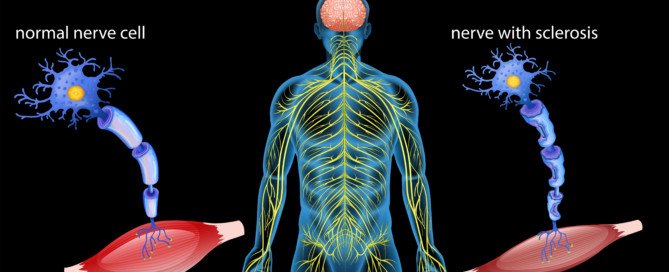
There is information on the Web stating that in ALS, muscle weakness comes before twitching (fasciculations).
To know that muscle weakness begins appearing prior to any twitching can be a big source of reassurance to people who are literally trembling with fear that they may have the incurable motor neuron disease known as amyotrophic lateral sclerosis.
In the research I’ve done for my articles, I was not satisfied with the information I was finding pertaining to whether or not the muscle twitching in ALS preceded the weakness.
So I decided to ask a neurologist this simple question:
Can the twitching (fasciculations) of ALS precede the pathological weakness in the muscles?
“Muscle weakness and cramps can either precede twitching or twitching can precede muscle weakness and cramps,” says Bonnie Gerecke, MD, director of the Neurology Center at Mercy in Baltimore.
To read that is a blow to men and women who spend inordinate amounts of time ruminating that they might have this devastating condition.
“There is no absolute paradigm for the disease,” says Dr. Gerecke. “A patient can experience muscle twitching (fasciculations) as an initial sign or symptom of ALS, although weakness usually follows shortly thereafter in this case.
“It should be kept in mind that many individuals who experience muscle twitching do not develop ALS, as muscle twitching can be benign.”
ALS is a very rare illness, whereas benign fasciculations are part of being human; they are exceedingly common and have many harmless causes such as:
Health Anxiety

Freepik.com/pressfoto
General Anxiety

Shutterstock/T.Den_Team
Dehydration

A Hard Workout

Freepik.com
Mineral Imbalance

In fact, it may very well be that anxiety causes the twitching to gear up the body for a fight or flight.
In a sense, the muscle fibers are on standby to fight or flee—kind of like engines revving up for the big race.
But if that fight or escape never comes…but the anxiety persists, the muscles may remain in a twitching or revving-up mode for extended periods.
Dr. Gerecke continues, “Conversely, a patient with ALS may develop muscle weakness and cramps prior to the onset of twitching, and not all individuals with ALS develop twitching.
“Muscle weakness and cramps can also be due to many other conditions.”
Fact is, a hefty number of conditions cause weakness in the muscles.
And the weakness can manifest in different ways.
It can be gradual; it can be rapid or sudden; it can be accompanied by severe pain or be painless; it can come only after intense exercise and be temporary.
Cramps in the legs are often caused by dehydration, but can also come from an assortment of non-neurological conditions, such as inflammatory bowel disease.
Bottom line: There is no rule that the twitching in ALS necessarily comes before or after any muscle weakness (or cramps).
Dr. Gerecke has a special interest in ALS, myasthenia gravis, myopathy/muscular dystrophy, peripheral neuropathy and radiculopathy. She is board certified in general neurology and neuromuscular medicine.
Lorra Garrick has been covering medical, fitness and cybersecurity topics for many years, having written thousands of articles for print magazines and websites, including as a ghostwriter. She’s also a former ACE-certified personal trainer.

School Bullying vs. Sibling Rivalry: Same or Different?
The only difference between school bullying and sibling rivalry may be their names.
Parents sometimes toss out that term, “rivalry,” to soften their perception of a truly bullying situation.
“Sibling rivalry and bullying at school can have the same impact on both the victim and perpetrator,” says Stacy Kaiser, a southern California-based licensed psychotherapist and relationship expert with a special interest in the topic of bullying.
“In both cases, the victim feels helpless, powerless, intimidated and out-of-control. He or she can be left with low self-esteem, depression, anxiety, a drive towards drugs or alcohol, and even suicidal thoughts.”
When this dynamic occurs, it’s not rivalry. Yes, sibling rivalry exists, but bullying is a different kind of behavior. Denying it by slapping on the label “rivalry” won’t make the problem go away.
“The perpetrator feels powerful, superior and a feeling of inappropriate pleasure,” continues Kaiser.
“He or she can be inspired to continue to bully both the sibling and the people at school, and that desire can escalate to bullying or physical violence in other environments.
“It allows the perpetrator to feel entitled, to have inappropriate boundaries and to develop a sense of grandiosity.”
Whether you wish to label the hostile behavior between siblings as rivalry or not, one thing is for sure:
Hostility between siblings brings a unique component that’s absent in the classroom between classmates:
The victim can’t get rid of the sibling. The victim lives with the bully. Even in the middle of the night, the bully might strike. School may even be something of a sanctuary, even if the victim is bullied there too.
“Sibling rivalry can actually be worse than bullying at school, because the siblings often spend more time together, and because of family obligations or loyalty, the victim is often less likely to tell the parents about the excessiveness or significance of the bad behavior,” explains Kaiser.
Furthermore (and very unfortunately), it’s not unheard of for the bully in the home situation to actually be favored over the victim.
In such a case, the parents tend to believe the bully’s version of events, even going as far as accusing the victim of “starting it” or “bringing it on,” or not being mature enough to stop complaining about it.
On the other hand, “bullying at school can be more intense, because the bully is attempting to get attention from an audience of their peers, whereas on the home front, the sibling is often doing it for their own gratification or revenge and not for attention.”

With over 100 TV appearances on major networks including CNN, NBC, CBS and ABC, Stacy Kaiser brings a unique mix of provocative insight to many topics such as anger management, office relationship issues and parenting.
Lorra Garrick has been covering medical, fitness and cybersecurity topics for many years, having written thousands of articles for print magazines and websites, including as a ghostwriter. She’s also a former ACE-certified personal trainer.
.
Top image: Freepik.com/ brgfx

How to Get Your Child to Like Martial Arts Lessons

Does your child balk at taking martial arts classes? Here are sure-fire ways to get him or her to look forward to every lesson and eagerly want to learn more and more.
If your child doesn’t like the idea of taking karate or other-style martial arts lessons, this might possibly be traced to some negative perception of the martial arts that he or she has picked up from somewhere.
It’s your opportunity as a parent to undo this perception.
I have studied martial arts in a variety of schools over the years and have a karate brown belt.
If your child is afraid or reluctant to take karate lessons, never become authoritarian with a growling “Well you’re gonna take karate whether you like it or not!”
The goal is to make your child feel good about martial arts — so good, in fact, that they never want to stop attending classes — even as an adult.
Never tell your child they must take karate “because I said so.”
This won’t cut it, and relying on this easy, quick response will fail to educate kids about the importance of martial arts.
“I’m afraid of getting hurt.”
Explain that more common physical activities, such as bike riding and playground equipment, have a much higher risk of injury.
Physical activities that involve wheels or a lot of running also rank high for injuries.
And according to the Centers for Disease Control, football, baseball, basketball and soccer comprise 80 percent of ER visits for kids 5 to 14.
Other high risk sports are gymnastics, figure skating, skiing and equestrian.
Tell your child that unlike many other sports, in karate, students wear protective padding, and work out on mats (stay away from martial arts schools that don’t use mats or a padded floor).
“I don’t want to fight.”
Explain that there is no angry fighting in martial arts, but there may be fighting on a basketball court or baseball diamond when kids get into arguments.
Learning self-defense, and sparring according to strict rules, are not the same as “fighting.” Tell your child that anger is not permitted in karate class.
“I don’t want to get beaten up.”
Explain that fighting, anger and hostility are forbidden in karate schools, and that karate lessons will help your child defend himself or herself against school bullies.
Ask your child why they are reluctant or afraid to study martial arts.
Chances are, they have seen martial arts in a video game or movie and thinks it’s full of violence.
However, they may also be fearful of failure.
Explain that in martial arts, there is no pressure to score points or make a perfect shot, and that it will be fun. Act enthusiastic.
If your child is still leery, ask the instructor to allow you and them to observe several classes first.
If your child, after you have tried all the tactics in this article, still feels discouraged about taking karate lessons, don’t give up.
Sign them up anyways; martial arts is something that your child will have to do because it is very good for him, just like kids must do other things they don’t want to do, like homework and taking baths.
But remember, always act enthusiastic rather than “because I said so!”
Lorra Garrick is a former personal trainer certified through the American Council on Exercise. At Bally Total Fitness she trained women and men of all ages for fat loss, muscle building, fitness and improved health.
.
Top image: Shutterstock/Kaderov Andrii
Child Asks Embarrassing Questions in Public to Disabled Person?
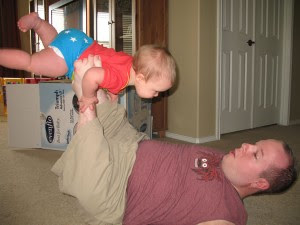
Here’s how to respond if your child asks an “embarrassing” question in public to a disabled person.
If your child has embarrassed you with questions to disabled people, or reactions to disabled people in public, a man who was born without arms has advice for how parents should deal with these tricky situations.
Chet McDoniel grew up without arms, and has very short legs. When he’s in public, people, including children, will stare, and sometimes there are questions, comments and reactions.
If your child has loudly called your attention to a person with a disability; or your curious kid has actually approached a handicapped person and inquired about the disability, McDoniel offers superb tips in how you, the parent, should respond.
The first and foremost rule for parents when their child blurts something about the nearby handicapped person is DO NOT SPANK.
McDoniel, father to two, explains that, though the parent should not ignore the child who spots an obvious disability, he also believes that parents should never “rebuke the child openly/loudly for their behavior.”
McDoniel continues: “I have even seen parents hit or spank their children for the outburst. I can only assume that the parent is embarrassed, and yes, outbursts like that need to be corrected.
“However, I believe that type of correction only serves the purpose of furthering the child’s fear of people who look different than they do.”
If your child spots a disability, consider this an opportunity to educate about the disability, rather than punish for being curious about handicaps.
There are general ways for parents to respond to kids who have noticed a disabled individual, and there are also specific ways parents can react, based on the child’s age and the specific behavior of the child. First here is McDoniel’s general guideline:
“If the parent has the opportunity, I recommend for them to stop what they are doing, get eye-to-eye with the child, and explain that some people look different, but that does not mean they aren’t people, too.
“Many times, with this reaction, I’m able to speak to both the parent and child, which reinforces what I am saying because mom or dad can interject when needed.
“Even better, when the parent involves me in the conversation, I get a golden opportunity to share God’s love with both the parent and the child. Even though I may look different, God still loves me in every way that He loves you.”
Specific situations involving kids who make comments about disabled people in public:
Child is preschool age and loudly blurts, “Look Mommy, that man…”
“Never stifle the child’s curiosity. Preschool children who have outbursts like this are truly surprised by what they see.
“They don’t mean it as an insult, but rather, that they are trying to reconcile what they are seeing with what they know about the world around them.
“Kneel down and talk about people who look different than we do. Unfortunately, many parents try to quiet the child, which will lead to more outbursts, rather than simply talking out the issue.”
Child is preschool age and can’t stop staring (though says nothing).
“Same kind of thing … while it’s important to talk to them about staring, a parent must let their child know that there is nothing to be afraid of.”
Child is grade school age and keeps staring, but says nothing.
“At this stage, I fear the parent has not followed the above advice and has allowed the child to treat others who look different as spectacles instead of allowing the child to know others as humans, first. It isn’t too late, though.
“Again, I would say that you cannot allow the child to continue to stare, but take the opportunity to have the child tell you their feelings about the person they saw.
“Then, work through those observations and feelings to help them understand why staring is inappropriate … and also why people who look different should be treated with kindness as they would treat anyone else.
Child is grade school age and actually goes up to person with disability and innocently asks about the handicap.
“I absolutely love this situation. It gives me a chance to tell the child about myself and to break down the communication barrier. Never apologize for the child’s curiosity.
“This is a perfect teaching opportunity, and it will allow the child to get to know the handicapped person.
“You might approach the person before the child does in order to ask if it’s okay for the child to ask a question.
“While I have never met a person with special needs who would be rude in this situation, I can imagine that such a person does exist, and you do not want the child to have a negative encounter at this stage.”
A parent’s instinct, when a child goes over to a disabled person and asks, “What happened to your arms,” or, “Why can’t you walk?” is to grab the kid by the arm or shoulder, mutter something like “Johnny! How can you?!” and then pull the kid away from the handicapped individual.
Now think about this for a moment. What message did you just send to an impressionable youngster?
You just made it far more difficult for him to ever feel comfortable or at ease around someone who’s handicapped, and your reaction won’t motivate him to befriend any disabled kids at school; he’ll feel it’s “wrong” to go over to them.
Child is grade school age and behaves fearfully or uneasily.
“Never ignore this issue. I have had grade school children who have been terrified of me because of the way the parent has either ignored or punished these behaviors.
“It’s ridiculous for a child to be afraid of a person with special needs, but the behavior can always be traced back to the parent and how they handled the child’s interactions with handicapped people.
“Take the time to reassure the child in that moment, and spend some time back at home working on building confidence.”
Grade school or junior high age kids are snickering amongst each other, pointing, whispering, giggling.
“At this age, if they are doing these kinds of things, I fear that parents have failed.
“Unfortunately, about the only thing you can teach at this point is to correct the behavior.
“Hopefully, once they mature, they will value all kinds of people enough not to do these kinds of things. That’s why it’s important to teach early.”
Child is junior high or teenager, and reacts in an alarming way with, “Oh my God, Mother, oh God, that man has no arms…(or whatever the situation)…” The adolescent or teen may let out an expletive and appear very distraught and upset.
“A parent cannot allow this kind of behavior. At this age, they know what is appropriate in a public setting, and if they won’t value the handicapped person enough not to make this outburst, at least teach them to control their reaction.
“Again, since the child wasn’t taught to respect early on, I fear you’ll just have to wait until maturity hits for this type of behavior to stop.”
Read more about inspirational speaker Chet McDoniel, author of “I’m Not Broken: You Don’t Need Arms to Be Happy.”
Visit Chet’s site at: chetmcdoniel.com
Lorra Garrick has been covering medical, fitness and cybersecurity topics for many years, having written thousands of articles for print magazines and websites, including as a ghostwriter. She’s also a former ACE-certified personal trainer. .
Legs Suddenly Too Weak to Stand After Playing Volleyball?

Have you ever been sitting out during sports play and then tried to stand and couldn’t due to “dead” legs?
This isn’t about your legs “falling asleep” due to a nerve being compressed from sitting in a scrunched position.
It’s about trying to get up, and your legs, particularly your quadriceps, just can’t support you, and you collapse back down.
I had a doctor weigh in on this, but before I tell you what he said, you should know that this exact situation once happened to me.
After training in volleyball with a volleyball club, I sat out because we were rotating in groups. I felt fine.
Then when it was time to stand, my legs just folded. My quadriceps felt very fatigued and weak, and I couldn’t get up.
Someone had to lift me off the floor and carry me to another part of the gym, where I just sat there to let this sudden leg weakness run its course.
Cause of Weak Legs, Inability to Stand, after Sports Play
“I would suspect that the culprit was lactic acid,” says Marc I. Leavey, MD, a primary care physician with 40-plus years of experience.
“During rigorous exercise, the muscles need energy faster than the normal metabolic pathways can provide it.
“An intermediate compound of metabolism, lactic acid, is produced as a means of delivering that energy without the use of oxygen.
“After a few minutes, it can build up, and the body responds to that buildup with burning or weakness in the muscles being exercised, such as the legs in volleyball.
“So a period of intense exercise may be followed by a buildup of lactic acid and an acute loss of strength and function.
“After a period of rest, which may be just 10 to 20 minutes, the lactate has been metabolized and all is back to normal.”
Note: I had not injured anything (no pulled hamstring or quadricep). This extreme weakness never occurred again, even though for years after, I continued to play at a very competitive level.
Leg work in volleyball is not the same as in basketball, tennis and soccer.
Though basketball involves a lot of jumping, keep in mind that in volleyball, along with the jumping is also a lot of deep hip flexion (squatting), from which the player must spring up from in different directions to pass balls.
Prevention
“You can help prevent this situation by staying adequately hydrated, being sure to practice good breathing techniques, and being aware of your body’s condition,” says Dr. Leavey.
“If you start feeling weakness or burning in a group of muscles or an extremity, don’t work through the burn; stop and rest.
“Weakness or discomfort that lasts more than a short time may be due to micro-tears in the muscles involved, and is a different type of process.

Dr. Leavey was formerly with Mercy Medical Center in Baltimore, MD, where his focus was primary care and internal medicine. He has a blog, STRING OF MEDICAL PEARLS.
Lorra Garrick has been covering medical, fitness and cybersecurity topics for many years, having written thousands of articles for print magazines and websites, including as a ghostwriter. She’s also a former ACE-certified personal trainer.
.
Top image: Shutterstock/P Stock

DVT Prophylaxis Duration after Hip Fracture Surgery
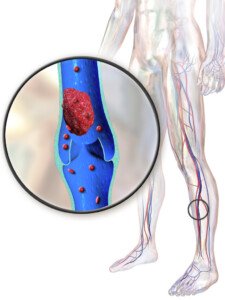
How long should DVT prophylaxis (prevention) be following hip replacement surgery to repair a fracture?
Unfortunately, there does not exist a be-all, end-all answer to this question.
Joint replacement surgeons don’t even agree on which anticoagulant drug to use.
“There is no right answer when it come to DVT prophylaxis,” says Kamala Littleton, MD, board certified orthopedic surgeon with Orthopedics and Joint Replacement at Mercy Medical Center, Baltimore, Maryland. Dr. Littleton specializes in joint, hip and knee replacement and reconstruction.
She continues, “We tend to use Coumadin for two weeks after surgery, then aspirin twice a day for an additional four weeks.
“However there are times when I just use a very low dose of Coumadin, so nothing is written in stone.
“If a patient is very high risk for PE or DVT, we will have the vascular surgeons place a temporary IVC filter.”
Hip fracture repair surgery (replacement with hardware) elicits a higher risk of deep vein thrombosis than does the elective hip replacement surgery which people have to mitigate the pain of osteoarthritis.
However, if the THR is performed with an anterior (front) entry, rather than posterior (back), this reduces the DVT risk, relative to the posterior approach.
Nevertheless, the DVT risk is still high when compared to other major surgeries, and research into the duration of the prophylaxis is intense and ongoing:
“The American College of Chest Physicians guidelines strongly recommend extending prophylaxis to up to 35 days for total hip replacement and hip fracture.” (ncbi.nlm.nih.gov/pmc/articles/PMC3195664/)
“Symptomatic VTE continues to be reported in patients within 3 months after surgery.” (ncbi.nlm.nih.gov/pubmed/21774881)
“As risk of VTE persists for up to 3 months after surgery, patients at high risk for postoperative VTE may benefit from extended prophylaxis…” (Chest. 2003 Dec;124(6 Suppl):386S-392S)
A lot of research shows that the risk of DVT following joint replacement surgery (such as hip) persists for 90 days out, even if the patient is mobile.
Nevertheless, there is no standard protocol, or universally accepted protocol, for just how long the DVT prophylaxis should be.
There’s not even a general consensus for a time range, such as four to six weeks, or seven to 10 days, or two to three months, etc.
Therefore, the proper duration of DVT prophylaxis following hip or other joint surgery is at your doctor’s discretion.
 Dr. Littleton offers years of experience and specialized training to perform anterior hip replacement as well as MAKO knee resurfacing and knee replacement. She also performs shoulder surgery.
Lorra Garrick has been covering medical, fitness and cybersecurity topics for many years, having written thousands of articles for print magazines and websites, including as a ghostwriter. She’s also a former ACE-certified personal trainer.
.
Top image: BruceBlaus/CreativeCommons

Is Daytime Sleeping Part of Hip Replacement Recovery?




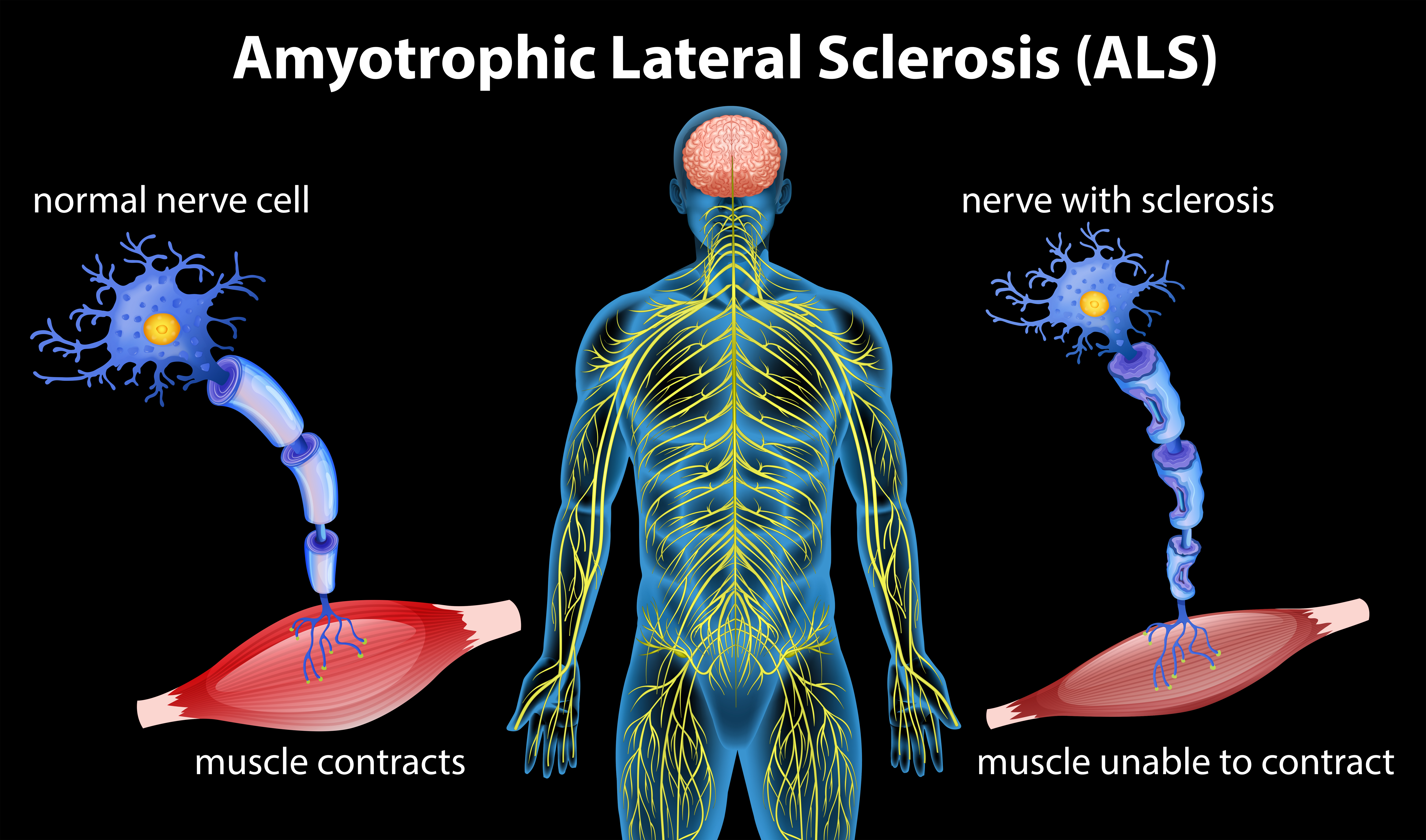
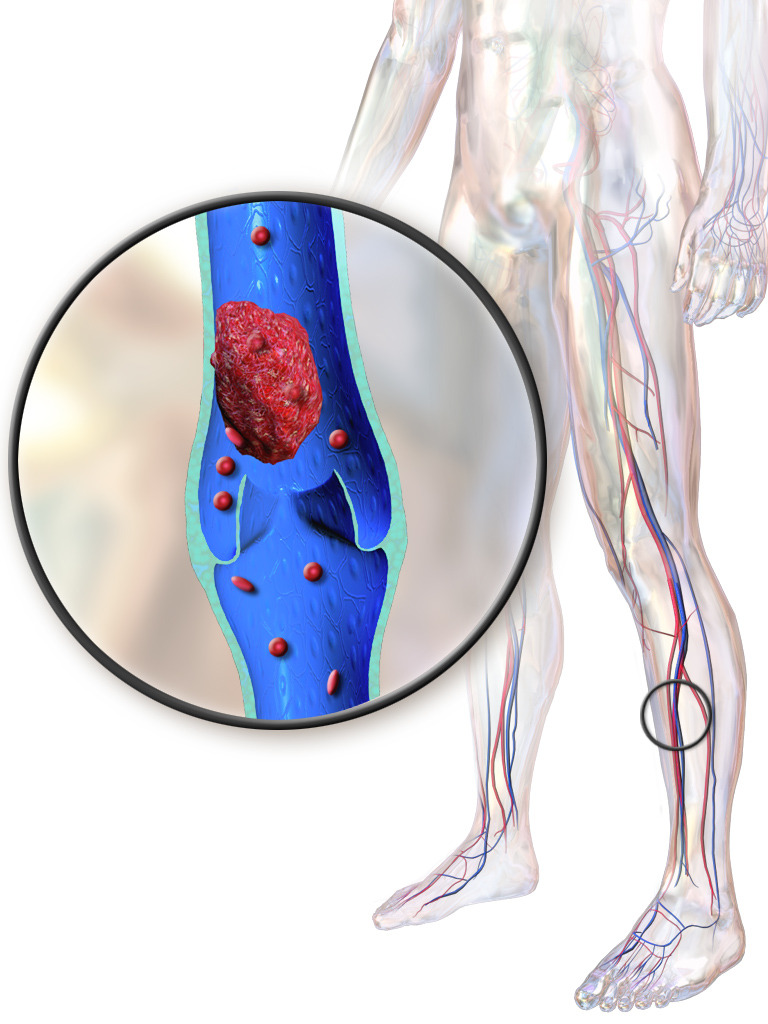

How much daytime sleeping is too much for the elderly hip replacement patient who just returned home?
Restorative sleep is a wonderful thing, and sleep deprivation is linked to a myriad of health ailments.
But too much of a good thing can be quite harmful, and sleeping in the daytime, when you already sleep overnight, is no exception to this rule.
How does daytime napping, however, apply to the elderly hip replacement patient?
“Daytime sleeping is fine,” begins Kamala Littleton, MD, orthopedic surgeon with Orthopedics and Joint Replacement at Mercy Medical Center in Baltimore, Maryland. Dr. Littleton is board certified and specializes in joint, hip and knee replacement and reconstruction.
“The fracture and the surgical intervention take a lot out of older patients so they need more rest,” she continues.
“They do need to get out of bed, exercise and walk several times a day. Spending most of the day in a recliner rather than bed is preferred.”
What this means is that the recliner is preferable to the bed, by far. But it does not mean, literally, that the older hip replacement patient should spend most of the day in a recliner. They should be up and about as much as they can tolerate.
The comfort zone is the recliner. The elderly hip replacement patient should be encouraged to leave this comfort zone.
This doesn’t mean they shouldn’t take rests including some snoozers. But too much recliner time, and especially bed rest, bring some serious risks.
“Too much time in bed puts one at risk for blood clots and pneumonia. but I have no problem with napping,” says Dr. Littleton. And what is a nap? A nap may be 20-30 minutes.
If the nap is for too long, the patient will start entering a deeper sleep cycle, and then when they finally get up, they’ll feel groggy and listless.
Several 20-minute naps throughout the day, for example, are beneficial. This should never transform into excessive sleeping or bed rest. Snoozing in a chair, rather than a bed, is less likely to result in an extended period of sleep.
Too much sitting, even in an upright chair, is a bad thing for the elderly hip replacement patient, because it will force the soft tissues around the hip to be in a prolonged “L” position (shortening the muscles), so that when the patient finally stands up and walks…there may be a lot of pain from the stiff, retracted muscles being stretched.
Excessive daytime sleeping, as mentioned, increases the risk of pneumonia, and via more than one pathway.
One of those pathways is that the lungs, being in a lying or reclined position, and even in an upright sitting position, are not in their ideal state in which they can open up with optimal efficiency and take in air.
In fact, the elderly hip replacement patient may be prone to sitting slouched, “crumpling” up the organs.
Being up and about more frequently opens the abdominal cavity up, giving the lungs more room, making breathing easier.
Dr. Littleton offers years of experience and specialized training to perform anterior hip replacement as well as MAKO knee resurfacing and knee replacement. She also performs shoulder surgery.
Lorra Garrick has been covering medical, fitness and cybersecurity topics for many years, having written thousands of articles for print magazines and websites, including as a ghostwriter. She’s also a former ACE-certified personal trainer.
.