

Hip Fracture Patient Traits that Help Regain Independence

About one-third of hip fracture replacement patients regain pre-surgical independence.
What is different about this group when compared to the two-thirds who fail to get back their independence?
This isn’t a comparison of total hip replacement (THR) patients who had elective surgery for osteoarthritis.
This compares those who underwent the THR for hip fracture with each other: the ones who regained their independence vs. the ones who did not.
“When a person fractures their hip, sometimes it is just a fluke: dog gets under them, crack in the sidewalk, etc.,” says Kamala Littleton, MD, orthopedic surgeon with Orthopedics and Joint Replacement at Mercy Medical Center in Baltimore, Maryland. Board Certified, Dr. Littleton specializes in joint, hip and knee replacement and reconstruction.
Dr. Littleton continues, “Others are at risk. They are weak, have neurological balance issues, dementia, have heart or lung conditions which can make them unsteady (shortness of breath, A-fib, congestive heart failure, poor heart function), which cause them to fall.
“Often (especially in the city) they live in very cluttered houses with many stairs, narrow hallways and throw rugs. They have lived in these places for years (often alone) and miraculously have managed.
“They are a bit like a ticking time bomb. The fall and subsequent fracture are the explosion.
“They can’t use a walker in their houses, can’t navigate stairs, spend time in rehab or nursing facilities and just can’t make it back to independence.”
Though no hardcore data exists on the precise elements that differentiate the hip fracture patients who recover fully from the ones who remain in nursing care or permanently on a walker or cane, it’s reasonable to say that the ones who fully recover have few to zero comorbidities (e.g., dementia, congestive heart failure).
But suppose we have a patient who has only brittle bones and is very de-conditioned, but has decent heart functioning and normal neurological status.
She quickly rises from a chair and hurries to answer the phone, and along the way, a leg gives out and down she goes, fracturing a hip.
If this person has always hated exercise, has always led a sedentary life, has always dreaded the idea of moving enough to trigger a sweat or increased heart rate—and toss in a little stubbornness, pre-existing mild depression and/or baseline sub-rational thinking—then you may just well have the perfect storm for a patient who never regains independence following hip fracture repair.
Another factor that can taint recovery efforts is when the patient, when it’s time to return home, ends up in an environment that’s not conducive to recovery.
An example would be a spouse who’s an enabler—who fetches everything his wife asks for instead of encouraging her to walk to get what she wants.
Or, the spouse may not be proactive. An example is if the patient announces she doesn’t want home physical therapy, and the husband goes along with this instead of wearing the pants.
I know a woman whose mother fractured her hip at age 88. After surgery and a little rehab center stay, the patient returned home—which was her daughter’s house, and refused physical therapy.
The daughter told her she was going to make up a list of nursing homes for her mother to choose from. This casual announcement by the daughter inspired the mother to commit to therapy, and she recovered.
When a patient refuses therapy, the family must do everything possible.
If the patient still isn’t motivated, the family should re-evaluate the environment they’re providing: Is it enabling?
This is particularly important if the surgeon and physical therapist have given NO medical or mechanical reason for why the patient can’t regain independence following the hip fracture repair.
Of course, the presence of psychiatric pathology will likely interfere.
People undergoing hip replacement for a fracture will also need to have their thyroid levels checked post-surgery, as major surgery could alter thyroid levels, especially in a person with pre-existing thyroid disease.
Unchecked levels can cause cognitive impairment, depression, sleepiness and/or weakness.
 Dr. Littleton offers years of experience and specialized training to perform anterior hip replacement as well as MAKO knee resurfacing and knee replacement. She also performs shoulder surgery.
 Lorra Garrick has been covering medical, fitness and cybersecurity topics for many years, having written thousands of articles for print magazines and websites, including as a ghostwriter. She’s also a former ACE-certified personal trainer.
.
Top image: Freepik.com
Powerback Rehab, Lakewood CO: Terrible for Elderly Patients

Here is my ONE-STAR review of Powerback Rehab in Lakewood, CO for hip replacement therapy.
Do not let your loved-one go to this place of low quality rehabilitation.
Several years ago both my parents stayed at Azura rehab, which I gave a good review for.
Since then ownership changed to Genesis Healthcare: hence the name change to Powerback Rehab. Here is my review!
Summation of Review of Powerback Rehab in Lakewood for a Hip Replacement Patient
• Physical therapy six days a week for 45 minutes, once per day
• Occupational therapy six days a week for 30-40 minutes, once per day
• This means on Saturday and Sunday they get only one or the other.
• Zero programs outside of therapy to get the patients up and moving.
This is a serious issue for non-compliant, stubborn or depressed patients, or those with impaired judgment stemming from lingering effects of general anesthesia or some other cause.
• Patients have opportunities to get in their walking when venturing to and from their bathroom and the dining hall, but for patients lacking motivation (for the reasons cited above), essentially the only walking they’ll do is that during therapy.
This means outside of therapy, patients are left to their own devices.
• They may be lying in bed all day long or sitting like a blob for hours on end in their rooms.
• Patients with initiative or self-starting capabilities may progress fast, as they will want to walk at every opportunity, including summoning a CNA to accompany them beyond just the walks to the dining hall or bathroom. Powerback, then, benefits only self-starters with sound judgment.
• It’s so crucial for hip (and knee) replacement patients to walk, walk and walk.
• My mother spent a lot of time in bed sleeping. Though Powerback Rehab offers activities like bingo, fruit and ice cream socials and someone who comes in with a “therapy” dog, these activities do not necessarily get a patient to walk.
CNAs at Lakewood Powerback Rehab
Watch out here. The CNAs have the most interaction with patients, and are NOT trained to be proactive with them.
Typically they’ll ask, “Do you want to be wheeled or walk?” when it’s time to accompany the patient to the dining hall or bathroom.
Though some patients cannot walk, others can and SHOULD. A non-compliant or judgement-impaired patient may answer “wheeled,” and the CNA will oblige, rather than recognize the need to encourage the patient to walk.
Before you assume that a CNA won’t be able to change a stubborn patient’s mind, there was one particular CNA at Powerback Rehab who could easily get my resistant mother walking to the dining hall or bathroom — because she was proactive.
A second CNA also took this approach and got my mother up and about. The rest were like robots or failed to recognize the detriment of the “I want to be wheeled” option.
Powerbak Rehab CNAs are NOT required to encourage patients, who can and should walk, to do so.
The isolated gems who actually DO this simply reflect the law of averages: In any group of CNAs there’s bound to be a few who are proactive.
Two of the CNAs had thick accents and spoke rapidly. I had to peel my ears to decipher them.
I cannot understand why a facility, in which most of the patients are elderly (and thus have poor hearing) would hire CNAs with such poor pronunciation of English. Powerback Rehab of Lakewood, Colorado, really misses the boat.
My mother couldn’t hear them half the time and kept asking them to repeat things.
They lacked the smarts to speak s-l-o-w-l-y and instead would repeat in their rapid, thick accent.
Powerback Rehab of Lakewood, Coloraod obviously failed to train them in how to speak to the elderly hearing impaired.
It’s not illegal for a facility with so many hearing-impaired patients to refrain from hiring someone on the grounds that they cannot speak clearly.
Powerback Rehab in Lakewood is very understaffed with CNAs.
I also witnessed at least a few times the CNA on assignment for my mother failing to receive the signal from my mother’s call button. Often it took them a while to respond (due to the understaffing).
Fall Risks
My mother soon made it known she was very prone to using her walker without assistance, even though she was given strict orders to summon for a CNA.
This made her a fall risk. I pointed this out numerous times, but staff didn’t show much concern, citing that laws prohibited them from using bed or chair alarms for a patient who didn’t want them.
Maybe this is true, but there was no program in place to guard against my mother falling.
Fall risks following hip replacement surgery are common, and I ended up having to watch her like a hawk, then keep my fingers crossed when I wasn’t there.
Nurses
One of the nurses could barely speak English. Why would Lakewood Powerback Rehab hire a nurse, whose English was so bad that even I, with my good hearing, had difficulty understanding, to work with predominantly elderly patients who — as everyone surely knows — collectively have poor hearing?
When I needed whichever nurse was assigned to my mother per the shift, it was usually difficult to find her or him.
Yes, there are other patients, but I got the sense that Powerback is understaffed in the nursing department.
Occupational Therapy
The two sessions I witnessed were a joke. For the first session I witnessed, my mother did only one thing in the therapy room: sitting at an arm-pedaling machine.
For the second session, she was shown how to use a device to put on a sock, then taken to that arm pedaling machine.
This second session was 30 minutes, even though the prior one lasted 40 minutes.
The second therapist kept speaking in a soft voice. A smart therapist will ask the patient if there’s any hearing loss and will quickly detect if the patient was truthful or unaware of this, and hence, speak with more volume.
Physical Therapy
I never witnessed a session, but the PT kept saying my mother did well. However, in the 11 days she was at Powerback Rehab in Lakewood, her ambulation never improved much, though she learned how to manage a three-step railed staircase.
Powerback Rehab’s grounds, lobby and lounges are very attractive and clean.
But attractive furnishings, lovely decorations and pictures on the walls, and well-landscaped premises are not what restores mobility to a hip replacement patient.
The food at Powerback Rehab in Lakewood, CO is good. But I’d be much more concerned about the aforementioned issues.
My mother’s home PT said that places like Powerback Rehab set the patient back: A week at rehab means two weeks to catch up. The home PT, after assessing her, said that her mobility should have been much further along.
Lorra Garrick has been covering medical, fitness and cybersecurity topics for many years, having written thousands of articles for print magazines and websites, including as a ghostwriter. She’s also a former ACE-certified personal trainer.
NEVER Pick Off a Melanoma, Says Dermatologist
Don’t even THINK about picking or scraping off that ugly or odd-looking mole that might be melanoma.
“You should not try to rub off a growth that you suspect could be a
melanoma,” says Dr. Janet Prystowsky, board certified dermatologist in New York, NY, with 30+ years’ experience.
A melanoma will not easily come off. You will need to deliberately and fervently pick or scrape at it to remove some of the cancerous tissue.
A melanoma cannot accidentally come off while routinely shaving over it, routinely rubbing a sponge or rag over it while bathing, while inadvertently rubbing the area against something such as a seatbelt or tight doorway, etc. The removal would have to be on purpose.
And this is possible with “aggressive picking or scrubbing with a device such as a Clarisonic to get to raw tissue,” says Dr. Prystowsky.
“After healing you may not see the growth return. However, in the case of melanoma, cancerous cells may be in follicles and even be non-pigmented, giving the illusion that you successfully rubbed off a suspicious growth.”
Usually, a cancerous mole is as deep below the skin as it is high above the skin.
So removing the surface of it, flush with the skin, will still leave the under-part of it.
And don’t even think of solving this issue by scooping out an area around it.
You STILL might not get all the cancer cells — because there could be microscopic branches of the melanoma extending deep into an area that your scooping missed.

Cancer cell. Shutterstock/Lightspring
And don’t trust your eyes; just because you can no longer see the black or dark pigment, doesn’t mean you cleaned it all out.
“The residual cells may multiply and grow more deeply into the skin and even spread throughout the body and be deadly,” says Dr. Prystowsky.
“Any growth that raises suspicion of melanoma needs to be biopsied to determine if it is melanoma.
“Any treatment decided upon will depend on what the cells look like under a microscope and how deep they are in the tissue.”
When a dermatologist inspects a suspicious mole or new spot, make sure he or she uses a dermatoscope.

In combination with her focus on early skin cancer detection and removal, Dr. Prystowsky provides a wide range of revitalizing and rejuvenating treatments.
 Lorra Garrick has been covering medical, fitness and cybersecurity topics for many years, having written thousands of articles for print magazines and websites, including as a ghostwriter. She’s also a former ACE-certified personal trainer.
Top image: Shutterstock/Air Images

How Much Caffeinated Coffee Is Safe a Day?

What does a doctor have to say about how much caffeinated coffee is safe on a daily basis?
“According to multiple studies, for people in generally good health, up to about 200 mg of caffeine a day is acceptable for most people,” says Marc I. Leavey, MD, a primary care physician with 40-plus years of experience.
Dr. Leavey continues, “With a standard six ounce cup of brewed coffee containing about 100 mg, this would be about two coffee cups daily.
“Remember that coffee cups are six ounces, not eight, so that 12 ounce mug holds two cups.”
Caffeine isn’t the only ingredient in coffee to be aware about.
“Along with the caffeine, there are other substances in coffee which are physiologically active,” says Dr. Leavey.
“Indeed, coffee made with a French Press may have substances which influence serum lipids; filtered coffee removes those substances in the brewing.
“Instant coffee is also lacking those chemicals, and likely is lower in caffeine (for regular instant) than brewed coffee.
“Some studies have suggested there may be toxins in instant coffee, but these are likely at very low levels, ft at all, and may or may not be of clinical significance in typical coffee drinkers.”

Dr. Leavey was formerly with Mercy Medical Center in Baltimore, MD, where his focus was primary care and internal medicine. He has a blog, STRING OF MEDICAL PEARLS.
Lorra Garrick has been covering medical, fitness and cybersecurity topics for many years, having written thousands of articles for print magazines and websites, including as a ghostwriter. She’s also a former ACE-certified personal trainer.
.
Top image: Shutterstock/NOBUHIRO ASADA

Can You RUB Off a Melanoma?
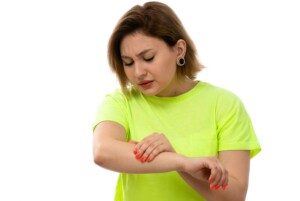
This article is about rubbing off a melanoma, not scraping, picking or cutting.
Ever wonder if melanoma can be literally rubbed off? For instance, with a fingertip, rag or piece of clothing?
“It is not possible to remove a melanoma completely by simply rubbing it with clothing, a rag or a finger,” says Dr. Janet Prystowsky, board certified dermatologist in New York, NY, with 30+ years’ experience.
But this doesn’t mean you can’t remove some of the melanoma with a rubbing action, especially if it’s big and has raised portions.
It just depends on how hard you rub, the length of time spent doing this (vs. just one swipe with a fingertip or wash cloth) and what the rubbing instrument is (finger vs. sandpaper).
Dr. Prystowsky says that it’s “possible with effort to purposely rub the visible signs of a melanoma off of the skin.
“It would require rubbing that leads to superficial bleeding, however, like a skinned knee from rubbing the rough cement on a sidewalk.”
In short, intense rubbing—with something rough rather than smooth, such as a loofah brush or emery board, as opposed to the smooth surface of your palm or a cotton swab. And it would require repeated swipes.
“Even with this extreme rubbing, it would not mean the melanoma is completely gone, however, because microscopic melanoma cells would remain behind in deeper layers of the skin,” says Dr. Prystowsky.
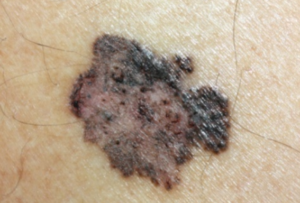
Melanoma
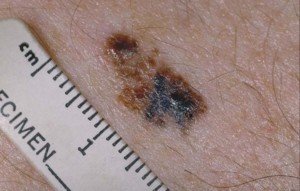
Melanoma
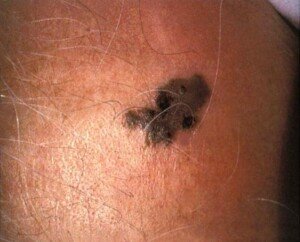
Melanoma. CDC, Carl Washington, MD, Emory Univ. School of Medicine, Mona Saraiya, MD, MPH
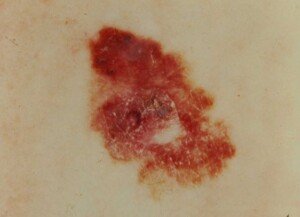
Melanoma. Laurence Meyer, MD/ cancer.gov
There can be micro-metastases, meaning, microscopic branches of the malignant cells extending underneath the visible spot, penetrating into the dermis, which is the second layer of skin.
“Someone rubbing the melanoma would have the mistaken belief that because they cannot see the spot on their skin any longer, that they do not have to worry about it –this is not the case,” explains Dr. Prystowsky.
If you leave even just one tumor cell behind (in theory), that one cell would likely proliferate unseen beneath the visible part of the skin.
“It is worth noting that skin cancer tissue bleeds more readily than normal skin typically, so minor trauma from tight clothing may trigger enough rubbing to disrupt the surface of a skin cancer and cause bleeding.
“This is because cancer cells more readily break away from each other and have a more generous blood supply than normal skin.
“After the bleeding stops, you would expect to see at least some of the skin cancer, e.g., melanoma, remaining under this less traumatic, accidental rubbing situation.”
In combination with her focus on early skin cancer detection and removal, Dr. Prystowsky provides a wide range of revitalizing and rejuvenating treatments.
Lorra Garrick has been covering medical, fitness and cybersecurity topics for many years, having written thousands of articles for print magazines and websites, including as a ghostwriter. She’s also a former ACE-certified personal trainer.
.
Top image: Freepik/KamranAydinov

Occasional Tender Spot on Head; No Injury

That occasional tender spot on your head can have different causes other than trauma or injury.
“It’s happened to most of us,” begins Marc I. Leavey, MD, a primary care physician with 40-plus years of experience. You are brushing your hair or having a shampoo or rest your head back on a chair, and that spot hurts.
“You have someone look at it and they see nothing, but it hurts.
“Could it be a brain tumor? Could it be a stroke? Could it be where the alien probe was? Probably not any of those.”
So what, then, causes a tender spot on your head to come and go if you haven’t been hitting your head?
Dr. Leavey explains, “Lacking a direct cause for a tender spot, such as being hit over the noggin with an object or suffering a fall, the vast majority of these pains are located in the relatively thin layer of skin and muscle that covers the skull.
“Unlike most other areas of your body such as the limbs or your trunk, pressing on the skin of the head directly compresses the tissue into the underlying, unyielding bone of the skull.
“That means that any disruption of the integrity of the skin of the head, no matter how minor, can be magnified in its effect due to this compression.
“Trauma could be so slight as to be unnoticeable to all but detailed inspection, and could be from an insect bite, a scratch from a brush or comb, an inflamed hair follicle, a pimple, or even a reaction to a hair product.
“I have had patients who rested their heads on hard surfaces for a period of time, reading or sleeping; and each awoke with a micro-bruise of the area, a tender spot without any apparent reason.
“Certainly, if you have an area of pain or discomfort, especially one without an apparent cause, you should seek medical attention to be sure that nothing more ominous is causing the problem.
“But be reassured that in the vast majority of such cases, the etiology is minor, the process is self-limiting and the discomfort normally clears in a short while.”
The tender spot on your head, don’t be surprised, feels like the same kind of tenderness you might feel in a specific spot on your shin, where that same pressure phenomenon can occur, since there’s not much “meat” between the skin and the shin bone.
If this article provided you with helpful information or reassurance, please consider supporting my work through Ko-fi. Donations help me continue writing detailed medical content that’s easy to understand.
Dr. Leavey was formerly with Mercy Medical Center in Baltimore, MD, where his focus was primary care and internal medicine. He has a blog, STRING OF MEDICAL PEARLS.
Lorra Garrick has been covering medical, fitness and cybersecurity topics for many years, having written thousands of articles for print magazines and websites, including as a ghostwriter. She’s also a former ACE-certified personal trainer.
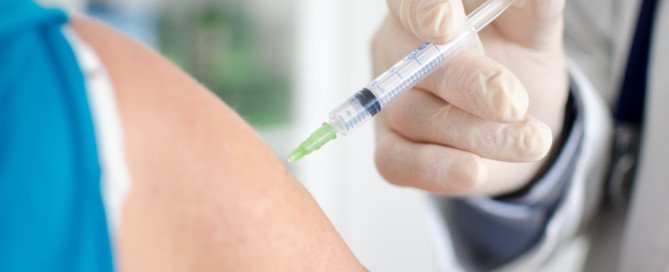
Safe to Lift Weights through Pain of Tetanus Shot?

Here is what a nurse told me after I asked if lifting weights through tetanus shot pain was safe.
The day after a tetanus shot, my upper arm felt as though someone had slugged me there.
I could not lift it to horizontal — as though doing a side lift with a dumbbell — without pain.
On this day, it did not interfere with my deadlifts, farmer walks or reverse rows.
But I could tell it would be a beast to attempt pushing movements—which I was scheduled to do four days later.
The next day, no change. Rather than see what laypeople are guessing at about this on sites like Yahoo Answers, and not finding this specific information on sites like webmd, I decided to call my medical carrier’s nurse advice line.
“Is it okay to lift weights through the pain of a tetanus shot?”
I left my message with the medical assistant. Shortly after I got a call from the nurse.
She started, “I got your complaint and I laughed. You are so right!” She obviously has received many complaints about pain in the arm from a tetanus shot.
She continued, “It hurts SO bad. I’ve had the same shot myself. It DOES hurt. It’s the medicine working in the arm. The more you move it, the more you’ll work out the medicine.”
The pain is from the vaccine drug working around in there. “It hurts really really bad,” she continued.
But she assured me that movement is the best thing for it, and this includes strength training.
I even said, “So I can go ahead and pick up my dumbbells?” And she gave me the green light.

Shutterstock/Syda Productions
Medical Doctor’s Answer
I then asked a doctor, for the purpose of this article, what her take was on lifting weights despite pain from a tetanus shot.
“Absolutely. In fact, keeping the muscles moving will help the pain,” says Susan L. Besser, MD, with Mercy Medical Center, Baltimore; Diplomate, American Board of Obesity Medicine and board certified by the American Board of Family Medicine.
However, the green light comes with a precaution. Your arm, due to the tetanus shot, may be weaker, even if you can mentally bully your way through the pain during a weightlifting set.
So start out with lighter weights, particularly with the dumbbell overhead press and dumbbell press.
Gradually work your way up to your working sets with the bench press; so if you normally perform warmups with four different weights, insert a few additional intermediary loads in there.
For best results, don’t do pushing movements or shoulder work within two days of a tetanus shot, as the pain may distract you and result in a sub-par weightlifting session.
 Dr. Besser provides comprehensive family care, treating common and acute primary conditions like diabetes and hypertension. Her ongoing approach allows her the opportunity to provide accurate and critical diagnoses of more complex conditions and disorders.
Lorra Garrick is a former personal trainer certified by the American Council on Exercise. At Bally Total Fitness she trained clients of all ages for fat loss, muscle building, fitness and improved health.
.
Top image: Shutterstock/thodonal88

White Flakes In Your Beard: Cancer May Be Cause

If you’ve been seeing white flakes in your beard, cancer must be ruled out.
A dermatologist explains the causes (including cancer) and solutions to white flakes in your beard.
“White flakes in a beard can reflect a dermatitis such as seborrhea (dandruff) or atopic dermatitis (eczema or psoriasis),” begins Dr. Janet Prystowsky, board certified dermatologist in New York, NY, with 30+ years’ experience.
“These are nuisance conditions that can be readily managed with topical steroids and anti-dandruff shampoos.
“Sometimes prescription strength formulations are required depending upon the severity.
“Most people with an itchy, flaky beard have some form of dandruff, eczema or psoriasis.
“If over the counter anti-dandruff shampoos don’t help, and if topical steroids don’t seem to help either, it may be time to see your dermatologist.”
Infections As Cause of Flakes in One’s Beard
Dr. Prystowsky explains, “Infections of the beard hair follicles can cause white flaking and are more serious.
“If suspected, the skin and beard hair should be cultured to determine whether fungus (dermatophytes) or gram positive bacteria (e.g., staph, strep) or gram negative bacteria (e.g., pseudomonas) may be present.
“Infections of the beard usually are best treated in my experience with oral prescription medication targeted for the particular infectious agent.
“Oral drugs work better than topical agents in the beard because the follicles containing the infection are deep, requiring blood delivery of the drug to clear up the infection.”
Cancer As a Cause of White Flecks in Your Beard
“Finally, precancerous and cancerous growths may produce white flakes, and a biopsy may be required to determine definitive treatment,” says Dr. Prystowsky.
These growths would be originating from the skin: skin cancer.
But who’d ever think that cancer might cause what appears to be dandruff in one’s beard?
But cancer is possible, though not the most likely cause.
“White flaking in the beard that does not respond readily to over the counter remedies should be evaluated by a dermatologist,” says Dr. Prystowsky.
In combination with her focus on early skin cancer detection and removal, Dr. Prystowsky provides a wide range of revitalizing and rejuvenating treatments.
Lorra Garrick has been covering medical, fitness and cybersecurity topics for many years, having written thousands of articles for print magazines and websites, including as a ghostwriter. She’s also a former ACE-certified personal trainer.
.
Top image: George Rudy
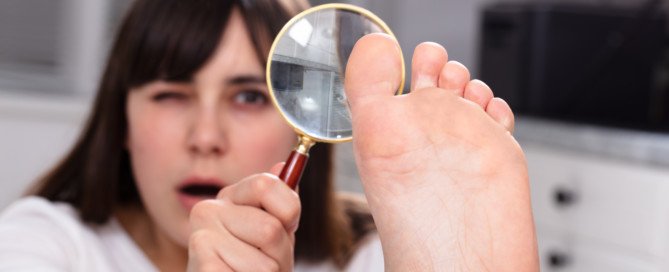
White Patches on Big Toenail: Causes, Solutions
Find out if cancer is one of the many causes of a white patch on your big toenail.
You may be quite scared that the white patch or multiple white lesions on your big toenail might be some kind of cancer such as melanoma.
There are multiple possible conditions that can cause a white patch to appear on the nail of your big toe.
And here’s some reassurance: Melanoma and other skin cancer are not among those conditions.
Possible Causes
“White patches on the big toenail usually represent a superficial fungus that can be treated with over the counter topical agents such as Lotrimin or Lamisil,” says Dr. Janet Prystowsky, board certified dermatologist in New York, NY, with 30+ years’ experience.
“Sometimes it can indicate no infection at all and may be nail plate dryness from removing nail polish with solvents,” she continues. “Moisturizing the nail plate with Aquaphor may help.
“Deeper fungal infections may also look like white patches, and a culture is necessary to verify this.
“Finally, trauma to the nail from ill-fitting shoes, or exercise that causes the end of the nail to jam repeatedly against the inside of a sneaker or ski boot can cause the nail to separate from the nail bed and make it appear whitish.”
In combination with her focus on early skin cancer detection and removal, Dr. Prystowsky provides a wide range of revitalizing and rejuvenating treatments.
Lorra Garrick has been covering medical, fitness and cybersecurity topics for many years, having written thousands of articles for print magazines and websites, including as a ghostwriter. She’s also a former ACE-certified personal trainer.
.
Top image: Shutterstock/Andrey_Popov

Small Circles of Peeling Skin On Fingertips: Doctor Explains



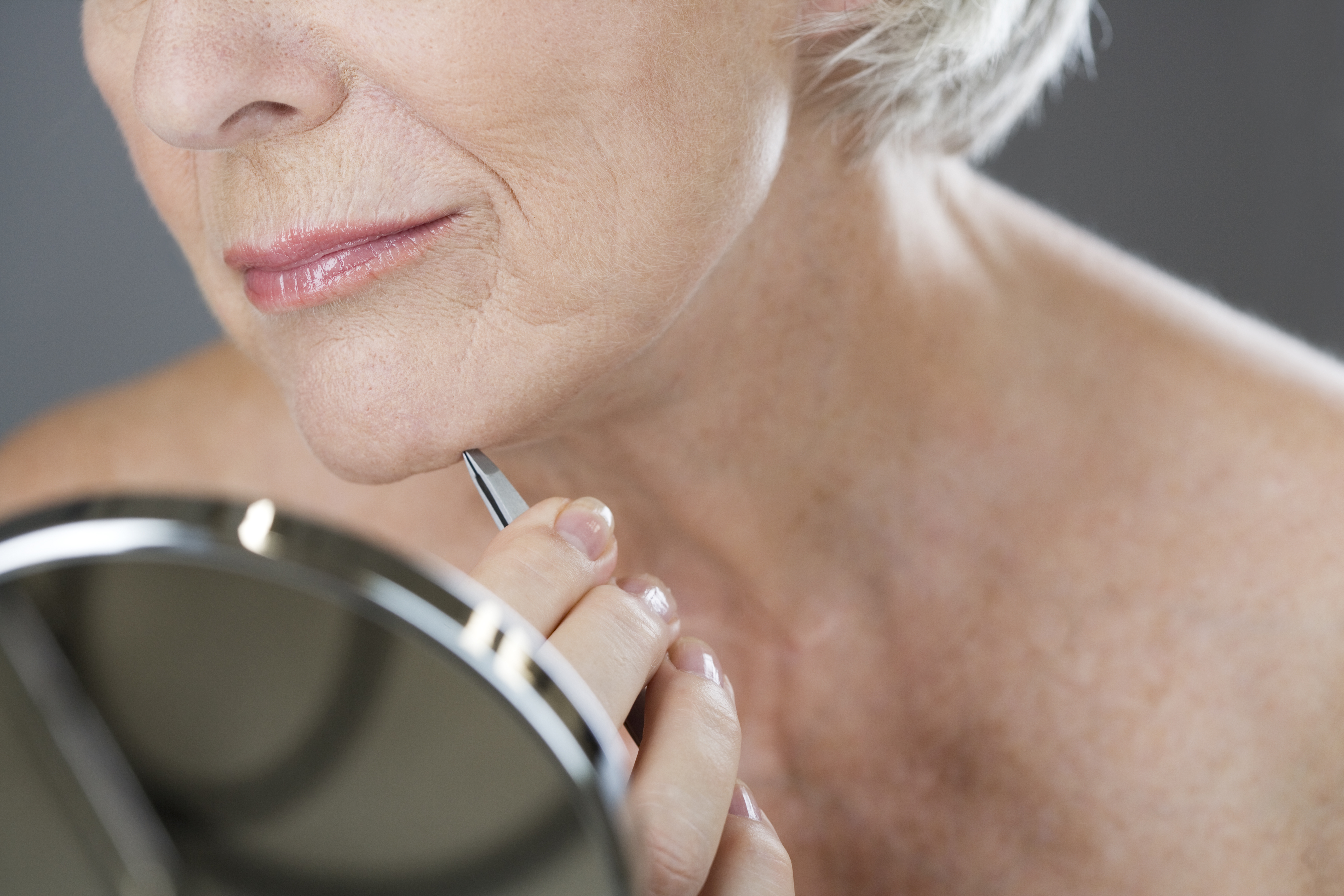



There are three causes, says a dermatologist, of small circles of peeling skin on the fingertips.
That’s a pretty odd-looking symptom, but here is what Dr. Janet Prystowsky, board certified dermatologist in New York, NY, with 30+ years’ experience, explains:
“Small patches of peeling skin on the fingertips is typically psoriasis; a contact reaction to a substance that you may be allergic or sensitive to; or may reflect recovery from a systemic viral illness.”
So to treat this symptom, you must find out what the cause is. A doctor can determine if the cause is psoriasis.
If it’s determined that this autoimmune disease is not responsible for circular peeling areas of skin on your fingertips, then you’ll need to evaluate whether or not you’ve been touching things or getting substances on your fingertips that might be triggering an allergic reaction.
Of course, if you’ve recently had a systemic (body-wide) viral illness, you will have felt sick enough to know this — or at least, that some kind of “bug” was in your body.