
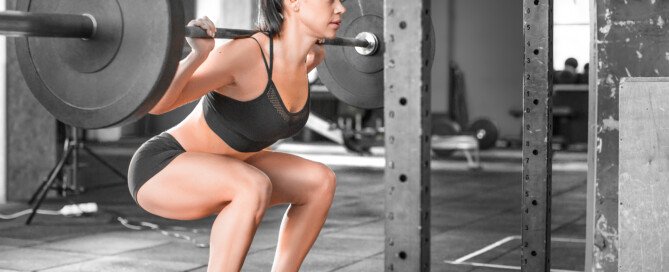
Shoulder Pain While Barbell Squatting: SOLUTIONS
There are different kinds of shoulder pain that can be associated with squatting with a barbell across one’s back.
The first type is a strained feeling, which may occur in one or both shoulders, soon after beginning the sets of squats.
It can be a sharp or pinching type of pain that tends to radiate down the medial (middle) deltoid.
The origin of this discomfort is a problem with the rotator cuff, a structure of four small muscles and tendons that is prone to injury from lifting weights, as well as from awkward positioning.
Though I’ve been a personal trainer, teaching the barbell squat, I have come across this problem only a few times — including with myself. But with myself, I found a solution.
Solution: Before you do barbell squats, stretch both shoulders by using the bar of a Smith machine.
Place it one increment higher than the height you’d normally use, if you were to do your squats on a Smith rack.
This height is important because it works perfectly for stretching the shoulders.
Position yourself beneath the bar as though you’re preparing to squat (even though the bar is one notch too high for your height).
Place hands as far out as possible on the bar. Place one foot ahead of the other as though you’re about to lunge, and lean body forward to generate a stretch in the shoulders. Hold for 30 seconds.
Rest from this stretch by doing anything (bodyweight squats, jumping jacks, sitting on bench, quad stretches, etc.).
However, after this 30 second break, you will start another 30-second stretch to help loosen up the rotator cuff.
Don’t force or yank the stretch; be gentle while you hold the position. Do four sets of 30-second stretches.
The joints should now be loosened up, and you can begin squatting (free or Smith).
Another possible cause of shoulder pain while squatting is that your hands are close to each other on the bar.
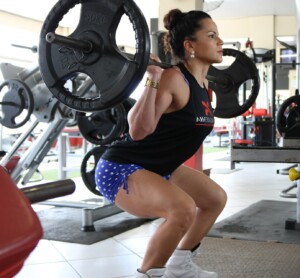
Place them further out. In fact, the further out they are, the less strain on the shoulder joints.
After the first set, you should do another 30-second stretch as described above.
In fact, after the first three sets of squats, do these stretches. By then, the joints should be thoroughly loosened up.
Another cause of shoulder pain during squats is that the bar is pressing down on the trapezius muscles.
This discomfort, for people who experience it, will be more pronounced during free barbell squatting versus that with the Smith machine.
The heavier the bar, the more pressure you’ll feel on your frame. However, make sure that the bar is truly across the shoulders, rather than resting upon your cervical discs!
If the bar rests on your neck, you’re asking for some deep trouble.
To avoid shoulder pain while doing barbell squats, 1) Decide you are going to take the time to conduct the stretches as described here, 2) Keep hands placed wide on the bar, even as wide as possible, and 3) Make sure the bar rests on the shoulders, not the neck.
 Lorra Garrick is a former personal trainer certified through the American Council on Exercise. At Bally Total Fitness she trained women and men of all ages for fat loss, muscle building, fitness and improved health.
.
Top image: Shutterstock/B-Media
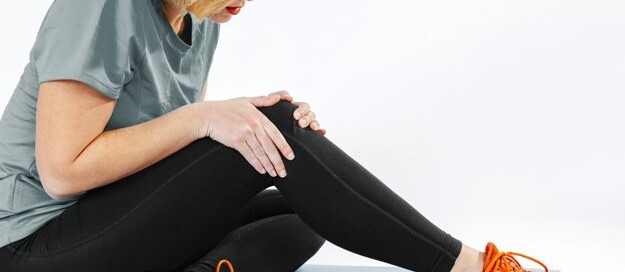
Knee Pain & ACL Injuries: More Often in Women than Men

A doctor explains all a woman needs to know about knee pain, which affects women differently than it does men.
• Do you have a dull but annoying ache just underneath your kneecap?
• Does it worsen after jogging or going up a flight of stairs?
• Do you especially feel it when you lock out your knee?
• Do you feel the pain when you sit on the floor, leg straight out in front, and press your hand down on your kneecap?
• When you bend your knee, do you hear “grinding”? Do you feel a grinding sensation?
• Does jumping bring it on?
You just may have chondromalacia patella, a fancy name that means wearing down of the cartilage underneath the kneecap.
It’s common among fitness enthusiasts and sports participants who engage in jogging, running and jumping activities. Wear and tear from such activities causes the cartilage to soften up.
It then breaks down, causing irregularities along the joint surface, says Michael A. Schwartz, MD, an orthopedic surgeon with White Plains Hospital Physician Associates in NY.
“I usually describe to patients that normal articular cartilage is like the Teflon coating of our pots and pans, as it allows for the smooth gliding of our joint surfaces as we move them,” explains Dr. Schwartz.
“The condition of chondromalacia is similar to when the ‘Teflon coating’ wears off, and the gliding is less smooth.” This condition can affect other joints, but is most common in the knee joint.
Though people over 40 can get it as cartilage deteriorates with normal aging, younger people beware:
This condition can strike 22-year-olds, as the result of trauma to the knee sustained in something as simple as slipping on grass slippery from a recent rainfall, from playing volleyball or from jogging for exercise.
“It can occur in younger, otherwise healthy and athletic people,” says Dr. Schwartz, “when the articular cartilage softens in response to excessive pressure on the cartilage.
“Running and other joint-loading activities are often implicated. Chondromalacia usually develops over time, but it can also be precipitated from an acute injury.
“During such an injury, opposing cartilage surfaces can impact, or bang against each other, which undoubtedly causes some type of damage to the lining articular cartilage.”
A classic symptom of chondromalacia is pain right beneath the kneecap upon locking the knee out straight.
If you suspect chondromalacia, sit on the floor with both legs perfectly straight out in front of yourself so that you can’t even slip a piece of paper beneath your legs.
Place your fingers on the kneecap in question, and press down, as though attempting to hyperextend the leg.
If you have chondromalacia, the pressing-down will almost always cause pain. But if you don’t feel pain, this doesn’t mean you don’t have the condition.
It’s best to seek medical consultation just to be sure the pain isn’t from something more serious.
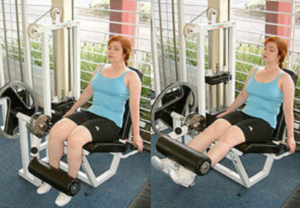
Treatment for chondromalacia is simple: leg extensions. They work absolutely wonders.
George Stepanek
Ice and rest provide only temporary relief, and do nothing to “train” the knee joint to be more reliable and efficient. But leg extensions will work magic.
“The worn-down cartilage cannot grow back and become smooth again,” says Dr. Schwartz.
“But the exercises strengthen the surrounding knee muscles, which can help in alleviating the pressure on the cartilage surfaces.”
If you’ve been diagnosed with chondromalacia, you must make leg extensions and other leg weight routines a permanent part of your life in order to keep the pain at bay.
And that’s not so bad a deal, because along the way, you’ll get toned, stronger legs that will always come through for you.
Preventing Chondromalacia
At first, you will need to minimize or even avoid joint-pounding activities, says Dr. Schwartz.
Activities that can aggravate or cause the condition include “running, especially on hard, unforgiving surfaces, squatting, kneeling, stairs and hill running.
“If one likes to do these activities for their conditioning, I always recommend cross-training, or varying one’s sports.
“With this, running should be alternated with swimming, elliptical machine work, bicycling, etc.”
Over time, as the knee’s surrounding soft tissue becomes stronger, it’s reasonable to expect a full absence of chondromalaciar discomfort. Other sports that can bring it on are soccer, lacrosse and field hockey.
Beginning-rehab Exercises
If you’ve never done leg extensions before, and you have this knee problem, then find a chair that’s high enough off the floor so that when you sit on it, your feet dangle.
Straighten the leg with the painful knee so that it is parallel to the floor, but avoid a full lock-out.
Hold for two seconds and lower. Repeat 10 times, three sets, three times daily. If both legs have the condition, you can extend both legs simultaneously.
Do this for several weeks, then graduate on to a weight stack machine, using the lightest weight possible. Gradually increase weight over time, and never quit these exercises.
If you quit, thinking you’ve “cured” the problem, don’t be surprised if within a few weeks, the pain pushes its way back into your life. Leg extensions with weights will keep the pain deactivated.
Exercise protocol for weights: 8-15 repetitions, 4-5 sets, twice a week. Never lock out knees.
Keep feet at a 90-degree angle to the shins at all times.
Do not let feet just flop around while performing the extensions.
Women far more likely than men to suffer ACL injuries.
Chondromalacia involves cartilage, a soft tissue that provides shock absorption for joints. On the other hand, ligaments connect bone to bone.
The ACL—anterior cruciate ligament—connects the thigh bone to the shin bone, and this ligament is somewhat shaped like a cross, hence its name, “cruciate” (think: crucifix).
ACL injuries aren’t just caused by a disastrous ski tumble. The ACL can be damaged from athletic maneuvers involving a sudden change of direction while the foot is planted, such as in volleyball, basketball and softball, even dancing or aerobics class.
Landing from a jump can also cause injury. ACL tears often require surgery—followed by up to nine months of rehabilitation.
It’s suspected that the way a female holds her trunk/hips during running and jumping activities, contributes to the higher rate of ACL injury.
Women tend to maintain a more erect posture than men, while running and jumping.
The next theory is that male athletes, more often than female, place their bodies in a protective squat-like position during athletics. Playing in a more erect position makes the ACL more vulnerable to harm.
Why men are more likely than women to do this isn’t clear, but female athletes should be trained to assume squat-positions more often during sports performance.
And if you’re not an athlete? You still should get in the habit of lowering your center of gravity during physical activities such as inline skating, trotting down staircases, hiking and even playing Frisbee.
A lowered center of gravity, while maintaining vertical spinal alignment, creates a protective effect against joint injuries and falling.
(Have you ever seen a skier standing erect while whooshing downhill? Have you ever seen a ski jumper land with straight legs?)
According to the American Academy of Orthopaedic Surgeons, here are a few explanations for why women suffer a higher percentage of ACL injuries:
- Biomechanical factors. Women tend to rely more upon their quadriceps during sports activities. A shift to more hamstring involvement can lower ACL injury risk. Women also more often than men land flat-footed rather than on the balls of their feet.
- Environmental factors. Shoes with high surface traction can increase injury risk.
Women will lower risk of ACL damage by learning more efficient techniques for landing, jumping and positioning their bodies during physical activities.
An exercise program that emphasizes upper leg strength and endurance will help the active female sustain the protective squat-like stance while engaged in sports or other pursuits such as trotting down a mountain trail.
Risk factors for knee problems in general:
- Overuse and/or improper biomechanics. This can occur from squatting excessively during gardening, for example. Prolonged kneeling with hamstrings against calves can also hurt the knee.
- Weak muscles and/or lack of flexibility.
- Mechanical problems like flat feet, misaligned knees, and one leg shorter than the other.
- High-risk activities like Alpine skiing.
It’s time to seek medical advice when the pain won’t go away despite rest and ice; the pain is severe; the knee is swollen or red; appears misshapen; and you can’t bear weight on the knee.
 Dr. Schwartz has previously worked as a team physician for high school, college and professional sports, and is the author of numerous scholarly research articles and chapters in orthopedic surgical textbooks.
 Lorra Garrick has been covering medical, fitness and cybersecurity topics for many years, having written thousands of articles for print magazines and websites, including as a ghostwriter. She’s also a former ACE-certified personal trainer.
.
Top image: Freepik.com
Strengthen Your Ankles 10 Ways; Best Way to Treat Ankle Sprains
There are 10 distinct ways to strengthen the ankles — and the stronger your ankle joint the less likely you’ll suffer a sprain or weakened ligaments.
As a former personal trainer, I wasn’t just helping people lose weight and build muscle. I also showed many clients how to strengthen their joints, from neck to ankle.
10 Best Ways to Strengthen the Ankles
1. Walk forward and backwards on the balls of your feet.
Turn your toes inward as well.
You’ll actually feel this in the sides of your thighs, but you are also working the ankle joint, strengthening the ligaments that bind it together.
Go 50 steps forward, and 50 backwards. Do not hold onto anything when you go backwards. Just make sure you won’t bump into anybody.
2. Pedal a stationary bike with just the balls of your feet. Do not use the foot straps.
3. If you use an elliptical trainer, pedal with just the balls of your feet, and turn your feet inward a little.
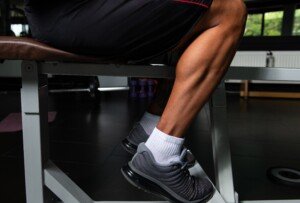
4. Do seated calf raises with light weights and many repetitions.
Shutterstock/Jasminko Ibrakovic
5. Walk backwards on a treadmill. Do not hold on. Start out very slowly at first.
If you hold on, you’ll cancel out the effect that the routine is supposed to have in the first place.
The ligaments in your ankles need to support your entire body weight in a natural motion — the natural motion of walking backwards without your hands holding anything for support.
6. Take up jogging.
7. Do brisk walks on uneven surfaces, such as grassy areas. Go hiking on trails that offer a variety of terrain.

8. Take step aerobics classes.
9. Take up inline skating. It’s best to do this after you’ve been exercising your ankles for a while, since this activity will make ankles ache in people who are not very conditioned.
10. “A precise ankle adjustment followed by proprioceptive neuromuscular facilitation (PNF) exercises/stretches — which are implemented in the Power Kinetics® Home Exercise Program —may be the single most important factors in restoring optimal functionality and strength to your ankle/foot complex,” explains Eugene Charles, DC, Diplomate of applied kinesiology and author of “Journey to Healing: The Art and Science of Applied Kinesiology.”
How should you treat a simple ankle sprain?
“The number one way to treat ankle sprains — and the most overlooked — is that you must have the ankle bone (talus) realigned by a doctor of chiropractic or osteopathy,” says Dr. Charles.
“When you sprain an ankle your talus bone usually slips out of alignment, and this explains why people usually have weak ankles form then on out.”
The Compression Bandage
I have had superb results with using a compression bandage.
It’s amazing how effective these can be. I ice the ankle, if it’s swollen, several times a day for 20 minutes.
Do not ice for longer than 20 minutes, and let at least two hours go in between ice treatments.
Keep foot elevated as much as possible. And keep the compression bandage on at all times.
The kind I use is tight enough to force me to remove it after a few hours. After my foot has a break from it, I put it back on again.
HOWEVER … if at any point you begin feeling tingling or numbness from the bandage, immediately loosen it. There’s also no need to sleep in it.
I have restored mildly sprained ankles in as little as three days with icing and the compressive bandage.
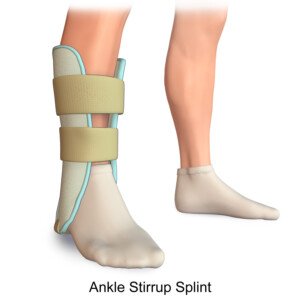
Another option is the air cast, shown below.
BruceBlaus/CC
For more severe sprains, you’ll want to consider talus bone realignment.
Strengthening the ankles should be a priority for any athlete and fitness enthusiast.
We all know how much a sprained ankle interferes with activities.

Dr. Charles has helped thousands of patients and taught over 1,200 doctors during his 30+ years of practice. He has also created the Power Kinetics® Exercise Program and line of nutritional vitamins and performance supplements. amazon.com/Journey-Healing-Science-Applied-Kinesiology/dp/0964421763
Lorra Garrick is a former personal trainer certified by the American Council on Exercise. At Bally Total Fitness she trained clients of all ages for fat loss, muscle building, fitness and improved health.
.
Top image: Shutterstock/ Skumer

Do Hardbodies Really Stare at Fat People in the Gym?

Is it reality or myth that in a gym, the hardbodies stare and gawk at fat people?
You’d think a gym would be crowded with very overweight people, but just the opposite is true.
Many overweight people believe that they’d be stared at, even snickered at, by the buff bodied patrons at a health club.
It’s true that the overweight jogger is bound to get heckled outdoors by motorists. But I’m talking about GYMS.
A gym, actually, is a sanctuary for overweight people, even the obese. The truly fat man or woman just doesn’t realize what a sanctuary a gym could be.
If you are obese and experience rudeness in public, the gym is one place where this will be nearly nonexistent.
Do not stereotype the “hardbodies” as being the rude type who’d snicker and stare.
Shutterstock/RomarioIen
I’ve watched TV shows, talk shows and news shows in which overweight people are explaining their fear of being openly stared at or ridiculed at a gym.
I’ve also read such points of view by overweight people in print media.
Now I’m not saying there aren’t isolated cases in which an overweight person was treated poorly by gym personnel, or treated rudely by another patron.
But these are isolated situations. Even a buff person can be treated like crap by a jerk. That’s life: Some people are just plain jerks.
I have witnessed very obese women and men walking towards the locker room in a crowded gym.
Actually, my eyes were more on nearby gym goers to see if, indeed, there was any truth to this idea that very big people at a gym get gawked at.
I have YET to witness just ONE person staring bug-eyed at an obese man or woman. I’m sure it’s happened, but behind the person’s back, I’m sure.
In fact, it’s expected that a nearby person’s eyes will nonchalantly follow a 300 pound person as they head towards the locker room.
If a 250-pounder in shorts is on the treadmill in the row of cardio equipment ahead of you, you’re certainly bound to stare a little.
And guess what: The anorexic-looking women get stared at, too.
In fact, there’s always lots of staring at a gym.
- The woman whose arms are completely covered in tattoos gets a lot of staring.
- The 5-2 woman who’s built like a bar bouncer as she trains for her bodybuilding competition also gets her share of gawking, stares and whispers.
- So does the man who grunts loud enough during weightlifting for the whole gym to hear
- And so does the woman whose spinal column is jutting out because she weighs 79 pounds.
But I have never, ever, ever caught wind of any ridicule or snickering directed towards fat people. Why would someone ridicule you for working out?
If you’ve been ridiculed at Dairy Queen as you walk out with an ice cream cone, this doesn’t mean you’d be made fun of at the gym.
If you’ve been heckled by a car load of teens at the grocery store parking lot, this doesn’t mean that you’d get taunted at the gym.
The gym is your escape from a mean world.
Everyone at a gym is so caught up with their OWN bodies, they’ll hardly notice yours.
Do not avoid the gym before you go there and see what it’s really like.
I swear, people on the cardio equipment are either in a trance, or, their eyes are glued to the TV screens, or, they’re yakking to each other on side-by-side machines or into their cell phones. They won’t even notice you.
As for the weightlifting equipment, again, have a seat on some exercise equipment.
Any hardbodies nearby will be too busy cranking out their routine, or too busy recovering from it, or too busy checking out their own bodies, to take interest in yours.
It’s a myth that hardbodies stare at “fat” people at the gym.
Lorra Garrick is a former personal trainer certified through the American Council on Exercise. At Bally Total Fitness she trained women and men of all ages for fat loss, muscle building, fitness and improved health.
.
Top image: Shutterstock/Lebedev Roman Olegovich

Speed Up Fat Loss with Anaerobic Cycling: Lose Belly & Leg Fat

Never underestimate the power of stationary bike workouts for melting off excess fat in your stomach, thighs or anywhere else — as long as you do it anaerobically.
Because pedaling a stationary bike is so easy, requiring no impact and no balance, you may think that it’s impossible to perform a wickedly punishing routine on this simple piece of exercise equipment.
Don’t let the simplicity of the stationary bike fool you; this tool is a potent weapon in the war on stubborn body fat.
Pedaling the bike in the “aerobic zone” has its limitations; namely, you won’t burn as much fat as you will if pedaling in the anaerobic zone (also referred to as the “cardio” or “athletic training” zone on some machines’ consoles).
Traditionally, the stationary bike has proven very useful for a comfortable, inviting warm-up for a grueling weight workout, or a hard-paced run on the treadmill. It’s also popular for warm-downs.
But don’t stop there. Include the stationary bike as a tool for igniting fat loss.

©Lorra Garrick
Take a break from the treadmill, elliptical or outdoor running. Shock your body with something different for a change.
A shocked body will use up more stored fat to deal with the shock—the shock of something entirely new that it is not acquainted with.
The anaerobic threshold varies from one person to the next. This is that point at which your body’s energy system shifts gears: from aerobic to anaerobic.
The more fit you are, the higher will be your anaerobic threshold. You must find out where yours is with cycling.
This is done as follows: Picture a number scale: 1 is how you feel when lying on a hammock, and 10 is how you’d feel if you just tried to outrun a train.
For ultimate fat loss, you want an exertion output that makes you feel at level 9-10. Because this is very near or at maximal intensity, it cannot be sustained for very long.
In other words, how hard must you pedal a stationary bike before you’re ready to fall off of it after only 20 or 30 seconds?
It’s easy to think you’re ready to fall off the bike if you’ve been pedaling with gusto for 20 minutes nonstop.
But when I say “ready to fall off,” I mean it: You’re so spent that you cannot pedal one revolution past 20-30 seconds.
Your thighs are wasted. You can’t talk.
The settings to achieve this kind of exertion, depending on your cardio fitness level, might be a level 12 on a bike that goes up to 12 “levels,” which indicate resistance of pedal crank.
This is a sturdy pedal resistance, but it must be combined with high RPMs to completely tax you in under half a minute. The RPMs in this case might be 100—sustained for an entire 30 seconds.
Try it. If you can go beyond 30 seconds, then after two minutes of easy pedaling at very light resistance (level 1-3), see if you can sustain an RPM of 130 at level 12.
Keep searching for that RPM speed that, if carried out at level 12, leaves you with no energy to go beyond half a minute.
Now, some bikes have up to 20 levels. In that case, a level 12 on these bikes is easier than a level 12 on a bike that has only 12 levels. There are many makes and models of stationary bikes out there.
For many people, it will be impossible to pedal 100 RPMs at level 18 on some models.
Don’t get confused by all these numbers here; focus more on the concept:
At at least 100 RPMs, figure out the pedal resistance (“level,” which is usually indicated by an “L” on the bike’s console), that turns you to toast within 30 seconds.
If you’re pedaling longer than 30 seconds, you begin going into a pacing mode.
This workout’s brief bursts of high-powered pedaling are supposed to be “sprints,” to maximize fat-burning.
They alternate with two minutes of lenient, gentle pedaling (70 RPMs at very light pedal resistance).
- Warm up for 10 minutes with easy pedaling progressing to moderate pedaling.
- Then begin this high intensity interval training by introducing your first 30-second interval—but make it a perceived exertion of 7 or 8 on that 1-10 scale mentioned prior.
- The next interval can be an 8.
- Make the next a 9.
- After that, you are warmed up for all-out sprints on the stationary bike.
Don’t get caught up with counting how many sprint intervals you do. Instead, when the time lapse hits 40-45 minutes, start winding down by pedaling at medium intensity for several minutes, and then light pedaling for a few more minutes.
50 Minutes Tops
The entire time you’re on the bike, including warm-up and warm-down, should not exceed 50 minutes.
This kind of anaerobic cycling can be done twice per week when you are trying to cut up or really thin out your body fat layer, while hanging onto mass.
A third cardio session per week should be done at low intensity and for long duration.
Lorra Garrick is a former personal trainer certified through the American Council on Exercise. At Bally Total Fitness she trained women and men of all ages for fat loss, muscle building, fitness and improved health.
.
Top image: ©Lorra Garrick

Broad Shoulders in Women: Solutions?

Are you a woman who hates her broad shoulders?
Perhaps you’ve been wondering if there are ways to shrink the size of your broad shoulders.
If you hate your broad shoulders because you’re a woman, then there’s only one thing that I, as a personal trainer, can think of as a solution, and it’s a solution that can actually work:
Embrace your broad shoulders.
That’s all a woman who hates her broad shoulders can do, and here’s why.
I once read a thread in a fitness forum started by a woman who despised her broad shoulders.
She sounded like she was in serious trouble, because although her initial post seemed to be no more than asking fitness enthusiasts if there were exercises to reduce her shoulder size, she made more posts that were increasingly disturbing.
In summary, this woman’s life was bleak and bitter, and she blamed this on her broad shoulders. Does this sound like body dysmorphia to you?
In the thread, none of the fitness enthusiasts, who included personal trainers, offered any exercises that could lessen the dimensions — because none exist.
But there was a recurring theme coming from the men who responded: Broad shoulders on a woman are sexy.

Shutterstock/RomarioIen
One guy pointed out that it’s a mystery where women get their ideas of what a man would find attractive or not attractive, that they probably get their ideas from other women.
He continued that they should not pay attention to what other women find physically appealing in each other.
Instead, he pointed out that they should pay attention to what MEN find appealing in women.
The one man also posted that it would be ridiculous for him to worry what other MEN thought was appealing on a man’s body, since he was attracted only to the opposite gender.
Likewise, if you’re a woman worried that men might be intimidated or turned off by your broad shoulders, where is this idea coming from — men, or your own gender ??

Freepik.com, Racool_studio
Your perspective should be based more on what men find inviting, not from what members of your own gender find attractive. Many men simply do not go for the small, petite, “weak” look.
Remember the shoulder pad craze of the ‘80’s?
There was a reason for that. Watch TV shows filmed in the ‘80’s and note how many actresses have shoulder pads.
You might even spot shoulder pads being worn by movie starlets in 1940’s films.
There are no solutions for you if you’re a woman who hates having broad shoulders, other than to accept them — because you cannot change them if they’re natural.
All I can suggest is that you exercise your entire body to make it as fit and strong as possible, to distract you from obsessing about something that you cannot change.
And before you dismiss me as someone who cannot possibly understand your predicament, I’d like to point out that I proudly sport broad shoulders.
Lorra Garrick is a former personal trainer certified by the American Council on Exercise. At Bally Total Fitness she trained clients of all ages for fat loss, muscle building, fitness and improved health.
.
Top image: ©Lorra Garrick
Cause of Child’s Skin Picking: OCD or Bad Parenting?

Here’s an answer to if the cause of a child’s skin picking is OCD or bad parenting.
What mother would ever blame herself for her child’s skin picking?
Does your child pick at his or her skin? Is OCD (obsessive compulsive disorder) or bad parenting the cause?
- Coming up with a conclusive answer could be challenging.
- However, is it logical to exclude parenting style from the equation?
When I saw my niece for the first time when she was 15, I inquired about what appeared to be cigarette burns up and down her arms. She said she picked her skin.
Her mother, a doctor whose practice at that time focused on treating people with ADHD and OCD, thought that the girl picked her skin as a result of some genetic wiring flaw in the brain.
Her mother is my sister. Just to give a little context: My sister does not have a medical board certification, and never did, in a specialty related to ADHD or OCD.
In fact, she’s never been board certified in any medical specialty.
Her residency, though, was in pediatrics, and after giving up on passing any Boards, she opened a private pediatric practice.
Eventually she turned to focusing on ADHD, OCD and even addiction, having taken certification courses in these areas, as well as acquiring certification in social work.
With all that said, it’s easier to imagine a child skin picking as a result of being henpecked day and night by a bullying mother, as opposed to being caused by a genetic disorder.
This girl’s parents also had begun divorce proceedings when she was 13, and it was ugly.
I want to interject here that in 2022 I was diagnosed with autism, and since then, have learned that skin picking is more common among autistic people than in neurotypical people.
However, this doesn’t mean that we should look at autism as a possible cause of my niece’s skin picking.
When I look back at her overall behavior, I realize that absolutely there were no signs that were suspicious for autism.
I also don’t see any point in considering the possibility that she concealed any autism via “masking.” But even if she had — this in no way dilutes the hardcore fact that her mother was emotionally abusive.
Furthermore, “more common in autism than in neurotypicals” does NOT translate to “common in autism.”
Neurodivergence aside, let’s imagine hearing from your mother, from the moment you get up in the morning, till it’s time for bed, everything you did wrong that day. Day after day.
That was my niece’s world when she was growing up.
Her mother continuously took slings at her. It was no wonder the girl became a skin picker.
Skin picking, like an eating disorder, is a response to feeling out of control and full of shortcomings, according to skinpick.com.
My niece had been on the receiving end of frequent denigrating remarks from her mother for years – confirmed by my cousin who’d had regular contact with them over the years.
When my sister and her kids were visiting my parents, an hour couldn’t go by without my sister harping on her oldest daughter for no good reason.
An example was when her mother went on a tirade because Emma was searching wastebaskets for a coupon that she believed she had accidentally thrown out.
Like, what is so abnormal and deserving of insults about searching for a coupon in a waste can? What level-headed adult has never done this?
“Emma takes long at everything,” her mother snidely declared, after the girl innocently commented to me that she eats slowly.
The girl had a brooding and glum, rather than neurodivergent, presentation.
Emma was on three drugs (prescribed by her mother) including Risperdal, whose main label use is for schizophrenia, says Risperdal.com.
However, my niece was not schizophrenic or psychotic. She took this drug for OCD: obsessive compulsive disorder.
A child would have to be superhuman not to exhibit maladaptive behaviors as as result of being raised by a bully.
Though my sister didn’t believe in corporal punishment, she definitely hurled words like rocks.
And sometimes, it wasn’t about words, but about behavior.
During their visit, I, my sister, her three kids and my brother went on an easy hike.
My niece complained of a headache at some point. It was very hot, and though she had a trim figure, she was out of shape because she didn’t exercise or play sports.
Her mother suggested she shake water from her water bottle onto her arms to cool off. So far, this sounds like a reasonable suggestion. But — there’s more to it.
Since it was hot out, the water in the bottle was warm; not very pleasant to drink.
Emma casually declined the suggestion to sprinkle it on her arms.
You’d think it would have ended there. But for about 10 minutes, my sister kept demanding that the teen sprinkle water on her arms to “cool off.”
I do not know how sprinkling warm water on one’s arms will cool someone off. Do you?
My sister wouldn’t let this go and turned it into a full-blown power struggle.
Finally, she grabbed her daughter’s bottle and began shaking it at her, droplets flying everywhere, and the distressed girl kept dodging the droplets, literally being chased by her mother.
This was no silly game of tag. Nobody was even grinning. This was clearly a bullying scenario. No wonder the girl picked at her skin.
Skinpick.com even says that a prominent reason a child begins skin picking is in response to being bullied by a parent!
I don’t have a PhD in child psychology, but I have eyes and ears.
This girl was a good kid in that she got good grades and was quite skilled with her favorite musical instrument. Her goal was to either be an English teacher or crime scene investigator.
She grew up to get a college degree in English and work at a bank. I’ve had no contact with her other than when she was 15, and then again at 18.
As of 2023 she’s 28. I have no idea if she ever ceased picking at her skin. However, she has many tattoos.
Skinpick.com explains that the definitive cause of skin picking is the subject of research, but a leading explanation is that a child feels she has no control in her world – except that which is very much within reach: her skin.
So she picked her skin, creating some order in a chaotic world by controlling this one feature. Skin picking symbolizes an active control.
The markings were obvious and plentiful. I’m not talking about just two or three on one arm.
I just cannot believe for a second that this child would have developed skin picking regardless of what kind of parent-child dynamics were going on.
Lorra Garrick has been covering medical, fitness and cybersecurity topics for many years, having written thousands of articles for print magazines and websites, including as a ghostwriter. She’s also a former ACE-certified personal trainer.
Source: skinpick.com/skin-picking-causes
Top image: ©Lorra Garrick
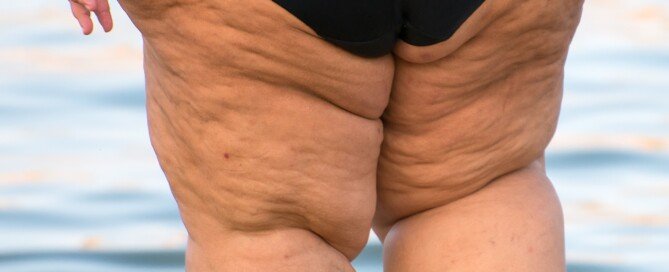
Have Plus Size People Really Tried Everything to Lose Weight?
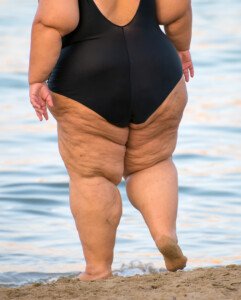
This article explains why “I’ve tried everything to lose weight” is a myth, and what obese or overweight people CAN do for permanent fat loss without surgery.
“‘I’ve tried everything, but nothing works,’ is a common statement that I hear, over and over again in my clinic,” says Richard Kelley, MD, a practicing physician in Texas for 20+ years, and author of “The Fitness Response,” “The Three-Hour Appetite” and the ebook, “The Fitness Response ‘Diet’ for Women.”
Dr. Kelley adds, “For almost all of these clients and patients, nothing could be further from the truth.”
This article was inspired by the countless times that I have seen obese people on talk shows telling the hosts, “I’ve tried everything to lose weight.”
And certainly, physicians of many different specialties have heard these very words as well, numerous times.
Dr. Kelley continues, “Robert Kiyosaki is fond of saying, ‘Excuses are just lies that we tell ourselves.’ In reality, most people know deep-down, that they have not tried everything.”
Look around at your health club. Not only are few patrons actually obese, but you’ll notice other things:
1) It’s quite uncommon to see obese to moderately heavy men and women in the gym’s free weight section
2) And if they are, you won’t see them performing the killer calorie burn routines, and
3) Though many of a club’s overweight patrons are mostly on cardio machines, they’re all doing steady state rather than HIIT.
HIIT is the rocket fuel of cardio.
“In reality, in almost any circumstance and for almost every problem, there are alternative solutions to consider, even when we believe we’ve run out of options,” says Dr. Kelley.
He adds that the majority of his patients who DO exercise, confine it only to aerobics.
Aerobics-only exercise does not equate to significant weight loss.
“Researchers will point to the fact that there is not a strong tie between exercise and weight loss, but again, their data is based by and large, on aerobic-only activity and research that tends to test in the realm of aerobic-only data,” explains Dr. Kelley.
“This is a bias which may not even be recognized by many researchers and investigators, who may believe that ‘exercise is exercise,’ and it must all be equal in its ability to burn calories.”
Magic Bullet for Weight Loss for the Obese
Research showing the power that strength training yields for weight loss is relatively new.
Shutterstock/Travelerpix
But this power is no secret to physique athletes and bodybuilders. A “bodybuilder” is anybody who seeks to build muscle, and these enthusiasts do not necessarily bulge with veiny muscle. Bodybuilding or physique development is on a continuum.
“I encourage almost every patient I see, who can do so safely, to consider beginning a resistance training program, to help them bridge the gap between the limited number of calories that most of us can burn through aerobic-only exercise, and to help them transition to a physiology capable of burning calories more consistently, 24/7.”
What Dr. Kelley means is that a serious strength training regimen will create a substantial increase in resting metabolism, something that Zumba, dance aerobics, and steady state sessions on cardio equipment will never produce.
This is why men and women who seriously train with weights, and eat sensibly, have such small, tight waistlines.
If you’re obese and think you’ve tried everything to lose weight, ask yourself if you’ve tried heavy weightlifting for six months.
If you’re obese and believe you’ve tried everything to lose weight, have you tried deadlifts, leg presses and bench presses?
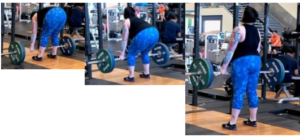
Deadlift Sequence
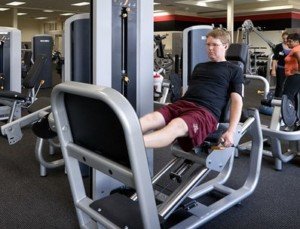
Leg Press
If you’re obese and believe you’ve tried everything for weight loss, ask yourself if you’ve tried HIIT: high intensity interval training.
If you’re obese and think you’ve tried everything but also believe you’re too large to do HIIT or intense strength training, you are mistaken. HIIT can be done by the obese.
Obese people are on an even playing field with thin people when it comes to strength training.
Next time you open your mouth to say, “I’ve tried everything to lose weight,” first ask yourself, “Am I sure?”
Chances are extremely high that you have never employed high intensity interval training — a proven way to crush fat.
 Richard Kelley, MD, is an author, speaker, fitness expert and transformation coach.
Lorra Garrick has been covering medical, fitness and cybersecurity topics for many years, having written thousands of articles for print magazines and websites, including as a ghostwriter. She’s also a former ACE-certified personal trainer.
.
Top image: Shutterstock/Dmitri Ma

Do’s and Don’ts if Your Child Is the Youngest in the Grade

If your child is the youngest in the class and especially entire grade, you’ll want to make sure that you don’t make the following mistakes.
I started first grade at age five, and I have some great advice for you.
Do’s and Don’t’s for Parents Whose Child Is Younger than Everyone Else in the Class
If he or she complains that classmates are reaching various milestones sooner, explain that the milestones will come to your child at the same rate whether he’s with kids his age or a year older.
Don’t ever make a big deal about the age difference, but if the issue surfaces, open up the lines of communication and listen.
Never, ever tell your child that she’s “emotionally behind” or “not as mature” as her classmates.
When I was in seventh grade (age 11), I was the only girl who remained sitting calmly at my desk in homeroom when a bee flew into the room.
All the girls (12 years old, maybe a few 13’ers) fled the room shrieking. The boys stayed behind.
I went to a new high school for grades 11 and 12. It was small and had only one restroom (with several stalls). Between class changes it was always filled with girls – older than me – smoking.
Stinking up the restroom with smoke, knowing full-well it was against school rules to smoke in the building, is a sign of immaturity and blatant disregard for nonsmokers who’d like to use the facility without gagging on the stench of ashes (the restroom wasn’t regularly cleaned).
I never smoked or drank. Older kids did. I never got into trouble. Older kids did. I never stuck gum under desks. And I’d witness older kids cry over things that didn’t phase me.
Was I perfect? No. Once I threw a paper airplane and it hit the teacher in her eye, knocking out her contact lens.
I had no idea the plane would veer that way. I looked away and played innocent, and the teacher never found out where the plane had come from.
Yes, I had my occasional moments, but overall, I was a very low-maintenance, chilled-out kid who began babysitting at age 11.
But believe it or not, I heard more than once from family members that I was “emotionally behind” my classmates because I was younger!
If you don’t want a resentful kid, never tell them they’re less mature than their classmates just because they’re the youngest.
And don’t tell other people that your child is less mature than their classmates, either.

Maturity Level Doesn’t Always Correspond to Being the Youngest in the Class
The most disruptive kids in any class I’d ever been in were not the younger ones.
How Do You Define “Maturity”?
An 11-year-old girl may still be drawn to “The American Doll” or scampering around with her seven- and eight-year-old neighbors, while her 12- and 13-year-old female classmates are more interested in fashion, boys and babysitting jobs.
But this doesn’t mean she’s less mature than they are.
Who’s to say that in a school bus accident, this 11-year-old wouldn’t be the first to go around seeing if anyone was hurt, while the older girls were hysterical and immobile, despite having no injuries?
When I was 13 and a freshman at an all-girls Catholic high school, some older boys from an all-boys Catholic high school entered the building between classes and released a decapitated chicken.
The bird crazily ran all over the place (neurological reflex), dripping blood everywhere.
When the bell rang for the next period and girls filled the hall, they screamed and chaotically dispersed in all directions—girls who were older than me.
I remained calm and simply made sure that the bird didn’t come near me.
Another incident at this school, when I was 13, involved the nun who was in charge of directing school musicals.
The cast performed poorly for the first evening’s production, and we were ordered to sit in the gym’s bleachers afterward.
The nun stood across the gym and began hollering at us, spouting ugly things.
She was so aggressive that the principal had to stand behind her, hands on her upper arms to restrain her.
After her tirade we were released to the dressing room. A 12th grade girl who towered over me was very shaken up and sobbing, exclaiming to me (because I was the nearest to her), “Did you hear what she said?! Did you hear what she said?!”
This girl, prior to all of this, had always come across as thick-skinned, rough around the edges, the kind who wouldn’t take any guff from another classmate.
Yet here she was, unraveled and in tears. And me? I wasn’t the least bit shaken up by the crazed nun’s temper tantrum. Instead, I hated the nun even more.
If your child is one of the youngest in his or her grade, don’t sweat it and never use it as an excuse for anything.
When Your Child Is the Youngest in the Class in Elementary School

“In my experience this is really only an issue in elementary school when a year can make a huge difference in developmental and emotional maturity,” says Dr. Tia Kern-Butler, a licensed psychologist for over 20 years who treats a broad range of issues including relationship problems and behavioral issues of children and adolescents.
“Yes, a parent should never tell a child that they’re emotionally behind, nor should they really compare the child in any negative way to their peers.
“If a child is struggling with this issue there must be a particular reason why they’re feeling out of place (perhaps they can’t do something the other children can, or another child is calling them a baby, etc.).
“A parent should try to talk to their child about what is going on and how they feel about it first, before jumping to conclusions or giving any opinion on it themselves.
“Often a child’s perspective on a situation is much different, and the parent can get a better idea of how to respond when they know how the child is perceiving it.
“If a child feels out of place because of skill differences, the parent should focus on the fact that all people are different and have different strengths.”
The parent should also remind the child that he or she will grow into the skill-set that older classmates have.
Maybe you can also say, “No matter what your age, you will always be a year younger than someone, and someone will always be a year younger than you.”
Dr. Kern-Butler also advises that the parent help develop their son or daughter’s unique strengths.
“They can also discuss that skills are learned and can be improved with practice and identify some ways to help their child do this,” says Dr. Kern-Butler.
 Currently in private practice Dr. Kern-Butler spent 10 years as the lead child and adolescent psychologist with Winter Haven Hospital and served as the mental health liaison for the Children’s Advocacy Center for 14 years.
Professionalpsychologyofpinellas.com/about-me
Lorra Garrick has been covering medical, fitness and cybersecurity topics for many years, having written thousands of articles for print magazines and websites, including as a ghostwriter. She’s also a former ACE-certified personal trainer.
.
Top image: Freepik.com, peoplecreations





Dropping Weights at the Gym & Getting Injured

Dropping weights at the gym is almost always done intentionally, and it’s no surprise that sooner or later, the men who do this get injured.
The whole idea of dropping weights at the gym needs to be changed.
After all, if you’re strong enough to do sets with a particular weight, you should be strong enough to set the weight down without forcefully dropping or “throwing” it.
The exceptions would be a one-rep max deadlift and farmer walks with the heaviest dumbbells possible, but almost always, the dropping appears to be done electively rather than from the inability to handle the weight.
Injuries from Dropped Weights at the Gym
Dropped weights at the gym cause far more injuries than you think, says a new study carried out by the Center for Injury Research and Policy of The Research Institute at Nationwide Children’s Hospital.
The study tracked weight training injuries between 1990 and 2007: over 970,000 overall ER cases in the U.S. during that time.
The most common way that injury occurred in the gym was from weights dropping on someone: 65 percent of the reported injuries.
Overall, 90 percent of the injuries occurred with free weights (which explains why so many injuries were from dropped weights).
I see men carelessly dropping dumbbells and plates to the floor all the time – but a lot of times, it’s the plates that are being dropped — sometimes tossed to the floor or carelessly dropped vertically into slots.
And when men do this, occasionally they miss. But I’ve never witnessed an accident.
As for dropping or “throwing” dumbbells to the floor after chest presses, the user isn’t at risk for a dropped-weight injury; someone nearby is — their feet.
However, I do not know if this specific mechanism of insult was reported in the study. “Dropped weights” can mean different scenarios.
It can mean a dropped barbell on someone’s chest. It can mean a dropped dumbbell on someone’s foot after he doesn’t quite place it in the rack.
Plates can slide off crooked barbells and easily land on someone’s foot.
The age bracket in which the highest proportion of injuries from dropped weights occurred, was12 years and younger. Kids are dropping weights left and right, apparently.
What about mishaps from resistance machines?
What age group had the most injuries from machines? People 55 and over. This isn’t surprising because these machines attract the older crowd more than the younger crowd.
Also, whenever I see someone incorrectly using a machine, it’s almost always an older man – particularly the preacher curl machine. What is it with men 50-plus and the preacher curl machine?
Ever see an old-timer use this machine? Cheat City, USA – which translates to injury risk.
The lat pull-down is another machine that older men improperly use, putting themselves at risk for back and rotator cuff injury.
“Before beginning a weight training program, it is important that people of all ages consult with a health professional, such as a doctor or athletic trainer, to create a safe training program based on their age and capabilities,” explains study author Dawn Comstock, PhD.
This report may make it sound as though pumping iron is a dangerous pursuit, but lifting actually ranks relatively low as far as injuries, when compared to other physical activities.
Weights being dropped is something that’s within people’s control, far more preventable than, say, a sprained ankle while playing basketball.
Also keep in mind that the report included children.
Kids should not handle strength training equipment without supervision, and I wonder how many of these injured kids were not supervised.
So with all of that said, it would be a smart move to work on limiting how often you let the weights drop during your gym workouts.