Can a Heart Attack Cause Only One Symptom: Chest Tightness ?

If you suddenly feel tightness in your chest but have no other symptoms, what are the odds that this could be a heart attack, especially if you have the classic risk factors?
12 Risk Factors for a Heart Attack
• Age: over 50 for men, 45 for women
• Atrial fibrillation
• Cholesterol: high triglycerides and LDL
• Coronary artery disease
• Diet high in processed foods
• Diabetes
• Exercise: not enough
• Family history
• High blood pressure
• Obesity
• Sleep apnea (untreated)
• Smoking
The most common symptom involving the chest that many people associate with a heart attack is that of “pain.”
Other symptoms are referred to as aching, heaviness or a squeezing sensation. The squeezing can also be thought of as tightness.
The following additional conditions have been associated with a higher risk for a heart attack:
• Insomnia or poor sleep habits
• Chronic stress
• Panic attacks
• Cocaine use
• Apple shaped body (excessive abdominal fat relative to the rest of the body)
• Consuming foods with trans fats
Chest Tightness As the Only Symptom of a Heart Attack

Shutterstock/pikselstock
“Yes, chest tightness can be the only heart attack symptom,” says Dr. Lowell Steen, MD, Interventional Cardiologist at Loyola University Medical Center, Director of the Interventional Cardiology Fellowship Training Program, and Medical Advisor to 120/Life, a functional beverage with a blend of six natural ingredients that promote normal blood pressure.
Dr. Steen explains, “When it comes to heart attack symptoms, pain is not the preferred symptom description because the vast majority of heart patients report tightness, squeezing or heaviness, but not pain.
“Others just have shortness of breath, jaw pain or discomfort, or fatigue. Additionally, many patients state nausea or vomiting symptoms, so it can be very misleading.”
If you’ve been having recurring bouts of only one symptom – that of a tight feeling in your chest – and otherwise you feel fine — don’t assume that you’re in the clear.
One might figure that it’s just not possible to keep having recurring heart attacks and surviving them without medical intervention, so therefore, repeated occurrences of chest tightness can’t possibly mean a heart problem.
Oh yes they can: coronary artery disease – causing angina. Angina isn’t just chest pain. It can be tightness in that area too, and only the tight feeling.
Angina is when coronary artery disease (clogged arteries) prevent adequate blood flow through the heart.
The interior of the arteries is narrowed due to plaque buildup, meaning impeded blood flow through the cardiac muscle.
This can cause episodes of tightness, heaviness or pain in the chest (and/or shortness of breath) upon even mild exertion. So if you’re been having this solitary symptom, the first doctor you should see is a cardiologist.
Then if all is negative, go see a gastroenterologist, since a tight feeling (or pain) in the chest can also be caused by digestive issues.
 Dr. Steen’s clinical expertise includes angioplasty, chest pain, coronary artery disease, heart attack, high blood pressure, valve disease, and vascular disease and intervention. 120life.com
 Lorra Garrick has been covering medical, fitness and cybersecurity topics for many years, having written thousands of articles for print magazines and websites, including as a ghostwriter. She’s also a former ACE-certified personal trainer.
.
Top image: Freepik.com

How Much Salt or Sodium Daily Will Harm Your Heart?

Certainly there has to be a tipping point or threshold after which the amount of salt every day can hurt one’s heart.

Does Feeling Palpitations in the Neck Mean a Heart Problem?

Have you been feeling “heart palpitations” in your neck?
Wondering if a fluttering feeling in your neck might mean that something’s wrong with your carotid artery, such as a blockage from carotid artery disease? (more…)

Can Heart Decompensation Occur at Higher Ejection Fractions?

So can acute decompensated heart failure occur with higher ejection fractions?
In other words, with mild to moderately reduced ejection fraction in the range of 40 to 50%? (more…)

Can a Person Live to 100 with Chronic Heart Failure?

Just how long CAN a person with chronic heart failure live?
First off, not all people with chronic heart failure experience congestion (which causes fluid retention). (more…)

Can an Acoustic Neuroma Affect the Tongue?

An acoustic neuroma is a slow growing brain tumor that, if not caught earlier, can start affecting nerves that involve the face.
The nerve that controls facial function is not the same as the one that controls the tongue.
Is it possible – even remotely — for an acoustic neuroma to affect tongue function?
“It is very rare for an acoustic neuroma to affect the tongue unless it is very large and extends lower in the intracranial cavity and puts pressure on the nerve to the tongue,” says Ted McRackan, MD, MSCR, Director, Skull Base Center; Assistant Professor, Department of Otolaryngology – Head and Neck Surgery, Medical University of South Carolina.
• So yes, it’s possible.
• Is it likely? No.
Dr. McRackan explains, “If this occurs, then the nerve can be weak. In modern medicine, acoustic neuromas are typically found before this occurs.”
Before the benign tumor would grow enough to start compressing upon the nerve to the tongue, it will have already begun causing other symptoms that the patient would have found impossible to ignore, thus prompting a visit to a doctor.
A diagnosis of acoustic neuroma will then have been made, and the condition – because it’s creating symptoms – will have been treated either via microsurgery for removal or radiation therapy to deactivate its growth.
In a Third World country, you can see how an acoustic neuroma can go undiagnosed, left to proliferate long enough to extend down into the intracranial cavity.
What Nerve Controls the Tongue?
This is the 12th cranial nerve, known as the hypoglossal nerve.
If there is pressure on it due to an encroaching mass, this will cause either weakness to the tongue or even paralysis (not necessarily to the entire tongue).
Common symptoms of an acoustic neuroma are hearing loss in one ear (which could be sudden); tinnitus or a subjective sustained tone, humming, hissing, etc., in one ear; feeling off-balance; and facial numbness or weakness.
The facial symptoms are not related to the tongue.
 In addition to acoustic neuroma, Dr. McRackan’s clinical practice focuses on comprehensive management of ear, hearing, balance and skull base disorders. Areas of interest include cochlear implants, facial nerve disorders and tumors, vertigo and endoscopic ear surgery.
 Lorra Garrick has been covering medical, fitness and cybersecurity topics for many years, having written thousands of articles for print magazines and websites, including as a ghostwriter. She’s also a former ACE-certified personal trainer.
.
Top image: Shutterstock/sirtravelalot

Can an Acoustic Neuroma Cause Dripping from the Nose?

Persistent dripping or draining from the nose is a concerning symptom and has a possible connection to an acoustic neuroma.
This brain tumor almost always affects just one ear and is benign and slow growing.
The common cold will not cause prolonged or persistent draining from the nose.
Plus, a cold or common sinus infection will produce what appears to be the same gunk and goop that’s always drained out of your nose in the past from benign infections.
But ongoing dripping out of the nose that doesn’t look like typical runny mucus is of concern.
Some people fear that this clear watery discharge (usually from one nostril) might be from a cancerous brain tumor.
“As a neurotologist who treats skull base lesions, my immediate concern when mentioning ‘dripping from the nose’ is a brain fluid (CSF, cerebrospinal fluid) leak,” says Ted McRackan, MD, MSCR, Director, Skull Base Center; Assistant Professor, Department of Otolaryngology – Head and Neck Surgery, Medical University of South Carolina.
“This is not common for an acoustic neuroma before having surgery,” continues Dr. McRackan.
“However, a CSF leak is a known, but rare, complication of acoustic neuroma surgery.
“This can present as a persistent dripping of clear fluid from the nose (especially when bending over) or from the surgical incision.”
When a CSF leak, which causes draining or dripping from the nose, is not from an acoustic neuroma, it can cause symptoms that mimic those from this benign growth:
• Hearing loss
• Tinnitus (“ringing” in the ear)
Other Causes of Cerebrospinal Fluid Leak Include Malignant Tumor
A sinus or nasal tumor, normally referred to as a paranasal tumor, can cause persistent drainage from the nose plus other symptoms such as excessive watering of one eye, voice changes and a new palpable lump on or near the nose.
About half of paranasal tumors are cancerous.
Non-malignant additional causes of a CSF leak include skull fracture, brain surgery and intracranial hypertension, and in some cases there is no known cause.
If the drainage or dripping from your nose is also accompanied by symptoms such as a reduced sense of smell, nausea, vomiting, a headache that gets better lying down, draining from an ear, and/or a salty or metallic taste in the mouth – your doctor is not going to suspect that an acoustic neuroma is the cause.
In addition to acoustic neuroma, Dr. McRackan’s clinical practice focuses on comprehensive management of ear, hearing, balance and skull base disorders. Areas of interest include cochlear implants, facial nerve disorders and tumors, vertigo and endoscopic ear surgery.
Lorra Garrick has been covering medical, fitness and cybersecurity topics for many years, having written thousands of articles for print magazines and websites, including as a ghostwriter. She’s also a former ACE-certified personal trainer.
.
Top image: Shutterstock/pathdoc
Symptoms of a Small Acoustic Neuroma vs. Large Tumor
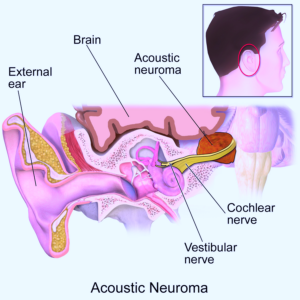
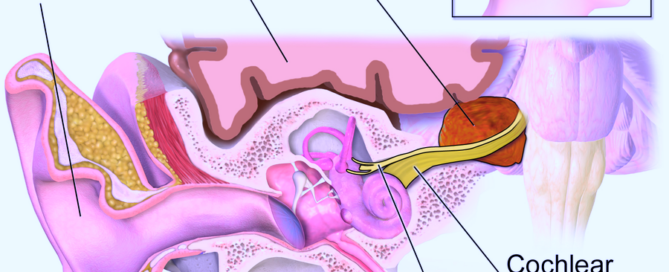
An acoustic neuroma is a brain tumor that grows slowly and can cause a variety of symptoms that usually correspond to its size: small or large, or somewhere in between. (more…)

What the Tinnitus of Acoustic Neuroma Sounds Like

Because an acoustic neuroma is a brain tumor that causes tinnitus in one ear, one has to wonder what it actually sounds like.

Can Facial Twitching Be Caused by an Acoustic Neuroma?

There are many causes of twitching involving the face, and a type of brain tumor called an acoustic neuroma can be one of them.
But if you have an acoustic neuroma, facial twitching should not be at the top of your worries. This brain tumor can cause worse problems.
Facial Twitches Caused by Acoustic Neuroma
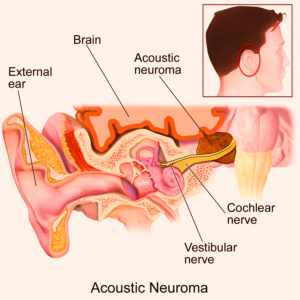
“This is rare but can be associated with larger acoustic neuroma,” says Ted McRackan, MD, MSCR, Director, Skull Base Center; Assistant Professor, Department of Otolaryngology – Head and Neck Surgery, Medical University of South Carolina.
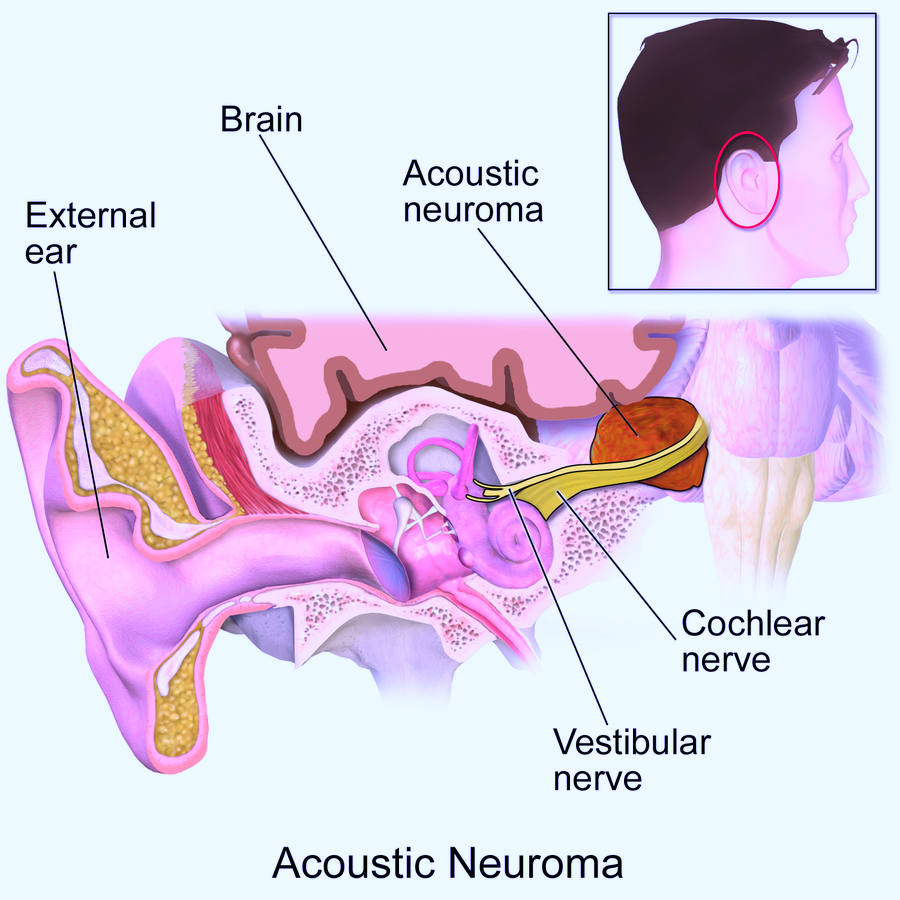
Blausen.com/CreativeCommons
“The vestibular nerves, which is the nerve that these tumors typically arise from, travel from the brain to the inner ear next to the facial nerve.”
The facial nerve is one of the 12 cranial nerves.
Dr. McRackan explains, “With very large tumors, the facial nerve can be compressed. This can cause twitching and/or weakness, but again, this is rare.
“The facial twitching arises from the facial nerve. This can occur anywhere on the face and sometime in the neck.”
Another name for this brain tumor is vestibular Schwannoma (the proliferative cells come from the Schwan cells).
“Sometimes when a patient has such symptoms, the tumor may arise from the facial nerve rather than the vestibular nerves (called a facial nerve Schwannoma),” says Dr. McRackan.
Twitching in the Face
• Very rare cause: acoustic neuroma. These benign tumors overall are rare, and their more common symptoms include hearing loss and/or tinnitus in one ear, pain in the ear, balance problems, dizziness, headache, numbness or weakness in the facial muscles, eye problems and swallowing difficulties. A person may have only a few of these symptoms.
• TMJ disorder: another rare cause.
• Benign fasciculation syndrome: not rare but not common cause of facial twitching.
• Stress, not enough sleep, fatigue, too much caffeine, dehydration: common causes.
The definition of “twitch in the face” is also open to interpretation.
• There’s the type of twitching at any location of the face that’s the same kind that affects an eyelid.
• Then there’s the so-called tic type of twitch, which can be caused by Tourette’s syndrome or just an odd habit.
Usually, a twitch in the face is nothing to worry about. But if these twitches began appearing at around the same time as the symptoms of acoustic neuroma (especially if you have new-onset hearing loss or tinnitus/ringing in one ear), this is more suggestive of this benign growth.
However, according to a paper in the American Journal of Otology (May 1994), some of the symptoms of a facial nerve mass can mimic an acoustic neuroma.
The growth can occur at any point along the facial nerve. An MRI will be ordered when a doctor suspects either condition.
In addition to acoustic neuroma, Dr. McRackan’s clinical practice focuses on comprehensive management of ear, hearing, balance and skull base disorders. Areas of interest include cochlear implants, facial nerve disorders and tumors, vertigo and endoscopic ear surgery.
Lorra Garrick has been covering medical, fitness and cybersecurity topics for many years, having written thousands of articles for print magazines and websites, including as a ghostwriter. She’s also a former ACE-certified personal trainer.
.