

Reasons Your Forearm Muscles Are Twitching: ALS Possible?

The forearm muscles are a unique muscle group, so when they start twitching, this is easily felt and even sometimes seen, raising the issue of ALS.
The forearm muscles are primarily responsible for wrist and hand movement.
If you’re worried about ALS because your forearm muscles are twitching, chances are highly likely that you googled some keywords that led you straight to ALS search results.
“If you consult ‘Dr. Google’ you might get yourself pretty worried because you are likely to find that ALS often presents with muscle twitches,” says Joseph Krainin, MD, board certified neurologist and sleep doctor.
Causes of Muscle Twitching in the Forearms
Dr. Krainin continues, “However, by far, ALS is NOT the most likely cause of forearm muscle twitches.
“Overall, the most common cause of muscle twitches is called benign fasciculations.
“As the name implies, this condition is not dangerous and is ‘self-limited,’ i.e., goes away on its own with time.
“If you have been overusing or carrying a lot of tension in your forearm muscles, you might be predisposed to getting benign fasciculations in these muscles.
“Activities such as racket sports and yoga can be very demanding on your forearms.” So can rock or wall climbing and lifting weights.

Shutterstock/Luka Funduk
Time passage is on your side. If over a period of several weeks, two months for sure, you have not noticed any weakness in your forearms, it’s a safe bet that you do not have any serious disease.
However, be careful with how you conduct strength tests for your forearm muscles.
For example, if you’ve never done wrist rolls against resistance before, and create a device with which to do this or use the device at your gym, your forearms and wrists will fatigue very quickly.
You’ll then probably start convincing yourself you have weakness.
If your forearms have a pathological weakness, you’ll know it. Anything that involves wrist action and gripping will falter, such as grabbing a half gallon milk carton out of the refrigerator with one hand and pouring the milk.
Lifting dumbbells to get into position for dumbbell presses is another movement that will greatly manifest pathological forearm weakness.
The list is endless, as we need our hands and wrists for so many daily tasks, including starting our car and putting on our seatbelts.
Forearm Muscle Twitching
There is nothing unique about the muscles in this location that would mean that their twitching is more suggestive of ALS or some other disease, when compared to fasciculations at other body locations.
Visibility of fasciculations, as well, is not indicative of the potential or odds that this might be caused by a motor neuron condition.
If you haven’t been doing racket sports, yoga, weightlifting or climbing, what could be causing your forearm muscles to twitch?
Anxiety, general fatigue and physical activity involving the upper body are leading causes, and the fasciculations can occur anywhere.
 Double board certified in sleep medicine and neurology, Dr. Krainin is founder and president of Singular Sleep, LLC, an award-winning online sleep center.
 Lorra Garrick has been covering medical, fitness and cybersecurity topics for many years, having written thousands of articles for print magazines and websites, including as a ghostwriter. She’s also a former ACE-certified personal trainer.
.
Top image: ©Lorra Garrick

Cure for Flaky Itchy Scalp Caused by Minoxidil: Simple Remedy

If minoxidil is causing your scalp to be itchy and flaky with white specks in your hair, there is a simple remedy for this problem.
An itching and/or flaking scalp, when caused by minoxidil, is usually caused by the 5 percent men’s solution applied twice a day. (more…)

What Happens in the ER When You Hit Your Head Hard: Tests

If you go to the ER fully conscious but report having hit your head hard, here’s exactly what to expect. (more…)
What to Expect in the ER if You Have Shortness of Breath

If you’re complaining of shortness of breath or difficulty breathing, here is what will be done for you in an emergency room. (more…)

Child Hit Head? Questions to Ask ER Doctor re CT Scans

If your child got hit in the head, you need to make sure they don’t get unnecessary CT scans.
Here’s questions to ask the ER doctor if you’re worried about radiation exposure.
CT scans take about 15 minutes and are easy to conduct. Not all doctors in an emergency room setting practice the same screening protocol when it comes to deciding to order a CT scan for a child who’s been hit in the head.
CT scans can be life-saving, being that they can show a brain bleed as a result of getting hit in the head – which children often do during play or from accidents.
The chart below shows radiation exposure from a CT scan of the head compared to other common sources of radiation.
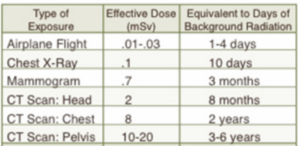
Questions Parents Should Ask About CT Scans for Kids’ Head Trauma
• Ask if the CT scan is necessary. Do not fear being thought of as “challenging a doctor” by asking this question. Think of yourself as an inquiring customer. You have a right to ask this question.
• Ask about other options such as MRI or ultrasound, as these do not use radiation. However, chances are high that an ER is not going to give an MRI for head trauma since it takes much longer.
• If the ER doctor will order only a CT scan, ask how the radiation dose will be adjusted to ensure use of minimal radiation.
• The answer to this question should include whether or not the staff has the expertise to ensure minimal radiation.
What if Child Seems to Have Only a Minor Head Injury?
The above questions apply, but there’s a few more questions you should ask the ER doctor if your child seems okay.
• Can a watchful waiting approach, in the emergency room, be taken instead of a hasty CT scan?
• If there’s no evidence of worsening symptoms, can the CT scan be put on hold while the child is held for several hours of observation?
• Be prepared for that—several hours—as this is what’s necessary for doctors to gain a strong foothold on whether or not head trauma can be serious or is truly minor.
• Ask about looking out for a change in, or worsening of, symptoms (if any) over those several hours as being the warrant for a CT scan rather than just the claim, “My child hit her head.”
Symptoms for Parents to Watch Out For
“If any symptoms appear after a head injury, a doctor should be immediately consulted,” says Dr. Lisa Lewis, MD, a board certified pediatrician in Fort Worth, Texas, and author of “Feed the Baby Hummus, Pediatrician-Backed Secrets from Cultures Around the World.”
“Although not as common as a concussion, brain hemorrhage (a bleed in the brain) can be life-threatening and require immediate intervention,” says Dr. Lewis.
“Symptoms to look out for that will warrant an immediate ER visit: vomiting, loss of consciousness, altered mental state, difficulty walking, not able to eat or talk, difficulty awakening.”
A worsening headache and nausea are also symptoms to take seriously and warrant an ER trip.

Having 25+ years’ experience, Dr. Lewis completed her pediatrics residency at Texas A&M University Health Science Center, Scott and White Memorial Hospital. For two years afterward she was assistant professor in the department of pediatrics at Texas A&M University Health Science Center.
Lorra Garrick has been covering medical, fitness and cybersecurity topics for many years, having written thousands of articles for print magazines and websites, including as a ghostwriter. She’s also a former ACE-certified personal trainer.
What Is Hyperhidrosis and Might You Have It?

Hyperhidrosis is a very bothersome condition that can impede the quality of one’s social life.
It can bring on enough embarassment to make the sufferer want to stay home.
“Hyperhidrosis is a condition that in any circumstances where a person would normally sweat (whatever the cause), those with the condition will sweat far more relative to volume .– four or five times more than what’s considered normal,” says registered nurse and emergency medical technician Angela Ballard, RN, EMT, with the International Hyperhidrosis Society (www.SweatHelp.org). (more…)

Does Hyperhidrosis Go Away with Age? Can You Outgrow Sweat?

Hyperhidrosis of the armpits, groin or feet–it can be bad enough to impair social life.
But is there hope as the sufferer gets older?
Can you “age out” of hyperhidrosis?
Hyperhidrosis is the medical term for excessive sweating. It can occur anywhere, but when it affects the armpits and feet, the odor becomes an issue in addition to the sweat.
If the groin is affected, this is really uncomfortable.
It can be so bad that several changes of underwear a day are necessary.
Too Old for Hyperhidrosis?
There’s a belief circulating that people who suffer from excessive sweating, which can also affect the hands and beneath the breasts, will outgrow this condition as they get older.
After all, how many elderly people do you know who complain of hyperhidrosis?
Then again, how many people of any age reveal this problem to family and friends?
They know it may be taken as poor hygiene rather than as a medical condition.
- But what really is the truth?
- Is advancing age the best treatment for excessive sweating?
“No, contrary to popular belief, research shows that hyperhidrosis does not go away or decrease with age,” says registered nurse and emergency medical technician Angela Ballard, RN, EMT, with the International Hyperhidrosis Society (www.SweatHelp.org).
“In fact, in one recent IHhS study, 88 percent of respondents said their excessive sweating had gotten worse or stayed the same over time,” continues Ballard.
“This was consistent across all the different age groups, from youngsters to older adults.
“Research from the IHhS also shows that profuse sweating is not simply dictated by the time of year (i.e., hot summer months).”
Nor is it simply a function of rigorous physical activity. It can occur during sedentary periods.
“The majority of patients in one survey indicated that their sweating bothers them equally, no matter the season,” says Ballard.
 Angela Ballard has been working with the International Hyperhidrosis Society (IHhS) since it’s inception in 2003.
 Lorra Garrick has been covering medical, fitness and cybersecurity topics for many years, having written thousands of articles for print magazines and websites, including as a ghostwriter. She’s also a former ACE-certified personal trainer.
.
Top image: Freepik.com pressfoto

What Happens in the ER when Elderly Woman Reports Chest Pain

Be on the lookout for specific things that should be done in the ER when an elderly woman complains of chest pain.
If an elderly family member is having chest pain, don’t delay getting them to the emergency room. (more…)

Are All Autistic Children Necessarily Withdrawn?

Is a “quirky” child possibly autistic even though they seem to be very socially interactive and uncomfortable being alone?
Of course, not all introverted children meet the diagnostic criteria for autism. (more…)







HIIT vs. Typical Exercise and Drugs for Battling Depression

A form of exercise called HIIT may be much more effective at treating depression than is more typical exercise and antidepressant drugs.
HIIT stands for high intensity interval training. (more…)