
Why Don’t More Doctors See Dense Breasts As a Cancer Risk?
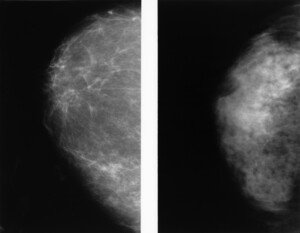
There’s a reason why most of the medical establishment still does not take seriously high breast density as a major risk for breast cancer. (more…)
Is Surgery Necessary to Diagnose Ovarian Cancer?

A doctor may suspect ovarian cancer based on symptoms, a blood test & an image of a suspicious mass.
But is surgery always necessary for a formal diagnosis of this ruthless disease? (more…)
WHY Does Stress Increase & Affect Vaginal Discharge?

Have you read somewhere that stress can directly cause vaginal discharge?
“There’s no direct mechanism for stress and vaginal discharge; however, chronic stress can cause hormone imbalances which can lead to abnormal discharge,” says Mylaine Riobe, MD, founder of Riobe Institute of Integrative Medicine.
Dr. Riobe, who’s board certified in ob/gyn and integrative medicine, is the author of “The Answer to Cancer.”
Despite no direct mechanism, stress sets the ball in motion that often leads to changes or increases in vaginal discharge.
“Chronic stress can also cause immune system weakness which can lead to infection, especially with unprotected intercourse,” says Dr. Riobe.
A compromised immune system can pave the path to issues with vaginal discharge.
“In traditional Chinese medicine, there is a mechanism for non-infectious vaginal discharge called damp and also spleen qi (pronounced chee) deficiency.
“Damp is excess fluids in the body, or inflammation. Spleen qi is responsible for management of fluids in the body, and when it’s weak, vaginal discharge can result.
“These causes of vaginal discharge are most closely linked with digestive problems.”
Does stress affect vaginal discharge differently for younger vs. older women?
“Stress-induced infectious vaginal discharge can occur at any age, and risk is increased with unprotected intercourse,” says Dr. Riobe.
“Stress hormones cause suppression of the immune system. The weakened immune system increases the possibility of infection.”
Stress’s Effect on the Immune System
Why does stress compromise immune function?
If you have to fight danger or escape from danger, which body systems do you need?
• Musculoskeletal
• Neuronal
• Cardiovascular
• Respiratory
Chronic stress triggers the same biochemical changes that acute (sudden) stress does.

Shutterstock/Cory Thoman
The body cannot tell the difference between the acute dangers our ancient ancestors faced in the wild, and the ongoing pressure-cooker lives that people face in industrialized societies (e.g., workplace issues, traffic jams, mounting bills, worrying about kids doing drugs).
Chronic stress puts the body in a never-ending state of “fight or flight.”

Shutterstock/tommaso79
The body is always in a preparatory state for that fight or escape from the perceived threat.
You don’t need your immune system to fight or escape from a threat.
The immune system becomes dismantled while more relevant systems gear up for the fight or flight (fast resting heart rate, high blood pressure, accelerated breathing, nervous twitches).
An actual physical fight never comes, of course, so the body remains on perpetual standby – meaning, a perpetually compromised immune system – leading to digestive troubles and creating the perfect storm for vaginal infection leading to more discharge.
“Stress hormones also suppress the ovarian function leading to reduced ovarian hormone levels which can also cause discharge,” says Dr. Riobe.
Again…do you need your ovaries to fight or flee from danger?
“Another possible mechanism is nutrient deficits which are needed by the liver to remove inflammation from the body.
“If the liver is missing key nutrients to perform its function, toxic inflammation will remain in the body causing discharge as well as other problems related to inflammation.”

Dr. Riobe has helped thousands of patients overcome difficult illnesses by addressing root causes, not just masking symptoms. The Riobe Method focuses on the prevention of disease, not the prevention of death from disease. She has 20+ years’ experience using integrative techniques to treat diverse patients.
 Lorra Garrick has been covering medical, fitness and cybersecurity topics for many years, having written thousands of articles for print magazines and websites, including as a ghostwriter. She’s also a former ACE-certified personal trainer.
.
Top image: Shutterstock/Prostock-studio
Benign Diseases with the Same Symptoms as Ovarian Cancer

Ovarian cancer is one of the most misdiagnosed diseases because its symptoms are so similar to many benign conditions.
The time it takes to correctly diagnose ovarian cancer, from the time a woman first sees a doctor for her symptoms, has been well-documented to take up to a year or more. (more…)

Black Specks on Nipple but Not Pregnant: What Can These Be?

Discovering black specks or dots on your nipple in the absence of pregnancy (which can cause this appearance) can be quite alarming. (more…)

Most Likely Cause of Breast Lump in a Teenager

Your teen daughter comes to you worried about a lump in her breast.
What’s this most likely to be?
The concept of “lump” has nearly become synonymous with cancer, so that’s why even when a teenager discovers a lump in her breast, it’s petrifying. (more…)
Can a Fibroadenoma Increase the Risk of Breast Cancer?

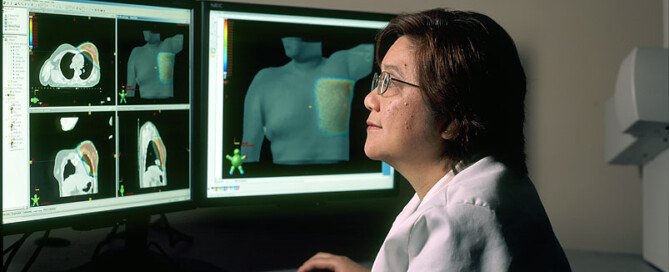
Unfortunately, the presence of a complex fibroadenoma in breast tissue means an increased risk of breast cancer.
However, the risk is influenced by this benign tumor’s cellular features.
“Simple fibroadenomas do not seem to increase breast cancer risk,” says Dr. Aashini Master, DO, a medical oncologist with a special focus on breast cancer treatment.
But if the fibroadenoma is complex, then there is a slight increase in risk.
“Since fibroadenomas most often occur in young women who are not undergoing routine screening, it is important that a women be familiar with her own breast tissue,” explains Dr. Master.
“This is where apps such as Keep a Breast can be particularly educational and beneficial for young women who may not have a regular self-check process or know what to do when they feel something abnormal.”
A research paper (New England Journal of Medicine report, July, 1994) says that certain cellular features of the fibroadenoma are associated with an increased risk.
This includes cysts within the fibroadenoma. Another feature is calcifications.
Women should ask their physicians to explain the full report on their firbroadenoma.
If there’s terminolgy that they don’t understand, they should feel free to ask for an explanation.
What exactly is a fibroadenoma?
This is a benign tumor (mass) of fibrous and glandular tissue.
When it has any of the particular cellular features, it is referred to as a complex fibroadenoma.
Ask your physician if your fibroadenoma is simple or complex.
If a complex fibroadenoma is removed, this does not eliminate the increased risk of breast cancer.
KAB for Breast Health
Dr. Master is with the Keep A Breast (KAB) Foundation, which launched its Keep a Breast app Sept. 1, 2020.
This app focuses on information, support and access, connecting users who’ve discovered something concerning with a telehealth medical professional via KAB’s partnership with Carbon Health, a technology-enabled healthcare provider – allowing users to have direct, instant support.
The 8 Signs of Possible Breast Cancer
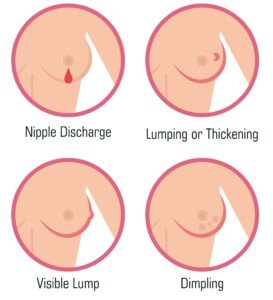
FOUR BREAST CANCER SYMPTOMS. Freepik.com, studiogstock
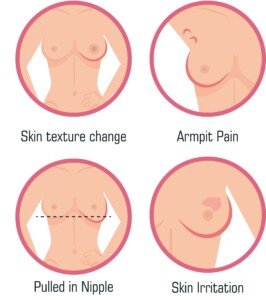
FOUR MORE BREAST CANCER SYMPTOMS. Freepik.com, studiogstock
What about simple or non-complex adenoma and increased breast cancer risk?
The New England Journal of Medicine study by Dupont et al states:
Two thirds of the patients [in the study] had noncomplex fibroadenomas and no family history of breast cancer and did not have an increased risk.
D r. Master, based in Beverly Hills, CA, is board certified in internal medicine, hematology and medical oncology. She is well-versed in evidence-based practices of anti-cancer natural approaches combined with conventional treatments.
 Lorra Garrick has been covering medical, fitness and cybersecurity topics for many years, having written thousands of articles for print magazines and websites, including as a ghostwriter. She’s also a former ACE-certified personal trainer.
.
Top image: Rhoda Baer/ cancer.gov
Sources:
nejm.org/doi/full/10.1056/NEJM199407073310103#t=article
cancer.org/cancer/breast-cancer/non-cancerous-breast-conditions/fibroadenomas-of-the-breast.html
Tiny Mole Growing Larger but Still Looks Normal: Self-Exams
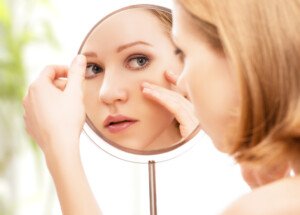
What if you had a very tiny mole and one day, realized it was no longer tiny – yet everything else about it looked perfectly normal?
As you probably already know, one of the guidelines for melanoma surveillance is the “E” in the ABCDEs: evolution. (more…)

3-Year-Old Bites Nails: Causes & Solutions

It’s tough to get a three-year-old to stop biting his or her nails.
Parents will use many tactics in an attempt to get their older child to stop this form of self-mutilation, including bribes with money.
But a three-year-old nail biter?
That’s a lot harder to tackle. What could cause a three-year-old to begin nibbling at their nails anyways?
“What causes a three-year-old to be anxious?” asks Dr. John Huber, a clinical forensic psychologist and chairman for Mainstream Mental Health, a nonprofit organization that brings positive change to the lives of those with mental illness.
“It probably has something to do with the communication between the parent and child. It may also have something to do with potty training.
“The reason why is because there are demands being placed on the child by society and their parents versus their natural proclivity to potty train when they’re ready. So anxiety is possible among young kids.”
Many parents think that a child so young can’t possibly know what anxiety is. Preschoolers don’t have bills to worry about, for instance.
But three-year-olds may indeed feel a lot of anxiety simply because their little brains aren’t developed enough to process the true nature of their sometimes bewildering environment.
Could a young child who feels very secure, safe and sound actually develop a nail biting habit? It’s just not likely.
I once told my three-year-old nephew, a nail biter, “Stop biting your nails,” when he had his fingers in his mouth.
He immediately withdrew them as I added, “Or nobody’s going to want to shake your hand.” I spoke in a matter-of-fact voice.
I said this more for his nearby mother to get the hint that she needs to be persistent in getting her son to stop the habit.
I had previously discussed it with her, and she had told me she and my brother had tried everything to get their son to stop biting his nails, including applying bitter tasting solution to his fingertips. “He just bit right through it,” she had said.
Of course, three is too young to make any sense out of “Or nobody’s going to want to shake your hand.”
So how can parents get a three-year-old to stop biting their nails? Unfortunately, there’s no easy answer.
What parents CAN do is enforce a rule of no biting when they’re in the presence of the child.
But we all know what will happen once the parents are out of range. This includes when the preschooler is in the bathroom alone, in his crib or bed, or at preschool.
If parents enforce a no nail biting rule at the table during meal times, this should work like a charm, what with the parents right there by the child.
Same with at church (parents are present) or at any time when the parents are with the child.
Maybe these restrictions will some day carry over to locations where the parents aren’t within visual range of the child. It’s worth a shot.
Don’t Give up on Your Very Young Nail Biter
My sister-in-law and brother have given up. This is a big mistake. The longer the boy engages in the habit, the harder it will be to stop. His fingers are frequently in his mouth.
If I perform the motion of removing my hand from my mouth, he immediately removes his fingers from his mouth.
That’s how easy it truly is to get him to stop munching his nails – at least while I’m watching him, of course.
Nail biting may seem like a low-ranking issue , but it should be a top priority rather than tossed under the rug.
The boy’s fingertips are red and raw looking, and as he gets older, the bitten nails will become even more obvious. The habit could have negative consequences in his future.
There really are people who do not want to shake the hand of a nail biter, not knowing where that individual’s fingertips were just seconds before the greeting.
The teen nail biter may have a difficult time finding employment; many teens seek jobs working with food, and there are employers who will not hire even the most eager teen due to unsightly chewed fingertips.
Additional Solutions
If your three-year-old or older child bites their nails, try the harmless bitter chemical. But taping the fingertips won’t work. Tape can easily be removed.
Distracting him or her with candy or suckers won’t work; they can’t have a mouth full of sugar 24/7.
For girls, see if painting the nails with bright colors might be a deterrent.
NEVER yell at, threaten or hit your child. This may stop him or her from biting their nails in your presence, but it will be very ineffective outside of your presence, and will only fuel the habit (remember the anxiety factor?).
 A mental health professional for 20+ years, Dr. Huber has appeared on over 300 top-tier radio shows (NBC Radio, CBS, Fox News Radio) and 30 national TV programs (ABC, NBC, Spectrum News).
Lorra Garrick has been covering medical, fitness and cybersecurity topics for many years, having written thousands of articles for print magazines and websites, including as a ghostwriter. She’s also a former ACE-certified personal trainer.
.
Top image: Shutterstock/Kostyazar

Does Adult ADHD Even Exist? If It’s Not ADHD, What Is It?



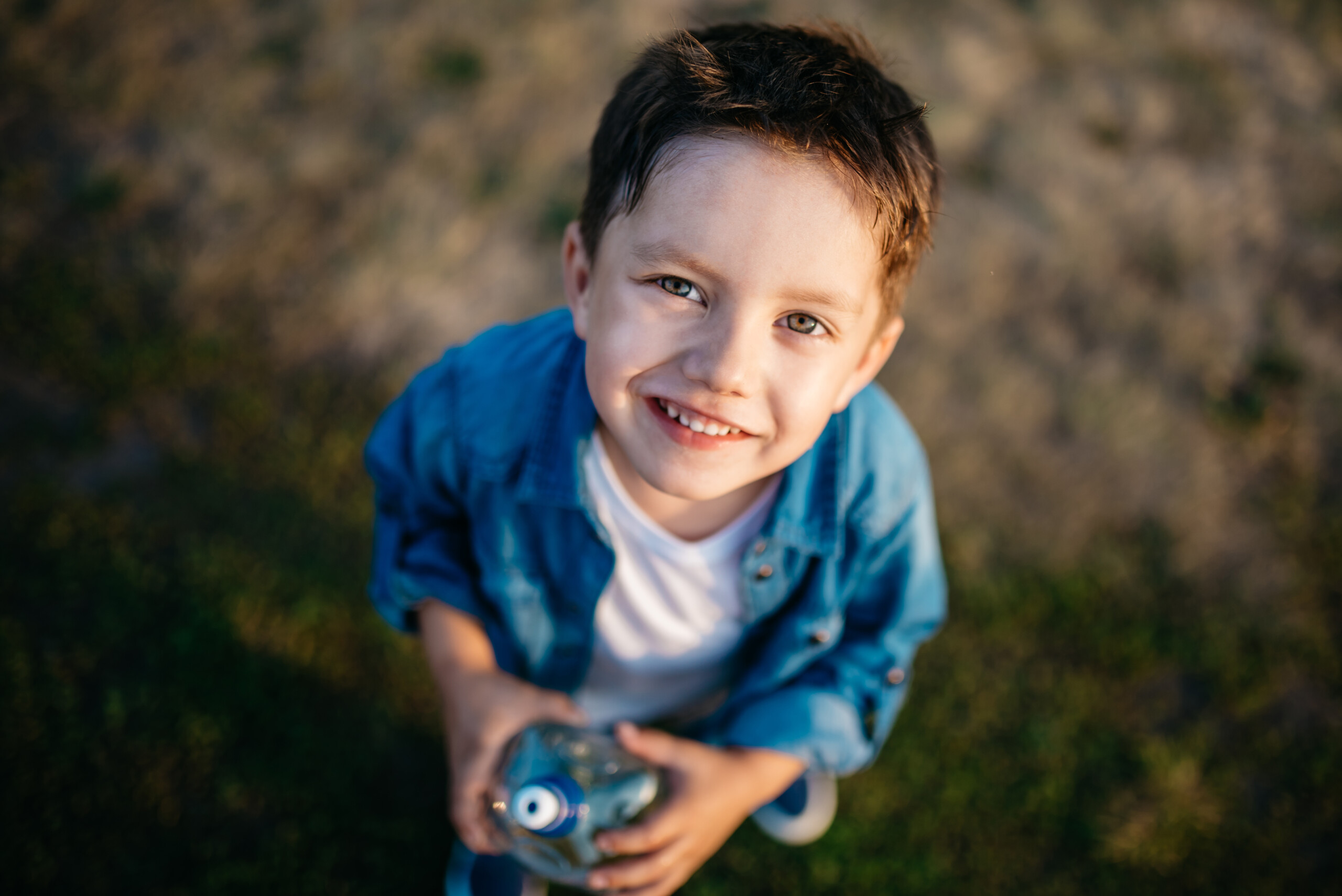

Many adults want to know if ADHD is actually a child’s disorder or if, indeed, adults can have it.
If we look at what “ADHD” stands for – attention deficit hyperactivity disorder – certainly we can easily come up with at least a few names of adults we know who are definitely hyperactive or impulsive in the way they go about life – or at least for specific situations.
And maybe these same people tend to have wandering attention spans or get easily distracted or disorganized, even if it’s only in specific environments.
To say that ADHD doesn’t exist in adults is to say that there’s no such thing as an adult who’s easily distracted, forgetful or “spacey,” nor who tends to be jumpy, fidgety, struggles with working memory or is seemingly unable to physically relax.
There are definitely adults who fit these descriptors.
But something needs to be made clear.
Just what is “ADHD” in terms of a single entity?
“Adult ADHD is a descriptor of behaviors that are emitted by an individual,” says Dr. John Huber, a clinical forensic psychologist and chairman for Mainstream Mental Health, a nonprofit organization that brings positive change to the lives of those with mental illness.
“It’s not a reason for those behaviors. It is typically a tallying list of behaviors, and they can be caused by a lot of things that include sleep deprivation. Depression is another one.”
In other words, the symptom set of ADHD overlaps with numerous other conditions.
However, ADHD (and inattentive ADHD) is recognized as a lifelong neurodevelopmental disorder by the DSM-5, the diagnostic tool for U.S. mental health specialists.
Untreated sleep apnea, too, can lead to ADHD symptoms. Merely having the symptoms doesn’t automatically mean that an adult has the actual neurodevelopmental condition (which they would have had since early childhood).
Attention deficit hyperactivity disorder is a four-word term that refers to a particular group of behaviors or symptoms.
Dr. Huber continues, “Does this individual as an adult all of a sudden manifest some neurological deficits that show up as ADHD — I would argue probably not, as ADHD needs to be present before the age of six” for a proper diagnosis.
“Can adults exhibit the behaviors similar to ADHD? Yes. However, the causes are different.”
Nevertheless, there are adults with a new diagnosis of ADHD or inattentive ADHD who, for all their lives, beginning in early childhood, have struggled with various issues that are the hallmarks of this condition.
These include struggling with focus, frequently losing things, often making careless mistakes, and difficulty with following instructions or completing tasks.
There may have also been excessive “fidgeting” throughout childhood, that the adult has taught themselves to suppress when around other people.
Autism Misdiagnosed As ADHD
This is possible. It’s also relatively common for autism to be misdiagnosed as only ADHD.
If it seems that there’s more going on in the adult with an ADHD diagnosis, an autism assessment should be considered. Autism often comes with ADHD (“AuDHD”).
A mental health professional for 20+ years, Dr. Huber has appeared on over 300 top-tier radio shows (NBC Radio, CBS, Fox News Radio) and 30 national TV programs (ABC, NBC, Spectrum News).
Lorra Garrick has been covering medical, fitness and cybersecurity topics for many years, having written thousands of articles for print magazines and websites, including as a ghostwriter. She’s also a former ACE-certified personal trainer.
.