Can a Victim of Childhood Bullying Become Workplace Bully?

It’s been said that the workplace bully must have been quite the tyrant during their young school years, but it’s entirely possible that many workplace bullies were victimized by their peers.
And they couldn’t fight back – not because they were smaller than their tormentors, but because they had no fight inside them.
And this includes psychological.
They just didn’t have it in them to wield some power, and instead gave it up to the bullies.
It didn’t help if these victims had critical parents who only contributed to making them feel small and helpless.
The Workplace: Prime Opportunity for Victim of Childhood Bullying to Turn the Tables!
“Someone who was bullied as a child got that way because of some kind of weakness (or perceived weakness),” says Dr. John Huber, a clinical forensic psychologist and chairman for Mainstream Mental Health, a nonprofit organization that brings positive change to the lives of those with mental illness.
“The child who has been bullied doesn’t have any other type of leadership skills or training — is going to go with what they know.
“If they’ve been bullied and been forced to do things they didn’t want to do, that can transition into a workplace situation where they force their employees to do similar things (such as manipulating them into doing tasks faster for example).
“The reason why is because this is what a grownup child of bullying knows and this transformation can occur quite easily.”
Dynamics of Workplace Bullying vs. School Bullying
A school bully doesn’t have to worry about getting fired from a job if he or she harasses classmates.

Shutterstock/igor kisselev
In fact, school bullies know they can often get away with stuffing their victims in lockers, throwing food at them, tripping them, etc.
The victim, stripped of power, eventually lands an office job as an adult, perhaps after completing four years of college. And the bullydom is brewing inside.
This person doesn’t necessarily set out to be a bully in the workplace.
But the opportunity might just land on his or her shoulders like a butterfly: The former victim of childhood bullying is now promoted to supervisor!
That supervisor, manager or foreman would never, outside the job setting, harass a subordinate, but inside the workplace, they become a whole new animal.
They know they’d lose a physical fight with any of their targets, but that’s okay, because they know that their targets will put up with the bullying to keep their job.
Occasionally, though, a subordinate will bite back. The bully takes this chance, because he or she knows that the majority will be submissive out of fear of getting fired.
Think of the “power going to his head” phenomenon as a do-over of a tormented childhood.
Problem is, the do-over never really occurs, because the workplace victims are not the actual school bullies.
There’s no true feeling of revenge, so the workplace tyrant is never satisfied and continues harassing select employees.
This gives the bully, once a helpless victim earlier in life, a surge of power that requires daily fixes to maintain.
Ironically, school bullying is far more tolerated than that at the workplace.
Kids are often told to “just ignore” the harassment, while adults are encouraged to bring lawsuits against the company. Go figure.
 A mental health professional for 20+ years, Dr. Huber has appeared on over 300 top-tier radio shows (NBC Radio, CBS, Fox News Radio) and 30 national TV programs (ABC, NBC, Spectrum News).
 Lorra Garrick has been covering medical, fitness and cybersecurity topics for many years, having written thousands of articles for print magazines and websites, including as a ghostwriter. She’s also a former ACE-certified personal trainer.
.
Top image: Shutterstock/nito

Does Your Heart Pound and You Think It’s Caused by GERD?

Bad news for those who’re trying to convince themselves that their pounding heartbeat is caused by GERD and GERD alone:
It very most probably isn’t. (more…)
Jaw Pain from GERD or Acid Reflux or from Your Heart?
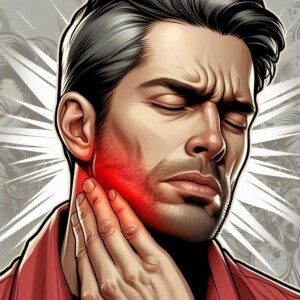
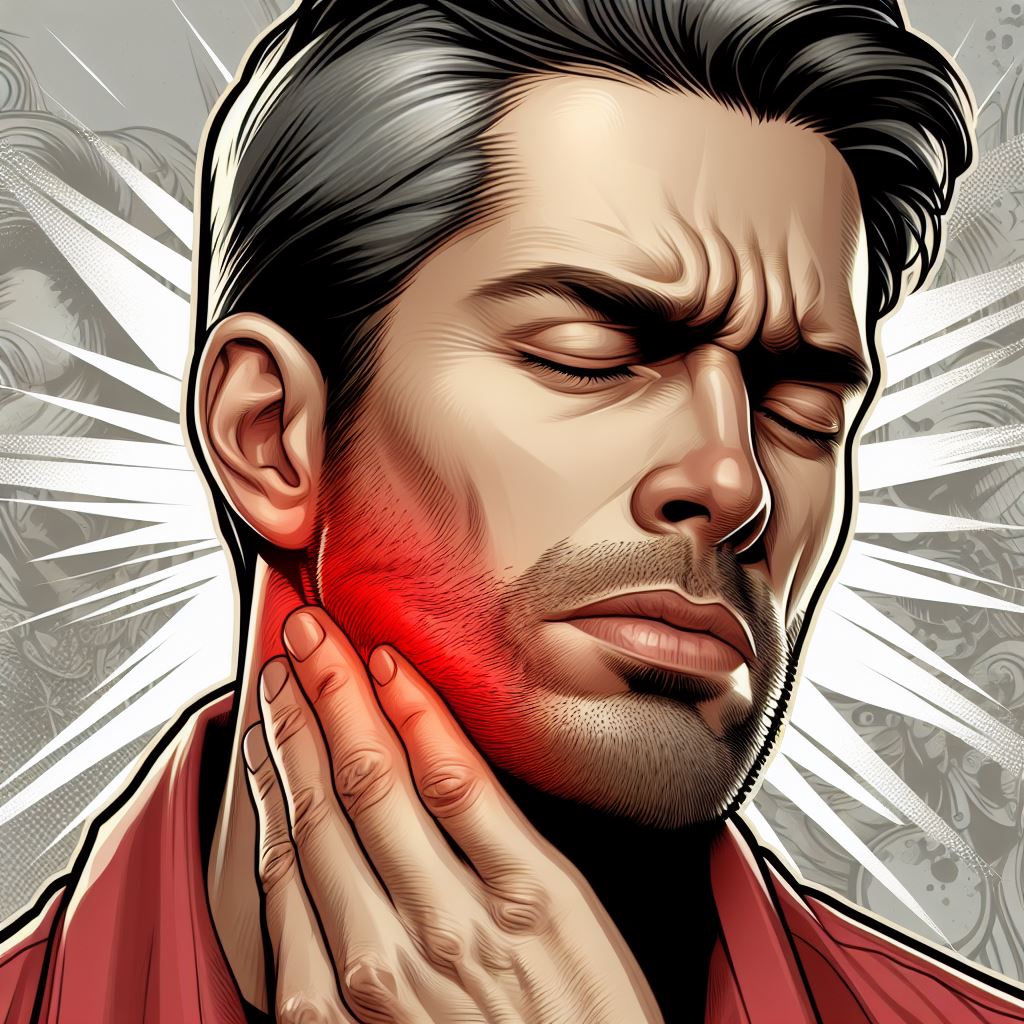
Jaw pain can have many causes including cancer, but GERD or acid reflux, as well as clogged heart arteries, can cause pain in the jaw.
If you’re experiencing pain in the jaw, you need to determine if it’s associated with any particular activities.
• Does it hurt only when you chew or yawn?
• How about only when you physically exert yourself — which would suggest an atypical symptom of blocked heart arteries?
• Maybe it occurs within a certain period after eating large meals.
• Or maybe it just happens for no known reason.
Jaw pain is strongly associated with two conditions:
Cardiac Problem: Heart Disease or Heart Attack
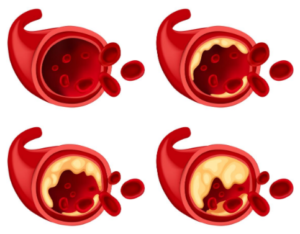
Coronary artery disease over time; plaque buildup inside the blood vessel. Source: vecteezy.com
Reduced blood flow from coronary artery disease or a heart attack can refer pain to the jaw due to shared nerve pathways.
TMJ Disorder (jaw joint problem)

Jose Larena/CreativeCommons
The temporomandibular joint is the hinge connecting the jawbone to the skull, allowing you to chew and speak.
A lesser-known cause of jaw pain is GERD or acid reflux.
Acid reflux, also known as gastroesophageal reflux disease, occurs when stomach acid frequently flows back into the esophagus.
This backflow happens because the lower esophageal sphincter, a muscle that acts as a valve between the esophagus and stomach, becomes weakened or relaxes inappropriately.
When this muscle fails to close properly, acid from the stomach can escape into the esophagus, leading to irritation and inflammation
“Chest pain that radiates to the left arm or jaw should be seriously investigated by a heart doctor to rule out angina or a heart attack,” says Hugh Mai, MD, a gastroenterology and internal medicine specialist in Baltimore, MD.
“Once a cardiac cause is eliminated, acid suppression should be tried.
“This can involve taking antacids or taking a medication that suppresses gastric acid.
“If either of these is successful in relieving the jaw pain, then the jaw pain may be associated with acid reflux as a referred pain pathway in atypical GERD.”
 Hugh Mai, MD, has 35+ years of experience and is well-versed in the endoscopic treatment of GERD. His areas of focus include interventional endoscopy, metabolic endoscopy and gut health.
Lorra Garrick has been covering medical, fitness and cybersecurity topics for many years, having written thousands of articles for print magazines and websites, including as a ghostwriter. She’s also a former ACE-certified personal trainer.
.
Top image: ©Lorra Garrick
Vomiting Thick Mucus After Eating Beef, Rice and Sauces

What are the causes and prevention of vomiting a thick mucus after eating foods like beef, rice and sauces? (more…)

Can Acid Reflux Make You Throw Up Foamy Bile and Other Yuck?

Ewww, you awaken having to “throw up” foamy gunk (bile? acid? mucus?) and it tastes as bad as it looks. Is this acid reflux? (more…)

Can GERD Cause an Electric Sensation in the Chest?
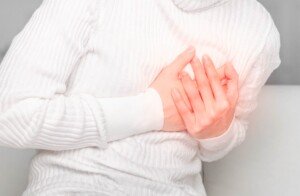
Sometimes a person will experience chest pain they describe as feeling “electrical” or “like electricity running through” and think it’s GERD at work.
However, there is no condition that literally causes electric currents to run through the chest or upper torso.
Not even a heart attack or ruptured aneurysm causes this sensation.
So if you’re feeling electrical sensations in your chest, it only seems like it’s electrical in origin.
Could the electrical sensation in your chest be from GERD?
“If a person has esophageal erosions or ulcerations, acid reflux can cause sharp pain which is sometimes described as a pinprick sensation,” says Hugh Mai, MD, a gastroenterology and internal medicine specialist in Baltimore, MD.
“Otherwise, the most likely atypical referred sensation could be due to reflux-reflex response.
“A reflux-reflex response involving GERD means the brain is trying to stop the acid from getting into the larynx and the lungs by telling the muscle in the esophagus to squeeze tightly.
“That can lead to esophageal spasms (non-acid chest pain) and spasms of the bronchioles causing asthma, wheezing or dry cough reflex to clear the throat.
“If taking a strong acid suppressor does not relieve the sensation, further evaluation is needed because the sensation may not be related to acid reflux after all.” It can be heart related.
But remember, it’s not actual electrical currents running through your chest causing this feeling — even if the cause is cardiac in origin.
How Acid Reflux Can Make the Chest Feel
• Pain, sometimes severe. It can mimic that of a heart attack.
• A burning or abrasive feeling (a.k.a. heartburn).
• A feeling of heaviness.
• A dull, medium or strong ache.
• Upper abdominal burning or discomfort may also be present.
• A feeling of something stuck in the chest or esophagus.
Hugh Mai, MD, has 35+ years of experience and is well-versed in the endoscopic treatment of GERD. His areas of focus include interventional endoscopy, metabolic endoscopy and gut health.
Lorra Garrick has been covering medical, fitness and cybersecurity topics for many years, having written thousands of articles for print magazines and websites, including as a ghostwriter. She’s also a former ACE-certified personal trainer.
.
Top image: Shutterstock/ ANN PATCHANAN

Why Does GERD Cause Pain Between the Shoulder Blades?
GERD does not directly cause pain between your shoulder blades, but the pain between your shoulder blades can be a result of GERD.
It can also mean a heart problem. (more…)

The GERD & Hairy Tongue Connection: It’s Not Your Imagination

There certainly is a connection between GERD and “hairy” tongue; this is a real condition that is not imagined. (more…)

Can Borderline QT Prolongation Be Caused By Computer Error?

An abnormal QTc interval from computer error?
Before you panic when your cardiologist points out that your EKG shows a prolonged QT interval or “borderline QTc interval,” first ask your doctor if the EKG results were determined the old-fashioned way rather than by a computer.
I asked an esteemed electrophysiologist (heart rhythm doctor) if a computer error could miscalculate the QTc and yield an abnormal result suggestive of a long QT interval.
“Absolutely. That’s why QT interval is manually measured,” says Andrea Natale, MD, cardiac electrophysiologist and executive medical director of the Texas Cardiac Arrhythmia Institute at St. David’s Medical Center.
Or rather, it should be manually measured. For example, an HMO system that schedules the highest number of cardiology appointments possible in a given day will likely rely upon a computer to calculate QT interval.
The computer calculation takes a lot faster than the manual version. This allows more patients to be squeezed in.
Dr. Natale adds, “Lead misplacement can result in a false positive. Additionally, the software can read the interval incorrectly when the T wave is relatively smaller.”
So what should you do if your doctor says, “I see that your QTc is abnormally prolonged”?
Well first of all, your doctor will want to get your electrolytes checked. Electrolyte deficiency can prolong the QT interval.
The cardiologist will review your meds if you’re on any, as certain medications can prolong the QT interval.
In my case, when I saw a cardiologist for a routine heart wellness exam, a lead misplacement was the apparent reason for the computer printout stating, “Borderline prolonged QTc interval.”
At the time, I knew nothing about QT intervals. I asked what this could potentially mean.
My doctor said it could mean possible fainting or ventricular fibrillation (which I knew). I couldn’t believe what I was hearing.
He knew I wasn’t on meds, wasn’t anorexic (a potential cause of long QT interval), and didn’t have hypothyroidism or heart disease (two more possible causes).
Yet he never mentioned the possibility of computer error or lead misplacement! Ironically, I was to learn that several past EKGs never yielded this odd result.
Three days later I had a repeat EKG with a different nurse, and I noticed that this nurse didn’t place a lead on my foot as did the previous one.
In fact, I realized right then and there that nobody had ever placed a lead on my foot except the nurse before this one.
Needless to say, the QT interval on the repeat EKG turned out normal.
Don’t panic if your computer-generated EKG spits out a QT prolongation finding – especially if you’ve done enough intense exercise over the past 20 years to have had a thousand cardiac arrests if you DID have long QT syndrome!
Genetic long QT syndrome is rare, but quite typically, when someone is diagnosed, they’ve had a history of fainting. However, in some cases the first symptom is cardiac arrest.
But then again, almost always, the patient knows of immediate and extended family members who either have a history of unexplained fainting or sudden unexplained death.
If you don’t have any risk factors for acquired long QT syndrome (e.g., anorexia nervosa or use of drugs such as antidepressants and antihistamines); have no family history of fainting or sudden cardiac arrest episodes; and have been a gym rat for many years without incident – and your computer EKG comes back positive for QT prolongation – do not panic, and request a manual calculation.
Computer Measurements of Qtc Fraught with Errors
“Computer-derived measurements are fraught with errors, particularly in patients with complex T-wave and U-wave arrangements,” states a report in The British Journal of Sports Medicine (Johnson et al, March 2014).
The BJSM report continues, “As such, physicians-in-training should be taught that the computer’s QTc cannot be relied upon when a diagnosis of LQTS is in question and, must be verified manually.”
Dr. Natale’s greatest reward is restoring his patients to a life free of cardiac arrhythmia. He pioneered a circumferential ultrasound vein-ablation system to correct atrial fibrillation and performed the procedure on the world’s first five patients.
 Lorra Garrick has been covering medical, fitness and cybersecurity topics for many years, having written thousands of articles for print magazines and websites, including as a ghostwriter. She’s also a former ACE-certified personal trainer.
.
Top image: Shutterstock/megaflopp







PVCs for Two Minutes Straight: Does this Mean Heart Problem?