Can a Brain Aneurysm Cause a Headache on One Side?

“Brain aneurysms can occasionally cause one-sided headaches,” says Farhan Siddiq, MD, a neurosurgeon with University of Missouri Health Care. (more…)
Can a Brain Aneurysm Cause Head Stabbing Pain?

Ever get a sudden “stabbing” type pain in your head and wonder if it’s a brain aneurysm rupturing?
These sudden sharp stabbing pains in the head can, indeed, be caused by an aneurysm – depending on how you define “sudden stabbing pain in the head.” (more…)

Can You Hear a Brain Aneurysm Rupture?

People hear balloons popping in their head, snapping, clapping and crackling and wonder if it’s an aneurysm rupturing.
Though when an aneurysm ruptures in the classic sense, a so-called thunderclap headache results — a headache so painful that it could drop a person to their knees. (more…)
Is a Treadmill As Good for the Heart As Walking Outside?
You’re mistaken if you believe treadmill workouts don’t work the heart as well as “real” walking or jogging outdoors.
The treadmill can even be better than the “real thing.” (more…)
Best Cardio Exercise for Postmenopausal Women

What may be the best cardio exercise for postmenopausal women offers not just fat loss and improved cholesterol, but also stronger bones and legs.
If you’re thinking running, think again. (more…)
Both Knees Hurt with Deep Knee Bends: Cause & Solution
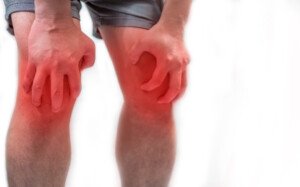
Does a deep knee bend or very low squat hurt both knees, even with only your body weight?
“There are varied opinions regarding ATG squats,” says Dr. Tom Carpenter, corrective exercise specialist, certified personal trainer and chiropractor, inventor of Stand Corrected™, a portable harness-like stretching tool that helps alleviate back, neck and shoulder pain.
The preschooler below is in a very deep squat or knee bend, also known as ATG: “ass to the grass.”
Young children are naturals at this due to their proportions. Come adulthood, these proportions are much changed.
Dr. Carpenter points out that some exercise experts advise never to bend your knees with your thighs more than parallel to the floor.
On the other hand, there are fitness experts who believe that stopping at parallel to the floor actually puts more strain to the knees.
“Proponents of ATG argue that the four main stabilizing ligaments for the knee — posterior and anterior cruciates as well as medial and lateral collateral ligaments — provide the greatest knee stabilization with full knee flexion (full squat) or full knee extension (standing),” explains Dr. Carpenter.
Therefore, stopping the squat at parallel “prevents these ligaments from fully engaging and providing full protection for the knee joint,” says Dr. Carpenter.
“Critics of ATG say that since we don’t all possess the same body architecture, ATG can be harmful for many people.
“Knee to hip proportional distance can vary from one person to the next, making it less advantageous for some people to perform ATG squats without risking injury.”
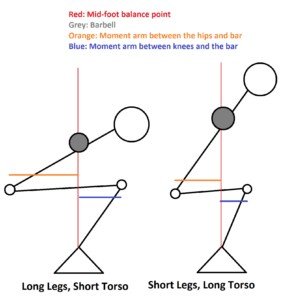
In other words, if your femur (thigh bone) is longer than your torso, or it’s disproportionately long relative to shin bone length, you will be at a biomechanical disadvantage with ATG squats or deep knee bending. The diagram below shows this.
“Also, proper form needs to be strictly adhered to or knee injury is very possible. My feeling is that if it hurts, stop doing it.
“As a former martial artist who wound up having to undergo a partial knee replacement, in part from over-training, I would strongly urge you to avoid risking your knees at all costs. It’s not worth it!”
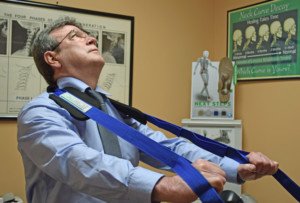
Photo credit: Aleesia Forni
Based upon 30+ years of experience, Dr. Carpenter’s practice approach reflects his belief that restoring optimum health and function will enable his patients to enjoy a much greater amount of vitality and wellness. Chiropractic care is true health care, not sick care!
 Lorra Garrick has been covering medical, fitness and cybersecurity topics for many years, having written thousands of articles for print magazines and websites, including as a ghostwriter. She’s also a former ACE-certified personal trainer.
,
Top image: Shutterstock/thebigland

Thin Upper Body, Fat Lower Body: Cardio or Weights?

If you have a thin upper body but a plump or fat lower body, you need to know which works better for busting fat: cardio or strength training?
The issue of having a skinny upper body and a fat or thick lower body is far more common in women than in men.
Cardio or Weights for a Thin Upper and Fat Lower Body?
“I recommend both,” says Dr. Tom Carpenter, corrective exercise specialist, certified personal trainer and chiropractor, inventor of Stand Corrected™, a portable harness-like stretching tool that helps alleviate back, neck and shoulder pain.
“There are basically three body types: ectomorph, mesomorph, endomorph.
“A thin upper body and fat lower body, otherwise known as pear shaped, is a combination of ectomorph and endomorph body types.
“It is believed that your body type is, to a great degree, determined genetically; you cannot completely change this reality.”
• Ectomorph: naturally fast metabolism, “lanky” build, has trouble putting on muscle.
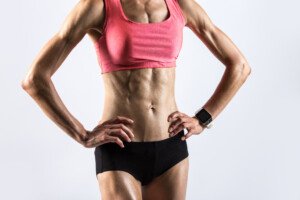
Ectomorph. Freepik.com/yanalya
• Mesomorph: naturally fast metabolism, athletic build, naturally stronger than average, easily puts on muscle.
Mesomorph. Shutterstock/SerdyukPhotography
• Endomorph: naturally average to slower than average metabolism, tendency towards a plump or soft build, no problem putting on muscle.
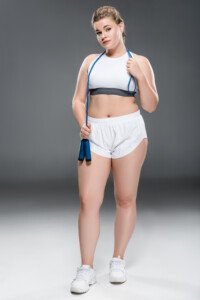
Endomorph. Depositphotos.com
Dr. Carpenter continues, “Also, ‘spot reducing’ fat in one area only is a myth; however, when you train to build muscle and reduce fat in the lower body, total body fat is then reduced.”
Think of the lower body, with all its large muscles, as the body’s overall metabolic furnace.
Large muscles require more energy for exercise and post-exercise recovery.
This energy will be pulled from the body’s fat depos – from all over, not just from the legs.
“This will the reduce size and add definition to lower body, as muscle takes up much less space than fat,” adds Dr. Carpenter.
“You can also build up the upper body size by choosing exercises that will encourage upper body hypertrophy.
“Combined, you can create a more proportioned figure, within reason.
“I would recommend resistance/weight training for the upper body as well as interval cardio and resistance training for the lower body, such as biking, treadmill, squats and lunges.
“And don’t forget the core. Planks are great for this.
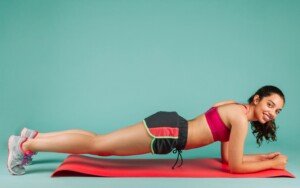
Plank. Freepik.com
“All of this together will encourage EPOC (excess post-exercise oxygen consumption), which turns the body into a muscle building, fat burning machine, continuing to change your body for hours after the workout is over.
“Think of driving a car on a cold night for an hour and then parking it in the cold garage when you get home.
“Go back into the garage 20 minutes later and you’ll notice that the temperature in the garage has warmed up from the heat the engine still gives off.
“Our bodies work the same way when it comes to building muscle and burning fat.
“An intense interval workout using compound joints for even 20 minutes will create EPOC. And this will help to reshape the body.”

Thin Upper Body, Fat Lower Body: Do Cardio AND Weights
Train the lower body also with deadlifts, squat variations and leg presses.
Work out intensely: get winded after each set. Get sweaty and feel hammered after each set.
This kind of exercise will create a hormonal environment that will unleash fat burning hormones – and these hormones will keep on burning for hours after the workout is over while your muscles recover.
This same process will occur with intense upper body training.
Focus on multi-joint movements such as the bench press, any kind of dumbbell press, seated chest press and any kind of rowing movement such as the bent-over barbell row (below).
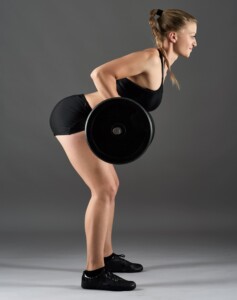
Shutterstock/Catalin Petolea
Interval cardio means just that: intervals – brief periods of high effort alternating with one to several minutes of casual paced effort.
An example would be mixing fast jogging with slow walking, or sprinting with slow walking (depending in your fitness level).
HIIT can also involve fast stair dashing alternating with easy descents.
HIIT can be applied to pedaling as well.
Having a thin upper body and fat lower body does not make you any less a candidate for strength training or interval cardio than if the top and bottom of your body were more matched.
Photo credit: Aleesia Forni
Based upon 30+ years of experience, Dr. Carpenter’s practice approach reflects his belief that restoring optimum health and function will enable his patients to enjoy a much greater amount of vitality and wellness. Chiropractic care is true health care, not sick care!
Lorra Garrick has been covering medical, fitness and cybersecurity topics for many years, having written thousands of articles for print magazines and websites, including as a ghostwriter. She’s also a former ACE-certified personal trainer.
.
Top image: Shutterstock/WAYHOME studio
Cause of Hip Pain Only When Lying Down
The causes of hip pain only when lying down are many, and don’t necessarily involve the bone itself.
The first thing you’ll want to do in coming up with a possible cause is to determine precisely what triggers your hip pain. (more…)
Shin Pain When Walking on Inclined Treadmill: Solutions
Walking on an inclined treadmill can cause shin splints, but there are several solutions to this problem.
First off, don’t assume that incline walking is not impacting enough to cause shin splints. You need not be a runner to suffer from this common problem. (more…)
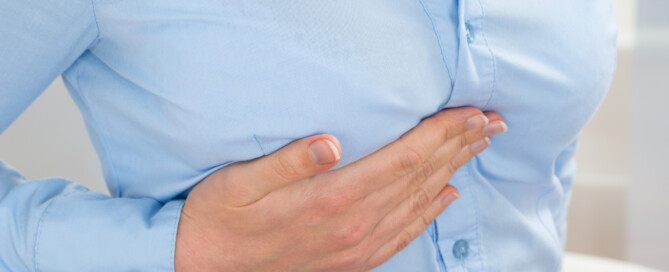
Back Pain Radiating to Breast Causing Intense Pain

Do you feel severe breast pain only when lying down, and you think it’s radiating from a tweak in your back?
When a woman experiences breast pain, this often makes her think of breast cancer. (more…)