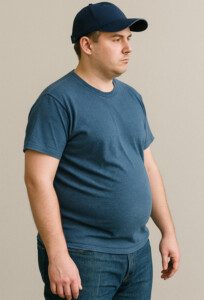
Your chances of dying early are greatly increased if you have both excess belly fat and untrained flaccid muscles.
Once again, research shows how crucial ridding belly fat and adding muscle are to living a longer life.
Researchers from the Federal University of São Carlos in Brazil teamed up with scientists at University College London and uncovered a troubling health pattern.
People who carry extra belly fat while also having low muscle mass face a much higher risk of dying earlier.
This sounds like old news, but the investigation found that people with both of these traits were 83 percent more likely to die prematurely when compared with those who had neither of these features.
Researchers say this combination points to a condition known as sarcopenic obesity.
What Sarcopenic Obesity Is
Sarcopenic obesity occurs when muscle mass decreases while body fat rises. It tends to develop gradually with age, which makes it easy to overlook.
However, this does NOT mean that a young adult can’t have the appearance of sarcopenic obesity due to poor muscle tone and poor body composition.
There are plenty of people in their 20s and 30s who, in the absence of a genetic condition that causes low muscle tone, actually have poor muscle tone, plus a body composition in the obese range.
They don’t necessarily look “fat.” But from a body composition standpoint, they have too much excess fat, and it’s concentrated in the abdominal area.
The poor muscle tone, or flabby appearance, is the result of a very sedentary lifestyle — void of any resistance activities.
With that said, sarcopenic obesity is strongly tied to frailty in older adults.
It can increase the risk of falls, reduce mobility and make it harder for people to live independently. Over time, it can also lower overall quality of life.
Researchers say catching the condition early could help people take steps to slow its progression.
The findings were published in the journal Aging Clinical and Experimental Research.
The analysis used 12 years of data from the English Longitudinal Study of Ageing, which followed 5,440 adults 50 and older.
When flabby untoned muscle and excess abdominal fat occur in younger adults, they are at significantly greater risk of being classified with sarcopenic obesity in older age.
But the younger someone is, the more they can reverse this unhealthy body composition with strength training and a healthy diet.
A Way to Screen for Sarcopenic Obesity
You may be thinking, “We can always say, ‘Well, look at him.'” But various tools can confirm what the eyes see.
Diagnosing sarcopenic obesity usually requires advanced medical imaging. Tools such as MRI scans, CT scans, electrical bioimpedance and densitometry can accurately measure body fat and muscle mass.
The problem is that these tests are expensive and not always widely available, which makes routine screening difficult.
On the other hand, personal trainers typically use skin-fold calipers to calculate body composition.
This tool is cheap, very portable, and the test is easy; the individual just stands there while the trainer takes the measurements.
The caveat is that access to a personal trainer isn’t always easy. Some gyms will give a skin-fold analysis to walk-ins. The gym where I was a personal trainer at would do this all the time for free.
So if you’re interested in this simple method, I recommend you call local gyms and see who’ll do it even if you’re not a member.
If visiting a gym is not an option, there’s still good news, in that the researchers say they found a simpler way to measure for low muscle tone and high belly fat.
By analyzing the long-term health data from the study participants, they discovered that waist circumference and estimated lean body mass can help identify people at risk.
Lean mass can be estimated using a formula that includes factors like age, sex, weight, height and race.
Why This Combination Is So Risky
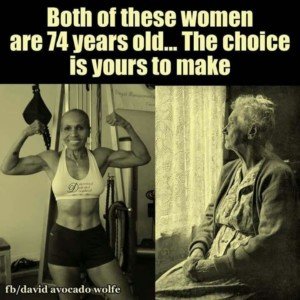
The research suggests that losing muscle while gaining abdominal fat creates a powerful negative effect on the body.
As mentioned, people who had both conditions showed an 83 percent higher risk of death.
Interestingly, those with low muscle mass but without abdominal obesity actually had a 40 percent lower risk of death compared with those who had both issues.
This may sound appeasing to “thin” people who don’t strength train, but that 40 percent less is relative to the 83 percent!
It means a thinner looking person who lacks muscle tone is still at heightened risk for an early death plus impaired quality of life.
It means this: Even if you have a slender appearance, if you don’t strength train, you still need to add muscle! You don’t have to bulk up or train to pick up a boulder. You simply just need to add muscle tissue.
The study also found that abdominal obesity by itself did not significantly raise the risk of death when muscle mass remained normal.
Excess fat in the body can increase inflammation and trigger metabolic changes that accelerate muscle breakdown.
Fat can also infiltrate muscle tissue and take up space that would normally belong to healthy muscle fibers. That sounds mighty scary: fat infiltrating muscle tissue.
Over time, this inflammation weakens muscles and interferes with their metabolic, immune and functional roles.
Simple Measurements Could Help Detect Risk Earlier
Because scientists still have not agreed on a single definition for sarcopenic obesity, the research team relied on practical measurements to identify risk.
- They defined abdominal obesity as a waist circumference greater than 40.2 inches for men and 34.6 inches for women.
- Low muscle mass was defined as a skeletal muscle mass index below 9.36 kilograms per square meter for men and below 6.73 for women.
The study points out that these simple measurements could make it easier for doctors to screen for the condition earlier.
If you’re wondering, though, how your doctor is going to determine how many kilos or pounds your skeletal muscle weighs, you can always make a judgement based on your lifestyle:
You have low muscle tone if you haven’t been doing any strength training, other weight bearing activity such as wall climbing or yoga, or do not work in a job that requires lifting or manipulating objects against resistance.
Nobody, especially older adults, has naturally trained muscle in the absence of activities that force muscles to work against loads. Nobody.