
Sore Adam’s Apple: Causes, Solutions

An ear, nose and throat doctor addresses the causes of a sore or painful Adam’s apple.
Are you feeling pain or soreness at or near the Adam’s apple?
“The Adam’s apple is also known as the thyroid cartilage,” says Dr. Stacey Silvers, MD, of Madison ENT & Facial Plastic Surgery in NYC, who is board certified in otolaryngology.
“If that area of the throat is sore, this may be from inflammation of the cartilage, inflammation of the thyroid gland which is close to this cartilage, or from acid reflux,” explains Dr. Silvers.
“Acid from the stomach comes up and irritates the back of the throat, causing redness and swelling.
“The location of the swelling is behind the Adam’s apple in the throat, giving a sense that the Adam’s apple is the location of the pain.
“The throat pain and/or a lump in the throat may be the patient’s only symptom.
“If the symptom is associated with fever or redness over the area, see your doctor as you may have an infection of the thyroid or the thyroid cartilage.”
Another possibility is a bacterial tonsillitis or epiglottitis infection, which can inflame tissues around the larynx and cause pain.
Can stress cause acid reflux?
Dr. Silver says, “Stress is in many patients the cause of acid reflux and can cause a lump in the throat and throat pain.
“Stress will increase the production of stomach acid and the acid can reflux up.”
Persistant Soreness
If the discomfort persists despite applying acid and stress reducing treatments, it’d be wise to see your physician, says Dr. Silvers.
A feeling of soreness in the Adam’s apple can stem from several other causes.
Vocal cord strain from excessive speaking or singing can create persistent soreness.
It’s possible a strained muscle could lead to what feels like a sore Adam’s apple.
A strain in a neck muscle can result from tilting the head upward under tension while lifting weights.
Tumors in the throat, larynx or thyroid can cause localized pain and sensitivity.
 An NYC expert in ear, nose and throat care, Dr. Silvers has been named among America’s Top Physicians and Surgeons in facial plastic surgery and otolaryngology numerous times since 2003. Dr. Silvers is an expert in the field of minimally invasive rhinology, resolving patients’ breathing and sinus problems with simple in-office procedures.
 Lorra Garrick has been covering medical, fitness and cybersecurity topics for many years, having written thousands of articles for print magazines and websites, including as a ghostwriter. She’s also a former ACE-certified personal trainer.
Top image: Shutterstock/9nong

Rotting Flesh Smell in Nose: Which Test Rules Cancer Out?

Cancer can cause a rotting flesh smell in the nose, but an ear, nose and throat doctor says the cause is usually benign.
The smell of rotting flesh in the nose can have several causes, says Dr. Stacey Silvers, MD, of Madison ENT & Facial Plastic Surgery in NYC, who is board certified in otolaryngology.
“A rotting flesh odor from the nose may be caused by an acute sinus infection,” says Dr. Silvers.
An acute (sudden) sinus infection usually comes with pain in the teeth, nasal congestion and fever, she adds.
The odor of rotting flesh may also be caused by a chronic (long-standing) infection of the sinuses, which can cause a buildup of old mucous in these cavities.
Dr. Silvers explains that “if mucous is not able to clear from the sinuses or the nose, it gets old and can smell bad.”
What about cancer causing a bad smell in the nose?
“The olfactory centers can develop growths (benign or malignant), and will present with loss of smell, decrease in sense of smell, changes in sense of smell or a chronically bad smell,” says Dr. Silvers.
If you’re concerned about cancer, what test should you undergo?
“A persisting smell with no evidence of sinus and nasal issues should be addressed with an MRI,” says Dr. Silvers.
Though an MRI is intimidating to some people because it requires that your entire head be inside a tubular structure, this procedure has no risks, no radiation exposure.
“If a simple sinus wash and sinus treatment does not help, consult your doctor for a possible MRI.”
The cause of a foul odor from a very young child’s nose is likely to have a different cause than in an adult; toddlers have been known to stick things up their noses.
A foreign object in the nasal cavity “can be present for over a year if not diagnosed properly,” continues Dr. Silvers.
Though cancer involving the sinuses can occur, Dr. Silvers says, “Very rarely we find cancer in the nose or in the back of the nose.
“If symptoms of a rotting odor persist, then the person should see an ENT for a good nasal, sinus and nasopharynx exam.”
An NYC expert in ear, nose and throat care, Dr. Silvers has been named among America’s Top Physicians and Surgeons in facial plastic surgery and otolaryngology numerous times since 2003. Dr. Silvers is an expert in the field of minimally invasive rhinology, resolving patients’ breathing and sinus problems with simple in-office procedures.
Lorra Garrick has been covering medical, fitness and cybersecurity topics for many years, having written thousands of articles for print magazines and websites, including as a ghostwriter. She’s also a former ACE-certified personal trainer.
Top image: Shutterstock/Kleber Cordeiro

Cause of Bad Odor after Blowing Your Nose

An ear, nose and throat doctor explains some likely causes of a bad smell after blowing your schnoz.
Blowing your nose is not supposed to result in a bad or foul smell, so when it does, what can this mean?
“Bad odor after blowing the nose is usually caused by old mucous in the sinuses or a sinus infection,” explains Dr. Stacey Silvers, MD, of Madison ENT & Facial Plastic Surgery in NYC, who is board certified in otolaryngology.
Another Cause of a Bad Smell from Blowing
“Occasionally acid from the stomach has been seen in the back of the nose,” says Dr. Silvers.
“This alone can cause a bad odor from the nose, but can also lead to higher incidences of sinus infections.”
Stomach acid can reach the back of the nose through a process known as laryngopharyngeal reflux (LPR), which is a type of gastroesophageal reflux disease (GERD) that affects the throat and voice box.
In LPR, the acid can travel upward and high enough, irritating the lining of the throat, vocal cords and sometimes even reaching the nasal passages.
Additionally, acid reflux can stimulate the production of mucous as a protective response.
This increased mucus can drip down the back of the throat and into the nasal passages, exacerbating the sensation of acid in the nose — and possibly causing a stink when you blow your nose.
In fact, if you catch a nasty smell after you blow your nose, and also feel a burning inside your nose, there’s a good chance you have LPR.
Chronic and Acute Sinus Infections
There are two kinds of sinus infections: acute and chronic.
Dr. Silvers says that a chronic sinus infection does not come with congestion or fever, but may “present with fatigue, pressure over the cheeks and forehead, and a bad odor in the nose after blowing.”
The chronic sinus infection often also comes with headaches, and if you just happen to have one of these headaches while you blow your nose, don’t be surprised if the headache intensifies while you blow.
Any kind of straining, including for bowel movements, can make a sinus headache feel worse.
If a sinus problem is causing the bad smell after blowing your nose, Dr. Silvers says that a neti pot with a sinus rinse can be very helpful.
“If it is not, then see your doctor or your ENT for a nasal/sinus exam and a culture.”
An NYC expert in ear, nose and throat care, Dr. Silvers has been named among America’s Top Physicians and Surgeons in facial plastic surgery and otolaryngology numerous times since 2003. Dr. Silvers is an expert in the field of minimally invasive rhinology, resolving patients’ breathing and sinus problems with simple in-office procedures.
Lorra Garrick has been covering medical, fitness and cybersecurity topics for many years, having written thousands of articles for print magazines and websites, including as a ghostwriter. She’s also a former ACE-certified personal trainer.
Top image: Shutterstock/Syda Productions

Heartbeat Problems: Thumping, Fluttering, Racing, Pounding Pulse, Etc.

Feeling your heart racing, skipping, pounding, thumping, jumping can be so scary.
Even after doctor after doctor tells you “you’re fine” and that “nothing is wrong,” feeling a lot of things going on with your heartbeat can still produce a ton of anxiety and fear into many men and women.
But just WHAT is going on with your ticker, then?
Why do you feel it so much?
Below are articles with feedback from cardiologists to whom I asked very specific questions relating to thumping, fluttering and racing heartbeats.
Heartbeat Related Articles
What if your heart flutters after lying down?
Is there any significance to a fluttering heartbeat upon lying down? Here is what usually happens:
Almost immediately after your head hits the pillow, you become aware of something going on in your chest. And it doesn’t feel right.
You begin worrying there’s something wrong with your heart, even if you’re young.
You are positive it’s not a twitching muscle in your chest. It feels like your heart because that’s exactly what it is. You are calm and still, so why is your heart doing flip-flops?
…………………………………………….
Should you worry if your heart thumps?
You’ve heard of things going “bump in the night.” What if your heart goes “thump in the night” or day?
For example, you could be focusing on a task at work, when suddenly…ba-boom! What just happened with your heart?
A thump is not the same as a flutter. Here’s the info you need about thumpers.
…………………………………………….
Diagnosed with a class II heart murmur and scared this means trouble?
I was told I had a class II heart murmur by a cardiologist. It was scary when the cardiologist kept on listening to his stethoscope; I kept wondering why he wouldn’t put the instrument down already.
This really unnerved me.
He ordered an echocardiogram and an MR angiogram — and I finally got the diagnosis.
…………………………………………….
Does eating make your heart beat fast?
Eating can speed up heart rate. This is not your imagination. ‘
It’s worrisome to many people and can even happen to seemingly healthy people. A fast pulse from eating can even happens to athletes.
 Lorra Garrick has been covering medical, fitness and cybersecurity topics for many years, having written thousands of articles for print magazines and websites, including as a ghostwriter. She’s also a former ACE-certified personal trainer.
.
Top image: ©Lorra Garrick

TRANSIENT ISCHEMIC ATTACK: Symptoms, Duration, Answers

TIA stands for transient ischemic attack, and the many symptoms can come in many permutations.
“A transient ischemic attack (TIA), also known as a mini stroke, is a temporary blockage to the blood flow of the brain,” says J. Mark Anderson, MD, DABFM, of Executive Medicine of Texas and who is board certified in family medicine.
Thus, the only difference between a transient ischemic attack and an ischemic stroke is the length of time.
The blood clot in the TIA dissolves before permanent damage results. However, having a TIA means that a person is at serious risk for a massive stroke in the near future.
Stroke is the U.S.’s No. 1 cause of permanent disability and doesn’t just affect “old” people.

Freepik.com/jcomp
It’s a common condition, and it affects so many people that even those who are middle aged or in their 30s can be stricken by this brain blood clot.
Symptoms of a Transient Ischemic Attack
Dr. Anderson explains, “Symptoms of a TIA include muscle weakness, trouble controlling one side of the body, slurred speech, blurred vision and facial muscle weakness/numbness.”
Other possible symptoms are confusion, vision issues other than blurriness, and a sensation that something is pulling one’s body to the side, or heaviness on one side of the body, while one one’s feet.
How Long Does a TIA Last?
“The symptoms only last from a few minutes to about an hour because the blood flow returns to that area of the brain.
“TIA’s can be scary because they mimic the symptoms of a stroke. TIA’s are different from strokes because a stroke leaves permanent damage, whereas a TIA is transient, meaning it comes and goes.”
Risk Factors
“People with high blood pressure, diabetes, high cholesterol, obesity and atrial fibrillation are more likely to have a TIA.”
So are people with untreated sleep apnea. If you’ve been diagnosed with sleep apnea, are you using a CPAP machine like you should?
“Since TIA and stroke are so similar in nature, it’s important to seek medical attention immediately,” adds Dr. Anderson. “Early intervention in a stroke patient may determine their ability to function in the future.”
Did you know that a TIA is a warning sign that you’re at very high risk for a stroke in the next 30 days?
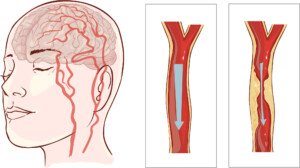
The blockage can originate in the brain. Shutterstock/ corbac40
Can a sudden severe headache mean a TIA?
Have you had sudden severe headaches and are plagued by the thought that these were mini strokes? Your fear is unfounded. Read more…
Can mental stress cause a TIA?
Stress actually CAN trigger a transient ischemic attack.
Certain situations, however, have to be present in order for this to happen.
Do not let the “transient” in “ischemic attack” lower your guard. A two-minute TIA is a medical emergency. Think of this as the sufferer’s body gearing up for a very near-future massive stroke.

Dr. Anderson is coauthor of the award-winning book, “Stay Young: 10 Proven Steps to Ultimate Health,” and host of the nationally syndicated Staying Young Show which goes to podcast as Staying Young Show 2.0.
Lorra Garrick has been covering medical, fitness and cybersecurity topics for many years, having written thousands of articles for print magazines and websites, including as a ghostwriter. She’s also a former ACE-certified personal trainer.
.
Top image: ©Lorra Garrick

Can Cancer Cause a Foul Smell from Your Nose?

An ear, nose and throat doctor addresses the various causes of a foul odor from the nose, including after blowing.
Ewww, what is causing that foul smell from your nose, you wonder—or someone dear to you wonders.
“A foul smell after blowing the nose may be caused by a sinus infection (this typically is associated with fever and pain in the teeth with nasal congestion), or old mucous in the sinuses,” says Dr. Stacey Silvers, MD, of Madison ENT & Facial Plastic Surgery in NYC, who is board certified in otolaryngology.
“If mucous is not able to clear from the sinuses or the nose, it gets old and bad smelling,” continues Dr. Silvers.
“Occasionally acid reflux can cause a bad smell from the nose. Stomach contents have a bad odor and can reach as high as the back of the nose.”
Dr. Silvers adds that a chronic sinus problem will not present with fever, but an acute one may.
“Patient may or may not have nasal congestion, but may simply present with fatigue, a bad odor in the nose after blowing and/or pressure over the cheeks and forehead.”
Dr. Silvers recommends trying a neti pot (which can be purchased at a drug store; example below), which is a tea-kettle-shaped pot that you use to rinse the nasal airways with a special rinse (that the store will also sell).

Neti pot. Shutterstock/nullplus
If this doesn’t resolve the problem, then see an ENT doctor for a nasal/sinus exam and a culture, says Dr. Silvers.
But what about cancer as the cause of a foul odor from the nose?
Dr. Silver says, “Very rarely we find cancer in the nose or in the back of the nose. If symptoms persist then the person should see an ENT for a good nasal, sinus and nasopharynx exam.”
What about children with this notable symptom?
Dr. Silvers says, “If the foul smell is noted on your child and there is drainage from only one side, it is most likely that the child has a foreign body in the nose.”
The foreign body can cause a foul odor that may not necessarily be pinpointed to the child’s nose.
Rather, it may be a bad smell about the child’s face, so if your child’s face or even head has a bad odor, consider the possibility that there is indeed a foreign object at the root of the problem.
“Chronic drainage from both sides may be from a chronic adenoid infection,” says Dr. Silvers. “A nasal culture and physical exam will be diagnostic.”
An NYC expert in ear, nose and throat care, Dr. Silvers has been named among America’s Top Physicians and Surgeons in facial plastic surgery and otolaryngology numerous times since 2003. Dr. Silvers is an expert in the field of minimally invasive rhinology, resolving patients’ breathing and sinus problems with simple in-office procedures.
Lorra Garrick has been covering medical, fitness and cybersecurity topics for many years, having written thousands of articles for print magazines and websites, including as a ghostwriter. She’s also a former ACE-certified personal trainer.
.
Top image: Shutterstock/Aaron Amat
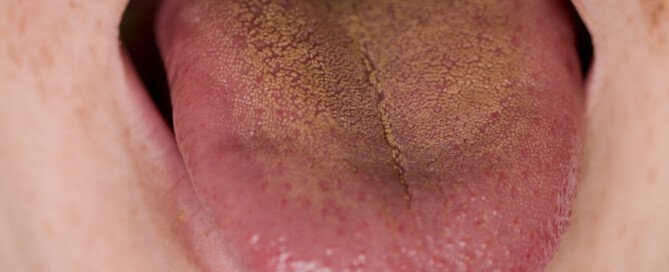
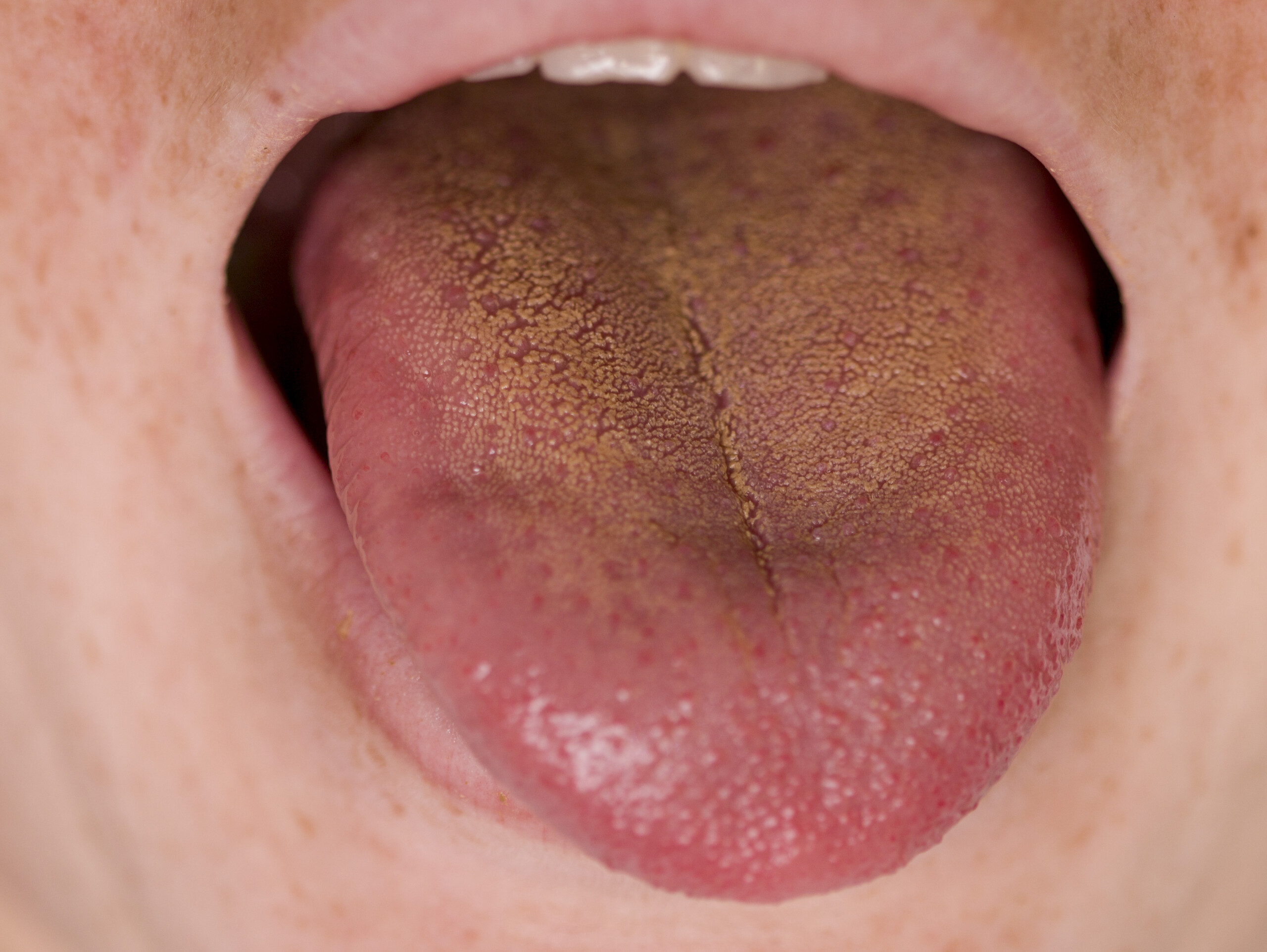
Yellow Tongue Causes: Is One Cancer?
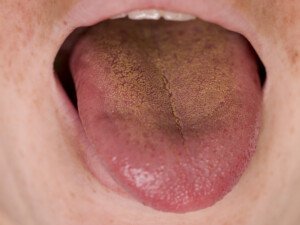
An ear, nose and throat doctor addresses the various causes of a yellow tongue.
If you’ve been noticing lately that your tongue is looking rather yellowish, perhaps you’ve been wondering if this might possibly mean cancer.
And if not, what on earth could possibly be causing this oddball symptom? Could it mean something serious?
There are various possible causes of a yellowish tongue.
But thank goodness, cancer is not a likely cause of this strange symptom.
The following situations are more likely to be the culprits.
COMMON VICES

Shutterstock/Slava Dumchev
“If you drink a lot of coffee and/or smoke cigarettes, the healthy pink membranes of the tongue can be stained yellow,” says Dr. Stacey Silvers, MD, of Madison ENT & Facial Plastic Surgery in NYC, who is board certified in otolaryngology.
“Other things that can stain the tongue are tea and other tobacco products,” continues Dr. Silvers.
“Quit or reduce smoking and consider less coffee and tea intake. You can gargle or brush your tongue after consumption of staining liquids.”
ACID REFLUX

Shutterstock/Monster e
“Acid reflux can change the pH in the oral cavity and lead to a yellow coating on the tongue; trial of reflux medication may be helpful,” says Dr. Silvers.
Follow the instructions and begin with the lowest recommended dose.
YEAST INFECTIONS
“Recent courses of antibiotics, poor ability to fight infection and steroid inhalers for asthma can lead to yeast infections,” says Dr. Silvers, “which can have a yellow/grey color to the tongue. The tongue should be cultured by your doctor.”
A tongue with a yellow tinge is usually a temporary and harmless issue.
RARELY can this mean a problem with one’s liver or gallbladder.
An NYC expert in ear, nose and throat care, Dr. Silvers has been named among America’s Top Physicians and Surgeons in facial plastic surgery and otolaryngology numerous times since 2003. Dr. Silvers is an expert in the field of minimally invasive rhinology, resolving patients’ breathing and sinus problems with simple in-office procedures.
Lorra Garrick has been covering medical, fitness and cybersecurity topics for many years, having written thousands of articles for print magazines and websites, including as a ghostwriter. She’s also a former ACE-certified personal trainer.
.
Top image: Shutterstock/donikz

Burning Tongue: 9 Causes, One Life-Threatening

An ear, nose and throat doctor explains the 9 possible causes of a burning tongue, and one of these conditions can kill you.
A burning tongue can have numerous causes, says Dr. Stacey Silvers, MD, of Madison ENT & Facial Plastic Surgery in NYC, who is board certified in otolaryngology.
“Burning tongue can be caused by dehydration, certain medications (which tend to lead to dry mouth), acid reflux, diabetes (dry mouth), infection (yeast), tongue ulcer or menopause,” explains Dr. Silvers.
New Medications
“If the symptoms started within days or weeks of starting a new medication, then speak with your doctor, as this may be the cause,” says Dr. Silvers.
Diabetes
“If you have excessive thirst and tongue irritation, then see your doctor for routine blood testing to check for diabetes.”
Diabetes is a life-threatening condition that also increases the risk of heart attack, heart disease, stroke and dementia.
Yeast Infections
“Recent courses of antibiotics, steroid inhalers for asthma and poor ability to fight infection (seen with HIV or other autoimmune disorders) can lead to yeast infections and cause a burning tongue; see your doctor for a culture.”
Acid Reflux
“Acid reflux is a common cause of burning tongue due to the acidity from the stomach which can irritate the tongue and the oral cavity.
“Consider seeing your physician or trying an over the counter reflux treatment to see if the symptoms resolve.”
Menopause
Dr. Silvers says, “If you are experiencing menopause then see your GYN. Hormone replacement therapy may be helpful.”
Of course, the burning can also be caused by having recently eaten something hot, or taken a hot drink.
Another cause of the burning sensation is a cut, usually caused by a sharp piece of food, such as a bit of potato chip or cracker.
An NYC expert in ear, nose and throat care, Dr. Silvers has been named among America’s Top Physicians and Surgeons in facial plastic surgery and otolaryngology numerous times since 2003. Dr. Silvers is an expert in the field of minimally invasive rhinology, resolving patients’ breathing and sinus problems with simple in-office procedures.
Lorra Garrick has been covering medical, fitness and cybersecurity topics for many years, having written thousands of articles for print magazines and websites, including as a ghostwriter. She’s also a former ACE-certified personal trainer.
.
Top image: Shutterstock/ilaria burlini

Why Does Blowing My Nose Cause a Bad Stink?

An E.N.T. doctor explains what can cause a bad odor after you blow your nose.
So what on earth can be causing that foul odor coming from your nose after you blow it?
“Bad odor after blowing the nose is usually caused by old mucous in the sinuses or a sinus infection,” says Dr. Stacey Silvers, MD, of Madison ENT & Facial Plastic Surgery in NYC, who is board certified in otolaryngology.
“Occasionally acid from the stomach has been seen in the back of the nose,” continues Dr. Silvers.
“This alone can cause a bad odor from the nose, but can also lead to higher incidences of sinus infections.”
“Chronic sinus problems don’t present with fever or congestion, but may simply present with fatigue, pressure over the cheeks and forehead, and a bad odor in the nose after blowing.”
If you ever feel a burning sensation in your nose, this is probably refluxed acid.
Is there a remedy ?
Dr. Silvers explains, “A natural sinus wash like a neti pot [see image below] can be very helpful if the sinuses are the cause.”

Aikhan, CC BY-SA 3.0
Your local drug store carries neti pots (sinus rinse device), and you can also buy sinus rinse solutions that come in a packet. If this doesn’t solve the problem, Dr. Silvers says:
“…then see your doctor or your ENT for a nasal/sinus exam and a culture.
“A child with a bad nasal odor may have a chronic adenoid infection or a foreign body in the nose (especially if there is mucous draining from only one side).”
An NYC expert in ear, nose and throat care, Dr. Silvers has been named among America’s Top Physicians and Surgeons in facial plastic surgery and otolaryngology numerous times since 2003. Dr. Silvers is an expert in the field of minimally invasive rhinology, resolving patients’ breathing and sinus problems with simple in-office procedures.
Lorra Garrick has been covering medical, fitness and cybersecurity topics for many years, having written thousands of articles for print magazines and websites, including as a ghostwriter. She’s also a former ACE-certified personal trainer.
.
Top image: ©Lorra Garrick

Chest Pain’s Many Causes & Which Mean Heart Trouble

Here is a sampling of chest pain articles.
- If doctor says your chest pain is from acid reflux or GERD, how do you know he’s not misdiagnosing an imminent heart attack?
This happened to my mother. The ER doctor sent her home with a prescription to an acid reflux drug. Two days later she was on the operating table for quintuple bypass surgery.
My sister, a doctor, said that this happens all the time: An ER doctor mistakes a pending heart attack for a digestive problem, and then days later, the patient is dead from a heart attack.
This potentially fatal mistake by a doctor, which happens frequently, can be stopped dead in its tracks if you know how to recognize it. Read more…
- Chest pain and shortness of breath? When to visit the ER…
If you have chest pain and labored breathing, even if you’ve been diagnosed with GERD, this can still mean a heart attack is looming or is actually in progress. Read more…
- Chest pain caused by acid reflux (GERD)
Severe coronary artery blockage is often misdiagnosed as gastroesophageal reflux disease.
However, GERD or acid reflux really CAN cause quite a bit of chest discomfort. Go to article.
- Does angina always cause chest pain?
You can have angina and not experience any chest pain, but you’ll certainly experience at least one of several other possible symptoms. Go to article…
- Chest pain with cough: several possible causes
Never ignore the pairing of pain in the chest with a cough, because three of the possible causes can kill you within minutes.
One of the possible causes is a bulge in the aorta, the big vessel that originates in the heart.
If the bulge is big enough, it can burst and cause death within minutes. Find out the other two causes.
- Can chest pain be the only symptom of a heart rhythm disorder?
An abnormal heart rhythm (arrhythmia) can cause faintness, dizziness and shortness of breath, along with chest pain.
What if all you have is chest pain? Any possibility this can be a heart rhythm problem? Read more…
Rushing to the ER for Chest Pain
Chest pain is one of the top reasons people rush to the emergency room.
Because it can signal serious conditions like a heart attack, blood clot or lung problem, doctors take it very seriously.
It should be taken very seriously even when the patient is a young adult athlete.