Jumping Workout with an 18 Inch Stool: Burn Fat

Learn how to use an 18 inch stool to burn the most fat possible.
Jumping routines with an 18 inch stool will burn fat and reap other fitness benefits. Eighteen-inch workout stools are sold online.
The great thing about plyometric (jumping) workouts is that there’s plenty of rest or downtime.
This is motivating because it makes you want to really go at it when it’s time to resume the jumping.
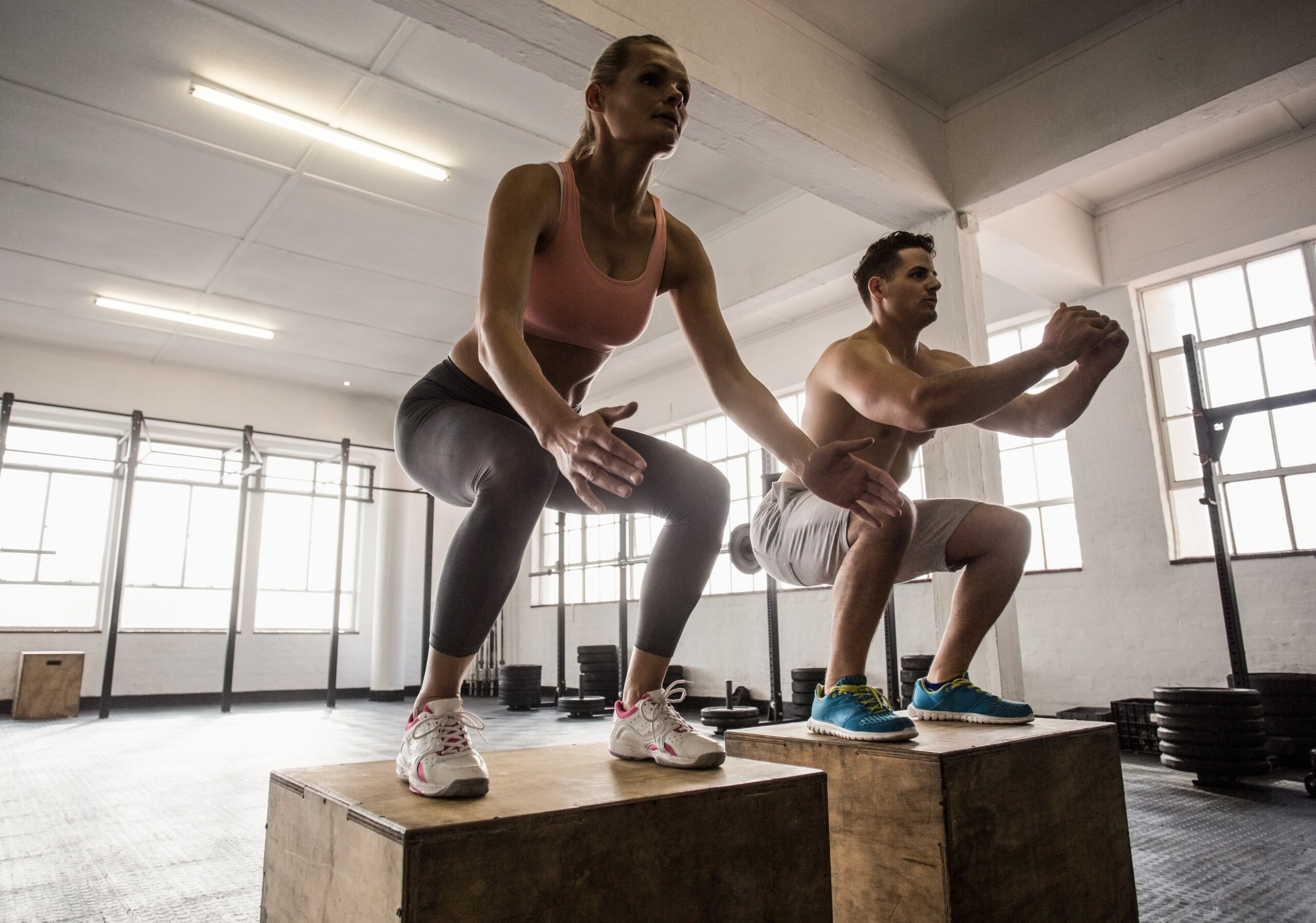
Stool jumping, even with an 18 inch device, should be rhythmic, smooth and clean, and quiet. If feet are slamming and making a lot of noise, this means lack of control.
Jump up and down as quietly as possible and see what happens. If it’s difficult to be smooth and quiet, then keep working at it; that’s part of the workout.
A hardcore jumping routine will activate fast twitch muscle fiber. Take a look at people who are skilled jumpers — jumping over and over onto an 18 inch stool (or sturdy box).
Do they ever look out of shape?
Do they ever have flabby, scrawny or chunky legs?
Even their upper body looks very fit. Plyometrics are part of any savvy fitness enthusiast’s program.
18 Inch Stool Workout for Burning off Fat
Beginners won’t do too well with 18 inch stool jumping, and thus, this program is more suitable for intermediate and advanced performers who’d like to burn fat.
Warming up for a plyometric session can be done by doing plyometrics. That’s the beauty of jumping exercises; you can go right into the actual mode of exercise with your warm-up.
Simply jump onto the stool with both feet at once, then jump off. Pace or march in place for several seconds, then jump again.
Focus on form and quietness, like a cat landing.
As you feel your body warming up, shorten the intervals between each jump.
Maybe toss a set of jumping jacks in between. And when jumping off the stool, don’t just jump off from where you came, but jump off to the other side — a forward exit.
Jump twice or thrice in a row quickly, then as fast as possible. Then do five jumps in rapid succession.
Simply jumping up and down in all these ways is a workout in itself for many trainees, even advanced.
How to Increase the Intensity
An advanced or very fit individual could increase intensity (and therefore increase fat burning) by doing the following:
• Increasing the distance from the jumping point to the stool.
• Increasing the distance from the stool to the floor landing point.
• Adding a pike when jumping off the stool.
• Jumping as high as possible when jumping off the stool.
• Adding a quarter or half squat upon landing onto the stool and then immediately squat jumping off of it.
• Adding a quarter or half squat upon landing back onto the floor.
• Jumping sideways onto the stool and/or sideways off of it.
• Holding weights when jumping
Plyometrics with the 18 inch stool should be conducted with strength training in mind, not aerobics.
This isn’t about trying to jump nonstop for 20 minutes. It’s about power, tapping into the fast twitch muscle fibers, which utilize more energy than the endurance-designed slow twitch.
With plyometrics, the goal is to jump with the most power: height, speed and distance, rather than doing tons of weak jumps nonstop over a long stretch of time.
This way you’ll burn more fat. Plyometric training is about explosive bursts, not endurance, for maximal fat burning and strength training.
 Lorra Garrick is a former personal trainer certified through the American Council on Exercise. At Bally Total Fitness she trained women and men of all ages for fat loss, muscle building, fitness and improved health.
.
Top image: Shutterstock/wavebreakmedia
GOMAD Alternatives that Work Better for Weight Gain

GOMAD means a gallon of milk a day, but there are better ways to gain weight.
GOMAD means a gallon of milk a day for weight gain; have you hopped on the GOMAD bandwagon? There is nothing special about milk that it should be regarded as a superior way to gain weight.
Though it’s true that people trying to lose weight will avoid whole milk like the plague, this doesn’t mean that whole milk is the ultimate for weight gain. Let’s look at GOMAD more closely.
A gallon of milk every day.
- There are 128 ounces in one gallon.
- Eight ounces of whole milk are 150 calories.
- There are 16, 150 calorie servings in one gallon (128 ounces) of whole milk.
- This means that GOMAD translates to 2,400 calories.
Wow — that’s a lot of calories to pile onto what you’re already eating on a daily basis.

Shutterstock/Andarii
So if you normally eat 3,000 calories a day of food and other beverages and still wish to gain weight, it only makes sense that tacking on an additional 2,400 calories a day will definitely make you gain weight.
There are 3,500 calories in one pound of fat. Assuming that with a GOMAD program, you continue to eat your normal 3,000 calories a day, rather than allow the milk to replace some of those calories, you will gain a pound of fat about every one and a half days (since 2,400 times three is 7,200, and remember, there are 3,500 calories in one pound of fat).
You will gain about four and a half pounds a week on GOMAD as long as the milk does not replace any of your regular food intake.
Some claims say that you can put on 25 pounds in 25-30 days with GOMAD.
Based on the math you just read, you know that this gain-rate of 25 pounds in 25-30 days is impossible.
It will also be difficult not to feel so full and bloated from all that milk, that it ends up replacing some of the calories you normally eat.
Think about that: A gallon of milk a day is a LOT. Some men who do GOMAD report having to run to the bathroom all day long with diarrhea.
Can you really drink all that milk, day after day?
If you love the taste of plain milk, GOMAD is doable.
- But will your stomach have room for all that extra fluid?
- And what will you do after you reach your weight gain goal?
- How will you maintain that weight gain?
- You can’t do GOMAD for life.
A better alternative to GOMAD is consuming a food that, for a much smaller amount than a gallon of milk, offers far more calories.
This way, you won’t feel stuffed or bloated; won’t have diarrhea emergencies; and won’t suffer the drudgery of having to drink down so much of the same bland-tasting beverage day in and day out.
You can get an additional 1,200 calories a day (no need to spike it way up to 2,400) by making the following changes daily:
- Adding a few tablespoons of olive oil to your salads and the water you cook rice in
- Eating a bowl of cashews, peanuts or other nuts
- Eating Grapenuts cereal (this stuff is loaded with calories and is a good source of complex carbs)
- Eating protein smoothies made with peanut butter; and increasing consumption of other high calorie foods such as avocados and lamb (which is free of hormones and antibiotics).

Chocolate coconut balls — made with coconut oil, coconut flakes, chocolate powder, almond powder and pureed dates — are loaded with calories.
Since a gallon of milk contains 64 grams of fat, it wouldn’t be any worse if you added a serving of ice cream at the end of the day to the above plan.
After all, your goal is weight gain, rather than eating the healthiest diet in the world.
If your primary goal is to put on weight and get bigger from your gym workouts, you can easily take in that additional 1,200 calories a day with a breakfast of French toast, natural butter and natural maple syrup, plus a tall glass of milk.
One quarter cup of maple syrup is about 200 calories. Do you realize how many quarter cups of maple syrup you’d use for four or five slices of French toast?
Add to that the butter, eggs, bread and milk, and there’s your 1,200 calories, easily. Then eat as you normally would the rest of the day.
When you get sick of French toast, substitute pancakes or waffles. When you get sick of it all, have a large bowl of Grapenuts, then eat a bowl of cashews as a mid-morning snack.
Have some pie and ice cream with your peanut butter and jelly sandwich for lunch.
Have a “hard gainers” protein shake a little while later. Go generous with the high fat salad dressing on your dinner salad.
There are all sorts of little tricks you can do for weight gain, that will be far more enjoyable than stuffing down a gallon of milk a day.
Lorra Garrick is a former personal trainer certified by the American Council on Exercise. At Bally Total Fitness she trained clients of all ages for fat loss, muscle building, fitness and improved health.

Homeschooling a Bullied Child: Pros & Cons

This article deals specifically with home schooling as a possible solution to bullying, since some parents of bullied children are at their wit’s end.
There are lots of online articles about the pros and cons of home schooling, but what about specifically for removing a child from an environment of bullying?
I first want to point out that this article isn’t about home schooling a child to prevent bullying that never happened.
When parents are asked why they home school their children, they may name “so that they don’t get bullied in the classroom” as one of the reasons, even though their kids have never even set foot inside a “regular” school.
My niece has always been home schooled. I’m sure that one of the reasons for this is to prevent bullying (which of course, has never happened since she’s always been home schooled).
But what about “yanking” a child out of a traditional setting and into the home school environment to escape from actual bullies?

Shutterstock/ VCoscaron
“While the first instinct is to remove the child from a negative environment for instant relief, the long term view needs to be the real focus,” begins Janet Lehman, MSW, co-creator of The Total Transformation Program; social worker who’s been a case manager, therapist and program director for 25+ years in traditional residential care and group homes for troubled children.
She explains that if the decision to home school is primarily fueled by educational reasons, it can be great.
I wonder if my niece, who at age 7 was reading at tenth grade level (I witnessed this), would have acquired this skill had she been in a traditional academic setting.
Lehman points out that kids (including victims of bullies) need to have “plenty of opportunity to interact with peers to develop a skill set to deal with troublesome personalities.
“The desire to swoop in and fix things can backfire if the message that your child is getting is that he is incapable of solving his own problems.”
She urges parents to balance the academic reasons for home schooling with the social ones, before making a decision.
Lifelong Scars from Being Bullied at School
I have read many online bully topic threads as research for my series of articles about bullying.
One of the things that kept coming up is how tainted and ruined kids turn out to be, from years of bullying, by the time they graduate from high school.
One man posted that as a result of the bullying he was “internally unstable.” Another woman posted that she was afraid of interacting with people and had few friends.
Many adult former-bully-victims make similar posts: that years of being targeted turned them into bundles of nerves fearful and skittish in a dog-eat-dog world, afraid to do things as simple as informing a restaurant server that their steak is undercooked.
Read bully threads and you’ll clearly see that bullying leaves a hideous mark on social development that’s carried all throughout the former victim’s adult life.
So it may seem that home schooling a bullied child is a sure-fire solution, to preserve internal stability and minimize all the social impairment that can result by the time they’re 18.
After all, social rejection can leave a hefty mark that can’t be cured with a pill.
But what Lehman emphasizes is that bullying at school needs to be remedied, rather than hastily taking the victim out of the system.
The victim needs to learn effective coping skills, says Lehman. This can’t happen in a home school environment, she adds.
Yes, there are victims who never learn effective coping skills. We’ve all heard horror stories in which the parents don’t care, are too afraid to get involved, and/or the school does absolutely nothing.
But Lehman stands by her assertion that “a ‘re-do’ in a home school environment” will not act as a “magical game changer.”
Early intervention in the traditional academic environment is crucial to provide the victim skills to change the bully-victim dynamic so that the victim does NOT grow up to be internally unstable or crippled in social settings.
Lehman speaks from experience. Her son, Jeremy, was bullied in junior and senior high school.
She says, “It was very tempting to try to pull him and switch academic settings but we struggled through it.
“He had some very tough days but eventually learned to deal with some very unpleasant people and to find a group that was supportive and accepting of him.”
Jeremy is now a productive, thriving adult who embraces new people and cultures overseas where he resides.
“If we had tethered him at home, he may have never become the person he is now,” says Lehman.
What about victims who, because they remain in the traditional school system, eventually snap and become violent?
Lehman says, “My advice is to have the child identify the behavior and share this with authorities when appropriate and continually touch base with supportive adults to give regular feedback on how it is going.”
What if a child is too afraid to be this proactive?
On the other hand, if a parent wants to home school a child to escape from bullying by classmates, then the parent is already very aware of the problem, and is in a position to begin working on the solutions that Lehman supports.
“Since my counsel involves interventions like alerting authorities and working on coping skills, my intent and approach is to avoid the example where the child is so overwhelmed and stressed that they lash out [e.g., shoots classmates].”
Lehman believes in role-playing by script and repeatedly rehearsing it so that a victim has “appropriate strategies to use when he is facing the aggressor.”
Lehman is concerned that homeschooling a child to escape bullies may have “unintended consequences like impaired problem solving skills and over-reliance on others.”
 Janet Lehman, with her husband James, developed the foundational parenting programs offered by EmpoweringParents.com.
 Lorra Garrick has been covering medical, fitness and cybersecurity topics for many years, having written thousands of articles for print magazines and websites, including as a ghostwriter. She’s also a former ACE-certified personal trainer.
.
Top image: Shutterstock/karen roach

How Much Can Thyroid Problems Be Blamed for Obesity?
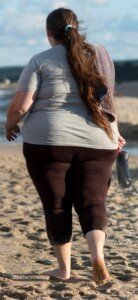
Where do we draw the line for blaming thyroid issues on obesity? Can low thyroid make a woman weigh 528 pounds?
That’s a LOT of weight to attribute to a sick thyroid gland.
It seems that only laypeople, not doctors, insist that obesity can be caused by thyroid problems, even in the case of Victoria Lacatus.
The 25-year-old Victoria Lacatus from Romania weighed 528 pounds and died — five months after giving birth.
Apparently, the morbidly obese Lacatus had a thyroid disorder that did not respond to medication.
The “comments” to the msnbc.com article about her have filled up rapidly, with many posters insisting that her extreme obesity was caused by a thyroid condition, in particular, hypothyroidism that was unresponsive to Synthroid or other treatments.
Can hypothyroidism actually cause morbid obesity?

Shutterstock/Kokhanchikov
“Yes, this is possible,” says Dr. Kent Holtorf, MD, thyroidologist and founder of Holtorf Medical Group in California.
“We have many patients come in that are considering gastric bypass or have gotten gastric bypass and still do not loss weight.
“They are told over and over that their thyroid is fine or given Synthroid or Levoxyl until their levels are normal and told it cannot be their thyroid.”
He continues, “However, when we check their metabolism it can be 500 to 1,000 calories per day deficient or more.
“This adds up to a 10 to 15 pound weight gain per month, and over the years it is hundreds of pounds.”
Dr. Holtorf mentions the case of one particular obese patient who failed to lose weight after a gastric bypass (stomach shrinking surgery).
She was placed in a hospital so that her caloric intake could be monitored: 500 calories per day. She still lost no weight.
“She came to us and we found she was severely low thyroid and very low metabolism, despite standard blood tests being normal,” says Dr. Holtorf.
“She was finally able to lose weight with proper thyroid replacement with T3, not T4 (Synthroid) and treating her leptin resistance. While not everyone will be so dramatically affected, we see such similar cases all the time.”
Dr. Holtorf adds, “With suboptimal thyroid treatment (considered to be fine by the majority of physicians), there will be ongoing difficulty losing weight, or continued weight gain. It can be 10 pounds a month or a hundred.”
In the case of Victoria Lacatus, who died from a heart attack, we don’t know what her exercise habits were. Those who believe that she was too heavy to exercise are mistaken.
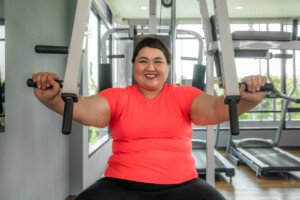
Morbidly obese people are very capable of seated strength training.
Whether or not you have a thyroid condition, whether or not you are extra obese, a little heavy or on the skinny side, you absolutely must exercise on a regular basis: cardio and strength training, and include bouts of intense, rigorous sessions.
Shutterstock/Travelerpix
A thyroid disorder is no reason to avoid exercise, even if you’re obese.
And if walking across a room is all that the obese person can do, then that’s the exercise: a 10 second “work interval” across the room.
Rest a minute or two. Repeat. Rest. Repeat 10 times. This can be done several times a day.
Water activity is also a very viable exercise option for the morbidly obese.
And I can’t say it enough: lift weights. This can be done while seated.
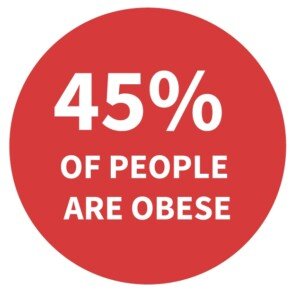
One thing is for sure: The percentage of obese, especially morbidly obese, men and women at health clubs is alarmingly much lower than is the percentage of obese people in the general population. This is very telling.
 Dr. Holtorf has published a number of endocrine reviews on complex topics in peer-reviewed journals on controversial diseases and treatments.
Lorra Garrick is a former personal trainer certified through the American Council on Exercise. At Bally Total Fitness she trained women and men of all ages for fat loss, muscle building, fitness and improved health.
.
Source: msnbc.msn.com/id/38521309/?GT1=43001

Do Fat and Sugar Feed Cancer Cells?

“Sugar is the main culprit to feeding cancer cells,” says Dr. Keith Kantor, a leading nutritionist and CEO of the Nutritional Addiction Mitigation Eating and Drinking (NAMED) program.
NAMED treats substance abuse, mental illnesses and other illnesses.
“Fat does not directly feed cancer cells like sugar, but consuming too much sugar can cause excessive fat buildup in the body which increases inflammation and risk for numerous chronic diseases like cancer.
“Adipose tissue, especially around the abdominal region, is extremely inflammatory, which can increase the risk for cancer too.”
Though a mice study in Cancer Research (2012, Kolonin et al) says that obese cancer patients have a more dismal prognosis, the consumption of excess sugar perhaps out-ranks surplus fat as a trigger for the development of cancer.
Obesity IS a risk factor for some cancers such as colon, uterine and breast.
A plant based, whole foods diet (or one that is mostly so) is linked to a lower incidence of cancer.
There is no need to be perplexed over which “feeds” cancer more: sugar or fat.
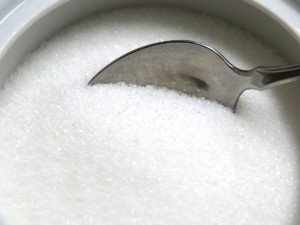
Both are bad for the body, and both are strongly associated with the development of, and prognosis for, certain cancers.
The solution if you’re confused is to restrict, if not eliminate, processed foods.
In a modern society, this is very difficult to do, but you’ll benefit from an ongoing effort.
If you’re overweight, then make an effort to lose the excess fat.
This will be a natural outcome if you switch to a plant based diet of mostly non-processed foods.
But it’s also crucial that you add cardio and strength training workouts to your lifestyle.
People who regularly work out and have a healthful diet, and who are not overweight (and who also don’t use tobacco), are less likely to develop cancer overall.
 Dr. Kantor has a PhD in nutritional science and a doctorate in naturopathic medicine, has appeared on CNN and Fox News Channel for his expertise, and has been an advocate of natural food and healthy living for 30+ years.
Lorra Garrick has been covering medical, fitness and cybersecurity topics for many years, having written thousands of articles for print magazines and websites, including as a ghostwriter. She’s also a former ACE-certified personal trainer.
Source: sciencedaily.com/releases/2012/10/121015084651.htm
The One Diet Change that Will Make Weight Loss EASIER
Make this one small and easy change in the way you THINK about food.
And you will begin losing weight — fat weight — including in your stomach and thighs and your entire body.
Here’s What to Do
Get away from the requirement that every time you eat, it must be delicious.
To expect every bite of food you ever eat to be delectable will sabotage your weight loss efforts.
Instead of expecting and requiring food to be an indulgence, think of food as sustenance, fuel for the body, and something that’s health-giving to the body.
By viewing food this way, you will no longer feel it’s necessary to have pancakes or waffles drenched in syrup for breakfast, or a sausage burrito for lunch.
Or fatty meat and buttery mashed potatoes soaked in gravy for dinner.
“Treat food as a source of nourishment to your body cells and tissues,” says Prajakta Apte, RDN, owner and founder of Right Nutrition Works who helps people create a healthier lifestyle.
“Learn to enjoy food in its natural form such as fresh fruits, and not in the form of fruit juices or fruit roll-ups.
“Avoid eating veggie chips as an alternative to fresh vegetables.
“Foods in their natural/original form act as a medicine to maintain, prevent and treat disease.”
Certainly this all doesn’t mean eat food that tastes like cardboard.
But do some investigating and experimenting with recipes and foods you’ve never tried in their whole form — and you may end up pleasantly surprised: “I can do this!”
For instance, some people have become conditioned to believe that breakfast must be a big production of heavy rich food, always including some kind of pastry — along with the toast, sugary jams and carb-crazed orange juice from a carton.
But you don’t have to “enjoy” every bite you eat in the day.
Get away from this thinking, and you will finally lose weight and keep it off.
Instead of the orange juice, have a whole orange, grapefruit or melon chunks.
And why have a pastry at breakfast when you know you’ll be craving a dessert-type food after dinner?
Replace the pastry with whole grain bread. However, even bread can be a problem. Aim for a brand with the fewest ingredients.
Maybe you’ll be able to eventually replace the bread with steel-cut oats sweetened naturally.
A sample lunch might be a tuna or chicken salad with a boiled potato and vegetables — rather than fast-food fare.
If you’re hungry 90 minutes later, that’s fine; who says that one feeding must satiate you for hours?
Have some fruit, or plain yogurt or kefir, or maybe some nuts or several squares of dark chocolate as a snack.
If food is always for sinful pleasure, you’ll end up snacking on ice cream, cookies, brownies, bon bons, tortilla chips drenched in cheese, etc.
If food is for health and sustenance, you’ll be drawn to a few apples or a banana for your mid-morning snack.
Make this one change to your diet – to the way you think about what you should eat – and weight loss will never be easier.
 Prajakta Apte is the author of the eBook “Overcoming Nutrition Roadblocks.” Her personalized approach to nutrition therapies helps treat root causes of conditions such as type 2 diabetes, high cholesterol, GI disorders, hypertension and many more.
Lorra Garrick has been covering medical, fitness and cybersecurity topics for many years, having written thousands of articles for print magazines and websites, including as a ghostwriter. She’s also a former ACE-certified personal trainer.
.
Top image: Shutterstock/Sinelev
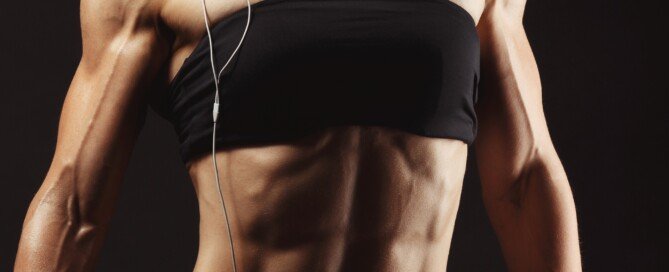
Get a Biceps Vein: Vascularity Exercises for Women

Exercises that can help a woman get a biceps vein…
Are you a woman struggling to get that biceps vein going?
I take pride in my own biceps vein, which I refer to as my “cable.”
To get a biceps vein, three key factors must be at play:
No. 1: A body fat percentage in the lower range of the “athletic range,” as defined by the American Counsel on Exercise, which would be 14 to 16 percent for women.
Bodies vary, and some women may be able to achieve a biceps vein at 16 or even 17 percent body fat.
Get below 14 percent body fat, and for sure a woman should not only be seeing the biceps vein, but feeling it with the pads of her fingers.
No. 2: Intense weight workouts, the kind that give you a pump, a burn. Moderate to heavy weights must be used to get that wonderful vein popping out.
No. 3: Specific kinds of weight routines are necessary to really bring out the biceps vein.

Shutterstock/Artem Furman
Best exercises to bring out the biceps vein, particularly for women:
Any pulling-towards-chest exercise in which your grip is supinated (palms facing ceiling), will create substantially increased blood flow and vascular action in your biceps, bringing out the vein, provided your body fat is low enough.
1 Rows using a cable machine or a barbell.
In both cases, use a handle with grip less than shoulders width apart. Height of the pull, relative to torso, can vary. Use an underhand grip.
Shutterstock/Catalin Petolea
A neutral grip (palms facing each other) can bring out a biceps vein, but not as much as the supinated or underhand grip. Single-arm rows in a seated position will also work.
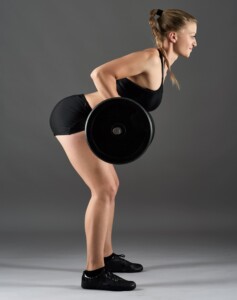
2 Single-arm rows while standing, using pulley machine, legs bent, upper body bent at hips, arch in lower back.
The free hand rests on thigh or knee of opposite leg, and the pulling motion resembles that of starting a lawn mower. How much you’re leaning forward can vary.
3 Chin-ups – without the assistance machine. “Hammer” chin-ups will also work.
4 Lat pull-downs with a supinated or neutral grip will help women get a biceps vein going.
5 Any kind of biceps curling will bring out the vein, as long as the routine is intense.

Shutterstock/Nicholas Piccillo
So how intense must exercises be to get that biceps vein?
The resistance should allow you to complete 8 to 15 repetitions … and no more.
The first repetition should feel challenging, and the entire set should be very difficult.
You should feel worked over at the end of every set. Complete range of motion should be used, with no cheating, though “loose form” is okay for the last few reps.
Rest in between sets should be 45 to 60 seconds. When these short rest periods, and an 8-15 rep max to muscle failure, are combined, you can get a biceps vein doing this just once a week for a 45 to 60 minute session.
Freepik.com/pressfoto
Women should take up rock-wall climbing. This will bring the daylights out of your biceps veins!
View the arms of experienced women rock-wall climbers with low body fat: Vein City, USA.
I’ve noticed that my biceps veins, as well as their extensions into my forearms, really seem to pop out after I’ve completed heavy deadlifts (palms facing me). Reverse curls will also bring out the forearm vascularity.
To top everything off, to maximize visibility of the biceps vein, women need to keep their sodium intake under 2,000 mg a day.
Some might say under under 1,600. Sodium makes the body retain water, and water retention between muscle and skin will mask vascularity.
Lorra Garrick is a former personal trainer certified through the American Council on Exercise. At Bally Total Fitness she trained women and men of all ages for fat loss, muscle building, fitness and improved health.
.
Top image: Shutterstock/Lyashenko Egor
Powerlifting and Can’t Lose Fat? Do Metabolic Weightlifting
Still have stubborn fat despite a powerlifting program?
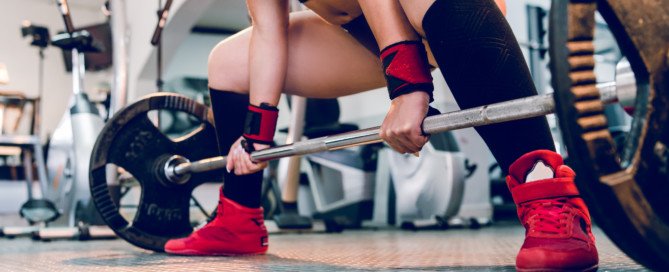
A powerlifting regimen is not the best protocol for burning fat. Lifting the heaviest amount of weight does not translate to maximum fat burning.
You’d think it would, but it really doesn’t. Maximum fat burning occurs when you lift weights according to a bodybuilding, or “metabolic” protocol.
This doesn’t mean that a bodybuilding regimen will make you look like Arnold or bulk you up if you’re a woman.
The ability to get the appearance of a competitive bodybuilder is part genetic, strict dieting (not necessarily calorie restriction), and a heck of a lot of commitment.
Nevertheless, for optimal burning of fat, the bodybuilding, or “metabolic” regimen, is the way to go.
The metabolic approach generates the greatest hormonal response. It is hormones that fire up the fat burning, even though this weight lifting protocol doesn’t involve lifting the heaviest weights possible.
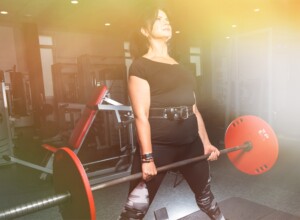
Let’s take the deadlift exercise as an example. Suppose you can deadlift 200 pounds barely eight times; the entire set is difficult.
Shutterstock/SerdyukPhotography
It’s so difficult that you must take a two and a half minute rest before your next deadlift set…you need that time to recover enough to do another eight reps at 200 pounds; or, maybe your second set is six reps at 220, because you like to lift as heavy as possible for reps.
After the second set, again you take a two and a half minute break, then do a few more sets at 200 pounds or so with two and a half minutes in between.
This is more of a powerlifting protocol. You’ll burn fat alright, but not as much fat burning will occur, when compared to a hormonal or metabolic approach:
You deadlift 175 pounds…you can do 12 reps, but barely. Now, instead of the two and a half minute rest, you take only 45 seconds. You’re not fully recovered, of course, and thus do only 10 reps…barely.
You wait only 45 seconds before your third set at 175, and you struggle to do just six or seven reps. The last set is six reps.
Despite lifting lighter weight this time, you actually feel more worked-over than you normally do with the 200-plus pound regimen. The next day you’re sore.
The metabolic weight lifting approach creates more release of human growth hormone and testosterone, two hormones that act as powerful fat burners. Lactic acid is another fat burner that’s triggered.
The metabolic weight lifting protocol calls for a 30-45 second rest in between sets. However, and this is a mighty big however, the sets must be done to muscle failure! And beginning with an 8-12 rep max!
These are the ideal conditions for maximum fat burning with your weight lifting regimen.
Lorra Garrick is a former personal trainer certified through the American Council on Exercise. At Bally Total Fitness she trained women and men of all ages for fat loss, muscle building, fitness and improved health.
.
Top image: Shutterstock/Miljan Zivkovic
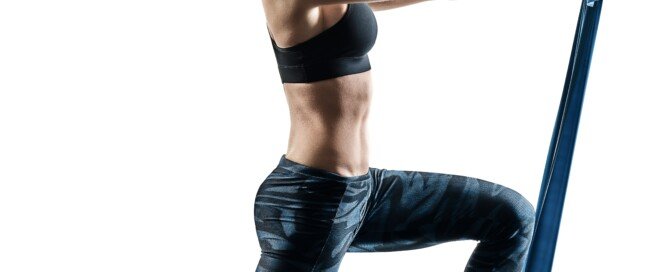
Resistance Band Exercises to Burn Fat & Tone: Pics
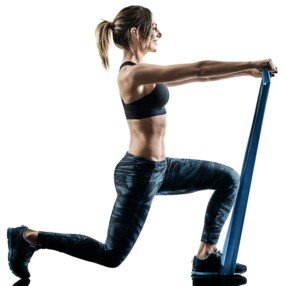
Images & simple instructions: best exercises for weight loss & toning using a resistance band or tension tube.
However, I must stress that the level of resistance in the band (also known as a tension tube) must be sufficient to make you work hard enough to achieve weight loss.
Using a resistance band that’s too light in tension, relative to your strength/fitness, will not result in the weight loss that you desire.
For optimal weight loss results, you’ll need more than one resistance band to provide different tension levels.
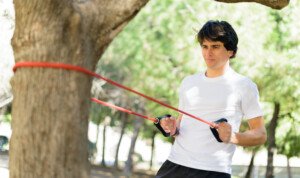
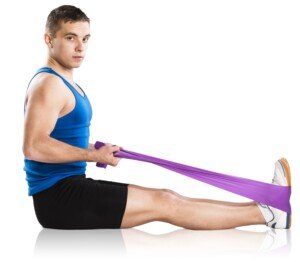
Row: Standing or Seated. Loop tubing around the leg of a heavy sofa or other stable anchor. Grab handles and stand (or sit) away from the anchor point, facing it..
Shutterstock/Kaderov Andrii
Keeping back straight, pull handles towards you, driving elbows behind body. Then reverse the motion.
Shutterstock/Halfpoint
Your distance from the anchor point should be sufficient to make 8-12 repetitions very challenging (this rule applies to all exercises).
Chest Press. Loop tubing around a secure anchor that’s not close to the floor, if you can find one. This may be the handle of a sliding deck door.

Shutterstock/InnerVisionPRO
You can use the leg of a heavy sofa, but this isn’t the best angle for a chest press.
Stand with back facing the anchor and push the handles out in front. Weaker people can be challenged by looping the tubing around the back of a sturdy chair, having a seat and then pushing the handles out in front.
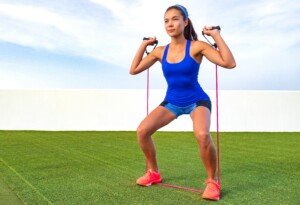
Shoulder Press. Stand on center of tubing with equal sides on either side of feet. Grab handles, straighten and push overhead.
Shutterstock/Maridav
If this is too difficult, use a lighter tubing, or, kneel on the tubing and try again. Another option is to wrap the band under a sturdy chair and push overhead while seated.
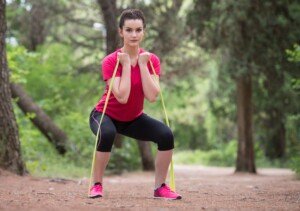
Squat. Stand on tubing, feet at least shoulder width apart, holding handles at shoulder level, palms facing out or towards each other.
Shutterstock/Jasminko Ibrakovic
While in this position, there should be enough tautness in the band such that if you lower to a squat, the band doesn’t slack out, and that when you rise back up, you can feel yourself fighting against the tension.
Leg Press. Lie on floor after looping the tension band or tubing around a stable surface behind your head.

Shutterstock/Photographee.eu
Place feet against the opposite side of the band, or tuck feet inside the handles of the tubing, legs bent, then push legs outward.
Lateral Raise. Using a tension band that has handles, stand on the band at its center point, then grab the handles and raise your arms out to the side. Release with control.

Shutterstock/Oleksandr Zamuruiev
The more distance between your feet, the tighter the tension (or the greater the resistance.
Triceps Extension. Stand on top of the band and raise your hands overhead, arms straight.
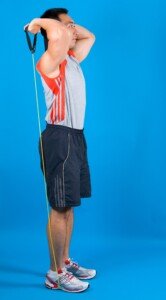
Keeping the upper arms still and tight to your head, bend your elbows so that your hands are behind your head. Then straighten your arms to complete the rep.
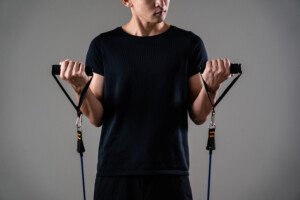
Biceps Curl. Place your feet over the band and simply curl up the handles, keeping your upper arms vertical and against your sides. Release with control.
Shutterstock/aijiro
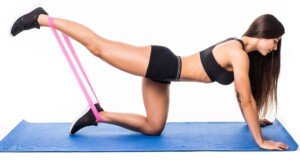
Glutes Extension. On all fours, situate yourself with the resistance band as depicted below.
Shutterstock/ F8 studio
Bring your knee towards your chest, then extend your hip outward, leg straight behind you, to recruit the gluteus maximus. Hold for two seconds, then repeat.
And remember, to achieve weight loss, you must use a resistance band with adequate tension, and adjust your body position for adequate tension, so that 8 to 12 repetitions are very challenging.
Lorra Garrick is a former personal trainer certified through the American Council on Exercise. At Bally Total Fitness she trained women and men of all ages for fat loss, muscle building, fitness and improved health.
.
Top image: Shutterstock/OSTILL is Franck Camhi

Should Skinny People Who Want to Gain Weight Avoid Cardio?

Sometimes, a skinny man or woman who wishes to gain weight will avoid cardio exercise out of fear it will prevent them from reaching their goal.
The irony is that in many people who want to lose weight, who do “tons of cardio,” the cardio isn’t very effective!
If you’re skinny and want to gain weight, DO cardio exercise.
This doesn’t mean you must spend hours and hours every week on cardio equipment.
But just because you want to gain weight, doesn’t mean you should deprive your heart from exercise that will make it fitter and healthier.
The effectiveness of steady-state cardio exercise at slashing body weight is overestimated.
The proof is all around you: Look at all the people on cardio equipment and in aerobics classes at your gym. How many are skinny?
But what about marathon athletes?
Yes, marathon runners are thin, but the cardio that a thin (or any size) person should do is hardly comparable to marathon training.
I’m talking three times a week for 30 minutes for cardiovascular health.
If a skinny person eats plenty of natural, complex carbohydrates, lean sources of protein and healthy fats like nuts, olive oil and coconut oil, AND strength trains using heavy weights and focuses on compound movements, that individual should gain weight.
Three, 30 minute sessions of steady state cardio per week will not sabotage this plan.
If anything, it can enhance it by providing the trainee with energy to carry them through their strength training sessions.
I’m not saying that jogging on a treadmill will enable you to bench press 200 pounds, but cardio exercise promotes better aerobic fitness, and better aerobic fitness will give you a little extra perk in your daily routine, giving you that extra boost to hit the gym hard.
When a skinny person can’t gain weight despite doing a lot of lifting, what’s typically the case is that they do the wrong lifting exercises and/or don’t use heavy-enough weight.
A food diary is especially important. Many thin individuals don’t eat as much as they think they do.
Bottom line for skinny folks: Do cardio, hit the weights hard, do not fill up on junk food, and focus on lean proteins, complex carbs, vegetables and healthy fats.
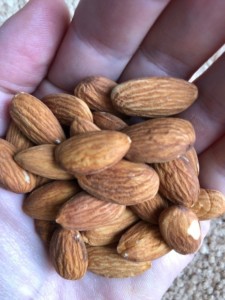
Almonds provide healthful fats.