Why Ignoring Bullies Won’t Make Them Go Away

Find out why telling your child to ignore bullies is one of the worst things parents can do.
Have you told your bullied child to “just ignore it”? Ignoring bullies is no more effective than ignoring sexual harassment in the workplace.
Ask anyone who’s ever been sexually harassed on the job and has ignored it: It doesn’t go away; in fact, it gets worse.
“When a bully locks onto a victim, they are invested in demonstrating and continuing to demonstrate their power over the victim,” says Rona Novick, PhD, who developed the BRAVE bully prevention program.
A clinical psychologist, Dr. Novick has worked with schools nationally on the issue of bullying, and is director of the Fanya Gottesfeld Heller Doctoral Program at Yeshiva University, NY.
“Especially because bullying often has an audience of peers, demonstrating this power in front of peers is important.”
So true. When I was in junior high, a bully, “Paula,” delighted in making her victim, “Annie,” cry in the presence of several onlookers. I was one of those onlookers.
Why Ignoring a Bully Won’t Make It Stop
“So when a victim responds to a bully by ignoring, the bully is very likely to escalate his/her violence, trying to get the expected response,” says Dr. Novick.
This is exactly what Paula was doing with Annie, who initially was ignoring the bullying.
“Violence” doesn’t always mean physical; Paula never laid a hand on Annie and didn’t even threaten her physically, for that matter; it was all psychological.
“Even if the victim ignores once, twice, three times, eventually, the bully’s escalation will become intolerable and the victim will react, once again signaling to the bully that he can control the victim.” And Annie sure did react: by beginning to cry.
Interestingly, this made Paula retreat, but not without first facing the onlookers with a proud smirk and sneering, “She’s crying!” Paula sauntered away only after a lot of damage had already been done, job accomplished.
Bullies should not be ignored.
There’s the case of another student whose last name sounded kind of like “gargoyle.” Kids called this boy gargoyle and he did not think it was funny, and his attempts to ignore the frequent teasing failed to stop the harassment.
Another Reason Ignoring Bullies Fails
In the case of “the gargoyle,” this child tried his best to “just ignore it.” He’d keep his eyes on his books and keep his mouth zipped, but his body language was powerful.
Most victims are “selected” as targets because of their emotional reactivity, Dr. Novick says. This trait of reactivity, largely based on inborn temperament factors, is difficult to change.
“These are children who blush and cry easily, who wear their hearts on their sleeves,” Dr. Novick continues.
“No matter how much such a child tries to appear untouched by a bully’s harassment, the impact is often written on their face.”
Ignoring the Bully Can Escalate the Behavior

Often, a victim will attempt to ignore. The lack of response from a victim who has responded in the past does not result in the bully ceasing his efforts, Dr. Novick explains.
“Rather, a bully will try something new, something more extreme, to get an indication that they still have power over the victim”.
In a junior high school class, I witnessed a boy verbally bullying another boy; the victim kept ignoring it, back facing the perpetrator.
This was so inviting to the mean boy that he took an eraser, soaked it with glue and smeared it on the victim’s back, who continued to ignore the harassment.
Many adults, thinking it will be helpful, advise victims to “ignore it and it will go away.”
Dr. Novick cautions that this is a bad move for adults, who, in offering advice that will not work, lose their credibility and may no longer be seen by children as a reasonable resource for bullying problems or other life challenges.
What parents and educators need to offer victims is an array of strategies, including telling adults, or using distraction.
 Dr. Novick is recognized for her expertise in behavior management and child behavior therapy. She has published scholarly articles on school applications of behavior management, children and trauma, and bully prevention in schools.
 Lorra Garrick has been covering medical, fitness and cybersecurity topics for many years, having written thousands of articles for print magazines and websites, including as a ghostwriter. She’s also a former ACE-certified personal trainer.

Preventing Social Exclusion at School: Teacher Tips

Here are guidelines for teachers who are serious about preventing social exclusion at their school.
Social exclusion can leave wounds that never heal, and teachers can be instrumental in minimizing its occurrence.
Social exclusion is when a child is excluded or ostracized for no good reason, or, if you need a reason, how about for not wearing cool clothes, for having an outstanding physical feature, for being too smart, too quiet or for not thinking “like everyone else”?
“Some social exclusion is inevitable, and children must learn ways to cope with disappointment and hurt feelings,” says Jamie M. Howard, PhD, clinical psychologist specializing in the evaluation and treatment of mood and anxiety disorders in children and adolescents.
Examples of Social Exclusion
• Having nobody to eat lunch with (the student has even tried to join groups at tables, but is told they’re not welcome, or, when they sit next to a few kids, the kids vacate)
• Nobody in the class wants the student in their group when the teacher tells the kids to get into groups to work on the new assignment
• Nobody wants to sit next to the student on the bus for a field trip.
Dr. Howard explains that “the school and classroom culture can do a lot to shape kids’ ideas about appropriate ways to treat one another.
“A culture of respect for individual differences and treating one another with kindness can reduce negative feelings, even if some social exclusion still exists.”
Teachers should rethink their insistence that kids get into groups if the same student is always left out, sitting alone.

Freepik.com, pressfoto
Schools can also arrange a place for such students to eat lunch where they don’t feel pressure to join someone or where eating alone isn’t so awkward, such as an offset location in the school’s library.
The most striking ways social exclusion can present itself is, indeed, when kids are asked to form groups, and during lunch time.
Teachers must ask themselves if there exists research showing that NOT having kids form groups stunts academic development.
Certainly, homeschooled kids are not exposed to the group setting, yet many homeschooled kids are several grades ahead of their traditionally schooled peers in math, science and English skills.
My niece is homeschooled — just she and the teacher, her mother — yet at the age of 7, was reading at tenth grade level (I witnessed this), and is quite well-adjusted and well-behaved in public and at home.
Though I’m not saying that one example speaks for all, it’s a fact that many homeschooled kids, who never work in groups, have excelled academically and socially.
A child/teen who’s subjected to ongoing social exclusion at a traditional school setting will not develop any admirable or advantageous psychological traits as a result.
That same child would logically turn out much more internally stable if homeschooled in a non-judgemental environment free of being rejected.
Social exclusion is a form of bullying.
Dr. Howard explains that there are three ways to help prevent bullying: 1) mindfulness, 2) understanding peers’ behaviors without necessarily agreeing, and 3) empathy; putting oneself in another’s shoes to understand their emotional experience.
“Group activities and projects are a good context in which to practice these skills,” says Dr. Howard. Teachers can form the groups rather than leaving this up to the students.
Nobody will lose sleep if they don’t get to be in a group with their best friends, but being rejected can be a source of substantial stress, and the anticipation of this could literally make a student sick to their stomach.
One way teachers can prevent social isolation or rejection is to assign groups based on having the students name out a number beginning with #1.
The teacher can then have all the ones, fours, sevens and tens form one group, and then all the twos, fives, eights, and elevens form the next, and so on.
There are many objective ways groups can be formed by teachers.
 Dr. Howard heads the Child Mind Institute’s Anxiety and Mood Disorders Center trauma response group. She specializes in the evaluation and treatment of anxiety and mood disorders in children and adolescents.
Lorra Garrick has been covering medical, fitness and cybersecurity topics for many years, having written thousands of articles for print magazines and websites, including as a ghostwriter. She’s also a former ACE-certified personal trainer.
.
Top image: Shutterstock/Iakov Filimonov

How to Handle Gym Bullies Who Are Women

Here’s how to face the problem of female bullies at the gym and how to manage them.
Is there even a such thing as gym bullies who are women?
This depends on how you define “bully.”
Much of gym bullying may occur in the locker room where there wouldn’t be many, if any, witnesses.
So how do you deal with a female gym bully?
I’m a big proponent of the concept of empowerment. That’s why I won’t recommend that the targeted individual ignore the “bully.”
I’m going to offer a perspective based on common sense and having lived long enough to observe a phenomenon among humans:
- Ignoring bully behavior will NOT make it go away.
- Ignoring bully behavior will NOT empower you.
In all seriousness, if you become aware that a woman is making snide comments about you deliberately loud enough for you to hear, march right over to her and speak honestly about what’s on your mind about the situation.
Don’t tell her she’s hurting your feelings, because this is exactly what her goal is.
Instead, put her on the spot. She does not expect you to step right up to her.
This may seem impossible to do, but this kind of reaction from the victim of the “bully” has a very high success rate at stopping the negative behavior.
There’s nothing to fear. She can’t get your membership revoked, and you’re probably more likely to get struck by a meteor on the way to your car in the parking lot than by her fist.
Just go up to her and tell it like it is, even if there’s other people with her. Put the bully on the spot and watch her crumble.
She is not prepared to respond intelligently, and she knows this.
There’s a second strategy for dealing with the woman gym bully. And that’s to get strong. Focus on making your body stronger and stronger.
Strong!
There’s something about knowing you can bench press or deadlift 135 pounds that makes you invulnerable to hurt feelings from a bully. This air of confidence about you, in turn, will make the bully retreat.
The bully likes to see hurt in your face. You can’t pretend not to show hurt if you feel hurt. You’ll be showing it alright if you’re feeling it.
But if you’re strong, it’s not likely you’ll get hurt feelings from a mean woman, even if she’s a size 6 and you’re a 16.
And by the way, getting strong does NOT mean getting big. You won’t bulk up without intending to.
Perception
Finally, consider the possibility that you’re actually not being bullied at all, that it only seems that way.
For example, two women may be looking your way, smiling and snickering, speaking softly.
This doesn’t mean they’re making fun of you. They may be talking about something unrelated and just waiting to use the equipment you’re on.
If a woman grabs the equipment you’re using, maybe she truly didn’t know you were using it.
This happens all the time. Someone leaves their equipment for just a moment to get water, then returns and sees someone using it.
Another example of “pseudo-bullying” is when a gym member points out behavior on your part that’s inappropriate.
They’re not trying to bully you, but may find your infraction to be quite annoying.
Examples are:
- leaving your sweat on equipment
- leaving litter behind on the treadmill
- coming into the gym drenched in fragrance and hijacking the air
- hogging the entire bench in the locker room with your personal belongings
- not flushing the toilet
- leaving water puddles all over a bench.
If someone points these things out to you, they’re not trying to be a bully.
Etiquette should be practiced inside a gym, and some members are quite vocal about correcting someone’s lack of etiquette.
If you encounter more of a real bully at the gym, which would most likely be a woman pressuring you to finish up on a piece of equipment, inform her that you’re going to finish your sets, but she’s welcome to work in with you. Do not give up the equipment to her!
Lorra Garrick has been covering medical, fitness and cybersecurity topics for many years, having written thousands of articles for print magazines and websites, including as a ghostwriter. She’s also a former ACE-certified personal trainer.

How Tall Teen Girls Can Stop Insults About Height, Bullying

Tall teens girls who get “bullied” or insulted about their height can say two simple words that will stop the taunting dead in its tracks.
I was inspired to write this article after reading about a teen girl’s plight with her extra tall height, and the ridicule she received from “friends.” This 15-year-old girl, 5-10, wrote in to Yahoo! Answers and states:
My friends tell me I’ll never find a boyfriend. She also says, Boys around me constantly say how tall girls are ugly. Most disturbing, this teenager writes: I generally want to kill my self (sic) because that’s all I think about.
Oh, and she also says: All I get are negative comments.
Certainly, she isn’t the only very tall teen girl who gets continuous taunting.
The girl above, as well as other tall teen girls in similar bully boats, need to come up with a tactic that will stop these insults dead in their tracks, a way to DISARM the bullies.
How can a very tall teen girl stop her bullies?
With these two words: “PROVE IT.” Before I elaborate, I want to first point out that this trick will work for only some types of ridiculing, but it will make a huge difference nevertheless.
The type of insult that this will work on are the overly-generalized statements (insults), such as:
“You’ll never get a boyfriend.”
“No man will ever want to marry you.”
“You’ll never get dates.”
“Tall girls are ugly.”
“Boys aren’t attracted to tall girls.”
Look the bully dead-smack in the eyes and say with a stern voice (like a teacher giving an order to a naughty student), “PROVE IT.”

Say nothing more. Keep looking dead into the bully’s eyes — even if the “bully” is your so-called friend.
Stand your ground as you wait for the perplexed bully to come up with an answer that will make him or her sound smart.
Here’s What’ll Happen
• They will be tongue-tied.
• They won’t HAVE an answer.
• You caught them off-guard.
They will NOT be able to cite any population studies, demographic data or reference any other kind of data that proves their statement.
They will not be able to cite any name of a research journal that verifies their statement.
They will be left in a quandary, while you continue waiting for them to give an intelligent answer.
If the bully simply repeats the statement (and he or she just might do that, in an attempt to get one up on you), then come back with: “PROVE IT.” Then wait. You are the cat, and they are the mouse.
Have fun with this!

The bully will soon begin buckling and will either go away or change the subject to something neutral.
This is basic psychology. You just presented a very unprepared person with a challenge that he or she is totally unequipped to take on.
If the bully insults you the next day or a week later with a similar comment, do it again: “PROVE IT.”
If they sneer, “I don’t need proof! Everyone knows that tall girls don’t get boyfriends!” then calmly but sternly repeat: “PROVE IT.”
Because you see, if they sneer back at you, they didn’t get ahead of you; they simply went around in a circle and put themselves in the same position of vulnerability.
They may huff and puff and snort and scowl, but they will know they’ve been had!
The tall teen girl can stop these kinds of insults because the bully doesn’t want to keep being put in a position of proving an incredibly unfounded statement.
But you must speak with the sternness of a strict school teacher. You must see the bully as a mouse and you as the cat.
Lorra Garrick has been covering medical, fitness and cybersecurity topics for many years, having written thousands of articles for print magazines and websites, including as a ghostwriter. She’s also a former ACE-certified personal trainer.

Top 5 Ways to Gain Fat if Overeating Makes You Sick

If you want to gain fat, this doesn’t mean you should force down foods you don’t like such as gritty protein powders or a ton of fastfood.
Obviously, if you pig out with the highest-calorie foods at fastfood restaurants a few times a day, you will gain fat.
Some fastfood selections are inundated with calories.
Assume that any gargantuan-portioned dish at a fastfood place is loaded with calories and fat. That’s a given.
However, there are alternatives that are cram-packed with calories, such as cashews and peanuts. Snacking on peanuts and cashews will help you gain fat.
Add pine nuts to salads and meat dishes. One tablespoon of pine nuts contains 190 calories, and they are very tasty. Any kind of nut should be part of your weight gain plan. Nuts are good for the body.
Smearing peanut butter on whole grain crackers or, better yet for weight gain, a whole grain bagel, will also contribute to your weight gain plan.
I’ve found that a chocolate mint bar can be devoured in seconds with a chilly glass of milk.
If you like chocolate mint, then snack on a couple of supersize chocolate mint bars – that’s almost 1,000 calories — that you can get at Whole Foods Market.
These bars have fewer processed ingredients than conventional mint patties.
Add a tall glass of milk and that’s another 200 calories or more, depending on type of milk.
Less Healthful, but Very Delicious Options

©Lorra Garrick
A breakfast of waffles, pancakes or French toast will add significant calories to your daily diet.
One tablespoon of regular syrup is an outlandish 200 calories, give or take.
When you pour syrup on your pancakes, waffles or French toast, you’ll be pouring (and thus eating) far more than just a few tablespoons.
Three pancakes can easily soak up five tablespoons of syrup.
The pancakes, waffles and French toast add a lot of calories, but don’t forget the butter – add a tablespoon of butter, and you have a ridiculously calorie-packed meal, and that excludes the tall glass of milk!
You are on your way to successful fat gain.
Additional Ways to More Easily Gain Fat

Load up on mashed potatoes, stuffing and plain cheese pizza.
Keep in mind that conventional grocery store preparations of these foods are highly processed and have very high sodium content.
An alternative is to make them at home.
Nevertheless, a whole box of Stovetop stuffing is about 1,000 calories, yet is easy to gobble down.
So have fun on your plan to easily gain fat, but don’t give up exercise; exercise is always important and should be a staple, whether you want to lose fat or gain fat.
Lorra Garrick is a former personal trainer certified by the American Council on Exercise. At Bally Total Fitness she trained clients of all ages for fat loss, muscle building, fitness and improved health.
.
Top image: Shutterstock/fizkes

Improve Brain Power with Balance Exercises

Brain power can be improved by doing physical things like balance and not just by performing mental tasks like crossword puzzles.
Never underestimate the effectiveness of balance-based exercises for improving the function of your brain.
Balance and coordination training will boost the power of your brain by engaging the nervous system to take on new challenges.
Neuromuscular facilitation is what happens when you perform balance exercises, and this affects the brain by forcing new neural connections to develop.
Exercise that revolves around balance will help prevent or minimize cognitive decline that comes with age.
You’ve certainly seen some balance-training tools at your gym, namely, wobble boards and pliable curving surfaces that people stand upon.
And for some individuals, just maintaining a standing position on these is challenging. For others, merely standing on these implements is too easy.
When you do balance exercises, the brain gets involved by trying to figure out how to solve the riddle of keeping balance during the task.
This keeps brain neurons active and working, causing them to sprout new pathways that link to other neurons.
Suppose it’s a major struggle for you to stand on a mushy air cushion or shaky wobble board, and at the same time, perform dumbbell curls.
If you do this often enough, eventually it will become easy; your nervous system has sprouted new neural connections to carry out this task efficiently. Your brain was involved just as much as your feet, legs and arms.
Convenient Balance Exercises for Boosting Brain Health
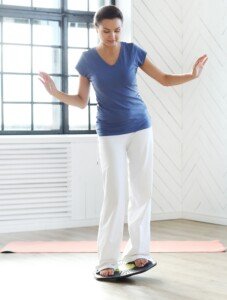
Wobble board. A simple, cheap board will do. These are sold online. If you need to at first, lightly hold onto a table or countertop. Freepik.com, Racool_studio
-Stand on one leg. If this is easy, lift the knee high. Rotate the raised leg to your side. Close eyes. Do this standing on a wobble board or air cushion. Add arm and torso movement.
Stand on one foot for 30-60 seconds. Shutterstock/Jacob Lund
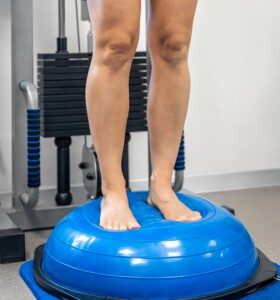
Go up and down on your feet standing on a BOSU board. Freepik/pvproductions
-Walking or jogging backwards on a treadmill without holding on.
-Walking or cantering sideways on a treadmill without holding on.
-Step-back lunges, and forward and side kicks (cardio kickboxing classes/martial arts).
-Swiss ball routines. For example, sit on ball and grab right foot with both hands, and pull leg up to stretch the hamstring (leg does not need to be perfectly straight up), while other foot remains planted on floor. Hold for about 8 seconds, then switch legs.
-Bench crunches. Keep hands in the air, crossed at your chest, or folded atop your head, while crunching in as tightly as possible before extending the legs.
-Hopping up a flight of stairs with both legs at the same time, without holding the railings.
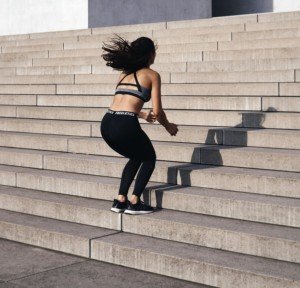
-And of course, one of the best ways to improve balance is with yoga.
As you improve brain power with balance exercises, you may not realize it in a direct way, especially if you’re younger.
But as you age, all that balance exercise will come in handy because you’ll have more “neural reserves” from which the aging process will draw from.
Lorra Garrick is a former personal trainer certified by the American Council on Exercise. At Bally Total Fitness she trained clients of all ages for fat loss, muscle building, fitness and improved health.
.
Top image: Freepik.com, kjpargeter

Weight Gain from Staying Up Late, Sleeping In: Link Not Clear

If you’re trying to lose weight or prevent weight gain, you’d better not stay up late and sleep in, as this increases the risk of putting on fat.
Weight gain is a risk from staying up late each night and then sleeping in.
A Northwestern Medicine study says that the weight gain risk, from these sleeping habits, results from night owls consuming more food in the evening, greater amounts of fast food, and fewer vegetables and fruits.
They tend to weigh more than normal-cycle sleepers. So far, sounds like nothing inherent in going to sleep late and awakening late causes weight gain, but rather, causes or leads to eating habits that are conducive to weight gain.
Another thing that I wondered about, at this point, was the idea that people with bad eating habits who don’t care about health, are more likely to stay up late, sleep in and just gain weight.
In short, I did not see any cause-and-effect relationship with the study. The night owls also drank more sugary sodas – again, which came first, the chicken or the egg?
“The extra daily calories can mean a significant amount of weight gain — two pounds per month — if they are not balanced by more physical activity,” explains (in the report) co-lead study author Kelly Glazer Baron, who is a health psychologist and neurology instructor at Northwestern University Feinberg School of Medicine.
Co-lead author Kathryn Reid points out that the extra junk food calories eaten at night may be because there are “less healthful options at night,” though she also adds that night owls may simply prefer more calorie-rich foods.
My question then is: How can there be fewer healthful options at night if your kitchen is stocked with healthful foods?
This sounds more like it has to do with what the night owl purchases at the grocery store, not whether or not Joe’s Vegan Restaurant is open all hours of the night.
“Human circadian rhythms in sleep and metabolism are synchronized to the daily rotation of the Earth, so that when the sun goes down you are supposed to be sleeping, not eating,” says Phyllis Zee, MD, senior study author, professor of neurology, director of the Sleep and Circadian Rhythms Research Program at Feinberg.
“When sleep and eating are not aligned with the body’s internal clock, it can lead to changes in appetite and metabolism, which could lead to weight gain.”
Now we’re talking, I then reflected, because “metabolism” is mentioned.
Indeed, wayward sleeping habits can disrupt metabolism – the rate at which one burns calories – and cause weight gain.
The study summary didn’t detail this, but as a fitness professional and weight loss expert, I already know the fact that going to bed late cheats the human body out of maximal production of human growth hormone during sleep.
To optimize production of HGH, one should get 7-8 hours of quality sleep between 9 pm and 6 am.
HGH is one of the most powerful, if not the most potent, natural fat-burners. You get shorted on this due to unnatural sleeping habits, and you can forget about optimizing weight loss.
This doesn’t mean that all night shift workers or second-shift workers will gain weight or struggle to keep a lean body.
I used to work a third shift and second shift, and I did not experience weight gain. I still got strenuous workouts in, played tons of volleyball and was conscious of my eating habits.
People who choose second shifts may do so because they are hardcore partiers, not likely to be gym rats who prefer clean eating over junk food eating.
One of my second-shift coworkers, a chunky woman, told me she chose the shift so that she could go clubbing afterwards.
The Northwestern researchers plan on broadening their study to a larger community, to further investigate the effect of staying up late and sleeping in, with metabolism, weight gain and other factors like circadian rhythms.
Lorra Garrick is a former personal trainer certified through the American Council on Exercise. At Bally Total Fitness she trained women and men of all ages for fat loss, muscle building, fitness and improved health.
.
Top image: ©Lorra Garrick
Source: sciencedaily.com/releases/2011/05/110504111143.htm

What’s an Effective Low Back Exercise for the Elderly?
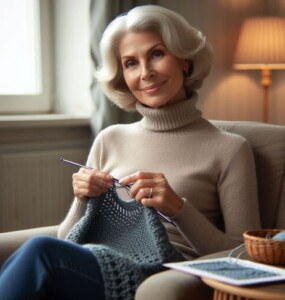
There is a low back exercise that elderly people can do that will also significantly enhance their efficiency in daily living tasks. It is the deadlift.
I have yet to see a personal trainer having a senior citizen client doing a deadlift. When I was training people over 65 at a health club, I had them perform the deadlift motion.
The key here is the MOTION. The amount of weight on the bar can be as light as only five pounds.
The deadlift motion, performed with a very light weight for novice older people, can reactivate many dormant muscles.
It’s actually a safe exercise, even though it’s a competition event for powerlifting meets.

Shutterstock/Ihor Bulyhin
When performed with a light barbell that engages the entire body including the core, with the goal of improved fitness and mobility rather than winning a powerlifting meet — the deadlift is a lot safer than you may think.
This puzzles me, because the deadlift can be very safe for senior citizens when coached properly, and will go a long way in 1) helping prevent low back pain, and 2) alleviating existing low back pain.
Before you conclude that the defining characteristic of the deadlift exercise is hoisting up a very heavy thick barbell, you are very much mistaken.
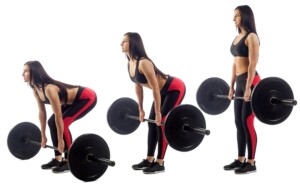
The image below shows how to perform a deadlift. Don’t let the youth of the model deter you.
Shutterstock/Everyonephoto Studio
So very few senior age people do the deadlift, it shouldn’t be surprising that I couldn’t find a photo sequence of an elderly-looking man or woman performing this exercise. I found only stills.
A frail elderly person can do bodyweight-only deadlifts as a start. The progression could be holding a broomstick or holding a 2-pound dumbbell in each hand.
Elderly people desperately need to lift weights, and the deadlift is one of the best strength training routines because it works the entire body at once.
“Resistance exercise is a great way to increase lean muscle tissue and strength capacity so that people can function more readily in daily life,” says Mark Peterson, Ph.D., a research fellow in the University of Michigan Physical Activity and Exercise Intervention Research Laboratory, at the Department of Physical Medicine and Rehabilitation.
This fact applies to elderly people. Peterson adds: “Our analyses of current research show that the most important factor in somebody’s function is their strength capacity.
“No matter what age an individual is, they can experience significant strength improvement with progressive resistance exercise even into the eighth and ninth decades of life.”
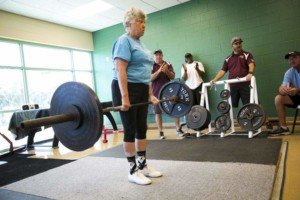
Trudy Daxon is of elderly age and just completed the top movement of the deadlift.
Hear that? If you’re in your 80s or 90s, it is not too late to reap benefits from lifting weights, and the deadlift – even with just your bodyweight – is a form of strength training.
Muscles worked include the front and back of the legs, upper back, middle back, shoulders, arms, and of course, the lower back.
A weak lower back is an impediment in many activities of daily living, as well as physical endeavors that senior citizens like to participate in, such as recreational hiking, wallyball, golf and bowling. A weak lower back will also become an issue during gardening.
Peterson endorses full-body exercises – exercises that engage more than one joint at a time (which means more than one muscle group at a time).
The deadlift is a very multi-joint exercise, tapping into the hip joints, knee joints and shoulder joints.
For elderly people who already go to a gym or health club, they should consult with a personal trainer to learn proper deadlift form.
However, the technique isn’t that far-removed from what people already do around the house; it’s just a modified (and safer) version.
Around the house, bending over to pick something weighted off the floor (such as a box of magazines, a cat, a toddler, a basket of laundry, a bucket of paint, a toolbox) yields a multi-joint motion that is similar to a deadlift. However, often, people use improper form and “throw their back out.”
As an elderly person gets stronger with the deadlift motion, he or she can advance to a 20-pound barbell if their gym has these.
A bare Olympic bar weighs 45 pounds. If that’s too heavy, dumbbells can be used.
But bear in mind that “Deadlifting 101” is not covered in medical school or in any hospital training.
So don’t be surprised if your physician has no idea what a deadlift is.
Ask if it’s okay to do strength training exercises that engage the lower back muscles.
Contraindications to strength training typically apply to intensity rather than to the type of motion.
Lorra Garrick is a former personal trainer certified through the American Council on Exercise. At Bally Total Fitness she trained women and men of all ages for fat loss, muscle building, fitness and improved health.
.
Source: sciencedaily.com/releases/2011/03/110331163539.htm

Five Traits of Kids Who Are Bully Proof

An expert on bullying explains five common characteristics of kids who are bully proof.
Don’t assume that in order for kids to be bully proof, they must act tough or exude a “You’d better not mess with me” persona.
To act tough to gain a bully proof armor is, essentially, over-correcting to prevent being bullied.
Kate Walton, a former public school teacher, has developed very effective anti-bullying strategies for schools, and she speaks to schools and universities on the topic of “The Power of Human Kindness.”
A mother of two, Walton is also the author of young adult novels about the hideous consequences of bullying, “Cracked” and “Empty.”
Walton says that the students she’s worked with throughout the years, whom she’d categorize as bully proof, shared five key traits. They are as follows:
Dignity and respect. Bully proof kids “treated every child around them with dignity and respect, regardless of popularity, race, gender, etc.,” says Walton.
There was no distinction in terms of ethnicity, religion, size, etc. Rather, everyone, in the eyes of bully proof kids, was a human being.
Confidence. Bully proof kids exude what Walton refers to as a quiet confidence.
This doesn’t mean meekness, but a self-assured type of quietness; no need for arrogance or loudness.
Happiness. Bully proof kids are happy and comfortable in their own skin, says Walton.
They are fine with their physical attributes, even if they don’t blend in.
Diffuser. Another trait of bully proof kids is that of not being afraid to stand up to bullies, but doing so in a diplomatic way.
Bully proof kids also “typically diffused the tension without any resulting drama,” says Walton.
At ease with expression. The fifth trait common to bully proof kids is ease at expressing their feelings, whether on paper or conversationally, says Walton.
These five common traits of bully proof kids all add up to confident, well-adjusted, happy, kind and compassionate individuals, says Walton, and these traits can certainly be cultivated at home by parents who set a proper example.
“When parents or caretakers parent in a compassionate, conscientious, and diligent manner, the result is a great kid!”
 A mother of two, Kate Walton is also the author of two young adult novels about bullying, “Empty” and “Cracked.”
 Lorra Garrick has been covering medical, fitness and cybersecurity topics for many years, having written thousands of articles for print magazines and websites, including as a ghostwriter. She’s also a former ACE-certified personal trainer.
.
Top image: ©Lorra Garrick

Strength Training Guide for 300 Pound Women: Safe, Burn Fat
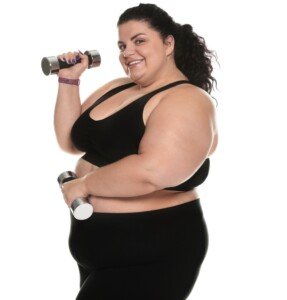
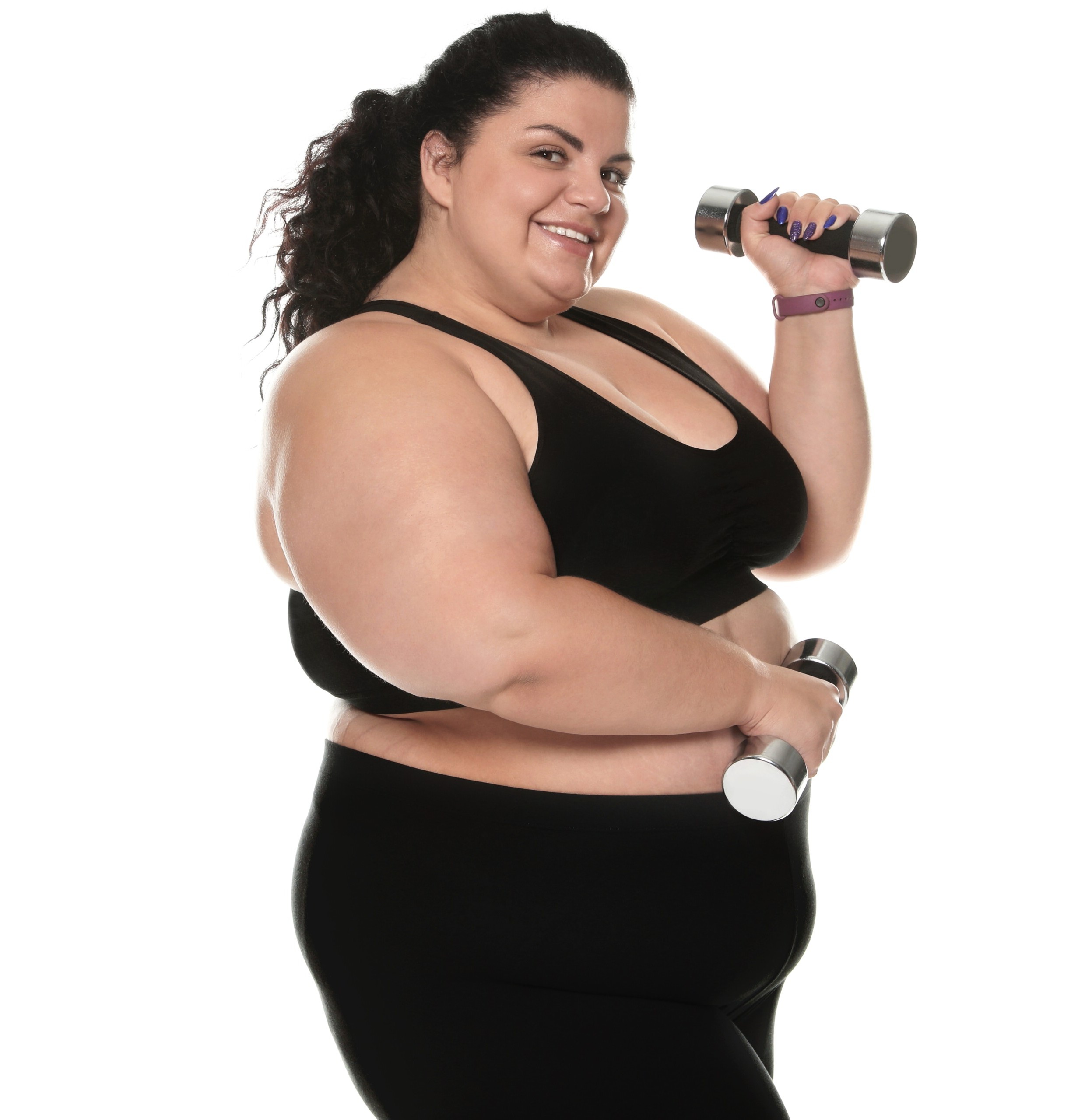
You’re never too heavy, never too fat, to begin strength training with weights.
Do you weigh 300 pounds and want to start lifting weights (strength training), but don’t have the tiniest clue how to begin, how much weight to lift, how many sets and reps, etc.? I’m a certified personal trainer.
Being 300 pounds or morbidly obese is not a contraindication to strength training.
No matter how heavy or “fat” you are, this is not a medical reason to avoid strength training.
In fact, if you weigh 300, even 400 pounds, the way you would strength train would be no different than if you weighed half this much. Lifting weights does not require a thin or light body.
Weigh 300 pounds?
Now is better than ever to begin strength training.
Obesity significantly impacts the ability to move swiftly. Strength training for fitness, fat-burning and better health does not require swift movement.
Being obese also interferes with one’s wind during cardio activities. Strength training is not a cardio activity; the work demand is primarily on the bones and muscles, not the cardiorespiratory system.
Weigh 300 pounds? Don’t wait till you lose pounds to begin strength training.
Strength training burns fat. Waiting around does not. Get started now. That’s the first step. Just get through the doors of the gym, health club or rec center.
“Help! I weigh 300 pounds and wouldn’t know what to do in a gym!”
Not knowing what to do is not (or should not be, anyways) a function of one’s body weight. Imagine you weigh 150 pounds and are setting foot in a gym for the first time.
- Would you feel as helpless?
- If not, why? You’d still be doing the same thing for the very first time: pushing and pulling against resistance.
So pretend you weigh 150 pounds, because weighing 300 or 400 will not make performing most strength training routines more difficult than if you were smaller.
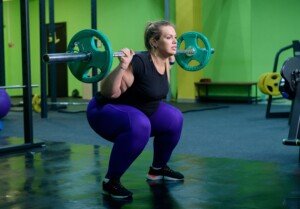
Shutterstock/Reshetnikov_art
Novices, regardless of their size, should start out with light resistance. Do not complicate things or else you’ll be setting yourself up for confusion.
Give yourself permission to take a while to figure out how a machine works.
Sit in the machine and take some deep breaths and relax. There is no deadline.
The machine should have an illustration of how it is used. Many machines are very self-explanatory.
As for how much weight to lift, it won’t hurt to just start out with the lightest possible, to get used to the machine.
Do 15 to 20 repetitions at this light sample weight.
Take your time in between routines for various body parts. Spend 30-60 minutes sampling various machines.
If you weigh 300 pounds, don’t let this stop you from walking into the free weight area and picking up some light dumbbells.
Lie on a bench and press them over your chest.
Or sit against a back support and press dumbbells over your head.
Sample the cable machine for back routines (pulling actions).
Being very heavy will not make it more difficult for you to do most strength training routines.
Stick to the basics to work the major muscles: seated leg press machine, pull-over or pull-down machine, and seated chest press.
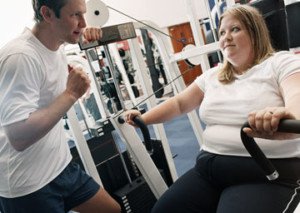
Ask a personal trainer to identify this equipment for you. Also ask about the seated row, shoulder press, leg extension and leg curl machines.
You will continue weighing 300 pounds unless you make some changes. Get into comfortable clothes and head to the gym right now!
Once your body begins acclimating to strength training, make a point of increasing the amount of weight that you’re lifting — gradually over a period of time. This is called progressive resistance.
This is crucial for significant improvement in body composition (ratio of fat to lean muscle tissue) and fitness.
Lorra Garrick is a former personal trainer certified through the American Council on Exercise. At Bally Total Fitness she trained women and men of all ages for fat loss, muscle building, fitness and improved health.
.