

Can Left Side Neglect Be Temporary?

Once a person develops left side neglect, will this usually be permanent or can it be a temporary condition?
Left side neglect is a fascinating neurological problem in which the patient lacks full awareness of his left side or part of the left side, as well as diminished awareness of inanimate objects that are leftward relative to wherever the person is in space at the moment.
My mother had left side neglect as a result of a chronic subdural hematoma on the right region of her brain that had resulted from hitting her head from a fall (in combination with being senior-aged and, most likely, the blood thinner she was on at the time).
Left neglect is more commonly the result of a stroke to the right area of the brain.
In the case of my mother, the problem was temporary.
But it had us unnerved when we realized the extent of it, after she was moved to a skilled nursing facility, a less-controlled, less-restricted environment than a hospital room where she spent just about all her time in bed.
If you clicked on this article, you already know what “left neglect” is, and most likely have been diagnosed with it, or know someone who has.
In the case of a stroke, left side neglect can be permanent, because a stroke is caused by oxygen depletion to brain cells, and once brain cells are starved long enough from oxygen, they cannot be brought back to life.
In my mother’s case, blood and cerebrospinal fluid were on the surface of her brain; the cells were still getting oxygen, but this fluid was creating a veil or fog over the cells, impairing neurological functioning.
As her body resorbed the fluid, the symptoms of the spatial neglect began disappearing.
The spatial neglect, at its worst, affected my mother’s ability to use a walker, maintain a linear walking path, and make turns without bumping the left side of the walker into baseboards.
Her left hand was orthopedically able to hold onto the walker, but it would keep slipping off because she lacked sufficient awareness of that side.
She’d end up trying to use the walker with one hand. But even when both hands were on it, she’d accidentally bump the walker into walls on the left side.
She was off the walker by evening; it was an impediment, actually, yet when she walked down the corridor, she had a tendency to veer to the right, and had no interest in anything to the left.
At the hospital in her room, seating for visitors was to her left, and often, she “ignored” me when I spoke to her when to her left, unless I raised my voice to call her name, and then she’d look at me as though suddenly hearing me.
I’d also get her attention by moving closer and more in front of her, though at the time, I didn’t know that this was the spatial neglect at work.
Currently, there is no sign of left side neglect in my mother, and the physical therapist who visited her home recently for an assessment, said that my mother didn’t need any home visits with a physical therapist, even.
Her left neglect did not disappear overnight, but there was a spike in improvement about 10 days after she was diagnosed with it.
When she came home from the nursing facility, she still had a tendency to drop things occasionally with the hand, but that problem soon disappeared.
At present, you’d never know that my mother once had a bizarre neurological phenomenon known as left neglect, also called spatial neglect.
In hindsight, I realize that left side neglect was at work prior to her second burr hole drain for the hematoma; at home she stated she wanted to lie on the futon in the dining room. From the kitchen this requires a left turn.
She exited the kitchen and began entering the living room, which is right. I had to physically steer her left into the dining room; classic left side neglect, fascinating phenomenon.
Left side neglect can be mild, moderate or severe. If you know someone with this condition, or have it yourself, there is hope, as there are multitudes of therapies to help overcome this condition.
 Lorra Garrick has been covering medical, fitness and cybersecurity topics for many years, having written thousands of articles for print magazines and websites, including as a ghostwriter. She’s also a former ACE-certified personal trainer.
.
Source: ncbi.nlm.nih.gov/pubmed/16408519
Top image: Shutterstock/Blue Planet Studio

Can Exercise Prevent Chronic Subdural Hematoma in Elderly?

Is it possible for exercise to prevent an elderly person from ever getting a chronic subdural hematoma?
“As we get older our brains shrink,” says Dr. David Beatty, MD, a retired general practitioner with 30+ years of experience and an instructor of general medicine for 20+ years.
“This happens to everyone, but happens quicker in some people than others.
“When the brain becomes smaller this leaves more space between the brain and the bones of the skull.
“This leads to stretching of the bridging veins and greater movement of the brain within the skull vault.
“To give an analogy. Think of a poorly packed box in the trunk of your car. The contents will rattle around more and be more likely to get damaged than if they were well-packed.
“Cerebral atrophy is not thought to be a reversible process, so it is crucial to prevent it where possible and to minimize its progression.”
Risk factors for chronic subdural hematoma include brain shrinkage (atrophy), old age, getting bumped in the head and daily use of blood thinners.
But one need not get bumped in the head, or be on blood thinners, to suffer a spontaneous chronic subdural hematoma.
The aging brain has a tendency to shrink, and so does the brain in people who never exercise.
An atrophied brain creates more space between the brain and the skull, which provides more room for a chronic subdural hematoma’s fluid to take up space – and hence create symptoms which require surgery to remedy.
To keep the brain healthy, Dr. Beatty recommends healthy lifestyle choices to reduce the risk of ailments that lead to brain atrophy.
These include avoiding smoking, minimizing alcohol intake, avoiding high blood pressure, and taking measures to prevent or remedy obesity.
“Exercise is another weapon in the fight to prevent cerebral atrophy,” says Dr. Beatty.
“It’s been shown that exercise increases blood circulation to the brain and slows the rate of cerebral atrophy.
“I think exercise may well have another benefit with regard to subdural hematoma prevention.
“Someone who is physically fitter is less likely to have the falls that cause the head injury which causes the subdural.”
Exercise and Brain Shrinkage

It’s been well-established that exercise prevents brain shrinkage in animal studies, and even human studies have demonstrated this.
There is a study that shows that moderate exercise over one year can increase the size of the hippocampus of the brain in older people.
This study, however, didn’t look at chronic subdural hematoma; it looked at spatial memory.
But the fact remains that exercise increased brain size, albeit only a particular portion of the brain.
The hippocampus study was carried out by researchers at the University of Illinois, University of Pittsburgh, Ohio State University and Rice University, and focused on older people who already had hippocampus shrinkage (atrophy).
The hippocampus is responsible for memory.
The study involved 120 inactive older subjects who did not have dementia.
They were placed in two groups: One group walked for exercise (40 minutes daily, 3x/week), and the other group simply did toning and stretching exercises.
Prior to the study, MRIs were taken of the subjects’ brains. MRIs were then taken six months into the study, and at the end of one year.
The group who exercised had a volume increase of the right and left hippocampus.
And get this: In the second group, the hippocampus decreased in volume! I.e., lack of exercise = brain shrinkage.
Another study showed that exercise increases the number of small blood vessels in the brain. (Radiological Society of North America [Dec. 2, 2008]; “Exercise Helps Prevent Age-related Brain Changes In Older Adults”)
If a brain has more small blood vessels, perhaps this can have a protective effect against a slow brain bleed, though there have been no studies specifically investigating this.
The bottom line, though, is that exercise is crucial for optimal brain function and integrity, and these benefits will extend into old age.
 Dr. Beatty has worked in primary medicine, surgery, accident and emergency, OBGYN, pediatrics and chronic disease management. He is the Doctor of Medicine for Strong Home Gym.
 Lorra Garrick is a former personal trainer certified by the American Council on Exercise. At Bally Total Fitness she trained clients of all ages for fat loss, muscle building, fitness and improved health.
Source: sciencedaily.com/releases/2011/01/110131153249.htm
Top image: Freepik

What If a Patient Pulls Burr Hole Brain Drain Tube Out?

After a burr hole craniostomy for chronic subdural hematoma, a “drain” tube is left in the patient’s skull. This was the case of my mother.
She had a chronic subdural hematoma, and the drain tube that was placed in her head, after her second surgery, accidentally came out after she was shifting in her bed while propped up, and – according to her report – sat on the short tube, causing it to get tugged.
She immediately reported this to the staff via her nurse call button. If you clicked on this article, I needn’t explain to you what the burr hole drain looks like as it feeds into the patient’s head.
In the case of my mother, all that was there were small bandages, but the tube, as it entered the shaved portion of her head, was visible.
Will blood and cerebrospinal fluid spurt all over the place if the tube is pulled out (or comes out by accident, at least)? Not in the case of my mother.
I wouldn’t think any spurting would occur unless the burr hole tube came out the same day of the surgery.
In the case of my mother, it was tugged out on Friday; she had had the surgery two days prior on Wednesday. So by then, there wasn’t heavy draining.
I saw spots of a mixture of blood and cerebrospinal fluid here and there on the bed sheets, but nothing messy or alarming.
The burr hole is already draining in these cases, so if the tube comes out prematurely, of course the draining is going to continue.
But instead of the fluid draining into the tube, it will be “leaking” onto the scalp and will need someplace to go.
In this case, the fluid went onto the gauze that the nurse was sturdily applying to my mother’s scalp … after she paged the neurosurgeon for instructions.
Do not try to place the tube back in the burr hole! When the tube comes out, it immediately becomes contaminated! Instead, call the nurse if the patient already didn’t. Do not touch the hole.
When the nurse was applying compression, it was painful. Don’t panic if the nurse says that “brain juice” is coming out.
“Juice” means cerebrospinal fluid, possibly mixed with blood – which you already know is the objective of the draining in the first place when someone has chronic subdural hematoma.
You actually want this “juice” to continue to come out, because its collection in the brain is why the patient ended up having surgery in the first place.
As I watched the nurse maintain her compression on the burr hole, I asked how they were going to control the leaking.
She mentioned something about applying Vaseline which would create a barrier. Do we really want that, I asked, because the whole idea is to get the fluid out of the brain, not trap it in there with a barrier.
The nurse acknowledged my point, and then the neurosurgeon got back to her.
The final verdict was to wrap my mother’s head several times with a special wrapping, then have her lie on her side (the burr hole side against the pillow) as much as possible, so that gravity would allow continued draining.
A collection sheet was placed between her head and the pillow in case any fluid seeped through.
Why weren’t plans made to put in a new drain? This would require a sterile environment, i.e., another surgery in the OR, and also, the surgeon wasn’t available.
When my mother’s burr hole drain came out, it wasn’t an emergency situation. Again, the fluid is supposed to drain out anyways.
Next morning the bandages were removed and I was told that there had been minimal leaking, and the bandages remained off. Sutures were put in place.
Lorra Garrick has been covering medical, fitness and cybersecurity topics for many years, having written thousands of articles for print magazines and websites, including as a ghostwriter. She’s also a former ACE-certified personal trainer.
.
Top image: Shutterstock/Natalie Board

Antidepressant Losing Steam and Pooping Out? Solution

An antidepressant may work wonders initially but then may lose its punch and can’t keep up with the depression.
You may be on an antidepressant that’s been working wonderfully…
But then soon after you go on the prescription drug, it begins losing its full effect. It has pooped out: the “poop-out effect.”
The antidepressant that my mother was on for clinical depression seemed to start pooping out less than two weeks after starting it.
The drug was Cymbalta and the prescription called for 30 mg the first week, then 60 mg the second week.
Oddly, the doctor prescribed only 30 capsules with no refill authorization.
I consulted with my brother, who had been working in the pharmaceutical industry as a chemist for many years.
When an antidepressant poops out, this means it has lost its fire or power when it comes to subduing depression symptoms.
This doesn’t mean it’s lost all of its effect, but enough to cause concern in the patient and/or family members. The regression in my mother was noticeable.
With my mother, the poop-out effect took place on day 13 and day 14 of being on Cymbalta.
I assumed that she’d have to go up to 90 mg so that the drug could resume its full effectiveness.
I also wondered if her doctor would switch to a different drug, or, keep her on Cymbalta but add a second drug.
In the case of my mother, it turned out that the antidepressant hadn’t pooped out at all.
On day 15 she did great, and the next day we were in the doctor’s office.
The doctor explained that it takes a while for antidepressant drugs to take full effect.
Some days will be better than others, but as long as the overall picture looks good, then the drug is working.
On day 12, in the evening, my mother received some alarming news about a family member — a divorce, and I surmise that the shock had not sunk in that evening — until she went to bed.
Next morning she reported she hardly slept, having been kept awake thinking about the family member.
The second half of next day, my mother had what appeared to be the beginnings of a relapse into the depression. This repeated next day, and was worse.
But the day after, she was hopping. And I figured that the relapse had to have been related to news of the divorce.
Though my mother had setbacks, the drug was still working because without the antidepressant, she would have been debilitated, weeping and hardly eating.
Lorra Garrick has been covering medical, fitness and cybersecurity topics for many years, having written thousands of articles for print magazines and websites, including as a ghostwriter. She’s also a former ACE-certified personal trainer.
.
Top image: ©Lorra Garrick

Atrial Fibrillation, Elevated Troponin: How Much Heart Damage?

Can enough atrial fibrillation episodes, over time in someone with heart disease, cause cardiac damage that’s equal to a heart attack?
“Generally, A-fib does not result in significant heart damage,” says Dr. Simon Dixon, chairman of cardiovascular medicine for Beaumont Health System in Michigan.
You may already know that the higher the troponin level, the more damage that’s been done to the heart. The higher the troponin elevation, the worse the long-term prognosis is.
Over a certain level means a heart attack. Under that cut-off point, the result is deemed “indeterminate” or a “grey area.”
I wondered if a lot of “indeterminate” elevations of troponin, from atrial fibrillation in a patient with heart disease, would, over time, “equal” a heart attack.
So for example, suppose the elevations range from 0.11 to 0.30 – many of these over an extended period of time from episodes of A-fib that occur between sporadically and frequently.
Wouldn’t eventually all of these fractions “add up” to a heart attack?
Dr. Dixon explains, “Some patients have chronic low levels of troponin elevation (for example, 0.14 ng/mL).
“This can be ‘normal’ in some patients, or associated with disorders such as heart failure and kidney failure.
“This level of troponin elevation does not necessarily cause the same level of damage as a heart attack.”

Dr. Dixon specializes in the treatment of acute and chronic coronary artery disease, with research focusing on pioneering treatments to save heart muscle in patients having heart attacks.
Lorra Garrick has been covering medical, fitness and cybersecurity topics for many years, having written thousands of articles for print magazines and websites, including as a ghostwriter. She’s also a former ACE-certified personal trainer.
.
Top image: Shutterstock/megaflopp
Why Can A-Fib with Heart Disease Cause Troponin Elevation?

There’s a specific reason why an episode of atrial fibrillation can elevate troponin levels if you already have heart disease.
Troponin is a protein enzyme that leaks from heart muscle when that muscle sustains damage, such as from a heart attack or blunt chest trauma.
But an episode of atrial fibrillation — an abnormal heart rhythm – -can also cause a leak of troponin, which of course, means that some damage to the cardiac tissue has occurred—but not nearly as much as would occur from a heart attack.
In a person whose only condition is A-fib, an episode of this cardiac arrhythmia won’t cause a rise in troponin.
But if someone has severe coronary artery disease, it can. In severe coronary artery disease (or “heart disease”), the arteries that supply blood to the heart are at least 70 percent blocked with plaque.
This leaves a small diameter through which blood gets through, and can cause symptoms, usually shortness of breath with only mild exertion, and/or chest pain.
Atrial Fibrillation + Heart Disease = Rise in Troponin
“Patients with coronary artery disease are more likely to have a troponin elevation because the blockage in the artery limits the ability of the heart to increase blood flow to the muscle during the AF episode,” says Dr. Simon Dixon, chairman of cardiovascular medicine for Beaumont Health System in Michigan.
When a patient’s troponin test result is elevated, another one should be taken several hours later to see if the numerical result is higher.
The test may be repeated a few more times to see when the number stops rising and starts coming down.
If the patient has not exhibited any sign of a heart attack, such as chest pain or pressure, clammy skin, nausea, jaw or arm pain, or shortness of breath, but they have atrial fibrillation, then the reason for the elevated troponin will not likely be that of a heart attack.
Dr. Dixon specializes in the treatment of acute and chronic coronary artery disease, with research focusing on pioneering treatments to save heart muscle in patients having heart attacks.
Lorra Garrick has been covering medical, fitness and cybersecurity topics for many years, having written thousands of articles for print magazines and websites, including as a ghostwriter. She’s also a former ACE-certified personal trainer.
.
Top image: Shutterstock/designer491
Does Every Episode of Atrial Fibrillation Damage the Heart?
In someone with coronary artery disease, does every episode of atrial fibrillation mean damage to the heart?
Damage to cardiac tissue can result from an episode of atrial fibrillation in a person with coronary artery disease.
Not all people with CAD experience A-fib, and not all people who have periods of atrial fibrillation have coronary heart disease.
Arial fibrillation is a rhythm disorder that increases the risk of blood clots that can lead to a heart attack or stroke.
In fact, A-fib is a major risk factor for a massive stroke, which could be fatal.
This arrhythmia is characterized by a sudden increase in heart rate — but it’s not a steady rate. It jumps all over the place.
This erratic beat can be felt in the pulse with fingers to the wrist.
The numbers on a heart rate screen will be jumping all over the place.
Atrial fibrillation and coronary artery disease can exist in the same patient, and there are times when an event of atrial fibrillation results in a mild elevation of troponin, the protein enzyme that leaks from the heart muscle—indicating that damage was sustained.
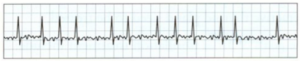
An EKG showing A-fib
Does every incidence of A-fib in someone with coronary artery disease necessarily damage the heart?
“Most episodes of AF do not cause the troponin to be elevated,” says Dr. Simon Dixon, chairman of cardiovascular medicine for Beaumont Health System in Michigan.
“This depends a lot on the heart rate during episodes as well as other factors such as blood count and the extent of coronary disease.”
Thus, if someone with heart disease has several A-fib episodes per week, this does not necessarily mean that the patient’s heart gets damaged (as revealed by elevated troponin) every time.
“Atrial fibrillation can occur in episodes (paroxysms) or be present all the time (permanent),” says Dr. Dixon.
“Most patients with AF do not sustain muscle damage unless the heart rate becomes quite uncontrolled, or there are other medical factors such as fever, low blood oxygen level or low blood count.”
Dr. Dixon specializes in the treatment of acute and chronic coronary artery disease, with research focusing on pioneering treatments to save heart muscle in patients having heart attacks.
Lorra Garrick has been covering medical, fitness and cybersecurity topics for many years, having written thousands of articles for print magazines and websites, including as a ghostwriter. She’s also a former ACE-certified personal trainer.
.
Top image: Shutterstock/TippaPatt
What’s the Elevated Troponin Range from A-Fib Episodes?
An episode of atrial fibrillation can elevate troponin, but what would be the typical range of this elevation?
Atrial fibrillation (A-fib) is a serious heart rhythm disorder that can have significant consequences if left untreated.
While some patients may not experience symptoms, A-fib poses a major risk due to the potential for blood pooling in the heart.
This stagnation increases the risk of ischemic stroke, particularly in individuals over 65 and those with additional stroke risk factors, such as a family history or smoking.
Additionally, A-fib can lead to elevated levels of troponin, an enzyme released by the heart when the cardiac muscle is damaged.
Elevated troponin levels indicate that the heart is under stress or experiencing damage, further complicating the management of A-fib and its associated risks.
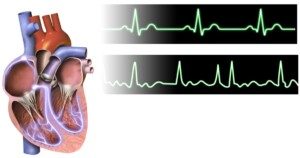
Atrial fibrillation. BruceBlaus
“Some patients with atrial fibrillation develop a fast heart rate (rapid ventricular rate) in the setting of infection, bleeding or other medical conditions,” says Dr. Simon Dixon, chairman of cardiovascular medicine for Beaumont Health System in Michigan.
One such medical condition is coronary artery disease: buildup of fatty deposits inside the arteries.
These arteries supply blood to the heart muscle, and when plaques accumulate, they narrow and harden the arteries, reducing blood flow.
When an episode of A-fib occurs, says Dr. Dixon, “the heart muscle needs greater blood supply to provide oxygen and glucose [blood sugar].
“At times, however, the ‘demand’ outstrips the ‘supply,’ resulting in damage to the muscle (especially on the inside wall of the heart, or subendocardial layer).
“Generally the troponin elevation in these cases is small, for example, 0.1-2.0 ng/mL (the upper limit for the normal range of troponin in our hospital is 0.06 ng/mL).”
This troponin range is called “indeterminate,” because it can have numerous causes other than an episode of atrial fibrillation, but this range isn’t high enough to arouse the suspicion for a heart attack.
Troponin elevation of unknown origin is far more common in elderly people, but should always be followed up.
Age of Patient with Elevated Troponin
The younger a person is, the more significant an elevated result is.
In the younger adult population, elevated troponin levels are less likely to be attributed to age-related conditions and more likely to indicate acute or significant cardiac issues, such as a heart attack or severe heart inflammation.
In contrast, older adults may have elevated troponin levels due to chronic conditions or age-related changes in heart function that are less immediately alarming.
Therefore, in younger adults, an elevated troponin level typically means a more urgent investigation to find out what the cause is.
Dr. Dixon specializes in the treatment of acute and chronic coronary artery disease, with his research focusing on pioneering treatments to save heart muscle in patients who are having heart attacks.
Lorra Garrick has been covering medical, fitness and cyber security topics for many years, having written thousands of articles for print magazines and websites, and this includes as a ghostwriter. She is also a former ACE certified personal trainer.
.
Top image: Shutterstock/ designer491
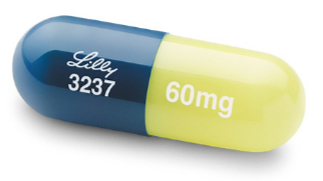
How to Get Relief from Fibromyalgia with Cymbalta
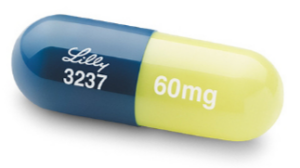
How does Cymbalta help relieve fibromyalgia pain?
You can get fibromyalgia relief with Cymbalta, a drug commonly prescribed for depression and also prescribed for panic attacks and anxiety.
You’ve probably seen the Cymbalta commercials, which begin with, “Where does depression hurt? Everywhere.”
Another of Cymbalta’s on-label uses is for the nerve pain of diabetes neuropathy.
There are a few ways in which Cymbalta relieves the pain of fibromyalgia, which is a pain disorder of the entire body.
Now, from an anecdotal standpoint, Cymbalta can bring on fibromyalgia relief by perhaps suppressing the patient’s perception of physical discomfort (which clinical depression will amplify).
This happened with my mother, but she didn’t have fibromyalgia; she had severe depression.
Coinciding with the depression were a few orthopedic issues, and while in a depressed state of mind, my mother complained that the orthopedic pain was excruciating.
Orthopedic discomfort indeed can be excruciating, but …. carpal tunnel syndrome?
Post-surgical discomfort from knee arthroscopy? (After my mother began taking Cymbalta, suddenly, the pain was no longer excruciating; it was merely inconvenient!)
Asking the Expert
How was it that an antidepressant like Cymbalta would end up with an on-label use for fibromyalgia relief?
“Pain management specialists prescribe Cymbalta for two reasons,” says Joe Wegmann, psychopharmacologist and licensed clinical social worker, author of Psychopharmacology: Straight Talk on Mental Health Medications.
“First, they are aware that that anyone with a chronic illness, especially a debilitating one like fibromyalgia, is at risk for depression.
“So physicians take this into account when treating fibromyalgia even if depression/anxiety is not present when treatment begins.
“Prolonged pain in anyone can cause changes in brain chemistry that can lead to depression.
“So physicians prescribe Cymbalta to cover for the depression that so often, at some point, develops in those with fibromyalgia.
“So brain chemistry does change as a result of this often debilitating physical illness.
“It’s impossible to separate the physical from the emotional; this is why depression rates are high in these patients.”
But even if a person with this disorder does not have depression, this SNRI antidepressant has been known to provide relief from the symptoms of discomfort associated with this condition.
Wegmann continues: “Another reason Cymbalta is prescribed for fibromyalgia is due to its powerful serotonin effects. Serotonin is a powerful vasoconstrictor, and since pain is linked to vascular vasodilation, Cymbalta’s constrictive effects help moderate pain.”
If your fibromyalgia is not responding to holistic treatments, and the pain is impossible to live with, your doctor may end up prescribing Cymbalta for pain relief.
 Joseph Wegmann is a licensed clinical pharmacist and clinical social worker with more than 30 years of experience in the field of psychopharmacology.
Lorra Garrick has been covering medical, fitness and cybersecurity topics for many years, having written thousands of articles for print magazines and websites, including as a ghostwriter. She’s also a former ACE-certified personal trainer.








How to Get a Very Depressed Person Who Refuses to Eat to Eat

It’s really scary when severe depression prevents a person from wanting to eat; right before your eyes you see your loved-one wasting away from malnourishment.
Clinical depression can destroy appetite and cause a life-threatening issue of malnourishment, especially if the clinically depressed individual is elderly.
Not too long ago my mother developed a bout of clinical depression that is now under control with Cymbalta.
When my mother’s depression first began developing (it was a gradual process, not an overnight event), she commented that she “had no appetite.”
I didn’t take this seriously until I began noticing about two weeks later a visible loss of muscle.
My mother is of senior age, and it is dangerous for seniors, especially women, to lose muscle tissue.
It reached a point where I, and my father, had to prompt her to eat nearly every bite of food, and most of these prompts netted a refusal.
So how did I get my depressed mother to eat?
#1: Buy Walgreen’s “Balanced Nutritional Drink Plus.” Amazingly, I managed to get my mother to drink 1-2 cans a day. One can is 350 calories. Substitutes would be Ensure Plus or Boost Plus.

If you can get your depressed family member to consume two of these 8 ounce cans, that’s a good foundation of 700 calories for the day.
#2: When giving your depressed family member a beverage, include a straw. A straw guarantees more of the liquid will get consumed.
#3: Do not ask your depressed family member if they want something to eat or drink.
My father would ask this to my mother, and every single time, she’d say “No.” He’d then give up. BIG MISTAKE.
I decided to take the bull by the horns and instead of asking if my mother wanted to eat, I’d just bring the food to her mouth.
I strongly suggest that you don’t even TELL your depressed family member you’re going to give him or her some food or drink, because this will give them an opportunity to refuse.
Don’t inform them at all of your plan. JUST DO IT: Bring them the food.
When the food is in front of them, they are likely to take a bite or sip.
My mother has always enjoyed eggs. My father would ask her if she wanted eggs. She’d say no. He’d give up.
I insisted, “Don’t ask. Just make her the eggs. She’ll eat some once they’re cooked and in front of her.”
My father at first didn’t go along with this, but he eventually learned that it was true:
Once the eggs were actually prepared and placed before my mother, she’d eat some.
#4: Don’t be passive. Be kindly aggressive. Again, my father (along with my brother) one evening were enjoying salmon while my mother refused any food at all and sat withered in another room.
I gathered some salmon scraps and not only took a plate to her, but literally fork-fed her.
She consumed six forkfuls (about 15 grams of protein) that she would have never eaten had I not taken an assertive stand.
DO NOT BE AFRAID TO GET ASSERTIVE with your depressed family member who refuses to eat. It really works.
There were many instances in which I just verbally nagged my mother until she agreed to eat something, if for no other reason to get me off her back. Every bite counts. Every sip counts.
#5: When presenting your depressed family member with unexpected food (review #3), don’t just set it before them and walk away. Spoon feed them if that’s what it takes.
I spoon fed my mother pudding, chicken, and placed pretzels between her lips. I also placed cups to her mouth.
- Do not hesitate to make statements like, “If you don’t eat this, you may have to be tube-fed at a hospital.”
- I also told my mother, “I’m going to hover right over you until you drink this juice.”
These tactics worked, though often, my mother refused to finish the item. But hey, half a cup of juice is better than nothing.
Don’t assume that a depressed person who refuses to eat, absolutely will never eat while in bed.
I’d bring my mother quite a few nutrition cans with a bent straw, and while propped up, she drank the beverage.
She also ate eggs in bed while propped up; she didn’t ask for the eggs; I brought them to her and told her she was going to eat them.
#6: Don’t get concerned about nutrition; the issue is to just get calories into the depressed family member’s mouth, even if it’s junk food.
I was actually encouraging my mother to eat bacon and sausage — these have calories and protein.
BIG MISTAKE: Pointing out to a depressed family member who’s lost their appetite that something they’re suddenly interested in eating is not healthy.
#7: Do not make any comments within earshot of the depressed family member that might discourage eating.
Example: My father poured a can of soup into a pot. I removed another can from the cupboard: one for my mother, one for him.
He told me no, he was going to eat half the soup in the pot, while my mother would get the other half.
He said, “There is too much soup here for your mother to eat; I have to take half of it.”
This possibly gave my mother, in her depressed, vulnerable state of mind, the idea that she could eat only half the can.
She ended up eating half of what was in the pot because my father divided it into two bowls.
Had my father poured two cans in the pot, and then divided THAT into two bowls, my mother would have ultimately eaten more, even if she didn’t finish the bowl: 100 percent of half a can is LESS than 75 percent of one whole can.
#8: Sneak calories into the food. If I poured half a can of the Walgreens product into a paper cup, I’d then give her the remaining portion straight from the can and tell her it was “half full,” when in actuality, I had added a little milk to it.
#9: When your depressed family member, after eating at your insistence, says for the first time, “I’ve had enough,” or, “No more,” etc., this means they can actually take two or three more bites.
This was very predictable — but you’re the only one who has to know. Spoon/fork-feed those two or three more bites.
Thus, do not stop feeding your depressed family member after their first “Enough.”
The above tactics enabled me to get my mother to consume about 1,300 calories a day.
In order to get a depressed person, who refuses to eat, to consume this many calories, it’s essential to include, daily, two cans of the “Plus” Walgreens, Ensure or Boost products.
Secretly add a tablespoon of olive oil or chocolate syrup for even more calories.