Do Blacks with Freckles Have Higher Melanoma Risk?
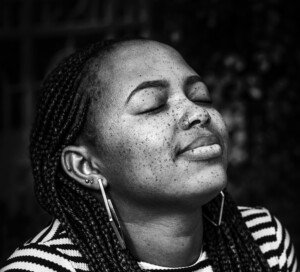
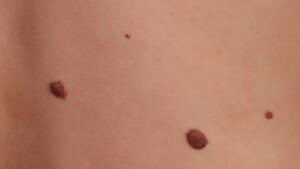
Do freckles raise the risk of melanoma in a black person?
Maybe you already know that melanoma risk in blacks, overall, is far lower than in whites or Hispanics, and perhaps you already know that having freckles is one of many increased risk factors for melanoma.
But what about black people who have freckles? After all, people with freckles are overwhelmingly of the Caucasian race.
Blacks do get freckles, and being black does not insure against developing melanoma.
The question is: Do freckles in blacks raise their risk of melanoma?
“Yes. Overall assessment of one developing a melanoma does not depend on a single factor,” says Joshua L. Fox, MD, founder and director of Advanced Dermatology, P.C., of New York and New Jersey.
“It depends on various factors such as skin type, personal or family history of melanoma, life-time accumulative UV exposure, etc.
“Thus, we can attribute one’s risk based on one or two physical differences. I have diagnosed melanoma in blacks.
“Their high risk areas (different than that for Caucasian) are palms, soles, mouth and under the nails.”
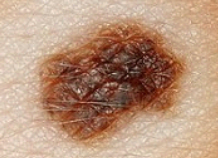
People with dark skin are 20 times less likely to get melanoma than Caucasians (who have no family history of this disease), but this doesn’t mean they can’t develop it.
However, blacks are more likely than whites to develop a certain kind of melanoma, called acral lentiginous (ALM).
ALM accounts for half of the melanomas that occur in dark skin.
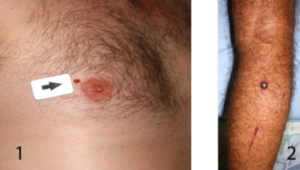
What’s even more troublesome about ALM is that it develops in locations that you wouldn’t think are at risk for skin cancer: soles of the feet; palms of the hands; beneath fingernails; and even on mucous membranes that line the nose, mouth and anus.
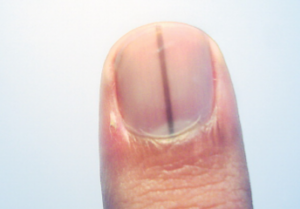
ALM may appear as a bruise, or a streak in the nail. Benign nail streaks are common, but the hallmark feature of an ALM nail streak is that it originates at the base of the nail bed, whereas a benign nail streak usually sits in the middle of the nail bed.
However, this doesn’t mean that a nail streak that connects to the base of the nail bed is necessarily a melanoma.
These indefinites are why all people, including blacks and even dark skinned blacks, should examine their skin monthly and have annual screenings for melanoma by a dermatologist.
Since blacks with freckles do have that increased risk of melanoma, is this heightened risk just in the freckled areas of their body (most prominently the face), or does this higher risk of melanoma apply to any part of their body?
Dr. Fox explains: “Once a person is at higher risk, the risk is not only in the area of freckling, but in all body areas, particularly in areas of high risk for African Americans.
“These are the palms, soles, nails, mouth and other mucous membranes.”

In 1987 Dr. Fox founded the AAD Melanoma and Skin Cancer Prevention Program in Queens, NY. He has been chief of dermatology of several major teaching hospitals including Mt. Sinai Hospital of Queens.
 Lorra Garrick has been covering medical, fitness and cybersecurity topics for many years, having written thousands of articles for print magazines and websites, including as a ghostwriter. She’s also a former ACE-certified personal trainer.
Source: skincarephysicians.com/skincancernet/who_is_most.html

Why Can GERD Cause a Stomach “Hiccup”?

Have you been experiencing something like an occasional hiccup, that your doctor has said is the result of acid reflux or GERD (gastroesophageal reflux disease)?
This isn’t in reference to what we all know are “the hiccups.” When it comes to GERD, this hiccup-like sensation is different, kind of like a spasm in the stomach.
Acid reflux can cause a wide assortment of symptoms — not just the widely publicized heartburn.
Hiccups and GERD
“Hiccups can be associated with GERD,” says Dr. Maxwell Chait, MD, gastroenterologist at ColumbiaDoctors Medical Group in Westchester County, NY.
Other Causes of Hiccups
“It can be due to irritation of the diaphragm or the vagus nerve because of severe reflux, ulcer of the esophagus or even a tumor invading these structures.”
An esophageal ulcer can be caused by acid reflux. A tumor can grow out of esophageal cells, or be a metastasis from another site in the body.
Dr. Chait adds, “Also, severe distention of the stomach pushing up on the diaphragm can cause this, such as in gastroparesis, which is a motility disorder that can be seen in such diseases as diabetes.”
Stopping the Hiccups
If you suddenly have a hiccup — see what happens when you hold your breath. A benign hiccup just might go away.
If you experience a lot of hiccup-type activity or stomach spasms, see your doctor about the possibility of acid reflux.
In the meantime, make sure that you are trying to avoid foods that you know trigger acid reflux or stomach hiccups.
Take note of any foods that seem to be correlated with heartburn, hiccups or other GERD symptoms such as a burning feeling in the throat, an unpleasant taste in the back of the throat and a liquid regurgitation of just-eaten food.
If you’re a fast eater and/or tend to gulp your beverages, slow down. Also cut back on late night eating.
These tactics will help reduce GERD symptoms including stomach hiccups.

Dr. Chait’s practice interests include digestive conditions such as colon cancer, gastrointestinal endoscopy and internal medicine. He has authored numerous publications in reputed journals.
 Lorra Garrick has been covering medical, fitness and cybersecurity topics for many years, having written thousands of articles for print magazines and websites, including as a ghostwriter. She’s also a former ACE-certified personal trainer.
.
Top image: Shutterstock/nhungboon
How Much Weight Gain Raises LDL Bad Cholesterol?
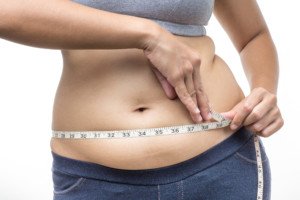
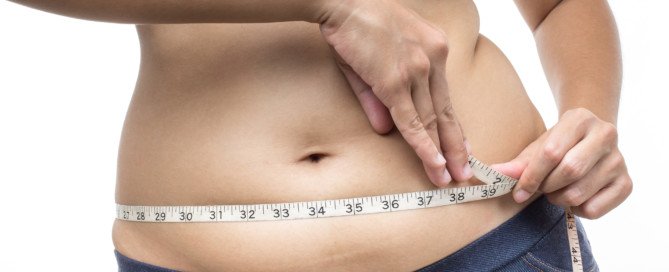
Even a small weight gain in fat can raise your “bad” cholesterol (LDL), and I’m talking a very small weight gain.
“Interestingly, a 10 percent weight loss has been shown to significantly decrease a broad variety of health risk parameters,” says Richard Kelley, MD, a practicing physician in Texas for 20+ years, and author of “The Fitness Response,” “The Three-Hour Appetite” and the ebook, “The Fitness Response ‘Diet’ for Women.”
Dr. Kelley continues, “For example, a woman who is 5 ft. 2 inches tall and weighs 170 pounds, would be at a much healthier weight, at 120 pounds, by body mass index.
“However, it is evident through research and clinical experience, that if this woman even lost 17 pounds (10%) off of her starting weight, a variety of physical parameters tend to improve.
“With a 10 % weight loss, we often see blood pressure improve, blood glucose levels decrease, asthma may improve, as well as decreases in cholesterol levels, including LDL level.”
When I was a personal trainer I had a new client who wanted to lose 15 pounds.
She had gained about 13 or 14 pounds of pure fat from junk food bingeing that resulted from stress. The year prior her LDL or bad cholesterol was in the 80s.
Shortly before seeing me, she had a lipid test and this time the LDL bad cholesterol was in the 130s.
She was floored because she had started eating healthier and less just a few months prior, and had even begun losing a little weight.
I said that the LDL increase was from the 14-pound weight gain, and that had she taken the test eight weeks prior, the bad cholesterol probably would have been even higher.
Dr. Kelley explains, in reference to the 5-2 woman, “Conversely, this same woman might see elevation of her LDL and total cholesterol even with a 5 to 10 pound weight gain, over a fairly short period of time.”
Dr. Kelley stresses that genetics influence LDL response to weight gain and food.
“I have seen many individuals who were well over 100 pounds overweight who had completely normal range LDL and cholesterol panels.
“By the same token, most physicians have seen patients who are rail-thin who have total cholesterol and LDL levels which were off the charts.”
Dr. Kelley adds that he’s been surprised at how much of an improvement some patients experience with their lipid/cholesterol panels with just a 5-10 pound weight loss.
He also explains, “I don’t know that there is any data that shows a direct and specific, linear correlation of increases in cholesterol with specific number of pounds of weight gained.
“Meaning, it is unlikely you will see that a 10 pound weight gain in a susceptible individual, necessarily means that there will be a corresponding, linear increase in cholesterol levels by a particular factor of X.”
Dr. Kelley states that it’s common for doctors to observe increases in total cholesterol including LDL that cannot be attributed to just an increase in a patient’s weight.
 Richard Kelley, MD, is an author, speaker, fitness expert and transformation coach.
Lorra Garrick has been covering medical, fitness and cybersecurity topics for many years, having written thousands of articles for print magazines and websites, including as a ghostwriter. She’s also a former ACE-certified personal trainer.
.
Top image: Shutterstock/Phonlamai Photo

Dumbbell Curls vs. Barbell Curls: Pros and Cons
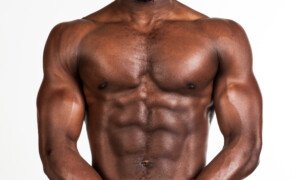
Dumbbell curls vs. barbell curls: Which is better, and what are the pros and cons?
Many of the great bodybuilding champs swear by barbell curls, yet many other bodybuilding legends swear by dumbbell curls.
But let’s look at it this way: Which routine – dumbbell curls or barbell – will better prepare you to have the strength to scoop your arms under a family member who just fainted and pick him or her up?
Of course, deadlift and squat workouts should be included in any strength training program, but in addition, isolated biceps work is important.
Dumbbells, as opposed to barbell work for the biceps, will better prepare you because they allow subtle shifts in hand/wrist and even forearm position while lifting — and this is what would occur if you were lifting a person.
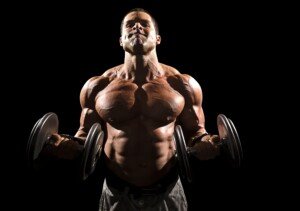
Shutterstock/Mark McElroy
Of course, you need more than strong biceps to scoop something heavy off the floor.
You also need stability and strength in your lower back, plus legs (“Lift with your legs”).
Barbell Curls vs. Dumbbell Curls
Both routines have their virtues, and you should not replace one with the other, even though it’s okay to stick to just one mode for a while when you get tired of the other.
- With dumbbells, you have greater range of motion, since you can bring your arms back further.
- A barbell will get in the way as it makes contact with your front, thus limiting range of motion. Many people don’t like this.
- With dumbbells, you can include wrist movements during the routine. A barbell, which fixes the wrists in place, prevents this.
Dumbbell biceps routines more closely mimic real-life lifting, because in real-life lifting, your wrists are rarely in a fixed position, but rather, in a variable position, sometimes continuously shifting angles.
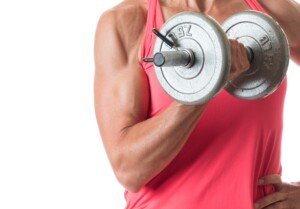
Shuttersock/Nicholas Piccillo
A barbell also has limitations if all you have is a standard straight bar, because the straight bar has a tendency to strain the wrists for some people during biceps routines.
You can counteract this strain by using dumbbells and rotating your palms inward a bit.
In addition to a standard straight bar is the “E-Z” bar, which is very popular for biceps routines, because the bent nature of the middle portions of the bar allow you to use it with inward palms, eliminating wrist strain.

Shutterstocfk/BLACKDAY
But if you don’t have access to an E-Z bar, you’re stuck with the straight bar.
The preacher curl apparatus can be used for E-Z or straight bar work, and many find this equipment to be very stabilizing to the elbows, as well as very effective at isolating the biceps group.
Dumbbells allow you to do hammer curls, and are also far more convenient to use while in a seated position, expecially angled back.

Everkinetic.com

However, there’s nothing like doing biceps routines with a loaded Olympic bar.
The length of this bar adds a new dimension to the resistance, and many women struggle with an unloaded bar because it’s long and weighs 45 pounds.
Imagine curling one of these with a 25 pound plate on each end.
No science proves dumbbells superior to a bar, nor vice versa. What it ultimately may come down to is what feels better to the athlete. In short, it may all come down to “Do what’s best for YOU.”
Lorra Garrick is a former personal trainer certified by the American Council on Exercise. At Bally Total Fitness she trained clients of all ages for fat loss, muscle building, fitness and improved health.
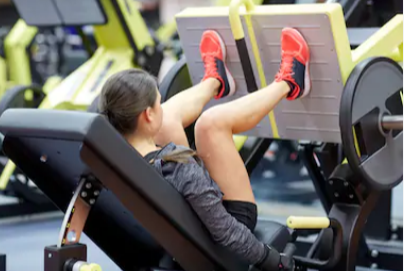
Floor Leg Press Machine: Mistakes to Avoid; How to Do
The floor or 45 degree leg press is one of the best weightlifting routines you can do for shaping and strengthening legs, as well as burning up fat.
Depending on how you use the 45 degree leg press machine, you can build significant muscle mass, if that is your goal.
As simple as use of the floor leg press equipment sounds, there are some mistakes that often get made.
The “horizontal” leg press machine is similar to the floor version, but this article will focus on the floor leg press because it’s more effective than the horizontal version.
However, most of the mistakes that I often see people commit on the 45 degree leg press are the same that I see done with the horizontal.
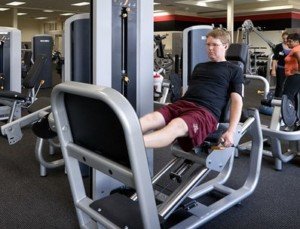
The following are mistakes on the floor leg press:
#1: Locking out the knees at the end of the push-out of the platform. I’ve even seen legs actually hyperextended.
Oddly, it’s always a woman who hyperextends the legs (knee lockout) with the 45 degree leg press.
Locking out the knees can lead to cartilage damage. Plus, it’s a cheat move in that it momentarily takes tension off the thighs and butt, which is what you want to target with the leg press. Continuous muscle tension will produce far better results.
#2: Pushing off with the balls of your feet; lifting your heels from the platform. This makes it easier to push, but it takes some work away from your thighs and butt, and transfers it to your calves.
Do you want to shape and tone your butt/thighs, or your calves? If you want to work the calves, there are calf-raise machines.
If you want to work the thighs and butt, keep your feet flat on the leg press platform.
#3: Allowing your butt to lift off the seat as you lower the weight towards you. It’s hard to avoid doing this if you want to go down deeply.
But be more aware of it; this can strain the lower back. Do lower back stretching exercises to improve this area’s flexibility.
#4: Never doing deep lowering. If the resistance is heavy enough, you can’t lower the weight deeply with the floor leg press. A very heavy routine permits only a 90 degree leg bend.
However, you should also work the entire range of motion, a deep release of the weight.
This will recruit different muscles, and in a different way, than from a 90 degree release. You’ll need to use lighter weights, of course.
Don’t go overboard with deep releases if your body is not used to them, or you might get a muscle pull.
Use very light weights to start, to gradually introduce the muscles/tendons to this move.
Don’t make these mistakes with the floor leg press, and you’ll get results much faster as well as reduce risk of injury.
 Lorra Garrick is a former personal trainer certified through the American Council on Exercise. At Bally Total Fitness she trained women and men of all ages for fat loss, muscle building, fitness and improved health.
.
Top image: Shutterstock/Syda Productions

Signs Your Sweet Child Is Bullying a Younger Brother or Sister

Your “angel” of a child may actually be a demon who’s bullying his or her younger sibling, but crafty enough to keep this hidden from you, unless you know the signs to look for.
Don’t assume your child isn’t bullying a younger sibling until you go through this checklist.
Will parents always pick up on the signs that one of their kids is bullying a younger sibling?
I know a man who says when he and his brother (who’s only 11 months younger than him) were very young, they were babysat for by their older brother (older by four years), and from what he tells me, he and his younger brother were bullied by the older.
“Every time our parents put him in charge and left the house, he’d beat us up. Then he told us if we ever told on him, he’d do it again next time he was alone with us.”
His parents never learned of this, and never suspected it. But it happened repeatedly.
“The issue of sibling bullying is not talked about nearly enough with parents, or in the media,” says Dr. Marilyn Benoit, MD, Chief Clinical Officer and SVP of Clinical & Professional Affairs of Devereux, which is the largest not-for-profit behavioral healthcare organization in the U.S.
Dr. Benoit runs a family practice as a child and adolescent psychiatrist.
“In fact, in many cases, parents do not realize that their younger child is being bullied by an older sibling,” says Dr. Benoit.
“I have seen this in family friends and in my patients where the older sibling takes on more of a parental role when both parents work / travel long hours, or in single parent households.”
Signs a Child Is Bullying a Sibling
Dr. Benoit provides five signs that parents can be alerted to that may strongly indicate that sibling bullying is taking place.
- Parents witness sibling fearlessly and continuously taunting a younger sibling through derogatory name calling or language.
- Parents see a lack of empathy by the older sibling that’s not just teasing, but constant and chronic.
- The younger sibling appears to have anxiety or depression. He or she may seem to be hyper-vigilant or withdraw, especially around the older sibling.
- Parents notice the younger sibling prefers to be around them when they are at home, signifying that they are seeking protection.
- The younger sibling may act out when parents leave them alone with an older sibling. This acting out may be inconsistent with their behavior in other settings.
Sometimes, signs of sibling bullying may not be so obvious, but more subtle, but keen parents should still detect them.
“Parents should look for these signs and be suspicious about changing behaviors before and/or after older siblings are alone with younger siblings for extended amounts of time,” explains Dr. Benoit.
“It’s important for parents to intervene when any of these signs are realized.”
 Dr. Benoit is past president of the American Academy of Child and Adolescent Psychiatry and has provided Congressional testimony on issues including child abuse, teen pregnancy and youth suicide.
Lorra Garrick has been covering medical, fitness and cybersecurity topics for many years, having written thousands of articles for print magazines and websites, including as a ghostwriter. She’s also a former ACE-certified personal trainer.
Substitute for Pull-ups for Overweight Exercisers
Seeking a pull-up substitution if you are obese or overweight?
There are several substitutes for pull-ups that overweight or clinically obese exercise enthusiasts can perform.
Keep in mind that doing an actual pull-up is NOT a natural ability for even a thinner person — the ability to do pull-ups is an acquired ability, though sometimes, fit, thin people can naturally crank out a few. Rock climbers develop this ability just from climbing.
If you’re overweight or obese and belong to a health club or gym, see if the gym has what’s called a pull-up assist machine.
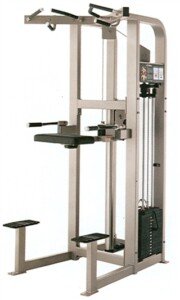
Pull-up assist equipment
These machines subtract weight from your body weight, so that, if you weigh 200 pounds, these machines can be set to make you “weigh” half that much or less.
Any overweight or obese exerciser can use a pull-up assist machine, and this tool is a perfect substitute.
Place the pin, say, at the 120-pound mark in the weight stack. This will subtract 120 pounds from your body weight.
Stand on the foot steps and grab the handles above your head. Then lift a knee on the rest pad in front of yourself, then get the other knee on it.
This may sound confusing to read, but once you are standing before one of these machines, you’ll probably know instantly how it works, especially after you’ve seen others use it.
The machine will mimic for you a pull-up motion, yet you’ll feel 120 pounds lighter.
Experiment with different weight “assists” by sticking the pin in different places.
The next substitute for pull-ups for overweight or obese exercisers is the modified version.
Find the gym’s Smith machine. This is also known as tracked barbell squat equipment.
Place the bar 3-4 feet from the floor. Get beneath it and place hands on it and hang straight-armed.
You can now place your feet at various points along the floor, relative to the bar.
The further your feet are out, the more challenging the exercise will be. Your legs can be straight or bent, but keep them together.
From this straight-arm hang, hoist yourself up, but of course, your feet remain on the floor.
If this wasn’t too hard, see if you can do 10. If that wasn’t too difficult, increase the pull-resistance by moving your feet further out on the floor away from the bar.
If this still isn’t too hard, then lower the bar one foot.
The lower the bar, the closer you can bring your body towards a horizontal position if your feet are all the way out.
Though a traditional pull-up is done when the body hangs vertically, you can mimic the exercise by being almost horizontal, heels on floor, legs straight and in alignment with upper body.
The lower the bar, the more challenging this exercise is.
The third substitute for pull-ups that overweight and obese people can do is the standard lat pull-down maneuver, and you can use various handles.
This exercise is very similar to a pull-up and thus qualifies for a substitute, and overweight and obese exercisers are on an even playing field with any thinner person, when it comes to the lat pull-down exercise. This will strengthen your body for pull-ups.
Lorra Garrick is a former personal trainer certified through the American Council on Exercise. At Bally Total Fitness she trained women and men of all ages for fat loss, muscle building, fitness and improved health.
.
Top image: Shutterstock/YAKOBCHUK VIACHESLAV

What Type of Parents Do Kids Who Don’t Get Bullied Have?

Some kids never get bullied. Are their parents different than the ones of kids who DO get bullied?
Do bully-proof children have different kinds of parents?
Certainly it’s not freak chance or luck that a child or teen is bully-proof–and I don’t mean because that child is a bully.
So what kind of parents do kids have who never get bullied, or the so-called bully-proof children?
There’s a lot out there on “bully-proofing” your children.
“There is no such thing as a bully-proof child,” says Rona Novick, PhD, who developed the BRAVE bully prevention program.
Dr. Novick, a clinical psychologist, has worked with schools nationally on the issue of bullying, and is director of the Fanya Gottesfeld Heller Doctoral Program at Yeshiva University, NY.
“Bullying is so common, virtually all children will experience it at some point in their school career (current research suggests rates over 90%).”
Be aware that there are different levels of bullying; bullying is on a continuum.
Some kids are bullied only within their circle of friends, while others are the individuals whom “everyone picks on.” And interestingly, some victims even become friends with their bullies eventually.
“In addition, since bullies tend to target victims who react emotionally, and since emotional reactivity is largely a factor of temperament and biological, parents can’t change a reactive child into a cool cucumber,” explains Dr. Novick.
The term “bully-proof,” then, can simply mean doing what you can, as a caring parent, to minimize the risk of bullying.
And this begins by supporting a child’s social development, says Dr. Novick. Being more alone, she says, puts a young person at higher risk of being bullied.
Type of parents to create a more bully-resistant child?
Parents must help their children make and keep friends. However, this can’t be forced any more than you, as an adult, can be forced to feel genuine kinship with a coworker whom you don’t care for.
Lead and encourage, but don’t force play dates or other unwanted interactions.
Another group of individuals who are highly vulnerable to being harassed at school are those with cross-gender behavior or same-gender attraction.
Tomboys, effeminate boys, and gay-lesbian, transgender and questioning-youth are very vulnerable to bullying and also benefit from parental support, explains Dr. Novick.
Thus, if parents have noted that a child doesn’t seem to be snuggly fitting into society’s expectations of their gender, parents need to show unconditional love and avoid criticizing their son or daughter.
This non-judgmental approach can go a long way in “bully proofing” a child — or to put it another way, ensuring that your child is one who never gets bullied in the true sense of the word.
 Dr. Novick is recognized for her expertise in behavior management and child behavior therapy. She has published scholarly articles on school applications of behavior management, children and trauma, and bully prevention in schools.
Lorra Garrick has been covering medical, fitness and cybersecurity topics for many years, having written thousands of articles for print magazines and websites, including as a ghostwriter. She’s also a former ACE-certified personal trainer.
.
Top image: Shutterstock/Cookie Studio
Why Obese People Should Lift Weights to Lose Fat
Lifting weights is the best thing an obese person can do to lose weight, to burn as much fat as possible; the beauty of weightlifting is that many fat-burning routines can be done while standing or sitting.
I’ve been going to two chain gyms, which means about 10 gyms total all over town, and year after year, I see the same thing: Few significantly overweight people lifting weights — let alone intensely.
Of course, the larger and more crowded the health club, the more likely you’ll see men and women of all sizes performing strength training routines.
However, they still comprise a very small percentage of people working out with weights.
Most very heavy people in a gym are on the cardio equipment.
Of the ones who are strength training, literally a few, if any, are in the free-weight area; just about all of them use the strength training machines.
Strength training machines have their virtues.
This includes being able to better isolate a muscle group, as well as help rehab an injury.
But ultimately, by far the best approach to strength training and thus fat-burning involves use of free weights such as dumbbells, barbells and kettlebells.
Obese individuals who do any strength training make up an extremely small portion of the general population of very overweight men and women.
Based on what I’ve seen at gyms, I will conclude that one of the reasons for very large people not lifting weights is because they think this will make them bigger yet.

When I see very overweight or moderately overweight women using resistance machines at the gym, they are almost always using light workloads — sometimes very light, so light that after many repetitions, they don’t look tired.
When they use dumbbells, it’s almost always light dumbbells.
They may believe that using heavy dumbbells will bulk them into a bigger size. When I was a personal trainer, I heard this from some of them.
Obese women are strong enough to handle heavier resistance; I know this because I’ve worked with many of them.
But I’ve had overweight women tell me outright, “I don’t want to get bigger.”
However, having excess fat in your body does NOT predispose you to bulking up from strength training.
If you have a lot of excess fat in your body, lifting weights will force your body to plunge into these extra fat reserves for fuel: You will get smaller, not bigger.
Obese people need to lift weights because this will 1) speed up their resting metabolism, 2) Tone muscles and thus yield a firmer, shapelier appearance, and 3) vastly improve fitness.
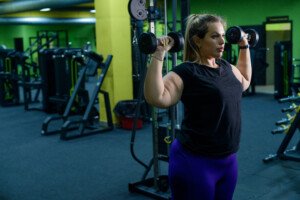
The fat-burning effects of intense strength training are unparalleled, more significant than the fat-burning effects of merely pedaling away like an automaton on the elliptical machine or stationary bike.
If you have obesity and are struggling to lose pounds, I assure you that there is one thing you have not tried yet: intense weightlifting, several times a week, particularly with dumbbells and barbells.
Do Not Overtrain
It’s crucial that you not go overboard with weight training, however. If you train too often, your muscles won’t recover properly.
The result will be the inability to train rigorously and hard, at a high intensity.
Muscles need adequate time to recover. You need not train with weights more than three times a week to reap some amazing fat loss.
Another point to remember is that frequency does not equal intensity.
You’ll lose more body fat with kickass strength training three times a week rather than with a lower level of training five times a week.
- And of course, how much and what you eat plays a key role in permanent weight loss.
- Portion control of a variety of foods, while limiting ultra-processed types of food, is extremely effective at achieving long-term weight loss.
Lorra Garrick is a former personal trainer certified through the American Council on Exercise. At Bally Total Fitness she trained women and men of all ages for fat loss, muscle building, fitness and improved health.
.
Top image: Freepik.com

How Can a Teacher Spot a Bully? Five Ways

Here are ways that a teacher can spot who the bully is in their classroom or beyond.
Teachers can be a bullied child’s first line of defense, because they are in such a position to prevent, or at least, greatly minimize, harassment in the schoolplace.
“There’s a tremendous amount of pressure on teachers today in managing their classrooms and students,” says Dr. Marilyn Benoit, MD, Chief Clinical Officer and SVP of Clinical & Professional Affairs of Devereux, one of the largest not-for-profit behavioral healthcare organization in the country. Dr. Benoit also has a family practice as a child and adolescent psychiatrist.
“It can be very difficult, because as I said, bullies are opportunistic. They take advantage of unsupervised opportunities.”
Dr. Benoit provides five ways that teachers can spot a bully:
Be aware of student’s activities, says Dr. Benoit. In junior high, I don’t know if the teachers were blind or decided to ignore bullying, but bullying went on right when the teacher was in the room.
How could the art teacher not have seen Paula pulling at Louise’s hair while we were all supposed to be working on a project?
Paula was in Louise’s face long enough that I’m sure the teacher must have sooner or later caught a glimpse, but did nothing.
Another sign of bullying that a teacher can pick up on is if “children tend to cower around one child; if one child appears to dominate others; if a bully has a ‘posse’ that tends not to join ordinary activities; if a bully uses ‘secretive maneuvers,’ i.e., extorting another child; if a child has an angry baseline,” explains Dr. Benoit.
Understand the family dynamics of children through parent / teacher conferences and interactions, says Dr. Benoit.
As an example, “if an older sibling is responsible for watching or even taking over the parental role, the younger child may be exposed to sibling bullying.”
Dr. Benoit advises teachers to monitor isolated areas at schools that a bully might take advantage of (hallways, restrooms, locker rooms, school buses, playgrounds).
The corner of a classroom where kids are more free to move about is also a hot spot for bullying, such as in an art or shop class. And one of the hottest bullying spots is the gymnasium.
“Teachers should listen to children and inform parents when children say they are being bullied (some teachers may ignore the complaints, or believe it’s only teasing or question whether it happened because they didn’t witness it),” points out Dr. Benoit.
The “It Didn’t Happen Because I Didn’t See It” Mentality
“I’ve seen instances where a bullied child fears speaking up because the teacher didn’t see it and therefore, it didn’t happen,” says Dr. Benoit.
“Almost 100% of the kids will tell me that when they report an incident to their teacher, the incident is ignored.”
This can foster more depression and isolation in the victim. “In their mind, the bullying never happened because the teacher doesn’t believe them.”