Recurrence of Chronic Subdural Hematoma Missed by Doctor?
Seemed the neurosurgeon was wrong and the layperson was right about recurrence of chronic subdural hematoma.
A neurosurgeon didn’t think my mother’s new symptoms were the result of a recurring chronic subdural hematoma.
My mother awakened one morning in 2011 with neurological symptoms.
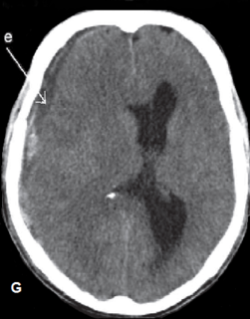
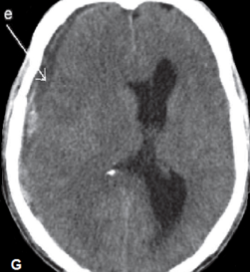
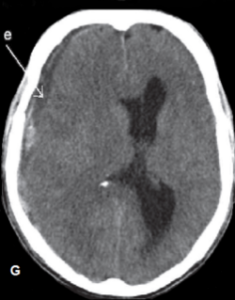
Later that day a CT scan showed bleeding in her brain: a chronic subdural hematoma. The next morning it was surgically drained via burr hole.
The neurosurgeon said there was a 15 percent chance of recurrence. A study by Byung-Soo Ko et al says the recurrence rate is 3.7 to 30 percent (after burr hole drainage).
For another article I wrote regarding chronic subdural hematoma and recurrence, I interviewed Kangmin Daniel Lee, MD, a neurosurgeon with New Jersey Brain and Spine.
I asked him about the typical time passage between a primary cSDH and its recurrence (re-bleeding at the surgical drain site).
Dr. Lee explains in that article: “There is some variability with this number depending on the technique, but most recurrences, when it does occur, will happen in the short term. Most published reports range it from the 1-3 week period.”
Chronic Subdural Hematoma Recurrence?
Around 10 days after my mother’s initial draining, she began exhibiting suspicious symptoms.
For example, she began dropping things. She also could not (with eyes open) join the ends together of two paper cups after bringing them towards each other with outstretched arms.
She also couldn’t join her hands in a clap position from an outstretched position.
Believing a recurrence of the chronic subdural hematoma, I reported these deficits to the neurosurgeon. He doubted a rebleed.
I gave my mother more tests, including picking a straw up from a table with her left hand.
She’d attempt to grab the straw but miss it. She’d pull her pants up after using the toilet, but only on the right side, unaware that the left side (including underwear) was still down as she walked away from the bathroom.
My mother was also experiencing escalating headaches. A follow-up CT scan (to the initial burr hole draining) had already been scheduled (and was still several days out).
On Jan. 23, four days prior to a follow-up appointment in his office, I again spoke to the neurosurgeon.
He insisted that there was no recurrence of the chronic subdural hematoma. He then said that sometimes the elderly get weakness in an arm.
Since when is literally grasping for straws and missing them a sign of muscle weakness?
And what about the other symptoms, such as unawareness that her underpants and pants were not pulled up on the left side?
This sure sounded like a recurrence of a chronic subdural hematoma rather than age-related weakness.
I had also described to him the inability to join the paper cups or her hands. I also pointed out that these symptoms were of a relatively sudden onset (several days). The neurosurgeon said, “If you’re concerned, take her to ER.”
He said that headaches normally don’t occur post-drainage procedure, but offered nothing else at that point other than to take her to the ER if she “deteriorates rapidly,” but otherwise, to keep things on schedule.
Results of that follow-up CT scan: The neurosurgeon’s colleague called me and said that the neurosurgeon said there was “nothing significant,” no “significant” mass, and the midline shift appeared normal or unchanged.
I managed to get the follow-up office appointment moved from Jan. 27 to Jan. 26.
Then the neurosurgeon’s physician’s assistant contacted me that the CT scan was “worse” but also “improved” in that the volume of fluid was greater, but density less. There was no new bleeding, however.
According to a report in Advances in Neurosciences and Clinical Rehabilitation, a CT scan can “miss” a chronic subdural hematoma (depending on type) that an MRI can easily show.
This makes me wonder why an MRI was never ordered for my mother.
The neurosurgeon finally confirmed that the increased fluid volume was causing the excruciating headaches and impaired left hand.
When I referred to the left hand malfunction as “significant,” the neurosurgeon promptly corrected me by saying it was mild or not significant, compared to what he sees in other patients, and that “significant” was total paralysis.
I had to bite my tongue hard to keep from criticizing his blasé attitude and inappropriate reference to “other patients.”
After all, I didn’t want to lose brownie points with a doctor who was probably going to be draining my mother’s brain again.
He offered my mother a choice between a Medrol Pak (oral steroids) or a second burr hole draining.
She chose the Medrol, but the redraining was scheduled in case the Medrol didn’t work.
The Medrol didn’t work. Next day my mother underwent the second burr hole draining.
After the procedure the neurosurgeon told me that there was a “new bleed.” I wondered if this “new bleed” was actually a recurrence of the original chronic subdural hematoma. I’ll never know.
What a coincidence that a “new bleed” popped up within that one to three week period following the burr hole draining of the first chronic subdural hematoma.
I have never doubted the meaning of that old adage, “Eighty percent of medicine is common sense.”

Dr. Lee focuses on minimally invasive techniques to treat traumatic and degenerative diseases of the spine and brain tumors. He’s been invited to speak at the regional and national levels on his research areas.
 Lorra Garrick has been covering medical, fitness and cybersecurity topics for many years, having written thousands of articles for print magazines and websites, including as a ghostwriter. She’s also a former ACE-certified personal trainer.
.
Top image: Dr. Miki Katzir, CreativeCommons
Sources:
ncbi.nlm.nih.gov/pmc/articles/PMC2588154/
acnr.co.uk/ND08/ACNRND08_management.pdf
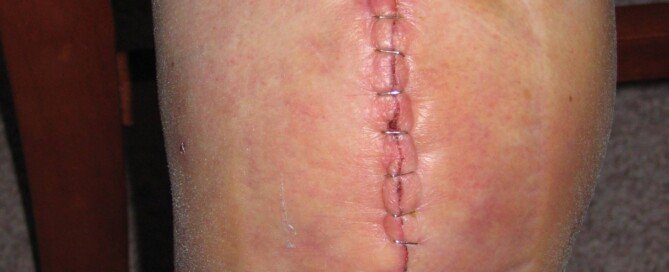
Is Leg Swelling After Knee Replacement Always DVT?
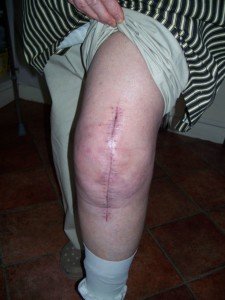
Have you had knee replacement surgery, and have noticed that the other leg seems to be getting bigger or swollen in appearance, even though after the first several days following the operation, it looked as it always had?
One of the leading risk factors for a deep vein thrombosis is knee replacement surgery, says Mayoclinic.com in the site’s DVT section.
If you’re familiar with deep vein thrombosis, you already know that a classic sign is swelling of the leg — a key symptom noted by Mayoclinic.com.
The site says that knee replacement surgery can cause a DVT because of debris that forms during the procedure that can get into the venous system.
Another cause is general anesthesia in combination with post-surgical immobility.
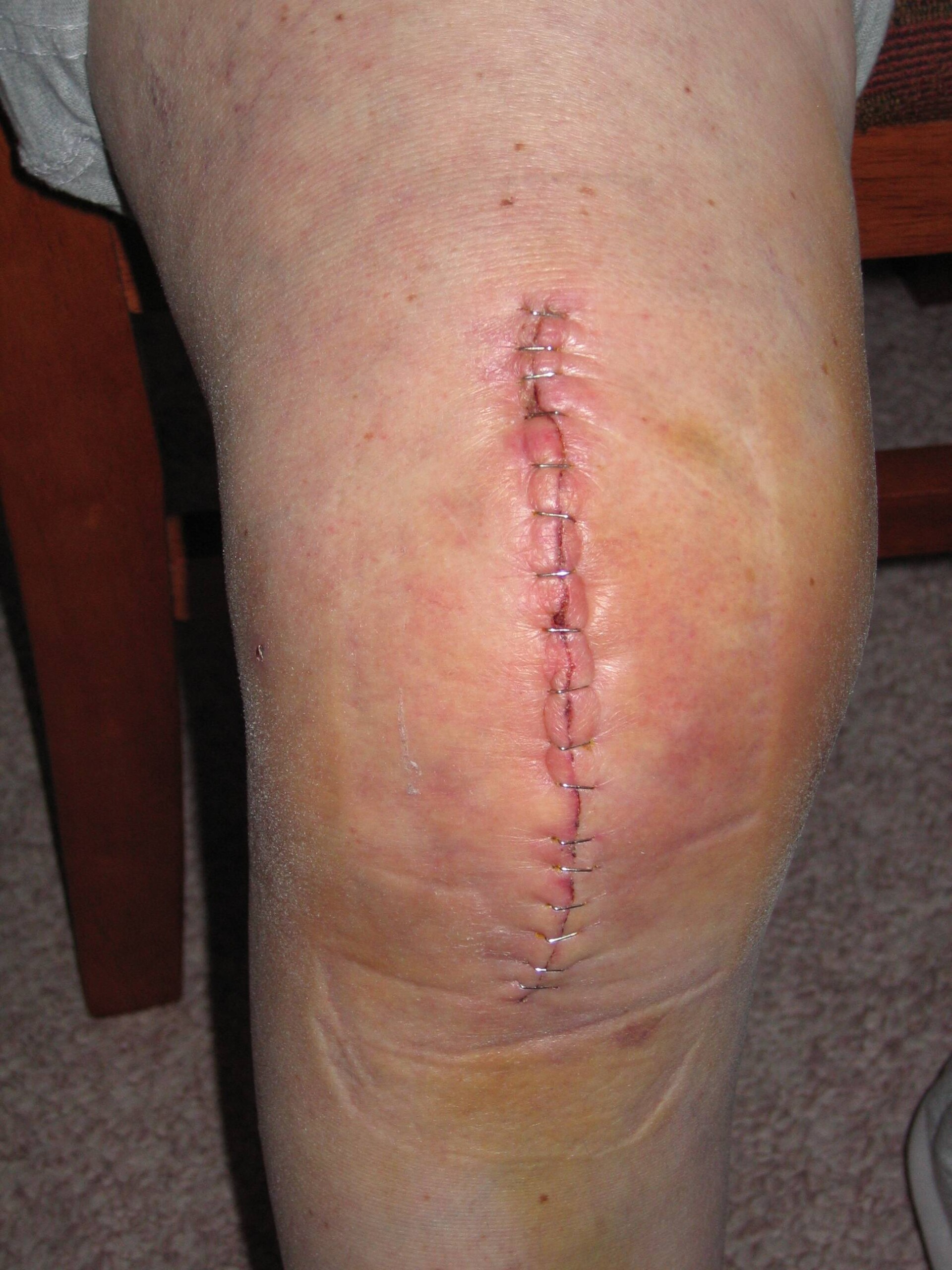
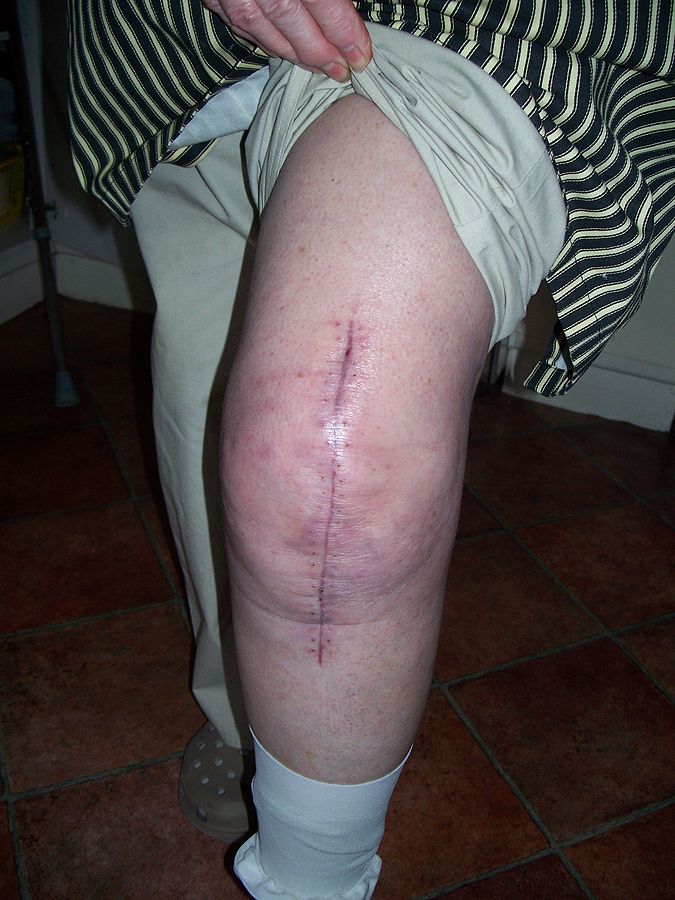
My father had knee replacement (revision) surgery. Five days after the surgery, I thought I began noticing that his non-surgical leg was a tad smoother than it usually looks, especially around the ankle, but I thought it was my imagination.
I’d been watching the non-surgical leg like a hawk since the surgery, so I knew exactly what it was supposed to look like.
Five days after the knee surgery, I took him to the ER upon the advice of his surgeon when the physical therapist suspected an infection.
I asked the nurse and the ER doctor if the non-surgical leg “looked fine,” and they both said it did, even though, by golly, I couldn’t help wonder if I wasn’t imagining things as I studied the leg from behind while my father shuffled with his walker.
The day before this, he had stopped wearing the “anti-emboli” ted hose.
Next day, there was no doubt; the leg was swollen, including the foot and toes.
Even my father admitted it. I was thinking, a DVT has formed because he removed the ted hose the other day.
His primary care doctor wasn’t at all concerned and said it was edema from excessive inactivity. Why did this not occur sooner; why five days later?
Most likely because he’d been wearing the ted hose continuously up till a few days prior.
Once he removed them, the edema (excess fluid in a limb) had a chance to build up. The ted hose (a.k.a. compression stockings) prevented this.
“Half of all DVT cases cause no symptoms,” says WebMd.com. Don’t be led astray by a doctor who makes it seem as though you can’t possibly have a deep vein thrombosis just because there’s no pain or redness with your leg swelling.
WebMD.com lists the following as DVT symptoms: swelling in the leg; tenderness or pain in the leg (may occur only when standing or walking); excessive warmth in the leg; red or discolored skin in the area; visible veins; undue fatigue.
If your non-surgical leg is swelling after knee replacement surgery (even if there’s no pain or redness), or the surgical one is swelling more and more, especially if initially the swelling was going down, get medical attention promptly.
Don’t assume it’s just edema from inactivity. Let a doctor tell you that.
Lorra Garrick has been covering medical, fitness and cybersecurity topics for many years, having written thousands of articles for print magazines and websites, including as a ghostwriter. She’s also a former ACE-certified personal trainer.
Top image: Dave Haygarth
Sources:
mayoclinic.com/health/deep-vein-thrombosis/DS01005
webmd.com/dvt/deep-vein-thrombosis-dvt-symptoms-diagnosis
Barbell Squat vs. Dumbbell Squat for Building Mass: Pros & Cons

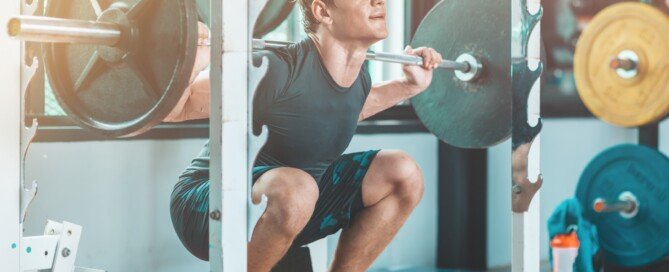
Barbell squats or dumbbell squats: which is better for building muscle mass?
The barbell squat and dumbbell squat both have plenty to offer fitness enthusiasts.
When I was a personal trainer at a gym, I’d occasionally be asked which was “better.”
Whether the barbell squat is better than the dumbbell squat, or vice versa, depends upon your goals.
Some people wish to build a lot of muscle mass/size in their upper legs and glutes.
Barbell Back Squat vs. Dumbbell Squat for Mass Building
The ability to build a lot of muscle mass in the legs and buttocks is not possible with dumbbell squats, because with dumbbell squats, you are required to support the dumbbell weights with your hanging arms as you hold onto them.
This is a problem for people who can barbell squat a lot of weight. For instance, suppose you can barbell squat 225 pounds 10 times.
To duplicate this resistance for your legs and butt, with dumbbell squats, you’d have to hold a 110 pound dumbbell IN EACH HAND while lowering into the squat position.
Your legs may be strong enough to support the weight with 110-pound dumbbell squats, but for many people, their upper body will not be able to hold onto those weights.
Women, especially, will find it too much to hold a 100-pound dumbbell in each hand.
In fact, I’d be willing to bet that extremely very few women, who can barbell squat 200 pounds, can maintain holding onto 100-pound dumbbells in each hand for the duration of eight dumbbell squats.
And if all a man can barbell squat is 200 pounds, I can pretty much guarantee that his upper body strength isn’t all that impressive, either, and hence, 100-pound dumbbell squats will be very difficult for his upper body to sustain.
Though a 200-pound barbell squat is impressive for a woman, it’s nothing to brag about for a man.
And then there are men who DO have impressive barbell squats, let’s say 315 pounds. How could he duplicate this effort with the dumbbell version?
First of all, what gym supplies 150-pound dumbbells? Of course, you can purchase these online, but come on.
Secondly, the heavier the dumbbells, the more that the upper body must get involved for these kind of squats.
If the weight is heavy enough, dumbbell squats will simply become impractical. They are not ultimate mass builders.
But don’t underestimate dumbbell squats for building fitness and durability in your legs.

Shutterstock/Jasminko Ibrakovic
Obviously, they are not the choice for building maximum size, maximal muscle mass or maximum strength in the legs.
But I’d like to see one of these men, who can barbell squat 400 pounds, do 30 repetitions of dumbbell squats on an air cushion, holding just 25-pound weights in each hand, reaching down so that their femurs are parallel to the floor — each time.
I can tell you right now, such a beast with the barbell squats will be screaming in pain by the 20th rep — if he even gets that far.
High rep dumbbell squats can be tweaked: Hold the down position for a 2-count and thrust quickly up to the upright position to recruit fast-twitch muscle fibers.
Don’t hang out at the top position; immediately drop down again and hold thighs parallel to the floor for two seconds. Do this 30 times with 20-pound weights on a flat surface.
If you think that was nasty, do it on an air cushion or the flat side of a BOSU board. Good luck.
Summary: When it comes to barbell squats vs. dumbbell squats for building a lot of mass, forget the dumbbells and do the back squat.
 Lorra Garrick is a former personal trainer certified through the American Council on Exercise. At Bally Total Fitness she trained women and men of all ages for fat loss, muscle building, fitness and improved health.
.
Top image: Shutterstock/Adamov_d
10 Reasons Never to Hold onto the Treadmill

Do you know the 10 reasons it’s wrong to hold onto the treadmill while walking or jogging?
As a former personal trainer, I have observed — with a lot of interest — how people use the most popular piece of gym equipment: the treadmill.
And the vast majority of them use it wrong. What? Use a treadmill wrong?
How can anyone use such a simple piece of equipment incorrectly? Well, believe it or not, it is used wrong all the time.
And when you exercise with poor form, you put yourself at risk for repetitive stress injuries, and you’ll get very little, if any, results.
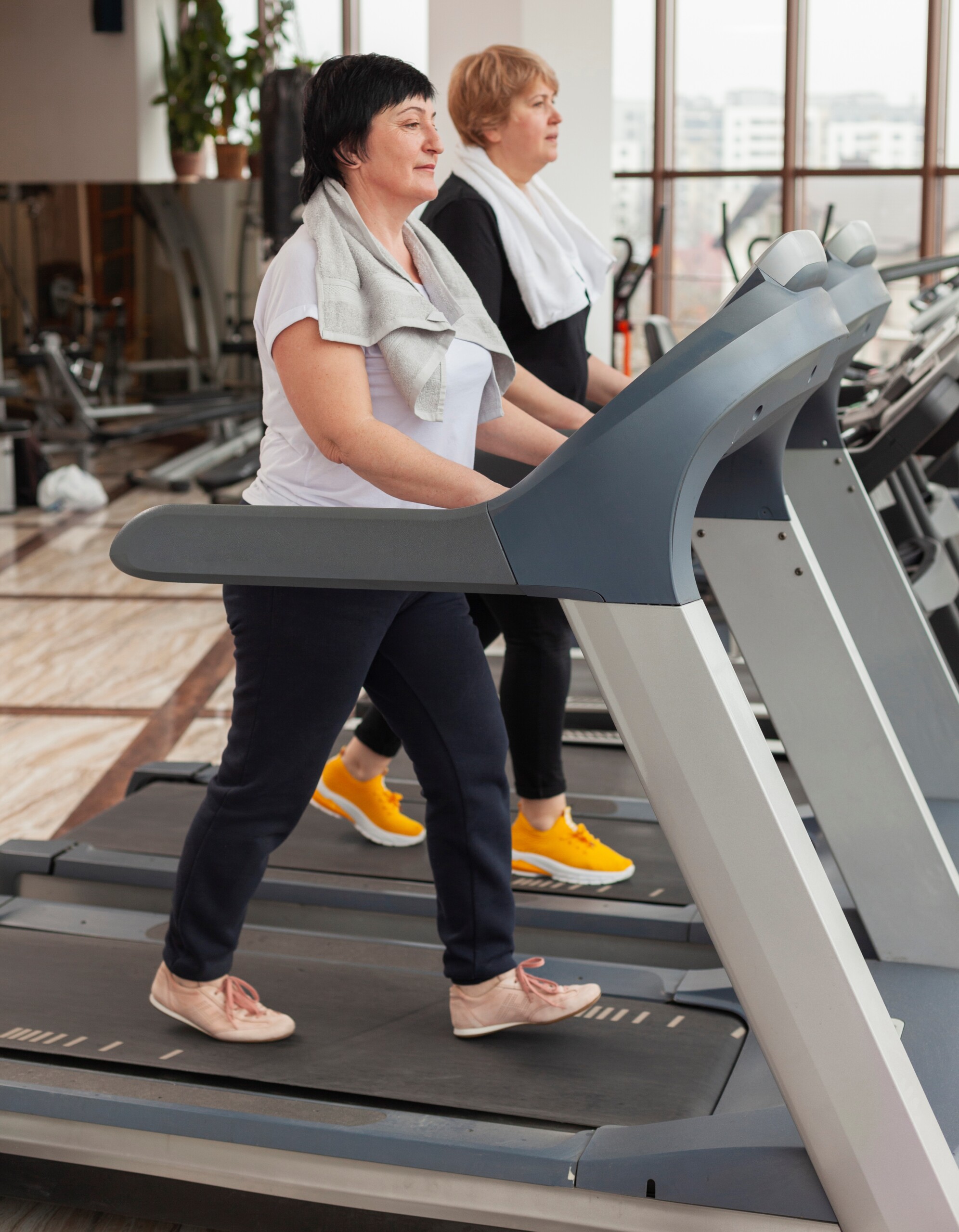
Most treadmill walkers hold on. And not just older people. Even young people do this. It’s very wrong, especially from a fitness and weight loss standpoint.
It burns far fewer calories (the calorie display is a computer that automatically shows numbers, based on the speed and incline only); and can wreck your posture.
Here are 10 reasons why you should not hold on.
1 Holding on burns about 20 percent fewer calories than letting go at the same speed.
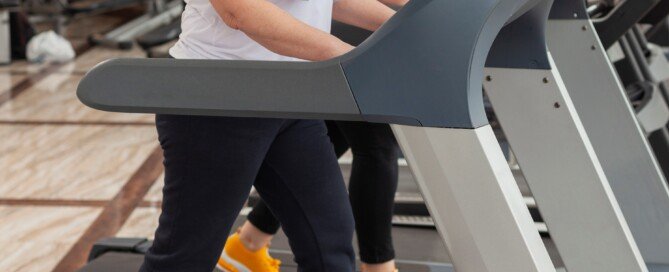
2 It will throw off your walking gait and posture. Look at the man in the photo above.
That is so unnatural and does absolutely nothing to improve mobility or coordination once he’s off the treadmill.
Maybe that doesn’t matter to a young jock, but it gets more relevant as one gets older.
“To get the most out of a treadmill workout, it is important to maintain an upright posture and correct walking or running form. This will help to improve measures of fitness as well as prevent unwanted injury from incorrect equipment use,” says Jacque Crockford, MS, CSCS, an ACE certified personal trainer and an ACE exercise physiologist.
The feet can suffer, too: “Changing of the gait can always lead to injuries especially soft tissue injuries such as tendonitis,” says Dr. Oliver Zong, DPM, a foot specialist and surgeon based in New York.
“To the extent that holding onto the treadmill changes one’s gait, this could happen,” he continues. “Clearly it is better to walk or run naturally with a natural gait pattern.”
3 It can cause repetitive stress injuries in the hips and shoulders. I once had a new client who complained of mysterious shoulder pain.
I found out she always held onto the treadmill while walking. I told her to let go. After she began walking hands off, after a few days, the shoulder pain disappeared.
4 When you hold on, you are not really, truly walking, because in everyday walking, you’re not holding onto anything for support.

Many people — including young — walk on a treadmill like this. Whether it’s being intenionally modeled or not, IT IS WRONG. It’s fake walking. Depositphotos.com
So if you hold onto the treadmill, your body is not being trained to do anything. In fact, it’s being UN-trained.
5 It UN-teaches your body how to balance. Your balance will become worse if you hold on.
When you hold on, the machine becomes an external support system to your body. This teaches your body to rely on an external agent for balance.
So when you’re outside somewhere, and you have to balance or walk on uneven surfaces, or step around things or go down stairs, etc., your body won’t be efficient at handling the demands of self-support without that external agent to hold onto.
6 Holding on at fast speeds can raise blood pressure, because you are gripping at something. A tight grip, especially, will raise blood pressure.
7 You will be tricked into thinking you’re far more fit than you actually are, because no matter how high you set the incline, even at a fast speed, if you hold on tightly enough, you can keep up with the tread without any challenge if you hold on.
This will fake you out into thinking you can handle actual hills outdoors.
8 Holding on can aggravate a pre-existing back problem or knee problem. When you hold on, the entire kinetic chain is disrupted.
9 Holding on creates a false sense of accomplishment. You’re not really doing anything. Even the most frail person can use a treadmill if he or she grasps the machine.
10 It looks…well, quite silly. One of my clients even pointed that out to me and stated, “Some people call that walking! That isn’t walking!”
 Jacque Crockford is also the exercise physiology content manager at ACE (American Council on Exercise) and has been an personal trainer for 15+ years.

Dr. Zong, a foot and ankle surgeon, has appeared on national and local TV programs such as “Good Morning America” and “The Doctors.”
Lorra Garrick has been covering medical, fitness and cybersecurity topics for many years, having written thousands of articles for print magazines and websites, including as a ghostwriter. She’s also a former ACE-certified personal trainer.
.
Top image: Depositphotos.com

Fat Burning Zone vs. Cardio Training Zone: Which Burns More Calories?

Fat burning zone vs. cardio training zone for burning fat?
Do you ever wonder what the difference is between the “fat burning zone” and the “cardio training zone”?
Surely you’ve seen these diagrammed in some way on cardio equipment, and perhaps you’ve noticed that the fat burning zone is an easier zone to work out in.
But when you work harder and get your heart rate up higher, the zone becomes “cardio training,” or “athletic training,” and no longer “fat burning.”
So in an attempt to lose weight, you make sure to remain walking, stepping or pedaling comfortably in that fat burning zone.
But have you ever wondered how it is, that exercising harder burns LESS fat? How can this be? This shouldn’t make any sense.
You’ve probably heard that a greater percentage of fat is burned during the fat burning zone, which is also known as the aerobic burning zone.
So surely, the best way to melt off fat is to stay in that fat burning zone, and to make sure you don’t get too out of breath or too worked up, right?
WRONG.
The fat burning zone, indeed, burns a greater PERCENTAGE of fat, relative to total calories burned.
But the higher intensity cardio or athletic training zone burns more TOTAL calories for the same length of time.
This means that the total amount of fat that’s burned with these calories, actually comes out higher than the total fat burned during easier “fat burning” work.
Let’s do the math. Suppose on Monday, you use the elliptical trainer machine for 60 minutes.
You stay within that target heart rate that correlates to the fat burning zone. You burn a total of, let’s say, 200 calories.
I choose 200 here arbitrarily, just for mathematical purposes. Everyone’s metabolism is different, and calorie readouts on machines are based on an average-height, 150 pound male. You may be a 5-2, 170 pound female.
So keep in mind the mathematical concept here, rather than how many calories your particular body might burn up in 60 minutes.
So, you burn 200 calories in 60 minutes in the fat burning zone. Now, about 50 percent of those calories will be fat. 50 percent of 200 is 100. Remember that: You’ve burned 100 calories of fat.
Now, let’s say on Wednesday, you get on the same machine, but train in the cardio zone. You pedal faster at a higher pedal resistance. You drip sweat.
You hear yourself breathing hard. You huff and puff. After 60 minutes, you’ve burned 300 calories.
In cardio zone training, about 40 percent of the calories burned will be fat.
Note: 40 percent is a smaller number than 50 percent. HOWEVER…what’s 40 percent of the 300 calories that were burned?
It’s 120! Your total fat-calories burned were 120! This is 20 percent MORE fat burned, than what you did in your fat burning session on Monday!
Lorra Garrick is a former personal trainer certified through the American Council on Exercise. At Bally Total Fitness she trained women and men of all ages for fat loss, muscle building, fitness and improved health.
.
Top image: ©Lorra Garrick
Why Old Men Have Skinny Arms & Legs but Big Bellies

It’s common to see old men with thin arms and legs, but fat bellies…
Ever notice how many old men have skinny legs and arms, but plenty of fat in their bellies?
In fact, as they age, men typically lose mass in their legs and arms — they get thinner, while their belly just gets fatter and fatter.
There is a perfectly logical, and quite simple, explanation for why, as men get older, their bellies get bigger while their legs and arms get thinner or scrawnier. It has to do with the metabolic furnace.
This phenomenon happens to men who don’t perform weight-bearing workouts on a consistent basis.
To put it another way, the increasing stomach size and decreasing leg and arm size will happen to nearly every man who doesn’t exercise, as he gets older.
The only exceptions are very underweight men, and it’s rare to see an old man with scrawny arms and legs and a flat firm tummy.
The metabolic furnace is the body’s muscle.
For inactive men (and women), beginning at about age 30, the body begins losing muscle mass. As muscle mass decreases, metabolism slows down.
A slower metabolism means that the rate at which you burn calories from food slows down.
A man, who was never into working out, as he approaches middle age, continues to lose muscle, about five pounds’ worth per decade.
By age 50, this sedentary individual has lost around 10 pounds of muscle.
This shows in thinner legs and arms; they’ve lost muscle mass. The butt sags. The thighs look, pardon my bluntness, pathetic.

So why does the belly in these men get fat?
Because the muscle they used to have in their legs and arms, which is no longer there, is no longer there to burn some of the food they eat.
Muscle burns more calories than any other body tissue; muscle is the body’s metabolic furnace.
The less muscle you have, the slower your metabolism (even though it may still be on the fast side, but relative to what you had when you had more muscle, it is slower nevertheless).
So food that used to get used by the muscle that was once in the legs and arms, is now getting stored as fat, and the first place men store fat is in the belly.
This phenomenon doesn’t just happen to skinny men as they get older.
A medium or even portly man will notice that as years go by, their belly just keeps getting bigger and bigger, while strangely, once thick legs are now smaller.
These men no longer have the muscle mass in their arms and legs to support their daily food intake, and thus, the non-used calories get stored in their belly as fat.
I might also mention that the muscle loss also occurs in their chest, back and shoulders.
However, loss of muscle is most evident in the legs and buttocks.
The fat belly in an otherwise “healthy” (free of disease) aging man is entirely preventable through strength training workouts.
Shutterstock/Straight 8 Photography
I see this all the time at the gym: old-timers with washboard abs, strong sturdy shoulders and backs, muscular arms and strong, toned legs.
Men over 30 who have noticed an ever-growing belly of fat can reverse this situation 100 percent in many cases (depending on variables including age).
The best way for men to lose the paunch is to hit the weights for their legs, back, chest and shoulders, and not camp out – yes, I said “not” – at the crunch machines.
 Lorra Garrick is a former personal trainer certified through the American Council on Exercise. At Bally Total Fitness she trained women and men of all ages for fat loss, muscle building, fitness and improved health.
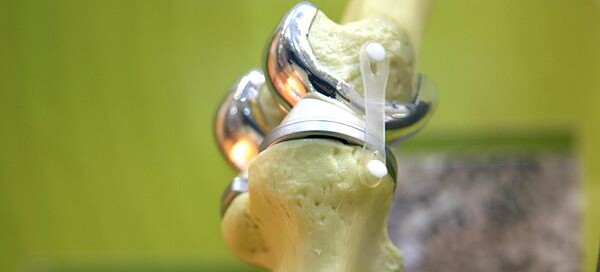
How to Lose Weight Before Your Total Knee Replacement
Here is a guide on how to lose weight with exercise even if you can’t do aerobics or leg workouts and need a total knee replacement.
A person who needs a total knee replacement can still lose weight in time for the surgery by engaging in the right kind of strength training exercises coupled with a specific technique that optimizes fat loss.
Obese men and women are at greater risk of complications following total knee replacement surgery.
For this reason, weight loss prior to the procedure is strongly advised.
“When considering losing weight before your TKR, one must have reasonable goals and means by which to achieve these,” says Marc F. Matarazzo, MD, a board certified orthopedic surgeon with Total MD Family Medicine & Urgent Care.
“A weight loss of 5-10% would be a reasonable goal to start.
“In general, low impact exercises along with resistance training exercises and proper diet are recommended.”
- Examples of low impact exercise are use of a stationary bike and elliptical trainer.
- Walking with hand weights and a good arm pump is another option.
“It is also recommended to seek medical advice and assistance in losing weight, as there could be medical ramifications involved,” says Dr. Matarazzo.
For example, if you have high blood pressure or diabetes, these conditions will alter how you should approach an exercise program.
“Effective treatment for weight management and obesity related to musculoskeletal symptoms can include 30 to 60 minutes of moderate intensity exercise three times per week.”
What if lower body exercise causes knee pain?
First off, you can try walking laps in a pool. However, this would only be the beginning of a weight loss plan — as there’s a more effective way to shed the pounds that should be prioritized over any water activity.
That more effective way is strength training the upper body, since lower body work would not be wise for someone with advanced osteoarthritis of the knees.
You’ll be able to engage in this in a maximal way, provided that you’re free of shoulder problems and have no other comorbities that can warrant restrictions such as lower back pathology or chronic heart failure.
The protocol for maximal weight loss via strength training is to use a resistance load that enables you to complete at least eight repetitions — but not more than 12.
This is called an eight to 12 rep max. It’s that sweet spot for maximizing the fat burning effects of strength training.
If the weight load is light enough for more than 12 reps — and you end up doing 15 or more — this will dilute the fat burning effect, while possibly increasing the risk of tendon injury due to the prolonged repetitive nature of the set.
A Closer Look at this Sweet Spot for Weight Loss, Even if You’re New to Strength Training
1) Use heavy resistance so that eight to 12 repetitions are very challenging — so challenging that the entire set requires concentrated effort.
If you can carry on a conversation while doing sets, the weight simply is not heavy enough!
Furthermore, conversation will distract you from focusing on correct form!

Bench press. Shutterstock/ LightField Studios
2) Maintain good form throughout the set. Avoid swinging or rocking your body.
If you’re not sure about your form, then ask a personal trainer to demonstrate.
3) Avoid exercises that isolate the shoulders, triceps and biceps (e.g., biceps curls, triceps kickbacks), as these will burn far less fat than will compound exercises that work several muscle groups at once.
Examples of compound exercises are any barbell press or dumbbell press, any machine where you push handles outward, and any pulling motion such as with equipment in which you have a seat and pull handles down towards your neck from above or horizontally towards your chest.

Narrow-grip pull-down. Zennis Se/Pexels
4) Avoid crunches and sit-ups. These are a waste of time and will not help you lose any weight. All they’ll do is make it easier to do crunches and sit-ups.
5) Make an objective to keep lifting heavier and heavier over the course of time so that you’re always in that zone of 8-12 rep max.
6) Perform these routines twice a week, e.g., Monday and Thursday, or Tuesday and Saturday.
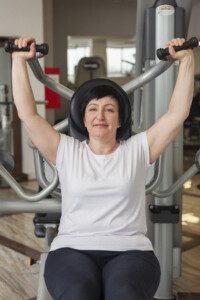
Overhead press. Freepik
Avoid dietary measures that are not sustainable in the long run. The best dietary approach to sustained weight loss is that of portion control.
- Replace juice with whole fruit.
- Replace soda with water.
- Replace processed foods with foods in more of a whole or natural form. For example, get fresh cuts of chicken and fresh broccoli rather than a frozen chicken and broccoli dinner that has sugar added to it.
- Replace white flour foods with whole grains; replace white rice with basmati or brown rice.
- Limit sweets.
- Unfollow any influencer who says it’s “fatphobic” to want to lose weight.
 Dr. Matarazzo specializes in sports medicine and related injuries. He performs minimally invasive and complex reconstructions, and joint replacements, of the shoulder and knee. Dr. Matarazzo is certified in the MAKO robotic-assisted knee replacement system and has 20+ years of orthopedic experience. He has a special interest in cartilage restoration and preservation.
Lorra Garrick is a former personal trainer certified through the American Council on Exercise. At Bally Total Fitness she trained women and men of all ages for fat loss, muscle building, fitness and improved health.
.
Top image: Rama/reativecommons
Source: sciencedaily.com/releases/2012/10/121024141631.htm
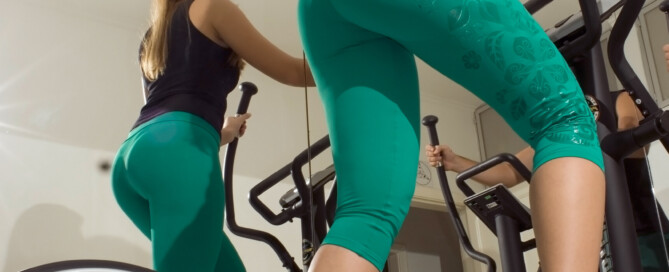
Pedal Backward on Elliptical Trainer for Knee Pain Treatment
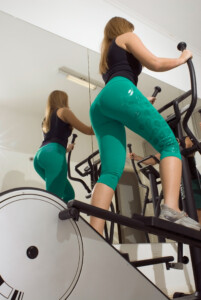
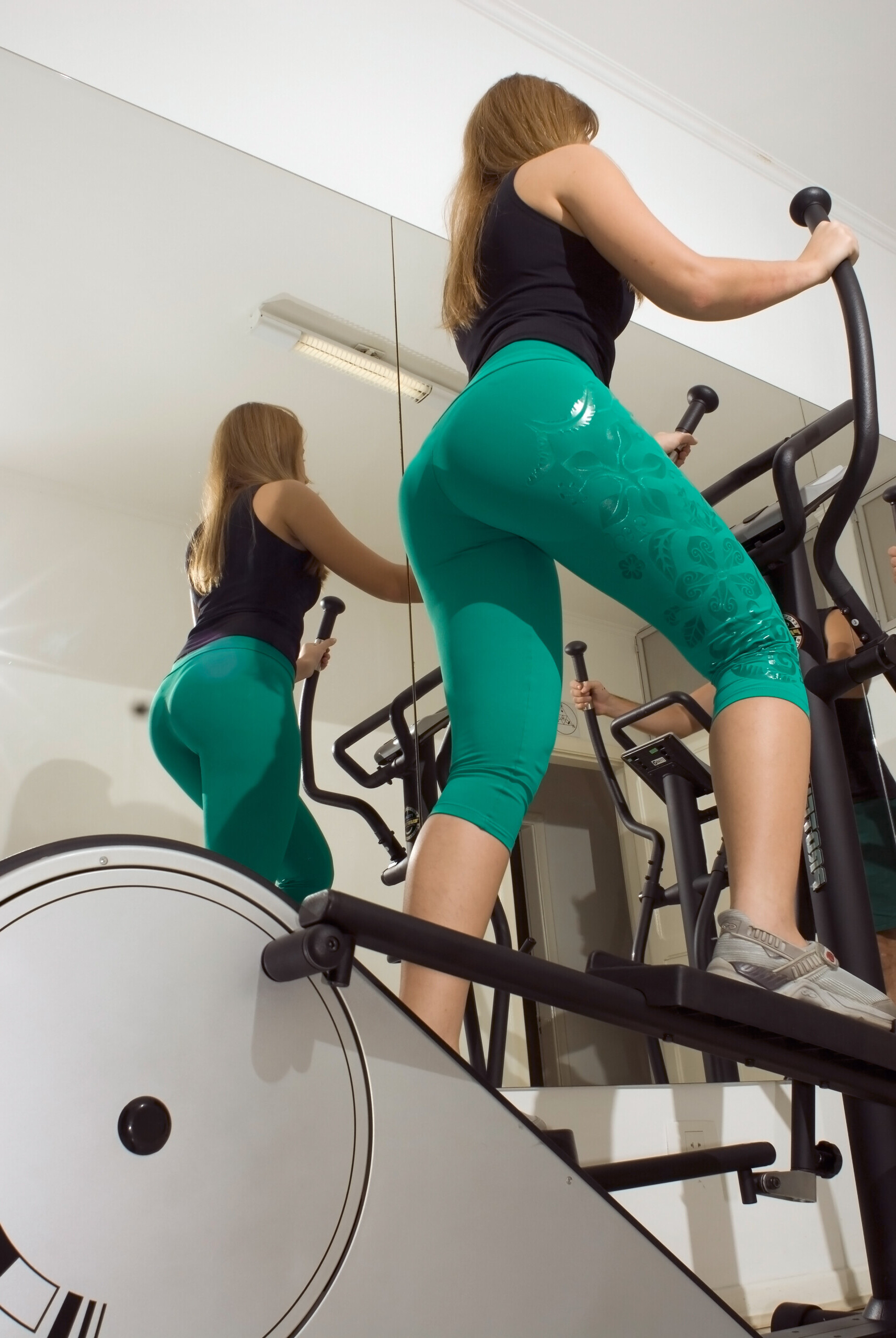
If you have knee pain, try pedaling backwards on the elliptical machine and see if this doesn’t alleviate your joint discomfort.
Most people don’t pedal backwards on the elliptical trainer, but this may actually alleviate knee pain, according to a study.
Most people don’t pedal backwards on the elliptical presumably because it taxes the quadriceps muscles of the thighs more, and also because most people do not think outside the box.
However, the leader of the study, Elmarie Terblanche, PhD, says that those who pedaled backwards experienced much greater gains in thigh and hamstring strength when compared to those who used the equipment going forward.
The stronger the quadriceps, the more stable the knee joint. The study also showed that those who pedaled backwards on the elliptical had greater aerobic function than those who moved forward.
The study subjects represented numerous knee injuries and were randomly assigned to forwards or backwards pedaling on the elliptical for a series of supervised sessions. Terblanche urges “do it backward!” for those with knee pain.
What people don’t realize is that only five minutes of backward pedaling are all it takes to produce a training effect and help alleviate knee pain, as well as strengthen knees in people without pain in this joint.
Next time you use the elliptical machine, toss in some backwards pedaling here and there for several minutes.
Don’t clutch onto the rails and lurch forward. Keep your back vertical to force your core to be engaged. Try not to hold on.
Move your arms in synch with your body and keep the back straight. By focusing on balance and good posture without holding on, you will burn significantly more calories.
For a deeper “burn” in the quadriceps, lower yourself to increase the bend in your legs.
This isn’t necessarily recommended for those with knee pain, but just as a general way to modify the exercise.
Remember to keep erect, straight posture and try not to hold onto the rails.
Fitter people should raise the pedal tension to increase the intensity of going backwards on the elliptical. Holding onto the rails will reduce pedal tension.
Lorra Garrick is a former personal trainer certified by the American Council on Exercise. At Bally Total Fitness she trained clients of all ages for fat loss, muscle building, fitness and improved health.
.
Top image: Dreamstime/Orangeline
Source: http://www.acsm.org/about-acsm/media-room/acsm-in-the-news/2011/08/01/moving-backward-helps-injured-knees-move-ahead

How Important Is Weight Loss Before Total Knee Replacement Surgery?

If you have a total knee replacement surgery planned, you’d be doing yourself a huge favor by losing weight before having this procedure done.
A report in the Journal of Bone and Joint Surgery (Oct. 2012) says that obese patients are at higher risk of complications following total knee replacement surgery.
To date, there are no studies showing that having a slender build is a risk factor for postoperative complications of knee replacement surgery.
Thus, we have a major difference between the “health” of a very overweight individual and that of a slim individual.
This particular element is completely overlooked by many body positive enthusiasts who keep insisting that there is no difference between the health of obese people and that of thinner people.
These complications (including infections) are correlated to the need for revision surgery.
A Problem that Doesn’t Exist with Thin Knee Replacement Patients
The Journal of Bone and Joint Surgery paper states that total knee replacement (TKR) can be technically more difficult to perform on obese patients.
The body positive movement focuses on the very easy-to-obtain health metrics from one’s doctor: blood sugar, blood pressure, cholesterol and the results of other routine exams such as peering inside the mouth, up the nose and in the ear.
Routine physicals don’t cover the technical challenge of performing TKR on obese people. Many obese people are walking out of doctors’ offices with a “normal” annual physical, believing that obesity does not negatively impact health.
Body Positivity Won’t Make Knee Replacement Surgery Easier for the Surgeon
If you’re plus size, and your knees aren’t feeling too good lately, you should put aside all the Instagramming on “self-love” and being body positive, and commit to losing some weight.
- What IF your knees hurt due to osteoarthritis?
- What if one day you’re told you need a TKR?
- Wouldn’t it be great if at the time you’re informed of this, you’ve already lost a lot of weight?
Body positivity is a process of improving one’s body and becoming the best human machine you can be, rather than settling for a slow, lumbering big body.
The paper points out that very overweight TKR patients have a higher rate of postoperative infection and a doubled rate of surgical revision on that original TKR.
Being Body Positive Means Being Knee Positive
Be good to your knees: Commit to a weight loss program of portion control and replacement of junk foods with healthful foods.
The report also advises that obese people, who are scheduled for a total knee replacement, should make a plan to lose weight prior to the procedure.
This is because even a 10% weight loss will make a different.
How do you lose weight if your knees hurt?
When I was a personal trainer, I worked with overweight clients who has “bad” knees. Some indeed told me that they’d been diagnosed with osteoarthritis (wearing down of cartilage).
- If you have this condition, you CAN exercise.
- It’s just that you need to avoid certain kinds of exercise.
- One need not jog, hop or jump in order to lose weight.
- Get off the aerobics bandwagon and get on the strength training bandwagon. Strength training is your ticket to weight loss — and feeling much more positive about your body.
Upper body strength training can be done in a seated position, sparing pain in the knee!
You can also lie on a bench for some exercises, such as the bench press and “skull crusher” (bringing a dumbbell with both hands behind your head, then bringing it back up above your face).
A complete strength training program for the upper body, combined with portion control of food, will result in weight loss, better body composition and a stronger, fitter upper body. Now THAT’S body positivity!
Strength Training Exercises for People Facing TKR Who Need to Lose Weight
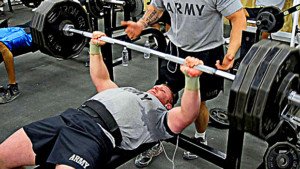
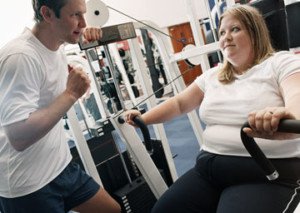
Bench Press and Seated Chest Press
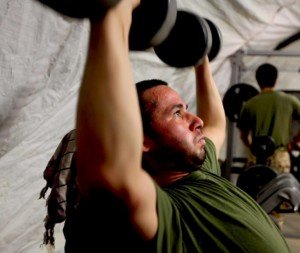
Overhead Dumbbell Press

Lat Pull-Down
Lorra Garrick has been covering medical, fitness and cybersecurity topics for many years, having written thousands of articles for print magazines and websites, including as a ghostwriter. She’s also a former ACE-certified personal trainer.
.
Top image: Shutterstock/Suzanne Tucker
Source: sciencedaily.com/releases/2012/10/121024141631.htm
Why You Have Pain Soon After Revision Knee Replacement
Is your knee pain worse after revision surgery even though at first it wasn’t so bad?
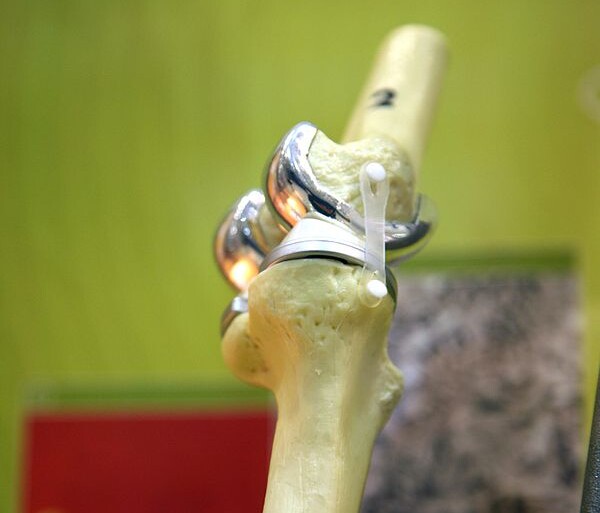
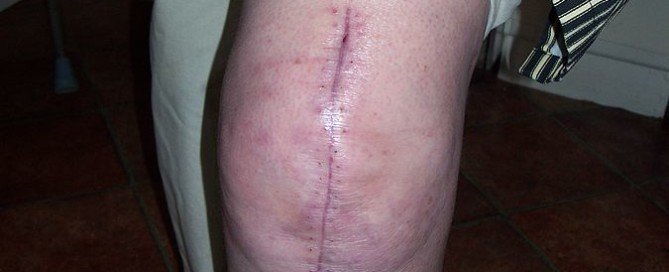
A knee revision surgery is when a failed or loosened implant is replaced in part or whole by new hardware, but what does it mean if soon after this procedure, the knee pain is a 9 or 10 out of a 10 pain scale?
Might this mean that the knee revision surgery failed? My father recently had a knee revision surgery.
In the several days after the knee revision surgery, while he was still in the hospital, he reported that everything felt fine, other than the surgical pain, which is to be expected with these procedures.
He spent four days in the hospital. The fourth night after the knee revision surgery, he slept at his house, and next morning, reported that the knee felt good (there was pain, of course, but this was related to the procedure).
However, next day, he said it was hurting bad and became concerned. I noticed that he wasn’t walking as much (the doctor told him to use a walker for the next three weeks, then a cane for three weeks after that).
The next day it was still worse, and he couldn’t help but wonder if the knee revision surgery actually failed, even commenting that maybe something in there was loose.
Interestingly, his physical therapist, who came to the house, noted some oozing from the incision, and decided that this, in combination with the severe pain, might mean an infection.
The PT contacted the surgeon’s office; he was told that my father should report to the emergency room.
I drove him there. The ER doctor said the knee didn’t appear to be infected. An X-ray was normal.
A blood test also was normal. An orthopedic physician’s assistant then examined the incision, feeling the joint, and said everything was normal. So what was up with all the pain?
The P.A. explained that after knee revision surgery, the patient is up and walking within 24 hours. Each day after, the patient walks a little more, feeling “great.”
Then come maybe the fifth or sixth day after knee revision surgery, the patient reports an increase in pain, sometimes dramatic.
This is because, said the P.A., the joint has become overworked. The patient typically cuts back on walking and becomes more inactive. This gives the joint a chance to recharge.
When the pain diminishes, the patient eagerly begins walking again, and may again overdo it, bringing on a resurgence of the pain.
It’s an up and down cycle, said the P.A., that can persist for a few weeks, but over time, as the joint heals, it won’t respond so much with pain from all the walking.
My father had a follow-up visit a few days after with his primary care physician, who basically said the same thing.
The joint looked perfectly normal, and that pain comes from walking too much (which doesn’t necessarily mean a marathon — remember, knee revision surgery is very traumatic to the joint, and what seems like normal walking about the house can easily qualify as “overdoing it”).
If you’ve recently had knee revision surgery and the pain has suddenly gotten worse, this might be due to “overdoing it,” but get a prompt follow-up with your primary care doctor to be sure.