Strength Training for Prader-Willi Syndrome

Here’s why people with Prader-Willi syndrome should train with weights (strength training).
One of the classic features of the genetic condition of Prader-Willi syndrome is that of very poor muscle tone — the result of low muscle mass. Patients also have a very slow metabolism.
Muscle is the body’s most metabolically active tissue—it burns more calories just for sustenance than any other body tissue. This is something that every fitness expert knows.
Personal trainers, such as myself in the past, push the idea of performing compound strength training to boost resting metabolism.
A person with Prader-Willi syndrome will experience an increase in resting metabolic rate by building lean muscle tissue via compound strength training.
Curling dumbbells (biceps curls) is perhaps the most common weightlifting exercise.
Beginners are notorious for spending inordinate amounts of time curling.
However, it’s a very inefficient exercise for raising metabolic rate because it essentially works only one muscle group, the biceps.
This is a very small muscle group, and working it even very hard won’t do much to increase metabolism.
To get the greatest bang for the buck, a patient with Prader-Willi syndrome should perform compound strength training: more than one muscle group at once…and large muscle groups at that.
So instead of the biceps curl, the trainee would do a deadlift, bent-over dumbbell row, standing barbell row, lat pull-down and seated row.
Of these compound exercises, the deadlift is perhaps the best.

Shutterstock/Reshetnikov_art
Though this exercise is performed in strongman and powerlifting competitions, it’s one of the simplest movements to learn!
Don’t let the simplicity or “un-fanciness” of the deadlift fool you; this is one of the best exercises ANYBODY can do, including those with Prader-Willi syndrome.
Get Cleared by a Doctor First
Scoliosis (abnormal curvature of the spine) is another feature that often comes with Prader-Willi syndrome.
The patient should be cleared by a physician for strength training, particularly the deadlift.
Some strength training movements can be contraindicated by scoliosis, though not all PWS patients have this spinal problem.
People with Prader-Willi syndrome can gain muscle mass.
This was demonstrated in a study (J Pediatr 2003;142:73-8). Children and adolescents with PWS performed standing calve raises.
This is an isolation exercise (non-compound), but was chosen for the study because it’s super easy to perform and requires only a stair to do, rather than weightlifting equipment.
The report states: In persons with PWS, a well-defined and easy-to-accomplish training program improves local body composition and has generalized effects on physical activity and capacity, opening up a new therapeutic option to improve metabolic conditions.
If this is the conclusion of a study involving mere calve raises, imagine the metabolic effect that compound weight training (e.g., deadlift, overhead barbell press, bench press, lat pull-down) would have.
Working several muscle groups at once means that much more of an increase in lean muscle tissue—translating to an increase in resting metabolism.
This will have a positive effect on body weight management.
Other compound exercises to consider: flat and incline bench press, incline dumbbell press, seated chest press, leg press, kettlebell swing and weighted walking lunge.
There are many variations of the squat, but the Prader-Willi patient could benefit from whichever version he or she feels most comfortable with.
Some form of squatting (with a doctor’s clearance if the patient has scoliosis) should be included in the strength training program.
You may be thinking that a person with PWS should stick to “simpler” strength training such as using only machines, using tension bands and using very light dumbbells for various arm movements.
However, people with Prader-Willi syndrome perform in various sports for Special Olympics that require more coordination than a bench press, kettlebell swing, lat pull-down, leg press, squat and deadlift. They even do martial arts.
When Evan Matesavec was six years old, he achieved a black belt in taekwondo. At that time he was doing 25-30 pushups and has Prader-Willi syndrome.

Evan Matesavec in 2013
People with Prader-Willi Syndrome will benefit from “big” compound strength training movements.
The compound exercises I’ve mentioned require either standing in one spot, sitting or lying down (with the exception of the walking lunge).
Though my recommended strength training exercises are highly effective when performed for increasing healthy muscle mass, they are also very simple to do.
 Lorra Garrick is a former personal trainer certified by the American Council on Exercise. At Bally Total Fitness she trained clients of all ages for fat loss, muscle building, fitness and improved health.
.
Top image: crossfitpowervalley.comblogarchives06-2016
Sources: globalgenes.org/raredaily/evan-with-prader-willi-syndrome-uses-taekwondo-to-show-his-fighting-spirit/ and gwinnettdailypost.com/news/2013/feb/27/6-year-old-battling-rare-syndrome-goes-for-black/

Colon Cancer Diarrhea vs. IBS Diarrhea: Is There a Difference?

A gastroenterologist discusses differences between colon cancer diarrhea and the diarrhea caused by IBS.
Do they look the same? How are they different?
You may have read that “constipation alternating with diarrhea” is a possible symptom of colon cancer.
The alternating feature here is a red flag (though benign conditions can also cause this).
But what about just plain diarrhea…without any constipation?
“Diarrhea is a rare symptom of colon cancer,” says Pankaj Vashi, MD, Lead National Medical Director, National Director, Gastroenterology/Nutrition/Metabolic Support, Cancer Centers Treatment of America.
“Diarrhea is usually related to travel, food allergy/intolerance or inflammation/infection in the bowel. Chronic diarrhea can be seen in IBS.
“Every patient with diarrhea should have a thorough evaluation including a detailed history and physical, stool, radiological and endoscopic studies before labeling it to be secondary to IBS.
“Diagnosis of IBS in a patient is usually made after excluding other treatable conditions.”
Don’t accept a diagnosis of irritable bowel syndrome until every other possible cause of your diarrhea has been ruled out, and that will require extensive testing.
Sudden-onset diarrhea, in the absence of having recently traveled or taken a new medication that can cause the side effect of diarrhea, can be alarming.
This happened to me. Where did my diarrhea suddenly come from? And it looked really weird, too.
Right away, the gastroenterologist’s nurse, as I was being prepped for a colonoscopy, mentioned that it could be IBS.
He also mentioned that it could be stress related, and he told me that his divorce had caused him to have diarrhea for three weeks.
But I was betting that his diarrhea didn’t look abnormal like mine did.
A doctor needs to look inside your colon, among other tests, before it’s determined that you have IBS.
Diarrhea, even weird looking, is a common symptom in the mass of population, though it CAN be caused by colon cancer. But it’s not a hallmark feature of colon cancer.
My diarrhea turned out to be caused by microscopic colitis (colon tissue samples are viewed under a microscope for diagnosis), a benign condition that does NOT increase the risk of colon cancer.
 For 20 years Dr. Vashi was instrumental in developing robust gastroenterology, and nutrition and metabolic support programs in all five Cancer Treatment Centers of America centers.
 Lorra Garrick has been covering medical, fitness and cybersecurity topics for many years, having written thousands of articles for print magazines and websites, including as a ghostwriter. She’s also a former ACE-certified personal trainer.
.
Top image: ©Lorra Garrick
Source: cancercenter.com

Are Big Tall Kids Rarely the Victims of Bullies?

It’s a myth that kids who are big or husky hardly ever get bullied.
Ever notice that in TV shows and movies, a boy who’s a bully is almost always bigger than his classmates? He’s taller and has a chubby or husky body, a portly kid.
Oddly, in films when a bully is a girl, she’s usually not big or hefty.
What’s up with the stereotype of a male bully being the biggest kid in the class?
Think back to your grade school and junior high school days.
Remember the bullies? Were they bigger than most kids their age?
Were their victims usually smaller?
Big tall kids are not immune to getting bullied.
Many big and tall kids get harassed about their size — by much smaller classmates.
When you get right down to it, it’s what’s inside that matters—inside that towering or big body, or that petite or slight frame.
And if what’s inside is full of pain, hurt and anger—then the conditions are ripe for producing a bully.

Shutterstock/igor kisselev
Kids don’t become mean just because they’re taller than everyone else or husky.
Ask yourself what is it about being chubby or tall that would make a child mean spirited. It’s a complete myth that a small child can’t bully a larger classmate.
It’s utter nonsense to believe this, yet on an episode of “Judge Judy,” I was livid when she blasted the defendants that their husky tall grade-school boy couldn’t have possibly been the victim of bullying by the plaintiff’s boy—because the plaintiff’s child was a lot smaller.
Judge Judy actually scolded something pretty close to, “There is NO way he bullied your kid; he’s half your kid’s size!” And here I was, thinking, “Judy Dear, where’s YOUR thinking cap?
I’ve witnessed situations in school in which the bully was half the size of the victim!”
Why do kids become bullies?
- Because they’re big?
- Or because of something going on inside the household?
- Do kids really think, “Gee, since I’m half a foot taller than everyone else in my grade, I might as well go around being mean” ??
Though it’s often said that a small child becomes a bully to prevent being bullied by bigger kids, the conditions for this defense mechanism have to already be in place.
I cite the case of a girl I’ll call Kera who went to my junior high school. She was shorter than most kids and had a normal, lean build for an adolescent (her adult height is probably 5-2, based on her relative height back in junior high).
I was told that in grade school (I didn’t attend Kera’s grade school), she was ridiculed as she struggled to learn English, having moved to the States from another country.
It’s logical to deduce that she became a bully come junior high to put an end to being the victim, and maybe some of this was related to her size.
But the conditions had to be there to begin with: lack of support from her parents; no adult role model to help her put things into perspective and deal with adversity constructively.
But small stature, in and of itself, did not turn Kera into a bully.
It didn’t turn Nunzio into a bully either. He was a lot smaller than his victim. Nunzio hardly looked like a bully, being short and scrawny.
His victim was taller, but not taller than average (yes, Nunzio was that short). But the victim was husky and had a good deal of weight on his bully.
So you see, being big, fat or husky doesn’t turn a child into a bully, and being small, skinny or short doesn’t automatically make a child a victim OR a bully.
What makes kids become mean has everything to do with the relationship they have with immediate family members, particularly the parents, and what kinds of behavior they witness among their parents.
Another Explanation for Why Bullies Often Are Smaller, Shorter than Their Victims

Bullying involves “an imbalance of power,” says Israel (Izzy) Kalman, MS, nationally certified school psychologist; director of Bullies to Buddies: and author of numerous books and publications on bullying and relationship problems.. The bully is supposed to be the stronger one, he continues.
However, very often, the bully is weaker than the victim—or apparently so, anyways, i.e., shorter, weighing less.
“But there is a very good reason that the so-called bully is often weaker than their victims,” continues Dr. Kalman.
“We no longer live in nature. If we live in nature and I pick on someone stronger than me, I am insane. They’re going to beat the crap out of me or kill me.
“But we no longer live in nature. We live in civilization. We are not allowed to injure or kill each other.”
So here’s what might be going on inside the bully’s head, though not necessarily word for word, but rather, an overall impression, says Dr. Kalman:
“Today, if I pick on kids who are weaker than myself, I look like a schmuck. If I’m smart, I’m going to look for the biggest kid in the class.
“I’m going to insult him and his mother. I’m going to drive him mad. And if he dares to lay a hand on me, he’s the one who’s going to get in trouble!
“So I’m going to pick on kids who are stronger than me, and everyone will admire me. But if I pick on kids who are weaker than me, I’m going to look like a jerk. No one is going to respect me.”
Final Thoughts
It’s a myth, a stereotype, that a bully is always bigger and taller, or physically stronger, than his or her victims.
Sometimes, the victim of bullying is one of the biggest kids in the class.
 Dr. Kalman is a psychotherapist in private practice and has treated many victims of bullying for over 20 years. He has published extensively on solutions to bullying.
Lorra Garrick has been covering medical, fitness and cybersecurity topics for many years, having written thousands of articles for print magazines and websites, including as a ghostwriter. She’s also a former ACE-certified personal trainer.
.
Top image: Shutterstock/Petrenko Andriy

Can IBS Cause Bloody Mucus?

Is it at all possible for irritable bowel syndrome to cause any bleeding, or blood to appear in the mucus that comes out when you have a bowel movement?
“Mucus is the product of shedding of lining of the large intestine,” says Dr. Saad Habba, MD, an attending consultant physician (gastroenterologist) at Overlook Medical Center in Summit, NJ.
He adds, “It is a reaction to any irritant that may start the process. In IBS, the colon seems to react by shedding some of its inner lining which is expressed visually as mucus.
“In IBS, bloody mucus never occurs. So if one sees blood in any shape or form with or without mucus, the diagnosis of IBS would be erroneous. and one is advised to seek the attention of a gastroenterologist to explain the source of bleeding. Bleeding is never a sign of IBS.”
 Dr. Habba pioneered the concept of IBS being a wastebasket diagnosis and collection of different entities rather than a true single medical condition. He’s been presented and published in 26 national and international medical journals and symposia.
Lorra Garrick has been covering medical, fitness and cybersecurity topics for many years, having written thousands of articles for print magazines and websites, including as a ghostwriter. She’s also a former ACE-certified personal trainer.
.
Top image: ©Lorra Garrick
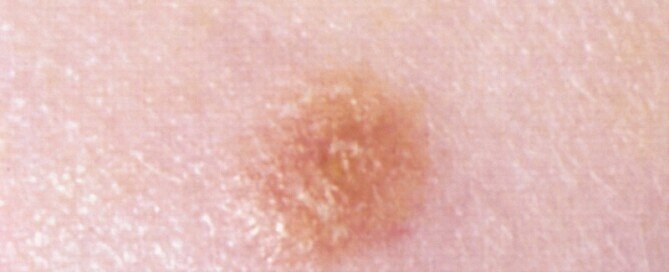
How Common Are Red Moles?
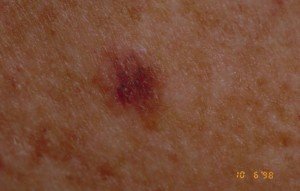
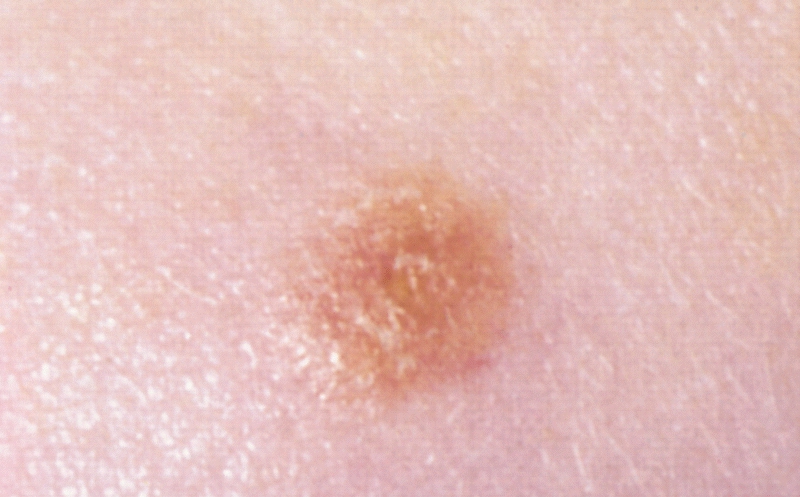
Here is information about red melanomas vs. benign red moles in terms of physical appearance.
“Benign moles can appear reddish in part due to sunburn or irritation,” says Dr. Michael Shapiro, MD, Medical Director and Founder of Vanguard Dermatology in NYC, NY.
Dr. Shapiro continues, “Repeated sunburn to moles will increase the risk of the mole turning cancerous, so use caution when going outside.
“Irritation can make moles red due to chaffing, which won’t directly increase the risk of melanoma, but it’s important to use caution, as it may cause the mole to be more sensitive, increasing its susceptibility to cancer.”
Melanoma vs. Benign Mole
“For most professional, experienced dermatologists, it is fairly simple to define a melanoma spot from a benign,” says Dr. Shapiro.
“However, there are ways to help the average patient to understand the difference from a red melanoma from a red benign spot such as angiomas.”
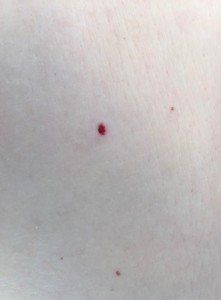
Angiomas
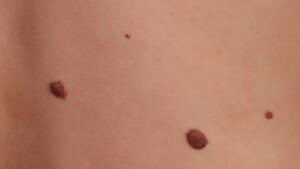
Angiomas (“strawberry marks,” hemangiomas) are concentrations of very tiny blood vessels and appear as red dots or moles on the skin.
They increase with age and can be elevated and quite striking in their strawberry/red color.
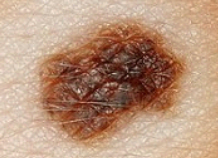
“A malignant spot will differ from a benign mole, in that it will have different variations of the color red or any other color that is not consistent throughout,” explains Dr. Shapiro.
“A malignant mole will also be asymmetrical and bumpy as opposed to a benign mole being symmetrical and fairly smooth throughout.
“While these are some tips to help assist you in self-diagnosis, if you are unsure in any way seek out professional medical attention. Request a biopsy.”
The image at the top of this post is of a melanoma.
Other Red Spots on the Skin
Dr. Shapiro further explains, “There are several different kinds of red or dark pink or magenta benign spots that may also appear on the skin.
“Dermatofibromas are small, firm, typically red bumps caused by an increase of fibroblasts or soft tissue cells under the skin.
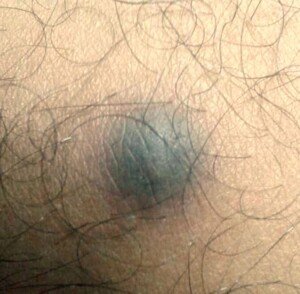
Dermatofibroma. Mohammad2018 CC BY-SA
“They are usually itchy and found on the legs and can be removed through surgery if the pain becomes a severe problem.
“Pyogenic granulomas can also appear on the skin — not to be confused with malignant moles — these are caused by excessive growth of small blood vessels and swelling.
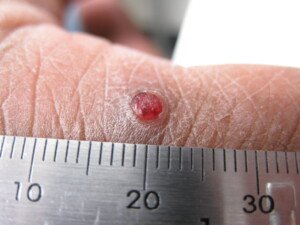
Pyogenic granuloma. Kilbad at English Wikipedia, CC BY
“These are common after an injury to the skin and usually disappear without any treatment.”
If a brown, tan or beige mole starts developing a red portion, immediately see a dermatologist, as this may be a sign of melanoma; a biopsy will rule it in or out.
Keep track of your moles with monthly skin self-exams so that you know which ones are normally red, tan, brown, etc.
 Dr. Shapiro is a board certified dermatologist and Mohs surgeon and has treated over 12,000 Mohs cases for skin cancer. He is widely published in peer-reviewed academic journals.
Lorra Garrick has been covering medical, fitness and cybersecurity topics for many years, having written thousands of articles for print magazines and websites, including as a ghostwriter. She’s also a former ACE-certified personal trainer.
Top image source: howardzzh.com/research/medical/data/book/index.html
How Common Are Grey Moles?
You may have read that moles can be grey in color, but how normal or common is this?
“The most common moles usually have an even pink, tan or brown color,” says Dr. Michael Shapiro, MD, Medical Director and Founder of Vanguard Dermatology in NYC, NY.
“People with darker complexion usually have darker moles than those with fairer skin.
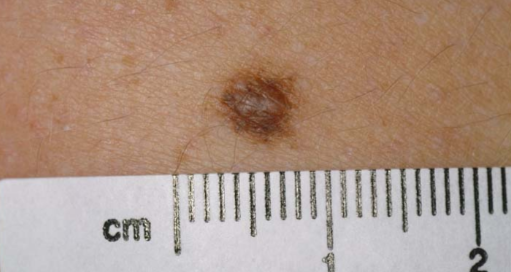
“Grey moles are fairly uncommon and usually seen in discoloration of moles — one of the symptoms of melanoma.
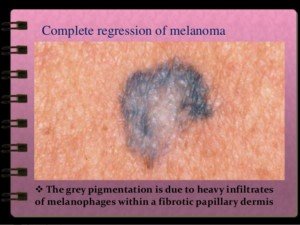
“If the mole changes from its original color to grey, seek out professional medical care.”
A mole that changes colors, regardless of the original color, is suspicious for melanoma skin cancer.
“There’s no specific evidence about patients with grey moles, but I would recommend seeing a doctor if there is any indication of grey or discoloration.”
Data does not exist regarding how common a benign grey mole is. In fact, have you ever seen a grey mole on anyone?
The big question, however, is if a grey mole on your skin used to be the common and normal tan, beige or brown.
A grey mole that was formerly any shade of brown or tan needs to be evaluated by a dermatologist who will likely remove it for a biopsy.
Melanoma often causes a normal pigmented lesion to become altered in color.
Only a biopsy can determine what exactly is going on.
A change in color is a very concerning sign and warrants an immediate evaluation by a dermatologist.
Dr. Shapiro is a board certified dermatologist and Mohs surgeon and has treated over 12,000 Mohs cases for skin cancer. He is widely published in peer-reviewed academic journals.
Lorra Garrick has been covering medical, fitness and cybersecurity topics for many years, having written thousands of articles for print magazines and websites, including as a ghostwriter. She’s also a former ACE-certified personal trainer.
Can Sun Spots Become Melanoma?
Sun spots mean there’s been damage to the skin. Whether or not these might one day transform into melanoma is a fair question.
“While sun spots do not automatically mean skin cancer, people with sun spots are at an increased risk” of melanoma, says Dr. Michael Shapiro, MD, Medical Director and Founder of Vanguard Dermatology in NYC, NY.
Just what is a “sun spot” anyways?“
Sun spots are a result of sun exposure and darken the skin area which also increases its absorbency to UV rays,” continues Dr. Shapiro.
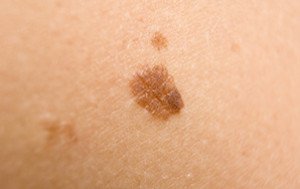
“It is possible for sun spots to become cancerous, so make sure to get these checked if you have any concerns.”
This is a layman’s term that can have more than one meaning.
For example, if you’ve ever seen tan or brownish spots on an elderly person’s hands and forearms, you may have thought of these as sun spots that have accumulated over time, though these are actually more often referred to as age spots.
As people approach 40 and beyond, and even in their 30s, they may begin developing tan to light brown colored spots or speckles on their face — the result of cumulative sun damage in their earlier years that’s finally manifesting itself. Sometimes these are referred to as sun spots.
The term “sun spots” has also been used to refer to a type of skin problem called actinic keratosis, which is quite common in people over 40. This is also known as solar keratosis.
It’s sun damaged skin; the cells are atypical. Actinic keratosis, left untreated, has about a 10 percent chance of turning into cancer — but not the melanoma type.
The skin cancer that the actinic keratosis “sun spot” can turn into is squamous cell carcinoma.
A true sun spot cannot become the melanoma type.
Check with your dermatologist to find out if the lesions on your skin are actual sun spots, freckles, liver spots, age spots, actinic keratoses, etc.
Actinic keratoses, however, almost always are not tan or brown.
They’re pink or reddish, and when you glide your fingertip over these splotches, they feel kind of like sandpaper. They should be removed.
Dr. Shapiro is a board certified dermatologist and Mohs surgeon and has treated over 12,000 Mohs cases for skin cancer. He is widely published in peer-reviewed academic journals.
Lorra Garrick has been covering medical, fitness and cybersecurity topics for many years, having written thousands of articles for print magazines and websites, including as a ghostwriter. She’s also a former ACE-certified personal trainer.
.
Top image: Shutterstock/Image Point Fr
Can a Melanoma on the Face Look Like a Typical Pimple?
“Sometimes, nodular melanoma can resemble a pimple you might find on your face,” says Michael Shapiro, MD, Medical Director and Founder of Vanguard Dermatology in NYC, NY.
“Nodular melanoma spots, unlike pimples, will be asymmetrical and vary in color — from pink to dark brown.
“This type of melanoma is more commonly found in men than women and more so in patients older than 60.
“Nodulars will grow rapidly in thickness as opposed to diameter, much like a pimple — but it may not have a readily visible phase of development, as it may occur beneath the skin’s surface.
“You may not notice drastic changes in the spot over time, which causes most patients to bypass any medical treatment.
“However, if you follow the ABCDE rule and have any of the symptoms, seek professional medical help right away.”
ABDCE stands for asymmetry, border (check for jagged or uneven edges), diameter (increasing is a warning sign), color (change in color or multiple colors are a warning sign) and evolving (a changing mole is a warning sign).
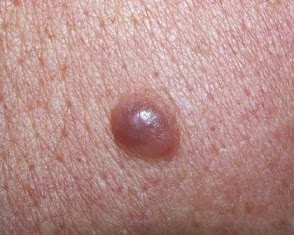
Nodular melanoma
If the “funny” appearance of a pimple bothers you, it’s time to have it checked by a dermatologist.
Another thing to consider is that a pimple will eventually go away, but a nodular melanoma will stay there (until surgically removed).
Dr. Shapiro is a board certified dermatologist and Mohs surgeon and has treated over 12,000 Mohs cases for skin cancer. He is widely published in peer-reviewed academic journals.
Lorra Garrick has been covering medical, fitness and cybersecurity topics for many years, having written thousands of articles for print magazines and websites, including as a ghostwriter. She’s also a former ACE-certified personal trainer.
.
Top image: Shutterstock/wavebreakmedia
Age Spots vs. Melanoma: Appearance Comparison
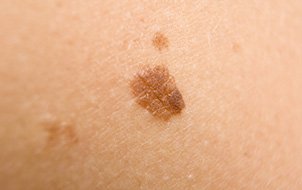
Age spot
Can a melanoma look like an age spot and vice versa?
As people get older, their risk of melanoma rises, but they also start developing age spots.
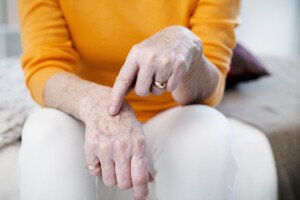
Age spots commonly appear on sun-exposed areas of the skin, such as the hands, face, shoulders and arms.
They are typically a result of prolonged sun exposure and are associated with aging.
Can the physical appearance of age spots and melanoma overlap each other?
“Age spots are linked to both aging and sun exposure,” says Dr. Michael Shapiro, MD, Medical Director and Founder of Vanguard Dermatology in NYC, NY.
“Also known as liver spots or solar lentigines, age spots are typically oval, flat and typically black, brown or grey.”
Can age spots ever develop into skin cancer?
Dr. Shapiro says, “It isn’t scientifically proven that age spots can become melanoma, but they are linked together due to the similarity of sun exposure.”
Physical Appearance Comparison
Dr. Shapiro explains, “Age spots differ from melanoma in that they are typically oval, flat and brown in color as opposed to the asymmetrical, discolored malignant spots.”
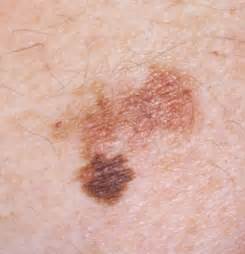
An extremely asymmetrical melanoma
“Malignant spots will also be itchy and may cause oozing or bleeding, while age spots don’t have that effect.”
It’s possible for a malignant tumor not to be itchy, however.
It’s also possible for an age or liver spot not to be oval, but a little asymmetrical.
But the asymmetry won’t be as pronounced as it often is in a melanoma lesion.
When someone develops multiple age spots over time, they look pretty much the same, though with varying size.
Clusters of age or liver spots. Shutterstock/Image Point Fr
Usually, a melanoma simply will not look right. It will stand out in appearance from any nearby benign lesions.
It will be the oddball, the funny, weird or ugly looking spot that doesn’t resemble the others.
That’s the one that should get your attention and get evaluated by a dermatologist.
Melanoma can be brown, black, tan, grey, red, pink and even flesh colored. It can even have blue, shades of maroon and even white in it.
And in addition to being asymmetrical, this cancer often presents with jagged or erratic edges, or more than one color in the lesion, such as both brown and grey.
Another suspicious sign is that some portions of it may be elevated.
Yet another alarming sign is part of the border “leaking” out (in appearance, not literally) into the surrounding skin.
Dr. Shapiro is a board certified dermatologist and Mohs surgeon and has treated over 12,000 Mohs cases for skin cancer. He is widely published in peer-reviewed academic journals.
Lorra Garrick has been covering medical, fitness and cybersecurity topics for many years, having written thousands of articles for print magazines and websites, including as a ghostwriter. She’s also a former ACE-certified personal trainer.

Are You Fit Because You Do Housework?

If you suddenly decide that housework counts as true exercise, does this then magically make it so?
One of the biggest gimmicks over the past decade or so is this idea that housework gets included in the daily exercise quota.
So now, all that housework you’ve been doing for years counts as a workout.
Now that you’re convinced of this, will the weight start dripping off your body? Will your heart now become fitter, bones stronger, back stronger?
You’ve been doing housework all along. So if it’s such good exercise…why do you still sweat and feel wiped out after a major event like cleaning the oven, the bathroom, the garage, etc.?
As a personal trainer, I’ve never told my clients that any cleaning they do around their house can replace structured aerobics or strength training.
I’ve never told them, “On the days you don’t have a session with me, you don’t have to exercise because you already have a built-in workout regimen: housework!
Just go about your day as usual, and whatever cleaning you do is your exercise for that day!”
Cleaning your home is a constant; this constant is there every day. Yes, every day, you do some form of cleaning or chores.
To reap results like fat loss, body transformation, toned muscles, a durable low back, stronger joints, improved heart function, etc., you must CREATE A VARIABLE. It’s called strength training and aerobics.
I had one client who would tell me about all the cleaning she was doing in the new house she bought.
Prior to moving in, she had no idea what was in store for her. The previous owners left certain things a total mess.
She’d describe for me the tasks, which included cleaning out gobs of dead moths.
Despite all this cleaning, she was in very bad physical condition. She was very weak and had poor aerobic capacity.
Only when she began training with me did she start gaining strength, losing abdominal fat and looking better.
When it’s time to change a flat tire or shovel heaps of wet snow, what will come through for you?
- All the housework you’ve been doing?
- Or the deadlifts, weighted squats, dumbbell bent-over rows, kettlebell swings, pushups and barbell shoulder presses?
Be sensible. Don’t get caught up in gimmicky fad thinking just to excuse yourself from knowing what you need to do.
Putting your fussy child in a car seat, then taking him out, hardly compares to one set of breath-taking squat jumps holding a 10 pound dumbbell in each hand.
Even if you wrestle with the child several times a day with the car seat…there’s just no comparison.
WORKOUT
- A good set of heavy kettlebell swings to exhaustion
- followed by a 30 second rest
- followed by pushups to exhaustion
- then a 30 second rest
- then jump-switch lunges for one minute (yes, deal with the searing burn in your thighs and butt)
- 30 second rest
- then one minute of burpees
- 30 second rest
- concluding with one minute of bodyweight squats … I guarantee you, this will do significantly more for your body than will two hours of cleaning the house.
Lorra Garrick is a former personal trainer certified through the American Council on Exercise. At Bally Total Fitness she trained women and men of all ages for fat loss, muscle building, fitness and improved health.
.