Why Zumba Classes Should Not Be So Crazy Loud

You will damage your hearing if you keep attending Zumba classes unless you wear significant ear protection.
Has it ever occurred to you, the Zumba enthusiast (either as a participant or instructor), that the volume of the music is harmful to your hearing? It is LOUD!

Zumba Classes Are Way Too Loud
Rachel Raphael, M.S., CCC-A, is a group fitness instructor (e.g., BodyPump and BodyStep) and also an audiologist with ENT Baltimore.
Raphael’s classes follow the Les Mills design for choreographed classes of exercise to music.
She explains, “The Les Mills slogan is ‘Turn It Up’, whereas my motto (as an audiologist who knows the risks of loud music) is ‘Turn it Down!’ I know it’s important to carefully balance the beat/volume of the group fitness music between being motivating and keeping it at safe levels!”
It doesn’t matter if it’s BodyPump, Zumba or a step class—pounding, battering music will cause hearing loss over time.
Think of exposure to thunderingly loud music like excessive exposure to sunlight. The damage is cumulative, and people respond differently.
Raphael says, “I’ve seen too many times the effect loud music can have on (mostly musicians’ and concert goers’) hearing loss, even though the damage (sensorineural or nerve type damage, with possible tinnitus as a secondary symptom) doesn’t usually show up immediately; can take many years.”
Zumba participants walk out of the class feeling energized, feeling as though they just did their body so very good.
But they put their ears in harm’s way. If you sprain an ankle in a Zumba class, you’ll immediately feel the pain.
If some nerve cells in your inner ear have been killed off by the loudness…you most likely will not feel any pain or other symptom.
Raphael explains that an immediate result of the loud volume is something called temporary threshold shift.
This is temporary hearing loss from excessive volume—but you may still not be aware of it!
After all, you exit the class and walk into the open area of the gym, which may be too loud for you to detect that you have a temporary threshold shift.
At one of the gyms I attend, the room where the Zumba class takes place opens up to the free weight area where music is played in overhead speakers.
Reams of women file out of the Zumba class at the end; that’s a lot of noise that can mask a temporary threshold shift: many women talking, plus music overhead, plus the clanging of weightlifting equipment.
At another gym I attend, the Zumba classroom is right next to the cardio equipment area.
During prime time, when the class lets out, participants walk straight into an environment loud with plenty of cardio machines going, especially the noisy treadmills. They’ll never notice they have a temporary hearing loss.
Even if you walk out into a quiet environment following a Zumba class, you may still not be able to detect the temporary threshold shift.
It’s painless. You simply head straight to your locker, or maybe you head for the dumbbells or straight to your car. Why would you necessarily notice you have this shift going on?
Temporary threshold shift can become permanent. Raphael says that temporary threshold shift can “become more permanent with repeated and ongoing exposures.” Need I repeat this a third time?
Solutions to Loud Zumba Classes
You’re health-conscious, right? Why would you want to sacrifice sharp hearing? You don’t have to.
You can’t get lost hearing back. Noise induced hearing loss is permanent over time.
And don’t think your ears will toughen up and become resistant. This is a myth. It’s like believing that the more you jump on that sprained ankle, the stronger it will get!
Hearing loss CONTINUES as long as you continue to be in the loud environment, even if you already have hearing damage.
Did you know that an older person who’s very hard of hearing will STILL receive injury to the nerve cells in their ears as long as they’re in a loud environment, even if they don’t perceive it as loud (due to their hearing loss)?
So don’t think for a second that your ears have been damaged so much that it no longer matters! And by the way, you cannot reverse hearing loss.
All of this is well-documented in medical literature. Make some hardcopies and present them to your Zumba instructor.
Hollering into the microphone, by the way, exacerbates the seriousness of the problem.
If your Zumba instructor fails to get any of this, then all you can do is have custom made earplugs made or find a brand that works very well.
They will muffle enough decibels to make the environment safe for your ears.
Or, you can wear the ear muffs that people in loud factories wear.
Are you afraid of what other class participants will think if they see the muffs or notice the ear plugs?
- Don’t rank YOUR hearing health below the opinions of people who choose to remain ignorant.
- If you do you’ll one day regret it dearly.
To be blunt…it just SUCKS being hard of hearing. Ask anyone who is.

Rachel A. Raphael specializes in clinical audiology and hearing aid dispensing. She helps in the diagnosis of hearing loss, tinnitus, dizziness and vestibular pathology in adults and children.
 Lorra Garrick has been covering medical, fitness and cybersecurity topics for many years, having written thousands of articles for print magazines and websites, including as a ghostwriter. She’s also a former ACE-certified personal trainer.
.
Top image: zumba class TV Jahn-Rheine 1885 e.V.
Does Popeye’s Elbow Always Hurt?
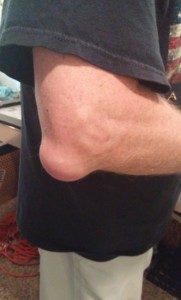
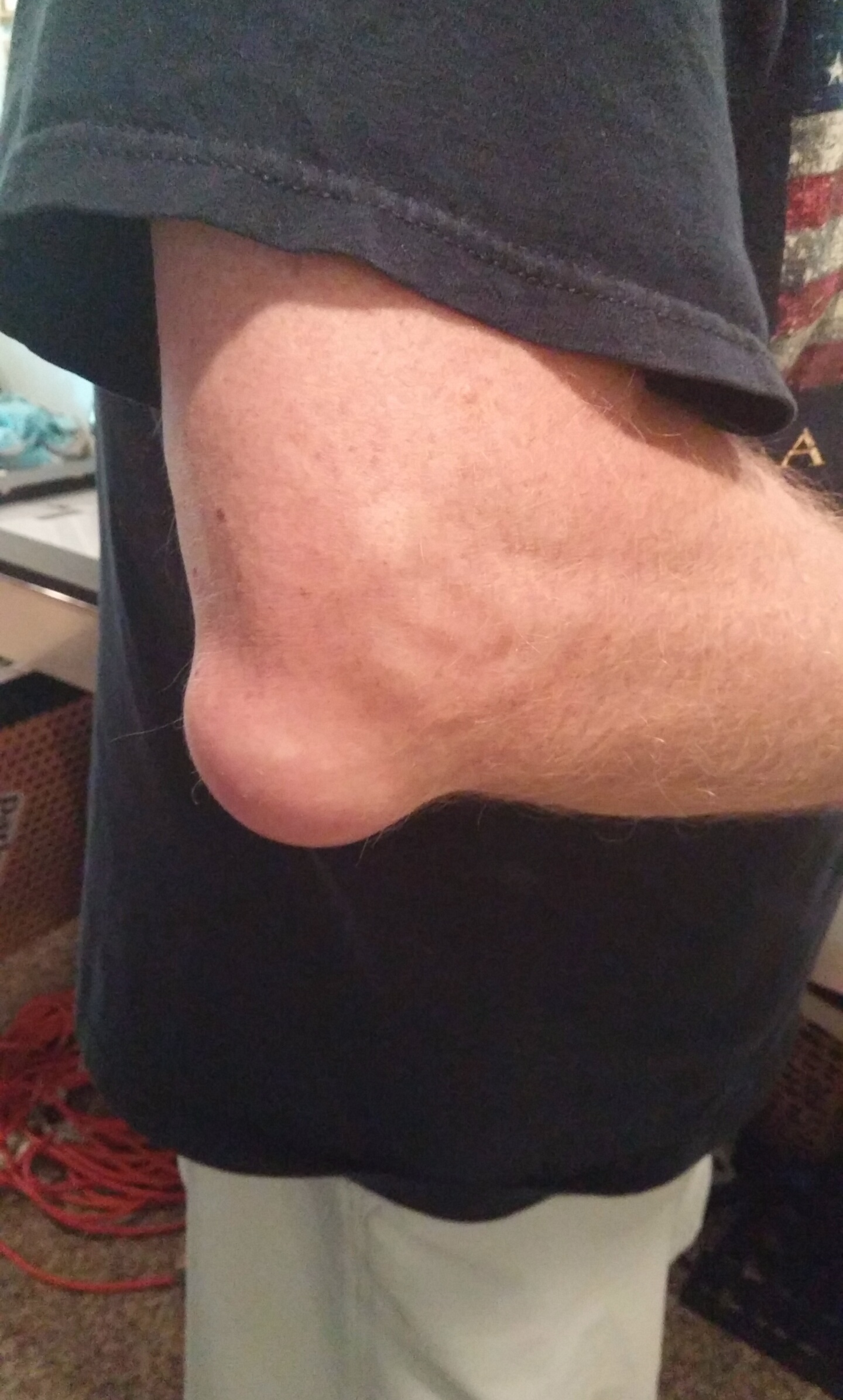
As funny and goofy as Popeye’s elbow looks, one has to wonder if this bizarre condition always comes with pain.
Though Popeye’s elbow (olecranon bursitis) is associated with pain, it can also be painless — as in completely.
I know this because my mother was diagnosed with Popeye’s elbow. There was a superball-sized “bump” at the joint.
It was soft (because this condition is an inflamed sac that’s filled with fluid of the bursa).
And as much as it looked like the classic Popeye’s elbow, it was 100 percent free of pain.
It wasn’t even tender or sore. She noticed it only when she just happened to look there shortly after awakening in the morning.
It didn’t even hurt when she was sitting at a table leaning on it (which was the obvious cause).
My mother’s Popeye’s elbow didn’t hurt at all when she or I touched the affected area.
Nor was there any pain when she flexed or extended the joint, carried groceries or worked in the kitchen.
The physician’s assistant told her to just let time dwindle down the inflammation. It wasn’t even red.
The PA told her it may take days, a few weeks or even a few months for it to go down, but in the meantime, she could put a band around it.
So yes, it is possible for olecranon bursitis to come without any pain.
If you see someone with Popeye’s elbow…don’t assume that it hurts just because it looks so strange.
“Popeye’s arm is not always painful,” says Dr. Dave Candy, a board certified specialist in orthopedic physical therapy.
“ A bursa is just a fluid-filled sac, and if the bursa ruptures, the fluid leaks out.
“Unless the fluid gets infected though, the swelling itself is not painful.”
 Dr. Dave Candy, PT, DPT, is a specialist in orthopedic physical therapy and owner of More 4 Life. He’s the author of Chronic Pain: You’re Not Just Getting Older, You’re Not Crazy, And It’s Not All In Your Head, available on Amazon.
Lorra Garrick is a former personal trainer certified through the American Council on Exercise. At Bally Total Fitness she trained women and men of all ages for fat loss, muscle building, fitness and improved health.

If You’re Dizzy Should You Get a CT Scan in the ER?

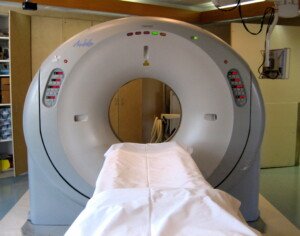
When is dizziness serious enough to warrant a head CT scan, being that this procedure emits radiation to the brain?
Many people go to the ER for feeling dizzy.
The sudden onset of what the patient can only describe as “dizziness” can be quite frightening, especially when they fall or feel nauseous as a result.
They may need to quickly sit down or even fall on the way to a chair.
Kaiser Foundation Hospital researchers reported that less than 7.1 percent of patients in the ER complaining of dizziness benefited from a head CT.
About only 6.4 percent of patients with faintness benefited.
The CT scan is fast and easy, but apparently much overused, says this study.
But ultimately, the ordering of a head CT should be based on each patient’s unique situation, including their medical history, rather than a percentage from a study.
Doctors definitely want to make sure they cover all their bases when dealing with dizziness in patients — which could have both benign and serious causes.
So it’s easy to understand when in general, CT scans are over-ordered.
After all, what if a scan isn’t ordered, and it turns out the patient had a brain tumor, which then caused a seizure while they were driving the next day — resulting in a fatal car accident?
On the other hand, it just wouldn’t be logistically possible for every single patient who reports dizziness to have a head CT scan.
When to Get a CT Scan of Your Brain
Liz West, Boxborough, MA, CC Wikimedia Commons
“Dizziness is a common complaint in general practice, and the severity of the symptoms we see is likely to be milder than those seen by hospital doctors,” says Dr. David Beatty, MD, a retired general practitioner with 30+ years of experience and an instructor of general medicine for 20+ years.
“It’s important to work out whether the patient is lightheaded and feeling they might faint, or whether it is vertigo — more of a spinning sensation.”
Feeling faint is not the same as dizziness, and the patient needs to be clear about that when describing symptoms to a doctor or physician’s assistant.
If the patient has only one symtpom — dizziness or lightheadedness — the CT scan is unlikely to be necessary.
A doctor or P.A. will check for neurological signs that increase the suspicion of a more serious cause of the dizziness.
Worrisome neurological signs include: increasing headache pain, deteriorating level of consciousness or increasing drowsiness, speech problems, vision problems and weakness.
Another very concerning sign is vomiting, though that can be caused by benign vertigo.
A careful medical history should also be taken.
Often, with only one symptom (feeling dizzy) and a non-eventful medical history, there won’t be a need for a CT scan, but the patient will be advised to follow up with their primary care physician the next day.
How about when to go to the ER for dizziness?
“If symptoms are getting progressively worse this would be a bad sign,” says Dr. Beatty.
He also points out that benign paroxysmal positional vertigo can be so severe that the sufferer can’t even walk. An ER visit is in order.
BPPV is easy to diagnose, and, while the patient is lying down, the doctor will move his head to resettle the natural crystal-like structures floating around in the inner ear.
“If there are other neurological symptoms like loss of power, speech difficulty, loss of coordination, bad headache or double vision, consider the ER.”
 Dr. Beatty has worked in primary medicine, surgery, accident and emergency, OBGYN, pediatrics and chronic disease management. He is the Doctor of Medicine for Strong Home Gym.
 Lorra Garrick has been covering medical, fitness and cybersecurity topics for many years, having written thousands of articles for print magazines and websites, including as a ghostwriter. She’s also a former ACE-certified personal trainer.
.
Top image: Shutterstock/sirtravelalot
Source: sciencedaily.com/releases/2015/01/150126112438.htm

Suicide Attempt by Bullied Teen: Shall We Blame the Parents?

Is it possible that a bullied teen could feel helpless enough to try suicide because their parents have shamed them for their troubles?
Maybe the parents have always been critical, and that certainly would not have ever helped a bullied teenager feel hopeful about the future.
This isn’t about blaming the parents. It’s about explaining how the parents fit into the equation of kids attempting suicide (whether they succeed or not) as a result of bullying.
There are people who insist that when a teen or adolescent becomes suicidal “because of” bullying, there has to be much more to it—namely, bad parents who make their kids’ lives miserable.
The bullying at school or online only compounds things.
“This has become a popular idea,” says Israel (Izzy) Kalman, MS, nationally certified school psychologist; director of Bullies to Buddies: and author of numerous books and publications on bullying and relationship problems.
“But this is because most people, even those who take a hard line against bullying, protesting about what a horrible, intolerable problem it is, and demanding the harshest punishments for bullies, have a hard time believing that kids will actually kill themselves for no other reason than that they are being bullied. They assume the parents must be making them miserable as well.
“I strongly disagree with this. Of course this can be the case, but it is not a necessary condition. I have worked with a number of kids who were suicidal because of being bullied, and as far as I could discern, the parents were positive and supportive.
“But as kids come closer to adolescence, relationships with peers become increasingly important to them.
“If they feel their peers don’t accept them, it far outweighs the benefits of parental support.”
I’m going to stop here for a moment and remind you of a phenomenon you may have learned in a psychology class called “learned helplessness.”
There are famous studies done with rats and monkeys that demonstrate this. But learned helplessness happens in humans all the time.
Bullied Teens Learn to Be Helpless from the Parents
Dr. Kalman says that in most cases of bullying, “the parents become as depressed as the kids because they suffer their children’s pain. They will often try hard to make their kids feel better, getting them professional help and pressuring the school to make the bullying stop.
“But the parents’ misery only compounds the kids’ misery, and the parents’ helplessness in trying to make the bullying stop reinforces the kids’ sense of helplessness as well.
“They feel so hopeless because even their parents and the school cannot make the bullying stop. So they feel they have no way out, and they take their own lives.
“The truly sad thing is that such kids can be saved quite easily. However, the adults who are trying to help them do not know how to teach them to solve their problems.
“Many of my bullied clients had been in counseling or therapy and it did nothing to help them stop being bullied.”
The Impact Parents Have on Their Bullied Children

Freepik.com
Below are selected comments, copied-and pasted (not edited; there are typos, poor grammar) from people who, as teens, were bullied and who attempted suicide.
Each paragraph pertains to one post (seven paragraphs = seven different posters).
Suicidal Bullied Kids Place Blame on Their Parents (and other family members): Actual Posts
“I attempted suicide at 14 because my family turned on me as some horrible kid for skipping school and at school i was spit on daily and assaulted regularly.”
“My mother was the biggest bully in my life. All my growing up years Mother Dearest bullied myself and my sister mercilessly after our father walked out (because he could not stand my mother anymore).
I and my sister were both suicidal almost all throughout our teen years but especially she was at age 13 and I really had to watch her closely because I was afraid she really would take her own life then.
I also knew I had nobody in my world who would understand my pain if she didn’t live through that.
Yes there were bullies at school and yes they totally exacerbated the problem, especially for her. It really hurts when you can’t go to your own mom about bullies because the biggest bully in your life is her.”
“As a teen, I struggled with depression. I became suicidal. It was NOT a result of bullying, even though I had been. I went to my mother for help. You know, since parents are supposed to listen.
She would roll her eyes and tell me to get over it, because teens can’t get depressed and have no idea what depression is really like.
She was also aware of the situation that started the downward spiral and didn’t believe that either.”
“I’ve thought about taking my own life since I was seventeen. Actually attempted several times. I should have been on meds and seeing a therapist as a teenager.
My family, however, viewed therapy as a personal attack on them and the way they were raising me. I was told to quit whining and grow up.
How many teenagers in this country are dealing with just this kind of home life?”
“I have found from dealing with a family member who has attempted suicide 3 times in his life last being 15 years ago that he grew up in an abusive home was bullied etc. it was more that fact that as he says the people that should have cared didn’t it wasn’t the bullying it was other family members not being there. they tried professional help etc but it’s not just getting them the help its really having to reassure them that you are there for them and not going anywhere and what they mean to you and others who do really care.”
“I attempted suicide as a young teen and in my case it was because of bullying and being the one to get blamed for everything at home.
My mother always said that I was just like her sister, with whom she always had a rocky relationship. I have come to realize that is the reason she always treated me like I was the family demon.
The truth was that I had a more adventurous spirit than she or my older sister and she couldn’t relate to or accept it.”
“I tried twice, once when I was just 14 the other when I was 23.. I came from a broken and violent home.
I was picked on as a kid because we were so poor we would have to wear the same clothes to school twice in a row and of course we didn’t have much.
My attempts had far more to do with my parents and their screwed up issues than it did with bullying, but just like him [a suicide survivor featured in the Yahoo article] I think it did affect my self worth and made it easier for me to attempt suicide since I didn’t think I was worth anything.”
Are the parents of a suicide victim who was bullied partly to blame for the child’s actions? You be the judge.
 Dr. Kalman is a psychotherapist in private practice and has treated many victims of bullying for over 20 years. He has published extensively on solutions to bullying.
Lorra Garrick has been covering medical, fitness and cybersecurity topics for many years, having written thousands of articles for print magazines and websites, including as a ghostwriter. She’s also a former ACE-certified personal trainer.
.
Top image: Shutterstock/Milles Studio
Source: shine.yahoo.com/parenting/survivors-teen-suicide-attempts-prevention-not-always-bullying-212800410.html

Acid Reflux in Nose (LPR): Cause, Solutions, Long-Term Effects

An ENT doctor explains all about acid reflux burning in the nose as part of LPR, plus cause, how to prevent and long-term effects if it keeps happening.
Acid reflux can shoot up into the nose. After this happened to me, stinging my nasal cavity, as a result of eating too much too quickly, I decided to write an article about it.
LPR is acid reflux that makes it up to the throat—and sometimes…the nose.
Acid Reflux and the Nose
“Acid reflux is very common, indicted by the isle of medicines in the pharmacy devoted to it,” begins Dr. Stacey Silvers, MD, of Madison ENT & Facial Plastic Surgery in NYC, who is board certified in otolaryngology—specialty of the ears, nose and throat.
ENT physicians deal a lot with LPR (laryngeal pharyngeal reflux).
“Many of us have it and are unaware that our symptoms are reflux related.
“Throat clearing, hoarseness and dry cough are amongst the most common symptoms of ‘silent reflux’ or laryngopharyngeal reflux (LPR).”
LPR can be episodic (occasional or periodic), frequent or ongoing/chronic.
“Many of us, however, do experience acid or burning in the chest and back of the throat which are classic symptoms of GERD or gastroesophageal reflux disease,” continues Dr. Silvers.
“Some people may even experience the stomach acid contents reaching the back of the nose.
“When this happens, especially if the body is not prepared, one experiences significant burning and pain in the back of the nose.
“Hydrochloric acid (stomach acid) has a pH of 2 which is very acidic.
“These and any reflux incidents can happen when eating too much, too fast and increasing activity soon after.”
In my case, I wolfed down a lot of food, and immediately after, experienced a little reflux spurting up my esophagus, up my throat and higher, into my nasal cavity.
I instantly felt the burning. It was really weird.
But this is NOTHING to be scared of. It’s just stomach acid. It won’t stay there forever. In my case it persisted for a few minutes, then suddenly was gone.
But what if you get acid reflux in your nose on a frequent basis?
Dr. Silvers explains, “If these occurrences become frequent the body can learn to protect itself by producing a thick mucus in the throat and we will experience ‘post-nasal drip’ (a symptom, not a diagnosis).
“This is a frequent symptom of chronic silent reflux [LPR].
“These reflux episodes in the throat and nose explain why refluxers are more prone to bronchial infections, throat infections and sinus infections.”
You don’t have to worry about getting cancer in your nose from acid reflux going up there.
“The acid changes our healthy protective bacterial flora, making us more susceptible to unwanted infectious bacteria,” adds Dr. Silvers.
“Chronic GERD sufferers should work with a gastroenterologist to assure that the acid has not caused stomach and esophageal problems.”
Though acid reflux going up into the nose won’t cause cancer, chronic GERD can increase the patient’s risk of esophageal cancer.
This is a condition called Barrett’s esophagus.
Prevention of Acid Going into the Nose
“Chronic LPR sufferers should see an ear, nose and throat specialist to have the throat examined.
“Most importantly, avoid late night eating, eat slower, avoid excessive highly acidic and processed foods. Medications are available if these conservative regimens fail.”
 An NYC expert in ear, nose and throat care, Dr. Silvers has been named among America’s Top Physicians and Surgeons in facial plastic surgery and otolaryngology numerous times since 2003. Dr. Silvers is an expert in the field of minimally invasive rhinology, resolving patients’ breathing and sinus problems with simple in-office procedures.
Lorra Garrick has been covering medical, fitness and cybersecurity topics for many years, having written thousands of articles for print magazines and websites, including as a ghostwriter. She’s also a former ACE-certified personal trainer.
.
Top image: ©Lorra Garrick

Child Says Fidgeting Burns Calories Years Before Research
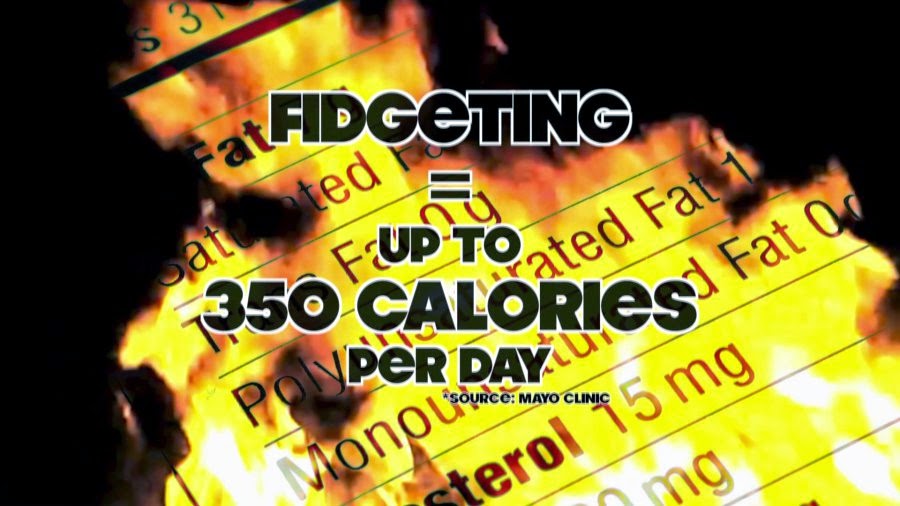
A teacher blew off a 13-year-old’s proposition that fidgeting burns calories, which, many years later, was proven by research to be true.
When I was 13, I was a freshman at a Catholic high school. There was a nun, Sister Jeane Francis.
She one day commented that I had a tendency to fidget while seated in her class. The fidgeting consisted of moving a crossed leg up and down repeatedly, or just repeatedly flexing my foot—that is, lifting the heel off the floor repeatedly.
The fact that this nun couldn’t think of anything more earth-shaking to comment about, speaks volumes about her character.
I told her that fidgeting burns calories.
She thought this was ridiculous. I think she then asked why I thought that fidgeting burns calories.
I explained that even though the movement was small, it had a cumulative effect; over time, all that fidgeting would add up to a good number of calories burned.
Sister Jeane Francis thought this was absurd. I don’t remember the words she used, but I DO remember the impression she left on me:
That the idea that fidgeting can burn enough calories over time to affect body weight was absolutely stupid.
Not in my wildest dreams could I ever have predicted that MANY years later, a study would come out, showing that the amount of calories burned from fidgeting was, over time, remarkable.
That study was like a snowball rolling down a hill; more studies suddenly popped up — with the same results: Fidgeting burns calories, and lean people tend to fidget more.
Some of the Studies
- Mayo Clinic (Levine et al)
- School of Kinesiology and Health Studies (McGuire et al)
- National Institutes of Health in Phoenix, Arizona (Ravussin et al)
In fact, so compelling was all this research that at least one book was written on how to lose weight by fidgeting.
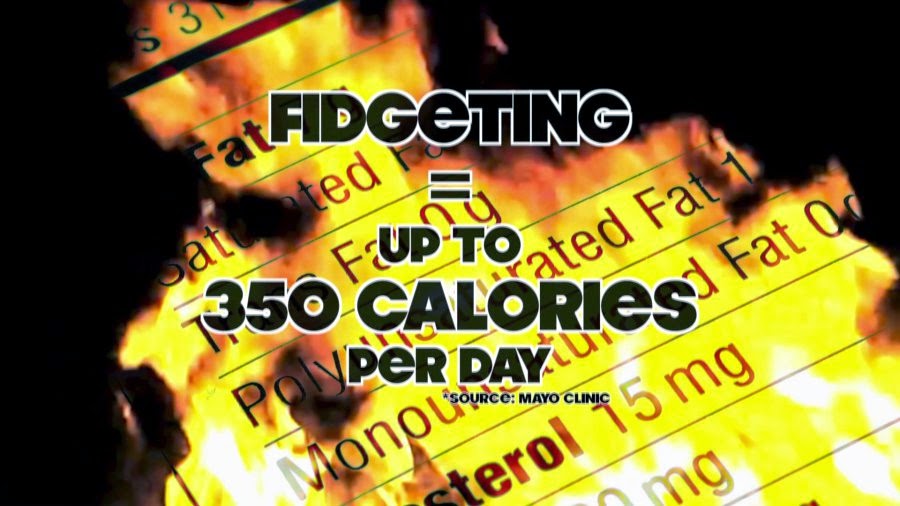
And by the way, the cumulative effect has been identified as up to several hundred calories PER DAY. Since there are 3,500 calories in one pound of fat, let’s do some simple math:
Let’s suppose fidgeting consumes 300 calories a day. Now, 300 x 365 days per year = 109,500 calories per year.
Divide by 3,500 to see how many pounds of fat that is: 31 pounds! If this sounds too incredulous to believe, read the studies.
Not only that, but fitness experts typically agree that fidgeting throughout the day will burn hundreds of calories that you would not burn if you “sat tight and still” like some teachers order their students to.
Of course, if the family is playing Scrabble and one of the kids can’t stop fidgeting, it can be annoying.
The person sitting behind you on an airplane, who can’t keep their legs still, will annoy you by “kicking” your chair. Yes, fidgeting can be very annoying to those nearby.
HOWEVER…this doesn’t change the fact that it burns enough calories in one year to either cause weight loss in those who take up fidgeting, or, prevent weight GAIN in those who’ve done it all along.
And that was my point with Sister Jeane Francis…and this biology teacher, who thought she knew everything, turned out to be clueless, while I, at age 13, was ahead of my time.
FIDGETING BURNS CALORIES
As a 13-year-old, and at no point after that, I never told anyone else about my theory that fidgeting contributes to calorie burning. What really riles me, however, is that the biology teacher thought this was poppycock.
I wonder if she lived long enough to become aware of the studies and mounting media support of this newly discovered accessory to a weight loss program.
Another point that must be made is the sorry fact that many teachers—and parents—are quick to dismiss ideas simply because they come from kids.
Usually, kids haven’t lived long enough to feel suppressed by expectations and pressure to blend into the herd mentality.
Kids tend to be more free-spirited than adults, less inhibited with expressing their thoughts, more inclined to think outside the box.
But over time, if they’re around the wrong people, they WILL become silenced. Hopefully, such kids will one day rediscover the power of bold expression and embrace it.
Meanwhile, keep moving those feet, twirling the hair and tapping the pencil—as long as your fidgeting isn’t getting on the nerves of the person sitting next to you.
The Studies
- Mayo Clinic
- School of Kinesiology and Health Studies
- National Institutes of Health in Phoenix, Arizona
Lorra Garrick is a former personal trainer certified through the American Council on Exercise. At Bally Total Fitness she trained women and men of all ages for fat loss, muscle building, fitness and improved health.

Why a Bullied Child’s Suicide May Be Rational vs. Mental Illness

Perhaps the bullied teen or adolescent who dies by suicide was thinking rationally rather than suffering from clinical depression or mental illness.
When yet another story breaks of a child who dies by suicide as a result of bullying, many people attribute this to a mental illness, namely depression, and the event spurs a lot of discussion about the stigma of mental illness — a stigma that keeps the depressed victim from seeking counseling.
But is it really a hallmark of mental illness when a young person sees suicide as the only escape from the bullies who make her feel worthless and defective?
This isn’t about “getting” a thicker skin or being overly sensitive.
Humans—the very social, emotionally needy creatures we are—by nature respond in a predictable way to emotional abuse and social rejection.
We see the parents of bullied kids who died by suicide communicating to the media. We see what appear to be wonderful parents.
But like the man who batters his wife several times a week behind closed doors, but then in public presents himself as the perfect husband, is it even remotely possible that many bullied kids (who die by suicide or attempt it) had abusive parents?
And when I say “abusive,” I don’t necessarily mean physically or sexually. Remember, words can strike a developing mind with the impact of a hot brick on flesh.
This is evident in the flood of comments that pop up when the teen bully suicide story makes it to a major news outlet.
Shutterstock/Milles Studio
You’ll find plenty of posts by adults who were bullied at school and had zero sanctuary at home.
Namely, they faced humiliation and scoldings from parents who blamed them for the bullying.
The posts are deeply disturbing, telling of the emotional abuse that these posters suffered at the hands of their parents, creating in them an internal fragility that the bullies at school feasted upon.
School ends late in the afternoon, but going home is the second and third shift of bullying. The situation is inescapable. Suicide becomes inviting. Mental illness or logical thinking?
When bullied kids see suicide as a solution, this isn’t the same kind of “crazy” thinking that, for instance, went on in the case of the Heaven’s Gate cult, in which the 39 brainwashed participants ended their lives because they believed suicide would take them to a space ship following a comet.
With parents who demean and dis-empower their kids, crushing any dreams in life they may have, these kids feel hopeless despair and see suicide as the only way out.
Hardly seems like “mental illness.” It almost makes a lot of sense. Again, read those posts of the former bully victims who grew up, which are found on any big article about this topic. The posts are chilling.
It’s a lot easier to blame mental illness as the driving force to youth suicide, and perhaps this IS the case when the teenager who takes his life actually had everything going for him: lots of friends, great parents, popular at school, athletic and talented.
But suppose a teen, let’s call him Greg, faces ongoing belittling by his booming father and popular “mean boy” older brother. By the time Greg reaches high school he feels disgusting on the inside.
He has great dreams but believes he’s not good enough to succeed (thanks to relentless discouragement from his father and brother—while Mum remains emotionally weak on the sidelines).
Greg is naturally introverted and awkward, so this makes him get picked on by teachers who favor more engaging, extroverted students.
Kids make fun of him daily and nobody wants him at their lunch table, so he eats lunch sitting on a toilet in the restroom because it’s too humiliating to be seen eating alone in the cafeteria.
Greg feels like a total loser and knows he’ll be saddled with lifelong psychological baggage. Would it really be a sign of mental illness or wayward brain chemistry that Greg would one day take his life?
Izzy Kalman, author of Bullies to Buddies: How to turn your enemies into friends, concurs.
Dr. Kalman believes that the same anti-bullying organizations, that work hard to raise awareness that the horrible effects of bullying can lead to suicide, still have trouble accepting that bullying is responsible, and that there must have been an underlying depression.
Yes, it is so hard to accept that suicide can be seen as the only solution by a rational person who is suffering abuse at the hands of others.
Dr. Kalman is a psychotherapist in private practice and has treated many victims of bullying for over 20 years. He has published extensively on solutions to bullying.
Lorra Garrick has been covering medical, fitness and cybersecurity topics for many years, having written thousands of articles for print magazines and websites, including as a ghostwriter. She’s also a former ACE-certified personal trainer.
.
Top image: Shutterstock/Sabphoto.
Source: wikipedia.org/wiki/Heaven%27s_Gate_%28religious_group%29

Child Bullying Younger Sibling: How Mom Should NEVER Respond

Find out what parents should never do in response to a child bullying a younger sibling; the way the parents respond in an attempt to “fix” the problem can make the situation far worse.
This article actually also applies to dads, but it’s usually the moms who catch a child in the act of bullying a younger sibling.
Has a child of yours been picking on, harassing or bullying a younger sibling for what seems like months on end, maybe even years?
This is a tip-off that whatever tactics you’re employing, in an attempt to end this problem, aren’t working.
Oddly, most mothers and fathers will continue using the same approach, even though it fails miserably; instead of detouring and trying a new tactic, they stick with the old, useless one — perhaps because straying from it would mean straying from a comfort zone.
But you know that famous saying: Insanity is doing the same thing over and over yet expecting a different outcome.
Don’t be insane!
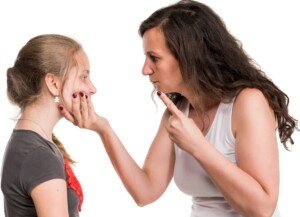
What should mothers NEVER do in response to a child bullying a younger sibling?
Shutterstock/Volodymyr Baleha
First, never put your best interests ahead of the bully’s and the victim’s. Next, never base your response or reaction on how easy it is for you to do.
In other words, it’s rather easy for a mother to blow up at the instigator and unleash a diatribe of criticism to that older child, slinging hurtful comments and all.
Yes, it’s actually quite easy to react this way because it requires no planning, creative problem solving, patience, rationale or logic. It’s pure raw, primal emotion.
And it will backfire, because when a parent reacts this way to the bully of the younger sibling … she (or dad) is exhibiting the very behavior that they’re denouncing!
A reaction of disgust and anger does NOT teach or show the bully how to love and respect the younger sibling.
Chastising with, “You’re older! You should know better!” will not cultivate love for the younger sister or brother.
Instead, it shows the instigator your anger. Well gee…if the older child feels compelled to belittle and invalidate the younger…how is a display of your anger going to stop that?
A threat of punishment won’t work. Again, this tactic won’t address the root cause. It won’t magically make the instigator feel kindness towards the victim.
Ask yourself how on earth your fury and threats will make the bully feel warm and fuzzy towards the victim.
Secondly, the threat of punishment will only make the bully try harder not to get caught the next time, or to develop an ingenious way of getting away with the “crime.”
This reminds me of the 11-year-old boy who drank a glass of chocolate milk after being told by his mother not to (the mother didn’t like her kids filling up on sugary items).
The 11-year-old knew he’d get in big trouble for this. The knowledge of his mother’s anger, however, did not stop him from disobeying a rule.
How many times have you heard kids say things like, “If my mom found out I (fill in the blank), she’d kill me.” Or, “If my dad finds out I (fill in the blank), I’ll be ground meat.”
The threat of punishment will only produce a more clever child — as was the case of the 11-year-old boy.
Someway, somehow, this nasty adolescent manipulated his nine-year-old brother (whom he regularly bullied psychologically) into admitting that HE had drank the chocolate milk (the mother discovered the chocolate-smeared glass in the kitchen).
The younger sibling ended up taking a lot of heat from the mother.
So you see, threat of punishment or knowledge of what the parent will do, will not stop sibling bullying. It will only make the perpetrator more cunning.
Other Responses to Sibling Bullying that will Fail
Don’t go into rants about how the siblings are “blood sisters” or “he shares your flesh and blood,” etc.
One woman would go into the same furious spiel every time she caught her two young sons “going at it.”
She’d fume: “You two both come from the same womb! You make me so ashamed!”
One day I said to her, “Do you really think they care they came from the same womb? Can they even remember being in there?”
Her only defense was pointing out that (at the time) I didn’t have any kids, so what did I know?
Yet if she had all the answers because she was the parent, why then, after years of this same angry spiel, were her boys still continuing to fight?!
Her words struck like a fist and did nothing to make these boys love each other. As adults, they are estranged from each other.
Another Thought on Sibling Bullying
“When the parents get in the middle trying to determine who are the real bully and the real victim, the kids start fighting over the parents,” says Israel (Izzy) Kalman, MS, a nationally certified school psychologist; director of Bullies to Buddies: and author of numerous books and publications about bullying and relationship problems.
“They each try to convince the parent to take their side against the other.
“This process intensifies hostilities between the kids, and whoever lost the parents’ judgment is mad not only at their sibling but at their parent as well.
“They continue to create fights over nonsense in order to get the parents to take their side, and the parents unwittingly establish a never-ending state of war.
“Ironically, kids learn to get along best when we refuse to get involved in their fights. Humans are social creatures and are hardwired to learn to get along.”
Sometimes it’s helpful for parents to get involved in a sibling bullying scene, continues Kalman.
“But our role should be to teach them how to solve their problems with each other, not to try to solve the problems for them.
“There is a free manual on my website that explains in great detail how parents (and teachers as well) unwittingly cause their kids’ fighting to escalate, and how to dramatically reduce the fighting with little effort: A Revolutionary Guide to Reducing Aggression Between Children.”
Dr. Kalman is a psychotherapist in private practice and has treated many victims of bullying for over 20 years. He has published extensively on solutions to bullying.
Lorra Garrick has been covering medical, fitness and cybersecurity topics for many years, having written thousands of articles for print magazines and websites, including as a ghostwriter. She’s also a former ACE-certified personal trainer.
.
Top image: Shutterstock/VCoscaron

Why Isn’t Corus CAD Test Done on All ER Chest Pain Patients?

Since the Corus CAD blood test can determine if chest pain is being caused by clogged arteries, why aren’t all patients with chest pain in the emergency room given this test?
Wouldn’t that more efficiently eliminate needless imaging tests that use radiation?
Why isn’t this test a standard protocol in emergency rooms for people presenting with chest pain and other symptoms that are often caused by obstructive coronary artery disease (CAD) such as shortness of breath?
“In clinical trials, patients with acute chest pain suggestive of a heart attack (acute myocardial infarction) were excluded from the studies,” says David N. Smith, MD, a board certified cardiologist with Premier Cardiovascular Care and Wellness in SC.
“The Corus® CAD test is not indicated for patients experiencing a heart attack, as they need to be evaluated and treated quickly in the ER.
“The Corus® CAD test has been established for use in ‘stable’ patients with non-acute signs and symptoms suggestive of obstructive CAD.
“Additionally, the turnaround time for test results is 48 to 72 hours. This timeframe is not feasible for a quick emergency room diagnosis.”
In the ER, a person with chest pain receives a blood test to measure the amount of troponin in their blood.
Troponin is a protein-enzyme that leaks into the bloodstream when heart tissue is damaged. The result of this blood test can be ready in about 15 minutes.
Often, a second such test is necessary, since the first test result might not be definitive for a heart attack.
However, the second test is usually given about four hours later, which by then a diagnosis for sure can be made, as troponin levels continue rising after a heart attack.

Dr. Smith is a published author, national lecturer and Yale-trained physician-scientist certified by the American Board of Internal Medicine in Cardiovascular Disease. From his basic science background combined with advanced clinical research training at the Columbia Mailman School of Public Health, he brings an integrated holistic approach to cardiovascular medicine.
Lorra Garrick has been covering medical, fitness and cybersecurity topics for many years, having written thousands of articles for print magazines and websites, including as a ghostwriter. She’s also a former ACE-certified personal trainer.
.
Top image: Shutterstock/igorstevanovic
More information .on the Corus CAD test: cardiodx.com/corus-cad/product-overview

Chest Pain: Blood Test Can Tell if It’s Clogged Arteries

This blood test uses age, sex and gene expression measurements to safely & quickly determine whose chest pain is the result of obstructive coronary artery disease (clogged arteries).
Certain patients are candidates for this blood test, called the Corus CAD (coronary artery disease).
They are: not diabetic; have not been diagnosed with a previous heart attack; are not suspected of having a heart attack at the moment; have not had coronary artery bypass surgery; are not currently taking chemotherapeutic drugs, immune-suppressing drugs or steroid prescription drugs.
Chest pain is a very common symptom of obstructive heart disease, the so-called clogged arteries.
Another typical symptom is shortness of breath. The Corus CAD blood test results are available in 72 hours and can be done in a doctor’s office.
Why isn’t the Corus CAD test recommended for the general population of non-diabetics who experience chest pain?
Being it’s a simple blood draw, why not just give it to everyone as part of their physical as well?
“The Corus® CAD test is not a screening test, so it should not be used in the general population, but should be focused only in those patients with specific signs and symptoms suggestive of obstructive coronary artery disease,” explains David N. Smith, MD, a board certified cardiologist with Premier Cardiovascular Care and Wellness in SC.
“The diagnostic accuracy of this test has proven it is an exclusionary test that truly outperforms current noninvasive diagnostic testing such as nuclear stress test for helping rule out obstructive CAD in patients.
“In symptomatic patients with scores 15 or lower, this test accurately rules out obstructive coronary artery disease in a greater proportion of people than any other current test, thus potentially saving patients with low scores from having to undergo unnecessary invasive procedures such as a cardiac catheterization.
“A ‘non-low score,’ defined as greater than 15, corresponds to a higher likelihood of obstructive CAD.
“But since the test was not designed to be a ‘rule-in’ test, it should not be used to rule in patients for obstructive coronary artery disease.”
Other notable causes of chest pain are acid reflux, esophageal spasm and musculoskeletal issues (namely, a muscle spasm or inflammation of the cartilage near the sternum—the chest pain can be significant).