How Fast Can Melanoma Change Visibly to Naked Eye?

Doctors tell us to check our moles every month, but is it possible to see melanoma changes over a faster time period?
It seems that we should check our skin perhaps every two weeks, if it’s indeed possible for the naked eye to detect cancerous changes in a mole in a shorter time frame.
I posed this question to Dr. Janet Prystowsky, board certified dermatologist in New York, NY, with 30+ years’ experience.
I first asked if melanoma in a mole can grow fast enough for a person to notice the changes from one day to the next.
“It is unlikely to notice changes in your melanoma day to day,” says Dr. Prystowsky. “However, you may be able to notice changes week to week.”
There are different kinds of melanoma. One such type, the most common, is called superficial spreading melanoma.
It can produce changes visible to the naked eye that, even over 12 months, are barely detectable.
A particularly astute person or one who has the so-called eye for detail, will be able to notice changes over a few months with such a cancer.
“Nodular melanoma is more aggressive than superficial melanoma,” says Dr. Prystowsky. “Since superficial melanoma spreads on the surface of skin first, you may be able to identify changes in it before it penetrates deeper.
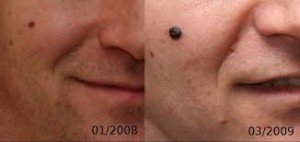
Source: 0x6adb015/CC
“Nodular melanoma is more likely to form a bump. When you notice a nodular melanoma, it is more likely to already be invasive than if it were a superficial melanoma.”
Nodular Melanoma Grows Fast and You’ll Easily See Changes
Most melanomas are not of the nodular type, but you should still know more about this kind of cancer.
According to a study of 404 patients led by Wendy Liu, PhD, of the Alfred Hospital Melbourne, the median monthly growth rate of nodular melanoma was 0.49 mm.
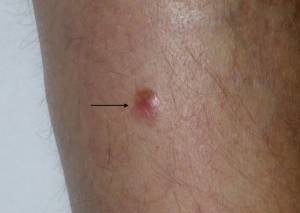
Source: pcds.org.uk
Can you tell if something has grown by half a millimeter?
It depends on if the growth is a strikingly different color than the mole that it’s occurring in.
It also depends on:
• Location of growth within the mole.
• If the growth is standalone.
• Your visual acuity.
• A magnifier will help.
Median growth rate per month for superficial spreading melanoma was 0.12, and for lentigo maligna it was 0.13.
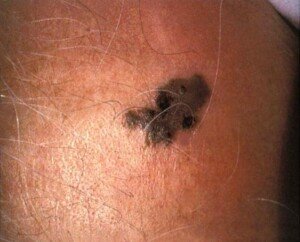
Superficial spreading melanoma. CDC, Carl Washington, MD, Emory Univ. School of Medicine, Mona Saraiya, MD, MPH
Characteristics of Rapidly Growing Melanoma
According to the study, they were more likely to be:
• Symmetrical
• Elevated
• Flesh colored
• Non-jagged border
• Cause symptoms
• Associated with men over 70
• Associated with patients with fewer moles, though this could just be a coincidence in the study.
The report states, “…the bad-looking melanomas were associated with slower rates of growth compared with those that were not bad looking.”
Liu et al points out that the study’s findings (published in Archives of Dermatology) were limited by the subjective reports of patients recalling rates of melanoma growth – presumably done with their naked eyes; no mention of magnifying glasses was made.
A nodular melanoma can change fast enough to be noticed from week to week.
The study showed 0.49 mm per month of growth on average, but it’s possible for the growth rate to be bigger in a month’s time – clearly visible to the naked eye.

In combination with her focus on early skin cancer detection and removal, Dr. Prystowsky provides a wide range of revitalizing and rejuvenating treatments.
 Lorra Garrick has been covering medical, fitness and cybersecurity topics for many years, having written thousands of articles for print magazines and websites, including as a ghostwriter. She’s also a former ACE-certified personal trainer.
.
Top image: Shutterstock/wavebreakmedia
Source: medpagetoday.com/dermatology/skincancer/4726
When to Worry About a Bump on the Roof of Your Mouth

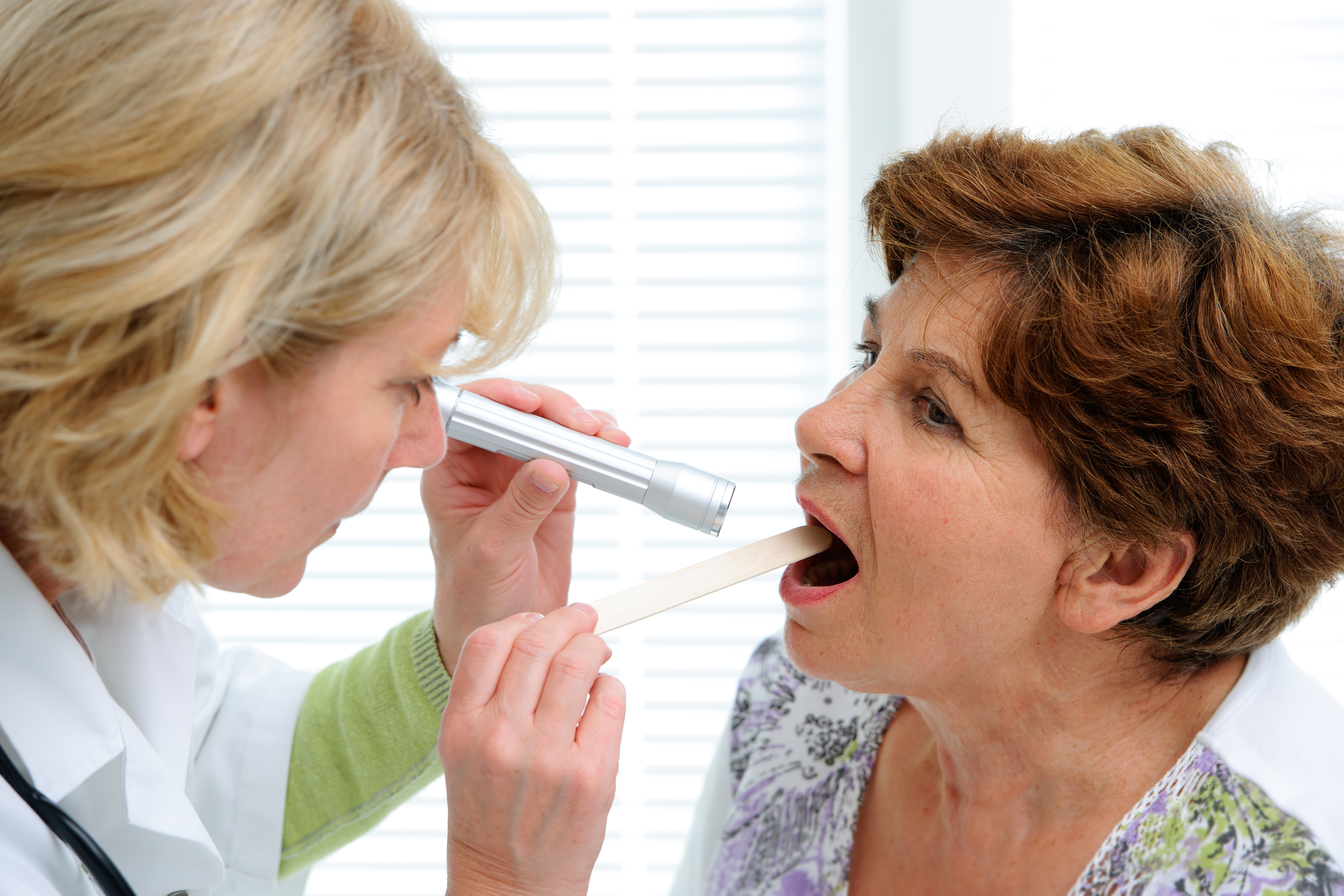
There are benign and dangerous causes of a bump on the roof of your mouth.
What makes this situation vexing is that often, you cannot see the bump but can only feel it.
If you’re feeling a strange bump (either with your tongue or finger) on the roof of your mouth, it COULD be cancer.
But – statistically, it’s far more likely to be harmless.
However, it’s natural to want to know about dangerous causes of bumps or lumps on the roof of your mouth – especially if you’re a smoker, chew tobacco or drink alcohol – all significant risk factors for oral cancer.
But non-tobacco users can get oral cancer, too.
When to Worry About Bump on the Roof of Your Mouth
• It has red and white patches and/or is very dark.
• It’s still there after two weeks.
• It hurts a lot, though oral cancer may be painless, too.
• You have other new symptoms such as fever, fatigue, nausea, unexplained weight loss, loss of appetite, numbness in the mouth, persistent stuck feeling in the throat, difficulty swallowing, or some other oddball symptom that you can’t explain.
“If it’s bleeding, painful, growing or changing in any way,” sums up Adam J. Mamelak, MD, a board certified dermatologist and founder of Sanova Dermatology in Austin, TX.
Additional Concerning Symptoms with a Bump on the Roof of One’s Mouth
• Ear pain
• Sore throat
• Hoarse voice
• Cough
WARNING: Oral cancer isn’t the only malignancy that has the potential to cause a bump on the roof of one’s mouth!
So if you’ve never smoked or drank, you will need to know what other cancers can cause this symptom.
• Squamous cell carcinoma. Awareness for this disease focuses on development in the skin, but it can also arise in the oral cavity where squamous cells are present.
• Verrucous carcinoma. This rarely spreads beyond the oral cavity but nevertheless, it’s still malignant.
• Palate cancer. If the bump seems to correlate with new symptoms of really bad breath, loose teeth, changes in speech and difficulty opening the jaw, it’s time to worry and make a doctor appointment stat.
• Salivary gland tumor.
Benign Causes
Causes of a bump on the roof of your mouth, that are not related to cancer, may still need prompt medical treatment – but they’re nothing to lose sleep over.
• Torus palatinus (may hurt or disrupt swallowing)
• Mucocele (may hurt)
• Anything that hurts or is bothersome
Here are additional possible causes of a bump on the rooftop of your mouth, but some of these conditions rarely end up in that location.
Don’t let the suffix “oma” scare you, either. “Oma” does not mean cancer. It means mass – and a mass can be benign. A benign tumor may still need surgical removal.
• Canker sore
• Enlarged incisive papilla
• Condyloma acuminatum (type of wart)
• Epstein pearl
• Fibroma
• Keratoacanthoma
• Leiomyoma
• Neurofribroma
• Nicotine stomatitis (caused by smoking; will not lead to cancer)
• Osteochondroma
• Papilloma
• Pyogenic granuloma
If you’ve never smoked or drank, this is reassurance that the new, stubborn bump or lump on the roof of your mouth PROBABLY is not cancer. Probably not. Probably not. Not likely. But not impossible!
But whether you’ve never smoked/drank or not, get it checked if it’s still there after two weeks. Again, nonsmokers and nondrinkers can get oral cancer.
Oral cancer, however, is uncommon, which means more times than not, a bump on the roof of a smoker’s or drinker’s mouth is not cancer. But remember that two-week rule!
 Dr. Mamelak focuses on the full breadth of dermatologic care, from cosmetic skin solutions to advanced skin cancer removal. He’s founder of the Austin Mohs Surgery Center, which is dedicated to the treatment and management of skin cancer.
 Lorra Garrick has been covering medical, fitness and cybersecurity topics for many years, having written thousands of articles for print magazines and websites, including as a ghostwriter. She’s also a former ACE-certified personal trainer.
.
Top image: Shutterstock/Alexander Raths
Sources:
cedars-sinai.edu/Patients/Health-Conditions/Palate-Cancer.aspx
hopkinsmedicine.org/healthlibrary/conditions/oral_health/oral_cancer_85,P00716/
healdove.com/oral-health/Possible-Causes-of-Bump-on-Roof-of-Mouth

Thin Woman: Small Bones vs. Fast Metabolism vs. Diet, Exercise

Just what exactly makes a woman skinny?
Some say small bones, particularly the thin woman herself, while others would argue it has everything to do with calories in vs. calories out.
Calories in vs. Calories Out
Many personal trainers insist that this equation is just too simplistic. I’m a former personal trainer for a large health club.
I’d tell clients that the common denominator, know matter what a person’s genetics, diet, bone structure or exercise habits are, is this:
This very simplistic equation is determined by all of those other factors that some other fitness experts insist are more important:
• Diet: what a woman eats, when and how much
• Genetics: Does fast metabolism run in the family?
• Amount of muscle mass: More muscle means a faster resting metabolism
• Exercise: Certain exercises burn more fat than others
• Hormonal environment: The hormonal picture in a woman can influence metabolism.
• Medical conditions: Some medical conditions decrease or increase metabolism.
But when all of those bullet points are stripped away, it still all comes down to calories in vs. calories out.
Small Bones and Thin Women
A woman is never thin simply because she has small bones. If you believe otherwise, ask yourself what would happen if something slowed down her metabolism, especially if she coincided that by increasing her caloric intake. And what if she stopped exercising?

Shutterstock/Just dance
A woman with small bones may very well be taking in more calories than she’s burning off. The equation may be this way for several reasons including:
• Depression—leading to quitting exercise and becoming sedentary
• Dating a man who’s always taking her out to restaurants with rich high calorie food
• Menopause (increased appetite and/or hormonal changes)
• Lack of strength training: causes muscle loss which slows metabolism
• Stress: drives her to eat way more than she should.
This woman with small bones will gain fat and become bigger as a result.
Small bones do not make a woman thin.
A small boned woman may have the biggest appetite in the West and not exercise, along with having an average metabolism.
What do you think she’ll look like, with those three factors in place? She will be fat or overweight.
If she diets and exercises and loses the 50 extra pounds of fat and can fit into a size 6, does this mean her bones shrunk?
Now let’s take a large boned woman who practices portion control, has a fast metabolism and works out. She’s going to be lean.
Her larger bone structure has NO influence on her resting metabolism.
What influences her resting metabolism is the same as what influences the resting metabolic rate of a small boned woman:
• Genetics
• Exercise
• Diet (processed food diet triggers hunger; healthy diet suppresses hunger)
• Hormonal environment inside her body
• Presence of medical condition
A large bone structure does not cause a woman to be big or husky. Have you not seen “before” images of husky women who then lost fat and gained lean muscle tissue (via diet and exercise), and in their “after” picture they are enviably lean and toned?
Bone size is not relevant.
Thin women who tell you they’re skinny due to small bones are perhaps trying to divert your attention away from suspecting an eating disorder.
This is akin to overweight women telling you they are “big boned” so that you don’t think they have out-of-control eating habits or are lazy.
When I was a fitness trainer I had overweight female clients whom I could tell had small bones, and thinner female clients who had large bones.
A large boned skinny woman has broad shoulders and relatively large hands.
A small boned fat woman has narrow shoulders and more petite looking hands.
There are additional ways to gauge whether a woman has small or bigger bones, but the amount of body fat is not one of them! Low muscle mass + low body fat = skinny.
Lorra Garrick is a former personal trainer certified through the American Council on Exercise. At Bally Total Fitness she trained women and men of all ages for fat loss, muscle building, fitness and improved health.
.
Top image: Shutterstock/Vikacita

How to Prevent Weight Gain During Double Mastectomy Recovery

When I had an elective double mastectomy without reconstruction, I prevented weight gain even though I was barred from gym workouts and restricted to light use of my arms. (more…)

How Soon After Mastectomy Can You Work Only Your Legs?

Does the “Do Not Lift Weights” for six weeks apply also to the LEGS when you’ve had a double mastectomy?
After all, why would training the legs impact recovery from breast removal? (more…)

How Soon After Double Mastectomy Can You Resume Yoga ?

There’s good news for yoga practitioners who are eager to get back into yoga after their double mastectomy. (more…)

Chest Twitching after Mastectomy without Reconstruction

Days after your mastectomy, you may feel a twitching where your breast used to be – a twitching in the chest wall. (more…)

Lifting Weights After Mastectomy: Why the 4-6 Week Wait ?

I had a preventive double mastectomy, and at the follow-up the surgeon explained why I must wait six weeks before resuming lifting weights with my upper body. (more…)

Visible Lump Above Incision After Mastectomy Bandages Removed

Here’s what a visible, palpable lump immediately after your mastectomy is most likely to be …
I recently underwent a preventive double mastectomy. Two and a half days later I removed the outer bandages and looked in the mirror. (more…)









Morbid but Effective Way to Recover from Double Mastectomy