

A slimmer waistline is more about heart health than beauty standards.
If your waist is thick, this can raise your risk of future chronic heart failure: weak pumping that can lead to kidney damage over time.
Research presented at the American Heart Association’s EPI|Lifestyle Scientific Sessions 2026 suggests that fat around the waist may increase the risk of heart failure, mainly through inflammation.
Chronic heart failure means that the heart doesn’t pump blood adequately. Over time this condition will interfere with quality of life.
The Boston-based conference focused on the latest findings in prevention, lifestyle and cardiometabolic health.
The study found that waist fat was more closely tied to heart failure than overall body weight.
Even people with a normal BMI faced higher risk if their waist size was larger. This suggests that where fat is stored matters more than total weight.
Inflammation appears to play a key role in linking belly fat to heart problems, meaning waist measurements could be a better way to identify risk than BMI alone.
BMI is widely used because the calculation requires height and weight only, an easy calculation that a computer spits out in an instant.
But BMI doesn’t disclose body composition nor how excess fat is distributed throughout the body.
How much can you pinch on your waist?
Ever wonder why someone who appears to be a “healthy” or “normal” weight still develops heart failure — even if they don’t smoke?
It could be that they have excess fat in their waist, which is easily hidden by clothes.
Inflammation throughout the body can disrupt the immune system, damage blood vessels and promote scar tissue in the heart.
The American Heart Association’s 2025 statement on primary prevention of heart failure notes that higher inflammation levels increase heart disease risk — even for people with normal cholesterol.
The Study Had Some Important Findings
* 112 participants developed heart failure over a median follow-up of 6.9 years.
* Higher waist fat, not BMI, was linked to increased heart failure risk.
* Waist circumference and waist-to-height ratio were both associated with higher risk.
* Participants with higher blood markers of inflammation were more likely to develop heart failure.
* Inflammation explained roughly one-quarter to one-third of the link between belly fat and heart failure.
A Closer Look at Heart Failure
Chronic heart failure, formerly known as congestive heart failure, means that the heart fails to efficiently pump an adequate supply of blood with each beat. See the diagram below for a better understanding of this common condition.
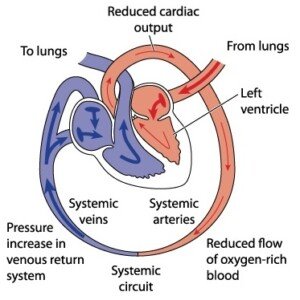
Heart failure. Shutterstock/Blamb
A Closer Look at the Study
The analysis used health data from 1,998 black adults in Jackson, Mississippi, from the Jackson Heart Study.
Participants were 35-84 years old (average 58), 36% were women and none had heart failure at enrollment between 2000-2004. Follow-up lasted a median of 6.9 years.
Researchers measured weight, BMI, waist circumference, waist-to-height ratio and blood markers of inflammation, including high-sensitivity C-reactive protein.
They noted that the study didn’t separate types of heart failure, so future research is needed to see how belly fat and inflammation affect different subtypes and whether reducing inflammation can lower risk.