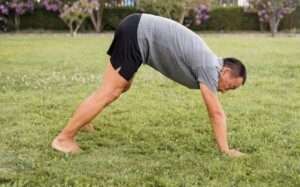
Quadrupedal movement sounds fancy, but it’s really just moving on all fours.
Crawling, bear walks, crab walks and similar patterns all count. Humans naturally use bear-like movements as babies, and when adults bring them back, something interesting happens:
The body starts working as more of an integrated system in a way that differs from any bipedal ambulation.
One of the biggest benefits is full-body coordination. Quadrupedal movement forces the arms, legs and core to work together at the same time – more so than in upright movement.
You may already know that, for example, when performing a back squat or deadlift, the core links the upper body to the lower body.
But this linkage goes a step further when you’re on all fours.
Unlike many exercises with strength training machines or cardio equipment, quad-pedal movements make it impossible to cheat.
How do you cheat with a bear crawl or crab walk? Well, I guess you can cheat with a crab walk by letting your butt slide on the floor, but when you keep it off the floor, there’s just no way to cheat.
With quadrupedal exercise, everything has to communicate, which improves motor control and body awareness.
Core Strength Development
Quad movement builds core strength, but not in the way most people think of core training. Instead of isolating the abs or lower back, the core works as a stabilizer while the limbs move. This mirrors how the core functions in real life.
The core acts as a stabilizer also for the squat and deadlift, but again, if you’re on all fours, that stabilization takes on a unique role.
Movements like bear crawls activate deep stabilizers, including the transverse abdominis and spinal muscles.
Over time, this can improve posture and reduce strain on the lower back, especially for people who sit for prolonged periods or feel unstable during traditional exercises.
Moving on all fours is neurologically demanding in a good way.
Cross-body movement patterns require the brain’s left and right hemispheres to coordinate constantly. This can improve balance, timing and reaction speed.
Athletic and Real Life Carryover
Athletes use quad-pedal training to build power, speed and resilience. This translates well to running, jumping and change-of-direction sports.
Because the movements are low to the ground, they also build confidence and control in awkward positions.
This can reduce injury risk when the body is forced into unexpected angles during sports and daily life.
One time I had to move under a gate at my apartment complex that was stuck. In zip time I got down on all fours, slithered under and then sprung back up.
You just never know what situation might arise that requires you to get on all fours and move from point A to point B.
How to Safely Train Quadrupedal Movement
Start slowly. Many adults underestimate how demanding these movements are. Even an athletic person may have difficulty sustaining a bear walk.
When I was in high school we had to do wind sprints via bear walk. The school’s best volleyball and basketball player struggled with these.
But nobody says you must perform the bear or crab walk rapidly. JUST DO IT.
Begin with short sets, even 10 to 20 seconds at a time, and focus on smooth, controlled motion.
- Try to keep the spine neutral.
- Avoid sagging the lower back or rounding excessively.
If your wrists feel strained, try fists instead of flat palms, or hold pushup handles and use those instead of directly contacting your hands to the floor or ground.
I use pushup handles for my bear walk because I have a pesky ganglion cyst in my wrist.
Warm up the shoulders with circles and light mobility drills before starting, or, finish off a regular strength training session with quadrupedal drills – your body will already be warmed up.
Progress Gradually
Some people may want to begin using a staircase: bear walk up facing forward; bear walk down going backwards; crab walk down facing forward.
Once basic crawling feels comfortable, you can progress by increasing time, adding direction changes or moving slightly faster. You can also add intensity by walking with dumbbells or wearing a weighted vest.
Advanced Variations
- Backward movement
- Sideways movement (can also be done with a cross step)
- Straight leg bear walk
- Bear crawl down a grassy hill facing forward; move back up it backwards
- Crab walk up the hill, torso facing the hill (feet higher than hands); I don’t recommend reversing direction, as this can strain the joints.
- Jump bear walk: Instead of moving one foot at a time, move both at the same time in a jumping fashion. Hands can move either one at a time or both at once.
Even just a few minutes once a week will produce a training effect.