Taking Heart Rate on Treadmill: Continuous Holding Not Necessary
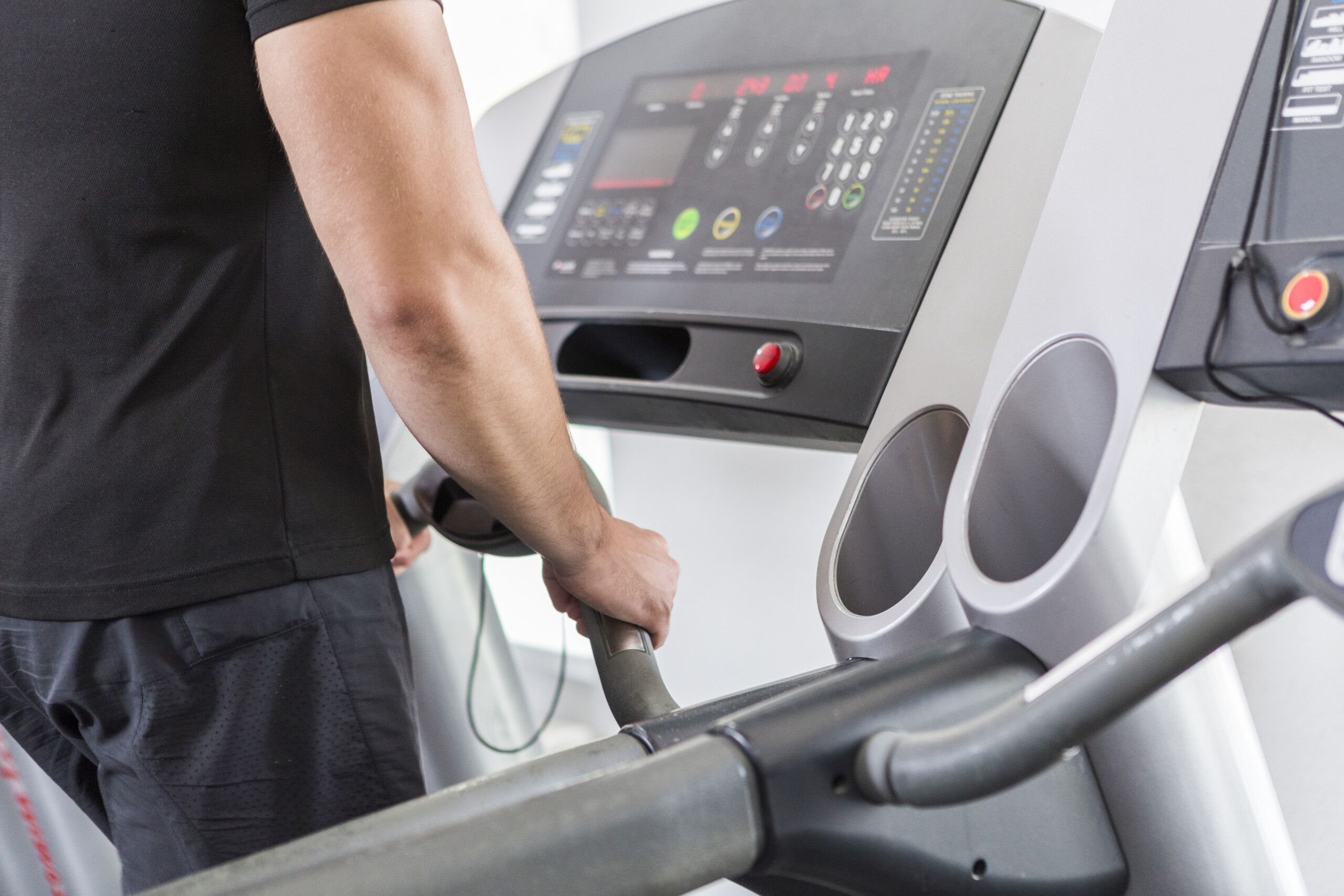
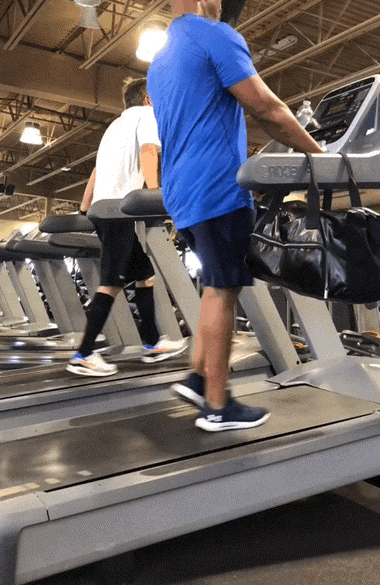
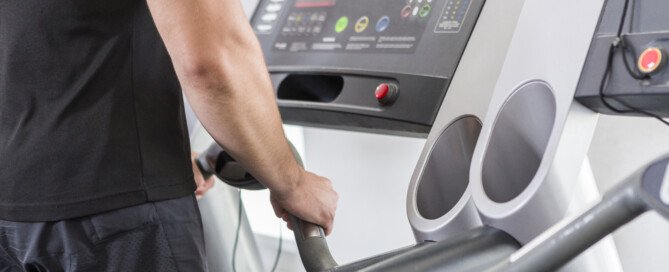
People have often told me that the reason they keep their hands on the front bar of a treadmill is to have a continuous heart rate reading.
Keeping your hands on the treadmill’s heart rate sensors is bad for your workout for many reasons.
It produces an artificial walking environment. The natural walking gait consists of some degree of arm swing.
Holding on disrupts natural movement and can cause “molding” of forward posture (a very bad thing) in tall people, who must slump forward to keep their hands on those heart rate sensors.
The disrupted gait results in several additional negative issues:
-Significant reduction in calorie expenditure. The calorie reading is generated by the treadmill’s motor (and incline), not by the person using it.
-Significant subtraction of workload; activation of key muscle groups is inhibited.
-Potential repetitive stress injuries in the hips, which ballistically move to compensate for the locked-up upper body.
-Deactivation of the body’s balancing mechanism; the exerciser will actually experience reduction in their ability to balance when walking outside on uneven surfaces.
-Rise in blood pressure. If you’re gripping tightly to the heart rate monitors while using a fast pace, this will, indeed, raise blood pressure.
Continuously holding onto a treadmill for heart rate can also lead to obsessing about heart rate.
Before you know it, you’re constantly checking the reading, fixating too much on this element.
Besides, do you really know with absolute certainty if the treadmill’s heart rate reading is even accurate?
A better way to take heart rate is to pause on the machine (feet straddling the tread) and place your finger to your neck or wrist, and count the beats.
Even though you’re standing still while doing this, it’ll still give you a good idea.
If you have doctor’s orders not to exceed a certain heart rate, keep in mind the following:
Continuous tight holding onto the heart rate sensors will raise blood pressure.
Figure out the speed that keeps your pulse below the doctor’s limit, then simply continue at that pace and swing your arms.

Shutterstock/Khakimullin Aleksandr
To ensure that your pulse will not exceed the limit despite this maintenance pace, check it five minutes later.
Check it every 10 minutes for peace of mind. This means every 10 minutes, your hands are on the sensors for 30 seconds, versus continuously: a whopping difference as far as exercise efficiency.
You can learn to take your pulse while walking naturally by lightly placing your fingers on your neck.
Finally, some treadmill models will cease to operate unless you keep your hands on the heart rate monitor.
Switch the program to avoid this problem. If the machine keeps giving orders to hold on, and will continue operating even if you let go, then just ignore the computer’s orders and swing your arms.
 Lorra Garrick is a former personal trainer certified through the American Council on Exercise. At Bally Total Fitness she trained women and men of all ages for fat loss, muscle building, fitness and improved health.
.
Top image: Freepik.com
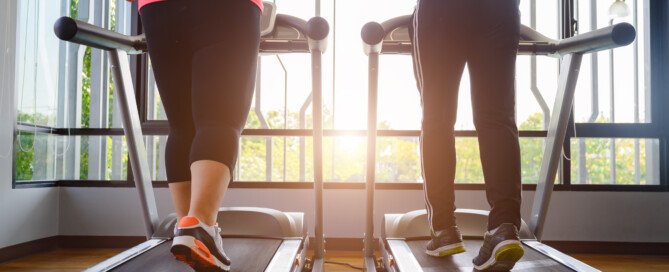
Scared to Run on a Treadmill? Solutions

You must read this if you’re fearful or reluctant to run or even slowly jog on a treadmill.
Just about anybody can jog, run or sprint on a treadmill, even if they’re intimidated.
I say “just about” because some orthopedic conditions are not compatible with any kind of running.
However, fear of a treadmill is never a solid reason for being unable to use this cardio equipment, and as a former personal trainer, I worked with several people who were a bit uneasy about running on something that was moving beneath their feet.
Your intimidation of this large, sometimes very noisy equipment can be overcome with some easy steps.
Get on the treadmill and do just that: Take easy steps. You don’t have to run the first time you get on a treadmill.
However, be warned about a disastrous mistake that many trainees engage in: holding onto the equipment.
- There is absolutely no need to do this.
- Don’t look around at other treadmill users and think, “Gee, everyone ELSE is holding on, so it must be the smart thing to do.”
Don’t follow the herd. You are the tiger, in charge, empowered and passionate about your fitness goals!
Step on the machine and begin with a comfortable speed; start walking, swinging your arms.
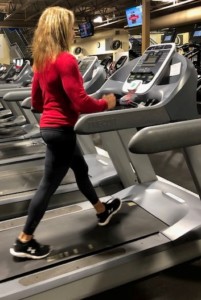
Model: Sharon Smith, 71
If you begin feeling dizzy, slow down. Do not hold on. You must force your body to adapt to this new stimulus.
This new stimulus will force neurological adaptation very quickly. Focus on good posture, which can be achieved only by swinging your arms.
Swing them naturally, as you would if walking the same speed outdoors or even from the gym’s lobby to your car.
At some point you will feel comfortable enough to begin running on a treadmill.
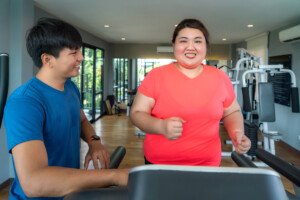
Shutterstock/Travelerpix
This may not occur during your very first session, and it needn’t. However, if you feel ready to begin running during your first treadmill workout, then do so.
- Do not fear falling off.
- Set the speed at 3 mph if you’re still intimidated by the treadmill.
Jog at 3 mph and keep your eyes straight ahead. If you feel like drifting your attention to a TV screen, that’s fine, as long as you feel in control of your balance.
I know I sound like a broken record, but do not fall prey to any temptations to place your hands on the rails or elsewhere. This will set you backwards. It will shut off opportunities for your body to adapt.
Fitness and weight loss are achieved only when the body is forced to adapt to an unfamiliar training stimulus.
Another way to overcome treadmill intimidation is to jog or run for only brief periods, alternating with walking.
Sharon Smith has been in the fitness industry for 25+ years and specializes in the over-40 client.
Lorra Garrick is a former personal trainer certified through the American Council on Exercise. At Bally Total Fitness she trained women and men of all ages for fat loss, muscle building, fitness and improved health.
.
Top image: Shutterstock/Iam_Anupong
How to Balance on a Treadmill Desk
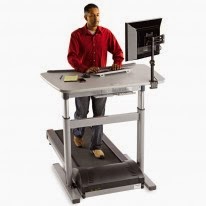
Learning how to balance while using a treadmill desk is easier than you think.
As an avid user of a treadmill desk, I’ve read of other peoples’ concerns with this device, and actually came across a posting in which the user was asking how to keep their balance.
The purpose of a treadmill desk is to alleviate the body from the harmful effects of prolonged sitting.
You will not burn a lot of calories walking 3 mph on a treadmill desk while holding onto the machine.
Save the calorie burning for the gym or a regular treadmill (don’t hold on), and reserve the desk device for the purpose of avoiding lots of sitting.
How do you balance on a treadmill desk?
Start out at the slowest speed. Don’t feel you must go 2 mph if you’re new to this instrument.
My treadmill desk starts at 0.4 mph. This is unbelievably slow, but if you have issues with balance, start this slowly.
Then gradually, as your body’s balancing mechanism adapts, increase the speed — say, to 0.6 mph, and see how you do.
If you get in the habit of holding onto the rails, your balance will always remain compromised because it won’t have a chance to adapt.
The only time you should hold on when using a treadmill desk is when you’re using the mouse or keyboard, in which case, there will be natural arm and hand contact with the machine.
But if you’re simply reading some e-mail, the latest news or watching a video, there’s no reason to hold on.
If balance is an issue, this isn’t inherent in the treadmill desk; it’s inherent in your body’s lack of adaptation to a moving tread.
The only way to adapt is to walk with a natural arm swing, to promote a natural gait and good posture: the way you’d walk anywhere from point A to point B.
If you’re doing a lot of scrolling, the scrolling arm/hand will be making contact with the machine’s desk portion.
I advise placing the other hand in a similar position on the desk portion to even things out.
But when there’s NO mouse or keyboard use, keep both arms at your sides and swing in correlation to the speed you’re walking. This is the natural way for the body to move.
If you feel like you’re going to fall off or lose your balance, lower the speed.
If you have a balance issue at the slowest speed, then resist the temptation to cling onto the machine. The best way to walk on a moving platform is naturally.
If you feel like you must struggle to maintain your balance at the slowest speed on your treadmill desk, keep struggling, because struggling makes the body more efficient by forcing it to adapt.
Lorra Garrick is a former personal trainer certified through the American Council on Exercise. At Bally Total Fitness she trained women and men of all ages for fat loss, muscle building, fitness and improved health.
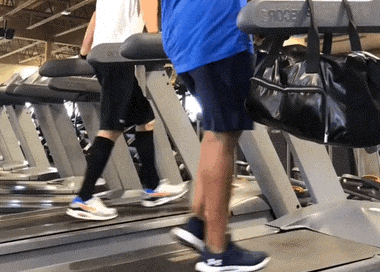
Holding onto Treadmill in Front with Incline: Why This Fails
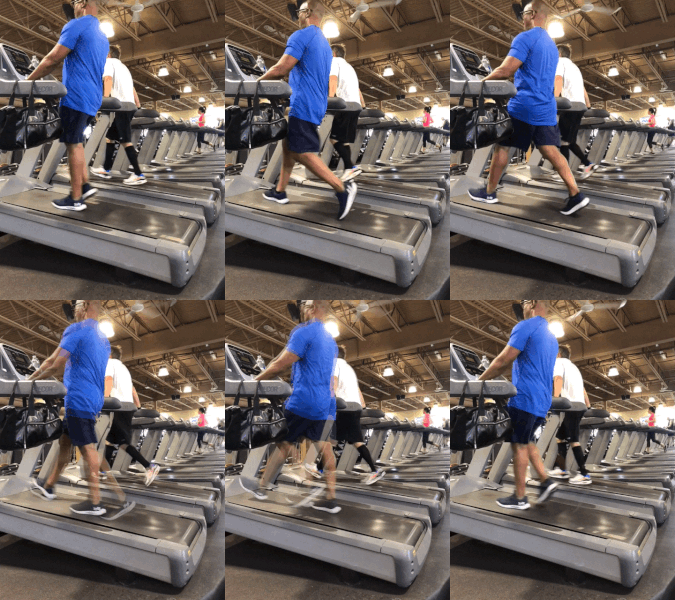
Clinging to the treadmill in front while using even a high incline is bad for the body, even if you have a condition; here’s why.
Often, the user “walks” in a tugging motion.
This incorrect use of a treadmill is a choice, even though the user may think it’s physically necessary.
The only time tugging on a treadmill is necessary is when you have the speed set too fast for what you can handle!
The woman below was tugging like mad when I took this photo. Her feet were slapping down with each step.
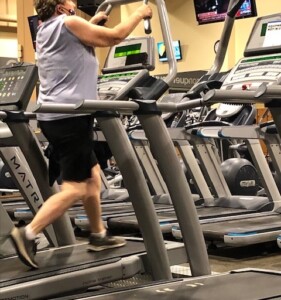
I asked an orthopedic surgeon with over 40 years’ experience what she thought of this.
“Just looking at this photo, I can’t imagine how this developed,” begins Barbara Bergin, MD, board certified orthopedic surgeon at and co-founder of Texas Orthopedics, Sports & Rehabilitation Associates.
“It strikes me as a weird, mechanically unsound mode of exercise, akin to walking deep knee bends with weights in the hands, or kettlebell jumping jacks.
“These are exercises designed to somehow give an extra bang for the buck, but often result in repetitive stress disorders.
“This is likely causing a kind of leaping gait, as the person tries to pull themselves up, and then they drop to the surface.”
Dr. Bergin also notes that aggressive or forceful tugging can cause repetitive strain injuries in the lower body.
Though the man in the top image, and the woman in the second image, were doing their make-believe walking at a fast clip with a tight hand grip, this doesn’t mean that the solution is to loosen the grip or try not to slap down the feet.
Even with a more relaxed body or a slower speed, “It’s certainly unnatural,” cautions Dr. Bergin, “and it seems like it would put some strain on the shoulders, as well as higher impact pressure on the legs. It’s so far from natural human movement.
“The closer we get to natural walking, the better.”
Does this mean that walking on a treadmill without holding on is still bad for the body?
No, of course not. For instance, walking without holding onto the front or anywhere else pleasantly forces the body into correct gait patterns and posture.
What if it hurts somewhere unless you hold on?
This means that the discomfort, whether it’s in a foot, hip or low back, originates from weak, unconditioned structures that are not being given a chance to get strong because you keep holding onto the machine!
Holding on deprives that area of beneficial work!
A very effective way to strengthen weak areas is to make them work in a capacity that they’re not efficient at: walking an incline without gripping the treadmill.
Usually, any discomfort that arises, when one uses an incline without holding on, is located in the low back.
When you continue to hold onto the front bar, these neglected low back muscles will continue to be weak.
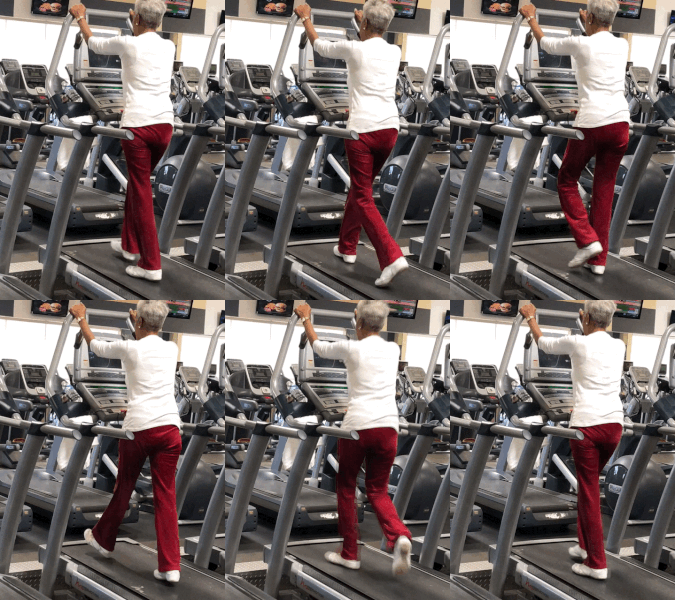
Letting go of the front bar will force these muscles to adapt and become stronger, because they’ll be forced to keep your spine upright (body vertical).
If you have a bad knee or painful feet, maybe you shouldn’t even be on a treadmill until the problem resolves.
If it’s permanent, then holding on may make the situation worse, in that holding on, even during a high incline, skewers gait pattern, making you walk with an unnatural gait that puts unnatural stress on the hip joints.
The hips over-rotate to compensate for the immobilized upper body.
The human body naturally swings an opposite arm with the opposite leg while walking — and even crawling.
When you hold onto the treadmill, especially when this involves a tugging motion from the front, unnatural forces are applied to the pelvis: not good.
In addition, the foot strike is altered, which can lead to or aggravate foot issues.
I’ve worked with many personal-training clients who were perfectly healthy yet held onto a treadmill simply because they thought they’d fall off otherwise.
What is the solution?
SLOW DOWN. Don’t think for a moment you’ll sacrifice some of the workout if you reduce the speed and LET GO.
Fast speed does not equate to a good workout if you’re gripping and pulling with your arms.
In 100 percent of the cases, my clients remained steady on the tread after freeing their hands, and immediately felt many more muscles being worked.
Nobody stumbled, let alone fell off.
Other Reasons Holding on Is Bad
- Zero improvement in balance; it may even get worse.
- Stabilizer muscles will be ignored.
The calorie counter will run up the same numbers whether you hold on or pump your arms. This little computer is based on only two metrics: speed and incline. It cannot tell the difference between a 300 pound man or a little mouse on the tread.
Holding onto the treadmill’s front bar, console or even side rails during an incline will sabotage your attempts to reach your goals.

Dr. Bergin is a general orthopedist, surgically and conservatively treating all manner of bone and joint conditions. She enjoys educating patients so they can emerge stronger than they were before their orthopedic injury or surgery.
Lorra Garrick is a former personal trainer certified through the American Council on Exercise. At Bally Total Fitness she trained women and men of all ages for fat loss, muscle building, fitness and improved health.
.
Image credits: Alie Greeley

Holding onto a Treadmill Can Cause Four Injuries

You may think holding onto a treadmill is safer than letting go, but it can set you up for several kinds of injuries.
It’s not safe to hold onto a treadmill because this can put you at risk for one or more of several types of injuries.
What kind of injuries or insults can holding onto a treadmill cause?
Here they are (no particular order):
Bad Posture (zero incline)
This is a no-brainer once you view the profile of someone holding onto a treadmill. A person’s height often dictates how their posture degrades.
Very tall people, while holding on, present with a forward head (think of a crow) and rounded shoulders.
They are slouched over so that their hands comfortably reach the rails or bar in front.
Over time, this forward posture can “mold” and becomes somewhat retained even after they get off the treadmill.
Short walkers will do the “shoulder bob” if they’re holding onto the side rails.
Sometimes this poking up and down of the shoulders is so pronounced, they can practically spin pizza dough on them!
With the shoulder bobbing comes tensed-up shoulder muscles.
All of this can lead to a repetitive stress injury: pain.
Hip Pain
A repetitive hip injury can result at fast speeds because the faster you walk when holding on (zero or inclined), the more the hips must abnormally rotate to compensate for the inertia of the upper body.
In normal walking, the upper body moves in rhythm with the lower body.
When you hold onto a treadmill, the upper body is frozen; it’s easy to see how this disturbs normal movement of the lower body and hips.
“It is possible that holding onto the treadmill while walking on it can lead to gait abnormalities that will cause hip pain,” says Bruce Pinker, DPM, who specializes in sports medicine and surgery of the foot and ankle.
“Especially while walking quickly (4-5 miles/hr.), can lead to gait disturbance if one is holding on,” continues Dr. Pinker.
“Our arm swing is an important part of walking, as it helps build momentum and provide balance.
Shoulder Pain (incline)
Leaning back with the machine’s angle, arms locked straight and tugging with each step, can cause a repetitive injury in the shoulder joints, though this is rare.
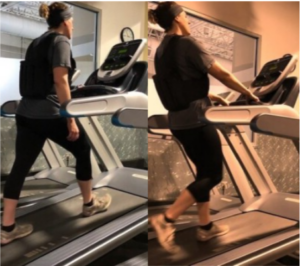
Left image is correct. The right is WRONG.
Those with elbow tendonitis may find this type of walking uncomfortable on those tendons, because grip-walking aggravates the tendons (if already inflamed) that control hand grip.
When I was a personal trainer I had a new client who reported mysterious chronic shoulder pain that would come and go, but she couldn’t associate it with any particular activity.
I soon learned she’d hold onto the treadmill when walking; I told her to swing her arms. The shoulder pain never came back.
Heel Pain
Plantar fasciitis can result from holding onto a treadmill simply because holding on causes an abnormal gait. This transfers down to the feet.
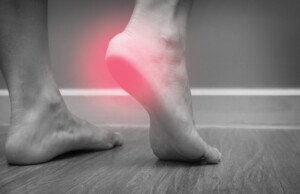
Plantar fasciitis often causes a burning sensation in the heel. Shutterstock/catinsyrup
If you have any kind of mysterious pain in the shoulder, neck, feet, and even back or knee, consider the possibility that the cause is holding onto a treadmill.
“Changing of the gait can always lead to injuries, especially soft tissue injuries such as tendinitis,” says Dr. Oliver Zong, a podiatrist (foot specialist), and director of surgery at NYC Foot Care.
He further explains: “To the extent that holding on to the treadmill changes one’s gait, this could happen. Clearly it is better to walk or run naturally with a natural gait pattern.”
To prevent falling off a treadmill, use a speed that you can manage without feeling you’re going to get tossed off the belt. Holding onto a treadmill, indeed, can cause injuries.
 Dr. Pinker is with Progressive Foot Care, which provides state-of-the-art, full diagnostic testing and treatment of the foot. He’s a professional foot and ankle health and wellness speaker who delivers many original seminars annually such as “Keep On Running.”

Dr. Zong, a foot and ankle surgeon, has appeared on national and local TV programs such as “Good Morning America” and “The Doctors.”
Lorra Garrick has been covering medical, fitness and cybersecurity topics for many years, having written thousands of articles for print magazines and websites, including as a ghostwriter. She’s also a former ACE-certified personal trainer.
.
Top image: Depositphotos
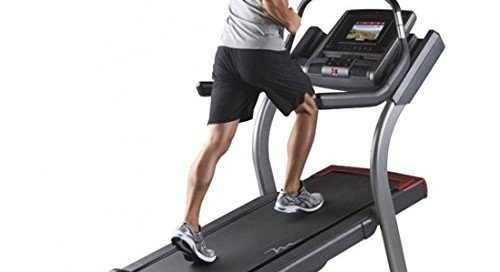
Benefits of 30 Percent Treadmill Incline Include the Low Back
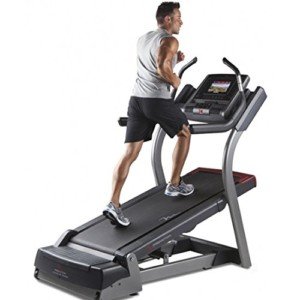
You can reap serious benefits with a 30 percent incline on the treadmill–but you’ll get ZERO benefits if you hold on!
You may have spotted those treadmills at your gym that go up to a 30 percent incline, and thought, “What’s the point? You have to hold on or you’ll fall off.”
I’m a former certified personal trainer, and you do not have to hold on, any more than you’d need to if you were walking up a flight of stairs or a dandy hill outside.
Walking a 30 percent incline on a treadmill will produce a training effect only if you don’t hold onto the bar in front or the console.
If you walk slowly enough, this will not be necessary. Problem is, people typically set the pace too fast for a 30 percent incline.
Benefits of 30 Percent Incline on a Treadmill
You need not spend a lot of time at this steepness to reap benefits. Benefits come in the activation of muscles that are only marginally tapped at lower inclines. At 30 percent, your Achilles tendon and calves will get a superior workout.
Another benefit goes to the anterior tibialis muscle, at the front of your lower leg. Another benefit of 30 percent incline work is that of ankle strengthening.
Plus, at this steepness, there is very pronounced hip and knee flexion. This means that the hip flexors (there are several of these) and the knee flexors (hamstrings) will get fruitfully engaged.
The benefits of a 30 percent incline don’t stop there.
Your low back will have to work to keep your body vertical. However, it’s natural to lean forward as fatigue sets in, as you would if hiking a steep trail.
Remember, to reap benefits of a 30 percent incline, do NOT hold onto the treadmill, or you’ll totally defeat the purpose.
Your body must be vertical, though leaning forward to keep up with the tread is also acceptable, and in fact, will invariably happen as you become fatigued enough.
When you don’t hold on, you’ll feel all sorts of uncomfortable fatigue setting in, all over. But of course!
Walking 30 percent is very new to your body; you’re not used to it. Like any new form of exercise, your body will have to adapt, and in the process, it will “hurt.”
Remember how walking lunges felt the first time? Or barbell squats? Or pushups? Don’t cheat by holding onto the treadmill. Another benefit of 30 percent incline exercise is that it’s easy on the knees.
Though I just mentioned there’s pronounced knee flexion, this means more work for the hamstrings, but there is far less impact and shock absorption on and in the knee joint itself.
If you have painful heels from plantar fasciitis, a 30 percent incline will provide the much-needed stretching of your plantar fascia.
Lorra Garrick is a former personal trainer certified through the American Council on Exercise. At Bally Total Fitness she trained women and men of all ages for fat loss, muscle building, fitness and improved health.
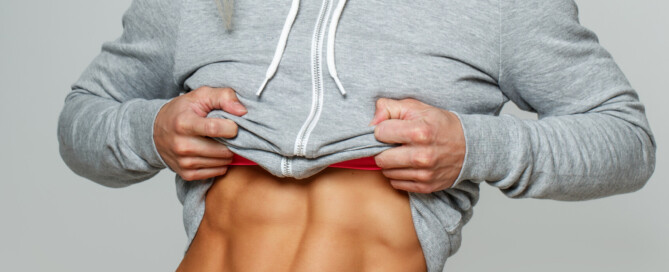
Treadmill Workout for Burning Stomach Fat: 2 MPH, 15 Percent Incline

With correct use of a treadmill, you can burn high amounts of fat in your belly and thighs, hips, etc., with only a 2 mph setting on the 15 percent incline.
Look at people when they use the treadmill’s 15 percent incline; what do you see?
They all hold onto the machine while it goes at a fast speed, often 4 mph.
Even 3 mph is a pretty fast clip for a 15 percent incline. As long as they hold on, they will not burn the fat in their belly (many have noticeable excess fat in their abdominal area).
You will burn WAY more fat in your stomach if you keep your hands off the treadmill, swing the arms naturally and use only a 2 mph speed (at 15 percent incline).
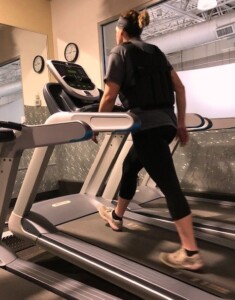
Source: ©Lorra Garrick
Yes, you read that right: 2 mph at the highest incline, without holding on, will burn serious calories.
The problem is that the vast majority of men and women who aim to shed fat in their midsection cling onto the treadmill, their feet simply gliding over the fast tread as their entire body tilts back, reproducing the same angle that occurs when walking on a flat surface!
Furthermore, holding on takes significant workload off the legs. You don’t want this to happen because larger muscles burn more fat when exercised than do small muscles.
To get rid of belly fat and excess weight elsewhere like the thighs and hips, you absolutely must make leg and butt muscles do all the work when using a treadmill incline.
“But I can’t keep up! I’ll fall off!”
You will not fall off if you go 2 mph. When I told my clients to walk only 2 mph (at 15 percent), they thought this was entirely too slow to cause fat loss.
However, they changed their minds within five minutes of this “slow” pace when done without holding on!
Ten minutes into it (not holding on), they were feeling far more worked than with 30 minutes of holding on at much faster speeds.
What if you’re ready to quit after only five minutes?
Should you then hold on? Or should you go only 1.5 mph?
If you prefer steady state exercise, slow down to under 2 mph. There is no shame in walking 1.5 mph at 15 percent incline when your arms are swinging instead of gripping the handrails or other portion of the treadmill.
When you let go, your posture is forced to be near perfect. Leaning forward, while NOT holding on, is perfectly fine.
This is what hikers often do. On the other hand, leaning forward, while holding on, is serious cheating. Don’t do it.
To expedite belly fat loss, defined abs and fitness improvement, you should employ interval training rather than steady state.
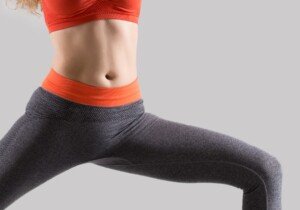
Freepik.com, yanalya
So if you can do 2 mph at 15 percent (without holding on) for only five minutes, or even for only two minutes, then at that point, lower the incline to five percent or zero, and continue walking 2 mph at this lower angle for a few minutes to recover your energy.
Then raise the incline back to 15 percent. Switch back and forth. So for a few minutes, you’re huffing and puffing, and then for a few minutes, you’re recovering.
Alternate back and forth for 30 minutes, without holding onto the treadmill, and believe me, you will bust up far more belly fat than clinging to the machine at 4 mph for a whole hour!
Lorra Garrick is a former personal trainer certified through the American Council on Exercise. At Bally Total Fitness she trained women and men of all ages for fat loss, muscle building, fitness and improved health.
.
Top image: Shutterstock/FXQuadro

Holding Onto a Treadmill: Balance Problem or Laziness?

Is it really about balance issues for all those people who hold onto a treadmill?
Is it possible that the hoards of men and women who hold onto a treadmill while walking do so because of some “balance issue”?
You need not be formally trained in exercise science to understand some fundamental facts.
I once read some posts to an article about common cardio mistakes. One of the mistakes mentioned was “leaning on the machine.”
Many readers posted that they were guilty of holding onto a treadmill.
Then someone posted that she has “balance issues” and that there should not be a one-size-fits-all approach to using cardio equipment, and that people should do what they believe is “best for their body.”
That’s the problem: Just what IS best for your body?
Do you have any idea? Many people don’t have a clue, which is why so many women and men can’t lose the weight they want or can’t make the progress they dream of as far as physique development or fitness.
If you think you know what’s best for your body, chances are you’re wrong.
The Balance Myth
I can’t begin to tell you how many people have told me the reason they hold onto a treadmill is because they have “bad balance,” “poor balance” or “balance problems.”
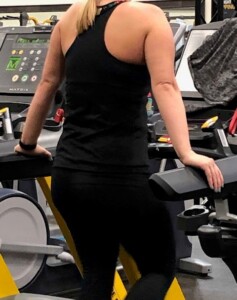
I ask them if they’ve been diagnosed with a balance disorder. Of course, they say “No.”
I’ve had only one client with a disorder that affects balance: Meniere’s disease, and I had her using the treadmill without holding on.
There was another man at the gym who had significant muscle development in his upper body, but had weak, unstable, scrawny legs; he’d sustained permanent neurological damage from a spinal cord injury suffered in a motorcycle accident.
He’d always hold onto the treadmill when he walked. Ironically, he had no problem loading 45 pound plates onto a barbell — at shoulder height.
I told him to remove his hands from the treadmill. He was reluctant, but he complied. As I expected, he didn’t fall or lose his balance. He simply continued walking.
So when people tell me they hold onto a treadmill because of “balance,” I believe they simply don’t know better.
I hesitate to brand them as lazy, because if they were lazy, they wouldn’t even be on a treadmill.
Though sometimes, laziness is obviously the reason, particularly in those who ramp the incline to 15 percent, grip the bar like a vice and lean way back, completely cancelling out the incline.
In most cases, I believe it’s not knowing basic walking mechanics. Does this mean they don’t have a problem with balance if they let go? No.
However, the problem with balance isn’t a medical problem; it’s a learned problem.
The analogy is never removing the training wheels from a bicycle.
Imagine riding a bike with training wheels as you grow up into adolescence.
One day you get on a bike without training wheels. What will happen?
Chances are very high you’ll fall. At the least, you’ll struggle and have “balance issues.” In fact, you’ll feel very balance-challenged.
That’s because you’ve trained your body to adapt to an external support: the training wheels. You’ve deprived your body of developing its internal balance mechanism.
This is what happens when you’ve been holding onto a treadmill for a long time.
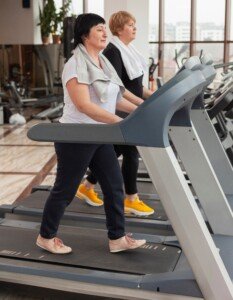
Freepik.com
Taking your hands off makes some people feel like they’ll fall off. Of course! Their body is trained to be dependent, not independent!
But why did they hold onto the treadmill in the first place?
Believe it or not, “Everyone else was doing it” has been named as a reason.
Another reason is because the rails and bar are there, and a novice’s hands will naturally gravitate towards them; a bad habit is born.
And I hate to say this, but sometimes this habit is born because a personal trainer set the novice client up for dependence by putting them on a treadmill and then saying something like, “If you feel off balance, hold onto the bar to steady yourself.”
This puts into the client’s head an expectation of balance problems, an endorsement of cheating.
Before you write yourself off as hopelessly balance-challenged, revisit the idea of walking on a treadmill with a natural, arm-swinging gait.
Do you really believe you’ll fall off if you try this at 2 mph?
If you’re nervous, then set the speed at 1 mph, and then increase by one tenth of a mile per hour every minute and see what happens.
 Lorra Garrick is a former personal trainer certified through the American Council on Exercise. At Bally Total Fitness she trained women and men of all ages for fat loss, muscle building, fitness and improved health.
Source: sparkpeople.com/blog/blog.asp?post=the_10_most_common_cardio_crimes
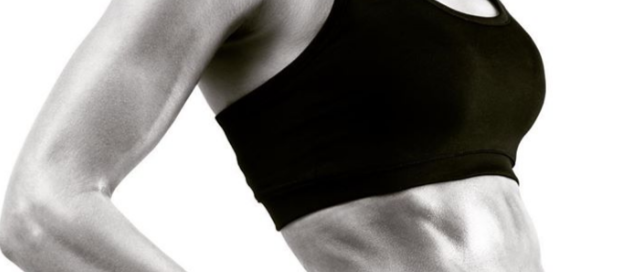
The Cardio Machine Setting that’s Best for Burning Fat
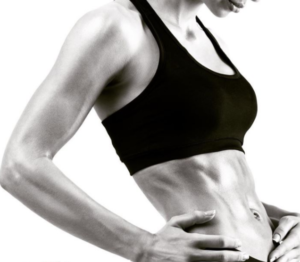
Confused over which cardio equipment program is best for burning the most fat?
Gee, one says fat burn, but another says cardio, then another says hills, or steady pace, or this and that.
Do they ALL burn fat? Or does one cardio program cause more weight loss than another cardio machine program?
To lose weight, burn fat and get the best weight loss results, it doesn’t matter which cardio machine program a man or woman chooses.
I’m a certified personal trainer. What matters is what kind of workout people apply to whatever cardio equipment program they have selected.
The kind of workout a person should apply is called high intensity interval training (HIIT). HIIT can be applied to the hill cardio program, the “cardio” program, the “fast” program, or any other program on the cardio machine.
Because no matter what the cardio program, men and women must do the following:
Spend 30 to 60 seconds putting YOUR ALL into whatever it is you’re doing, be it pedaling a bike, elliptical, revolving staircase, rowing machine or treadmill.
Do ten, 30 to 60 ULTIMATE EFFORT spikes, within your overall time with the cardio machine.
Between each burst spike is approximately a few minutes of recovery time. During this time, a person continues to move, but at a casual pace.
So if you’re running as fast as can be on a treadmill, recovery time would consist of either a very, very slow jog, or a slow to medium walk. Be sure to swing your arms at all times, however.
On an elliptical machine, the fat burning spike would consist of your fastest possible pedaling at a higher pedal tension that you would use for a casual pace.
What your fastest pedaling would be, and which tension you’d use, varies from one person to the next, depending on fitness level.
I’ve noted that some people wipe out after 30 seconds at level 7 and 170 RPMs.
Whereas, a much more fit person, who’d like to lose weight, would need 30 seconds of a level 10 and 250 RPMs to wipe out.
Every time I see people on a rowing machine, they are taking a row through the park. Add up to 10 high-tension, as-fast-as-you-can intervals within your overall time on a rowing machine.
This principle can be applied to all cardio machines, which is why no particular cardio “button” is the best for fat burning.
Actually, the best setting is the manual setting on the exercise machine. This means an individual must input setting changes every few minutes, then every 30 seconds, then every few minutes, every 30 seconds, and so on.
You’ll get used to this, and the hard-and-easy switching back and forth will actually make overall time go much faster.
HIIT burns more fat than traditional fixed-pace movement. This has been proven time and time again by science.
Lorra Garrick is a former personal trainer certified through the American Council on Exercise. At Bally Total Fitness she trained women and men of all ages for fat loss, muscle building, fitness and improved health.
.
Top image: Shutterstock/Improvisor
Are Big Thunder Thighs Genetic? Are Some Women Doomed?

Are you convinced that your big thunder thighs are genetic and nothing can be done about them?
Do you stare at your big thighs in disgust, but then think, “It’s genetic”?
Maybe you don’t have thunder thighs, but when you see them on women, you’re convinced that “It has to be genetic.”
“Thunder Thighs” Defined
If a woman weighs 300 pounds, of course she’ll have massive legs, but they’ll usually match pretty well with the rest of her body; her entire body is huge.
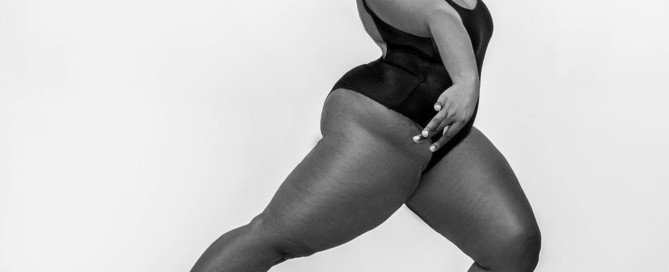
However, in the case of classic thunder thighs, the upper legs are too large for the rest of the woman’s body.
She may be carrying extra weight all throughout her body, but her thighs are still out of proportion, and they really stand out.
Another way that this problem manifests itself is when a woman’s upper body is of medium girth – she’s not chubby or stocky here, but her lower body, especially the thighs, and sometimes only this area (and the hip region) is big; chunky; hefty.
And it is not muscle.
A layperson can easily tell the difference between the fat of classic thunder thighs with their accompanying jiggly or fatty tissue in the hip region, and the impressive muscle size of an Olympic woman sprinter or speed skater.
The major difference is that in the sprinter (or speed skater), the entire body is hard, and often quite muscular.
A woman with “big” or “thunder” thighs usually does not have a trained-looking physique. Often, she’s quite soft looking or pear shaped.
So, are thunder or disproportionately large thighs in a woman genetic?
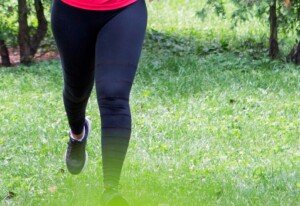
Freepik.com
Well, to some degree.
However, this doesn’t mean there isn’t a cure for out of proportion hefty thighs.
Many women are convinced that nothing can be done about this problem; many women resign to living with this unappealing feature, even though they hate this.
But here is a very compelling question: Have you ever, ever, ever seen a woman with tree trunk thighs/big hips, and a ripped, lean upper body?
And when I say ripped, I mean chiseled, sculpted, glistening with tight, sleek muscle (not bulk). Have you?
Now don’t confuse big muscular thighs with big chunky fatty ones here.
I’m talking about a woman with a size 6-10, ripped upper body (and the size 10 would correspond to a taller woman), but with fatty, hefty, porky thighs.
You won’t see such a woman. And why is that? Because the workout and nutritional regimen that create a totally buff, ripped upper body will valiantly fight against thunder thighs.
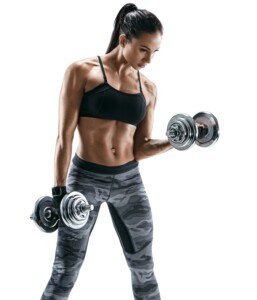
Shutterstock/RomarioIen
I have seen many women with chunky thighs and a size 6-10 upper body — but — their upper body was nowhere near buff status, not even in the same ball park.
The workout regimen (and diet, of course), that gives rise to an amazingly sculpted upper body will, likewise, create astonishing effects for the lower body.
This assumes that a woman works her lower body in the same way that she does the upper body.
Genetics do play a role, in that women tend to carry more fat in the upper legs and hips than do men.
And in the absence of intense strength training, some women’s legs will just fill out with fat and cellulite.
I might add that I never see women with thunder thighs working their legs the same way as the women do who have lean, sleek, buff legs (not scrawny; not thin; but sculpted, shapely hard gams).
So if you suffer from thick thighs, what’s the takeaway message here? Don’t give up.
Change your workout routine; it’s not effective. Cut your cardio time in half and double your strength training time.
And employ the following weapons:
- High intensity interval training
- The back squat
- A most calorie-crushing exercise while keeping your feet still