Treadclimber vs. High Incline Treadmill: Pros, Cons & Benefits
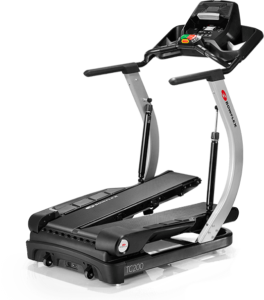
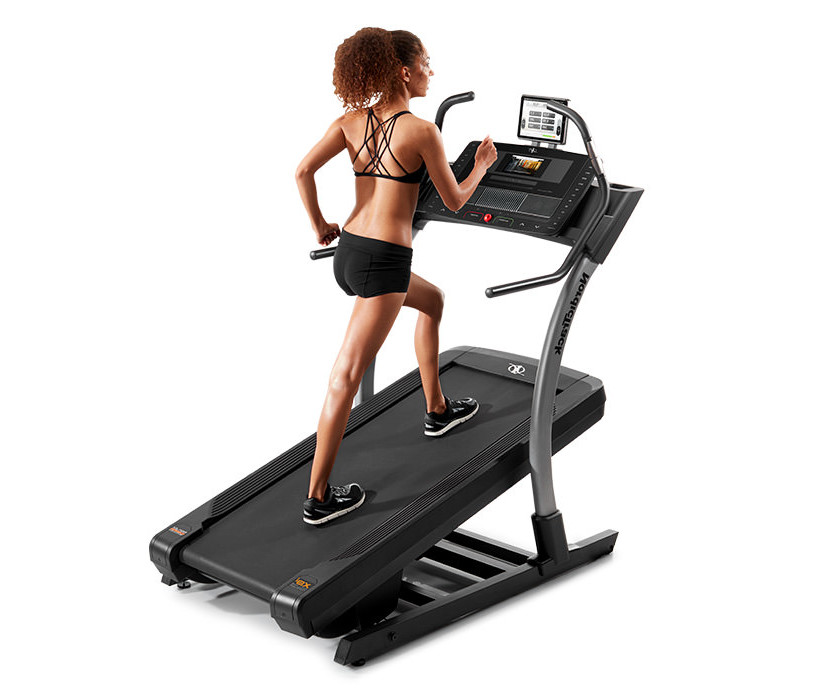
When the Treadclimber is compared to a high incline treadmill, it’s pretty difficult to determine which one actually works better — and then that depends on the user’s goals.
It also depends on how much the user likes the Treadclimber … or the treadmill.
I have spent plenty of time using the Treadclimber, and it’s tough to compare this with a high incline treadmill because both pieces of cardio equipment have their superb virtues.
However, let’s be fair and actually compare the Treadclimber with a standard treadmill.
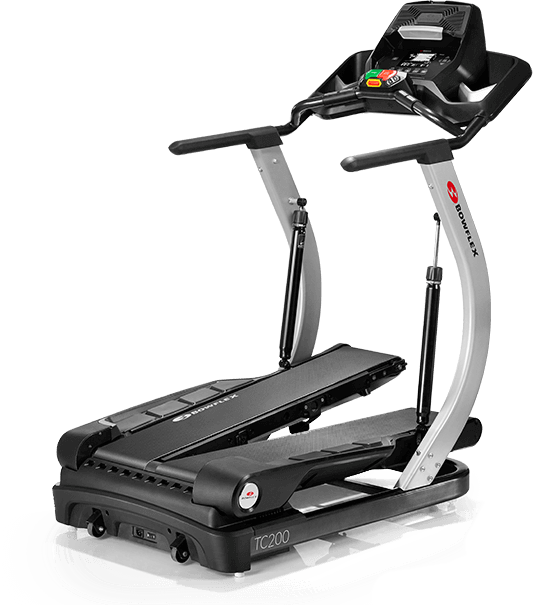
The Treadclimber is easier on the knees and back than the treadmill because the impact is soft, due to this cardio machine’s unique pedal design. Plus, it simulates, to some extent, snow shoeing and sand dune running.
The Treadclimber, despite being gentler on the joints, can yield a tremendous cardio workout – if you don’t cheat by holding onto this machine, that is.
The minute you hold on, you defeat the entire purpose and end up compromising much of the workout.
(The infomercials for the Treadclimber used to show the model holding on for the entire ad, but several years ago, did away with this and now alternate between a model holding on and a model pumping her arms.)
A treadmill, on the other hand, provides opportunity for joint impact if you run on the incline (though not as much as if you ran on a flat grade at the same speed), which isn’t always the terrible thing that it’s made out to be.
High impact cardio strengthens bones and joints, though it’s bad for people who already have problems with their knees and even back.
High impact cardio makes bones denser. Walking a high incline, however, is a low impact activity.
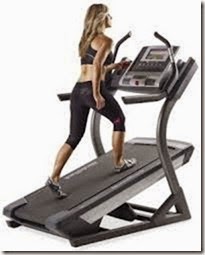
A treadmill is the cardio equipment that most closely simulates actual outdoor ambulation (running, jogging, brisk walking, hill climbing); it’s as close as possible to the real deal.
Running on a treadmill, more so than using a Treadclimber, will bring improvement to athletic performance.
For instance, if you want to improve your basketball conditioning, a treadmill is the far better choice.
If you want to go backwards, it’s easier to do this on a treadmill.
On the other hand, if you want to buff up your agility and neuromuscular coordination, moving backwards on a Treadclimber, without holding on, will really kick in some results.
For people with high levels of conditioning, a treadmill offers better options and more variety, especially since your gym might have a party pooper who tells you it’s against club policy to “run” on a Treadclimber!
I was running on this cardio machine one day (with a jogger’s arm pump) and the manager told me I can’t do this because it might damage the machine.
Despite what some people claim, it’s actually possible to “run” or jog on a Treadclimber. I had done this many times before the manager spotted me.
If you have a hamstring injury or something similar, that makes jogging painful, try running on a Treadclimber – you may find that this is painless, which was one of the reasons I was doing it; at the time I had a hamstring injury.
Both pieces of equipment offer great benefits for cardio conditioning for all levels of exercisers, including people rehabbing injuries.
For best results in your cardio training, use both the Treadclimber and the treadmill; no need to choose.
 Lorra Garrick is a former personal trainer certified through the American Council on Exercise. At Bally Total Fitness she trained women and men of all ages for fat loss, muscle building, fitness and improved health.
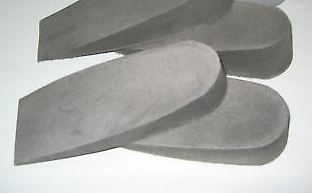
Very Cheap Alternative to Olympic Weightlifting Shoes
It amazes me how prevalent the recommendation for Olympic weightlifting shoes is in the online muscle building and fitness forums for people struggling with the back squat, when a so very cheap alternative is right at your fingertips! (more…)

Weight Loss Tips for Heavy Teen Girls Fed Up with Fat

If you’re a plus-size teen girl wanting to lose weight, it is perfectly okay to pursue this goal as long as you do it within reason and in a healthy way. (more…)
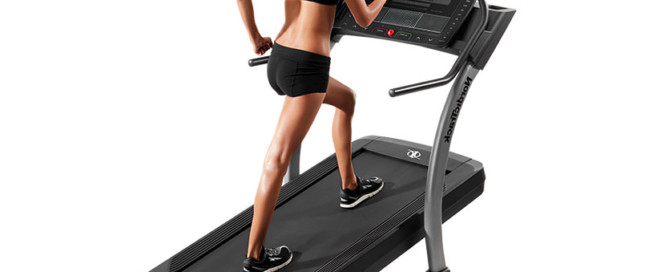
Should You Hold Onto a 40 Percent Incline Treadmill to Walk ?
Treadmills that go up to 40 percent incline are getting more popular, but just how high must the incline be before you should hold on while walking?
The TV commercials for the 40 percent incline treadmills show the models walking without holding on, and also while holding on.
The manufacturer wants to appeal to the largest demographic possible.
To show only a hands-off walk would deter potential buyers – who are easily influenced by what they see in commercials — who think they’d fall off without holding on.
I know that sounds really silly, but manufacturers do not want to take a chance on deterring potential buyers, so they show both a hands-off and hands-on demonstration.
So never mind what the TV commercials show.
Let’s look at this from a fitness and mechanical perspective.
First off, it’s logical to assume that anyone who’d want to purchase a treadmill for its 40 percent incline is not physically disabled.
That’s a very logical deduction. I can’t imagine a person with multiple sclerosis, cerebral palsy or Meniere’s disease wanting to use a 40 percent incline … though anything is possible, for sure!
It’s safe to assume that people who are eager to walk on a 40 percent grade are free of disease or injury that impairs their balance and steadiness.
Should You Hold On When Walking a 40 Percent Incline?
As a former personal trainer at a health club where I worked with many people on their treadmill use, I say NO.
From the standpoint of layperson’s common sense, I also say NO.
It’s quite simple, no PhD in exercise physiology required to understand:
What’s the point of walking on a 40 percent grade if you’re going to hold on, which nullifies the slope effect?
If you hold on, you’ll deprive yourself of the 40 percent incline benefits:
• Works the low back like mad – in a way that deadlifts and yoga do not, though keep doing THOSE too if you already are.
• Provides a way to fire up your heart rate without generating impact – appealing to those whose knees can’t tolerate the impact of jogging.
• Strengthens the ankles.
• Stretches the Achilles tendon and calves.
• Works the glutes more than do lower inclines (though it will NOT make your butt bigger).
• Concentrates more work in the quads than do lower inclines.
• Can prepare your body for steep outdoor hiking.
• Can really get your heart rate up at a slow speed.
• Will improve balance and proprioception.
These benefits will be cancelled out if you hold on. Does the image below make sense?
Holding on in front causes one’s body to angle back, cancelling out the net effect of the incline!
Perhaps you’re wondering if a LIGHT grip won’t make a difference, especially if it’s on the side rails and you’re making an effort to keep your body vertical.
Well, the problem with even a light hold is that it encourages the potential to tighten it – something you may not even be aware of as you get lost in the workout.
It also subtracts workload, even if you try to keep vertical.
Why bother holding on at all?
What’s the purpose of a 40 percent grade if you’re going to hold on? This opposes its novelty in the first place.
The rails are there to grab onto in case you start feeling off-balance. Re-steady yourself and then let go.
Swing your arms (you need not exaggerate) as you would if you were climbing a steep hill outdoors.
Conducting 40 percent walking workouts without holding on will give you a true sense of accomplishment, especially if you’ve been leading a sedentary life.
Lorra Garrick is a former personal trainer certified through the American Council on Exercise. At Bally Total Fitness she trained women and men of all ages for fat loss, muscle building, fitness and improved health.

Why Must Daylight Savings Time Cause Anxiety & Sleep Disruption?

How can a change of just one hour disrupt the sleep of so many people and cause anxiety?
It’s just ONE HOUR, yet throngs of people are thrown into a tizzy over such a seemingly simple change to make! (more…)

How Many Times a DAY Should You Use a Treadmill ?

Just how often in a single day are you drawn to your treadmill that you actually fear that too many visits on it can somehow damage your body? (more…)

Is Taxotere Really the Best Breast Cancer Drug? No Options?

MUST a woman take Taxotere in order to beat breast cancer?
Some women wonder if there are studies showing that chemo treatment without Taxotere results in much lower survival rates or higher recurrence rates of this dreaded disease.
Women who have read stories of breast cancer patients who’ve suffered permanent hair loss after receiving chemotherapy that included Taxotere are apt to wonder if Taxotere must be the “go to” drug for their own treatment.
• Is Taxotere the key to my survival of breast cancer?
• Does this come down to “my hair or my life”?
• Or is there another chemo drug that’s just as effective but has not been fingered as a cause of permanent hair loss in six percent of its recipients?
These are very smart questions that you should ask your oncologist if you’re worried about permanent hair loss. There is no such thing as a silly question when it comes to breast cancer treatment.
• It’s your body.
• It’s your life.
• It’s your quality of life post-treatment.
Another Drug to Ask About
Northwestern University Feinberg School of Medicine has found a solvent-free, less toxic chemo drug.
It’s more effective in the prevention of the progression of metastatic breast cancer, says a report of a study led by William Gradishar, MD, who is the director of breast medical oncology at Robert H. Lurie Comprehensive Cancer Center.
Remember the Name: Abraxane
When compared to Taxotere in the study, Abraxane prolonged the progression-free survival by nearly seven months.
“It nearly doubled progression-free survival,” points out Dr. Gradishar in the report that’s published in the Journal of Clinical Oncology (May 26, 2009).
Abraxane is free of chemical solvents and is delivered via albumin, a protein. Abraxane’s generic name is nab-paclitaxel.
Abraxane vs. Taxotere
• In the study, patients received Abraxane on a weekly schedule.
• Taxotere is typically given every three weeks.
• Beyond the study, the appeal of Taxotere to some patients is its relatively infrequent administration.
The “Best” Drug for Breast Cancer Treatment?
“No one drug is the ‘best’ – it’s usually about combos of chemo-Rx drugs, sequencing and MOST importantly risk assessment (which then dictates what chemo-Rx regimen to use,” explains Mark Levandovsky, MD, Founder and Medical Director of Preventive Medicine and Cancer Care. Dr. Levandovsky is a board certified internist and oncologist/hematologist in practice for 25+ years.
“Taxotere belongs to a taxane family of drugs that contain Abraxane and Taxol as well, each with their particular side effects,” continues Dr. Levandovsky.
“If goal is cure, these taxanes are given over 12 weeks, with each woman’s goals and unique comorbidities dictating which agent to pick.
“The effectiveness is comparable, but side effects differ both short term (fatigue, infusion reactions, blood counts/infections) and long term (neuropathy).”
More on Abraxane
“This is a win-win finding,” says Dr. Gradishar in the paper. “The weekly schedule of Abraxane has more anti-tumor effects,” he adds, “and is better tolerated than Taxotere.”
Dr. Gradishar says that Abraxane is also “able to deliver the chemotherapy drug more effectively to the tumor.”
The paper explains that weekly Abraxane “may be an appropriate alternative” to Taxotere in the first-line treatment of mets breast cancer.
Like all chemo drugs, Abraxane has the potential to cause serious side effects. But it has not been associated with permanent hair loss.

Dr. Levandovsky provides personalized care to health conscious individuals as well as cancer patients and survivors, focusing on an integration of genetic/molecular risk assessments, prevention, education, nutrition and psycho-oncology.
Lorra Garrick has been covering medical, fitness and cybersecurity topics for many years, having written thousands of articles for print magazines and websites, including as a ghostwriter. She’s also a former ACE-certified personal trainer.
.
Top image: Freepik.com
sciencedaily.com/releases/2009/05/090526162846.htm
drugs.com/abraxane.html
academic.oup.com/annonc/article/23/11/2879/234091/Permanent-scalp-alopecia-related-to-breast-cancer

How to Love Your Chemo Curls, Even if You Loathe Them

If you despise your “chemo curls” for their unmanageability and even their looks, here’s a simple trick for learning to embrace your new hair overnight. (more…)

The Strange Way that Severe Headaches Can Lead to GERD

It’s not that GERD can cause headaches, but rather, headaches can cause GERD. Now how is this possible? (more…)

Can GERD Appear Like Magic Out of Nowhere ?

So can you get GERD one day for no apparent reason?
Or does it begin subtlety, gradually building up over time until you realize that your chest and stomach has been burning lately? (more…)