

What’s the Youngest You Can Get Carpal Tunnel Syndrome?

Now isn’t it funny that all these kids spending hours every day on their keyboard but few young people seem to get carpal tunnel syndrome? (more…)
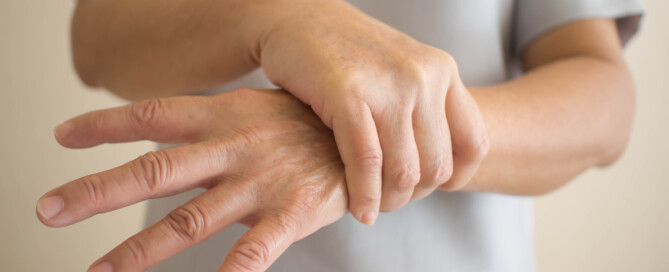
Does Carpal Tunnel Syndrome Always Cause Pain?

Carpal tunnel syndrome can be quite painful, prompting frustrated patients to seek a surgical solution.
But for some individuals with this common disorder, there is never any pain.
Tingling and/or numbness may be the only symptoms of carpal tunnel syndrome.
This condition occurs when the median nerve, which runs through the carpal tunnel in the wrist, becomes compressed.
The compression can lead to sensations of tingling or numbness, particularly in the thumb, index finger, middle finger and part of the ring finger.
The initial presentation of carpal tunnel syndrome often involves only tingling and numbness.
Those with only the tingling and numbness naturally worry that one day they will start experiencing pain.
The next question the becomes: When does the pain usually strike? In the morning? During activity?
With certain hand use such as chopping vegetables or using a computer?
“Actually, the most common symptom initially occurs at night, where there is numbness and tingling of the fingers,” says Alejandro Badia, MD, FACS, hand and upper limb surgeon and owner of Badia Hand to Shoulder Center in Doral, FL.
“People think it’s because of a problem with circulation or that they’re sleeping on their hand.
“Certainly this is partly positional, particularly flexing or bending the wrist or extending it.
“Those positions cause increased pressure on the median nerve which runs within the carpal tunnel that is defined by floor and walls of the carpal of wrist bones, and the roof is a thick two and a half inch center ligament called the transverse carpal.”
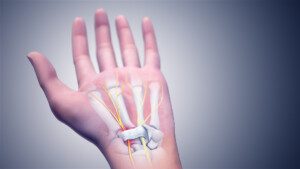
Compression of the median nerve in CTS. Scientific Animations
Furthermore, carpal tunnel syndrome can develop in both hands at about the same time — even though this presentation is very uncommon.
Causes include repetitive motions such as what are used on a keyboard, cash register or with sewing activities; underactive thyroid; obesity; rheumatoid arthritis and diabetes.
Dr. Badia explains, “The symptoms usually are a numbness and tingling, and then usually pain will begin at a later stage or sometimes never comes on, but regardless [the numbness and tingling] is very uncomfortable.”
 Dr. Badia is a founding member of the American Hand Institute, a think tank and medical device start-up company focused on minimally invasive solutions to hand, wrist and elbow pathology. orthonowcare.com
 Lorra Garrick has been covering medical, fitness and cybersecurity topics for many years, having written thousands of articles for print magazines and websites, including as a ghostwriter. She’s also a former ACE-certified personal trainer.
.
Top image: Shutterstock/ Orawan Pattarawimonchai

Can Carpal Tunnel Syndrome Make Fingers Crooked?

If you’ve been noticing lately that your fingers are becoming crooked, you’ll actually wish that this was only carpal tunnel syndrome.
Because what it most likely is – is far less treatable than carpal tunnel syndrome. (more…)

Can Carpal Tunnel Syndrome Cause Your Palm to Itch?

The itching of your palm is driving you mad and there seems to be no explanation for this itching – except maybe carpal tunnel syndrome?
Well, don’t go there. “Itching, which is called pruritus, is usually a result of a histamine release by mast cells,” says Alejandro Badia, MD, FACS, a renowned hand and upper limb surgeon and owner of Badia Hand to Shoulder Center in Doral, FL., and founder of OrthoNOW, the only urgent orthopedic care franchise in the world.
A mast cell is a type of white blood cell.
Itching, says Dr. Badia, “can be from a symptom of a variety of issues.” Itching that doesn’t seem to have a cause that’s directly related to the skin (a dermatological cause) can actually be caused by a variety of conditions.
But one of them is not carpal tunnel syndrome, which is a disorder involving the median nerve. In carpal tunnel syndrome, the median nerve is subjected to compression or pressure, as depicted below.
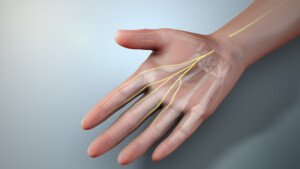
Carpal tunnel syndrome. scientificanimations.com/CC
This results in the classic symptoms of numbness, tingling and/or pain in the wrist. The pain may also extend up the arm.
But a release of histamines does not result from CTS.
If you’re plagued by an itchy palm, and you have numbness, tingling and/or pain that fits the bill for carpal tunnel syndrome, this doesn’t mean that the itching in your palm is related to the median nerve compression.
Instead, you have two unrelated conditions occurring. Having your carpal tunnel syndrome treated will not relieve any itching of your palm.
Dr. Badia is a founding member of the American Hand Institute, a think tank and medical device start-up company focused on minimally invasive solutions to hand, wrist and elbow pathology. orthonowcare.com
Lorra Garrick has been covering medical, fitness and cybersecurity topics for many years, having written thousands of articles for print magazines and websites, including as a ghostwriter. She’s also a former ACE-certified personal trainer.
.
Top image: Shutterstock/WSW1985

Can Carpal Tunnel Syndrome Cause Cracking Wrists?

So your wrist is going snap, crackle pop!
Maybe there’s even some pain or tingling along with the cracking in your wrist: carpal tunnel syndrome as a cause for cracking of the wrist bones?
“CTS does not cause cracking wrists,” says Alejandro Badia, MD, FACS, a renowned hand and upper limb surgeon and owner of Badia Hand to Shoulder Center in Doral, FL., and founder of OrthoNOW, the only urgent orthopedic care franchise in the world.
So what usually causes wrists to crack?
Dr. Badia explains, “That is due to ligamentous laxity which people mistakenly call double jointed.” Ligamentous laxity means that the ligaments are loose.
“That is a huge misconception, but people who are lax tend to have multiple problems, whether it be with their shoulders — women particularly with their knees,” or in the spine or elsewhere.
“But no, cracking wrists has nothing to do with a nerve compression in the wrist.”
And that’s what carpal tunnel syndrome is: The median nerve is being compressed – and by soft tissue.
The bones have nothing to do with the condition, and carpal tunnel syndrome does not affect the bones.
Of course, it’s possible to have both carpal tunnel syndrome and cracking wrist bones at the same time, but this is just a coincidence. There is no cause and effect.
Dr. Badia is a founding member of the American Hand Institute, a think tank and medical device start-up company focused on minimally invasive solutions to hand, wrist and elbow pathology. orthonowcare.com
Lorra Garrick has been covering medical, fitness and cybersecurity topics for many years, having written thousands of articles for print magazines and websites, including as a ghostwriter. She’s also a former ACE-certified personal trainer.
.
Top image: Shutterstock/Jtas

Why Can’t Carpal Tunnel Syndrome Go Away on Its Own?

If you don’t think carpal tunnel syndrome can go away on its own, there’s actually more hope than you’ve been thinking about this common and sometimes very painful condition. (more…)

Can a Very Positive Ape Index Make Everyday Lifting Hard?

We know that a very positive ape index is an advantage in the deadlift, boxing/MMA fighting, swimming and rock climbing.
But in everyday lifting? (more…)
10 Signs of a GOOD Nursing Home: Have Peace of Mind

Here are 10 signs that a particular nursing home would be a great place for your elderly loved-ones to live at – signs that you can feel good about and reassured they’re getting top-notch care. (more…)


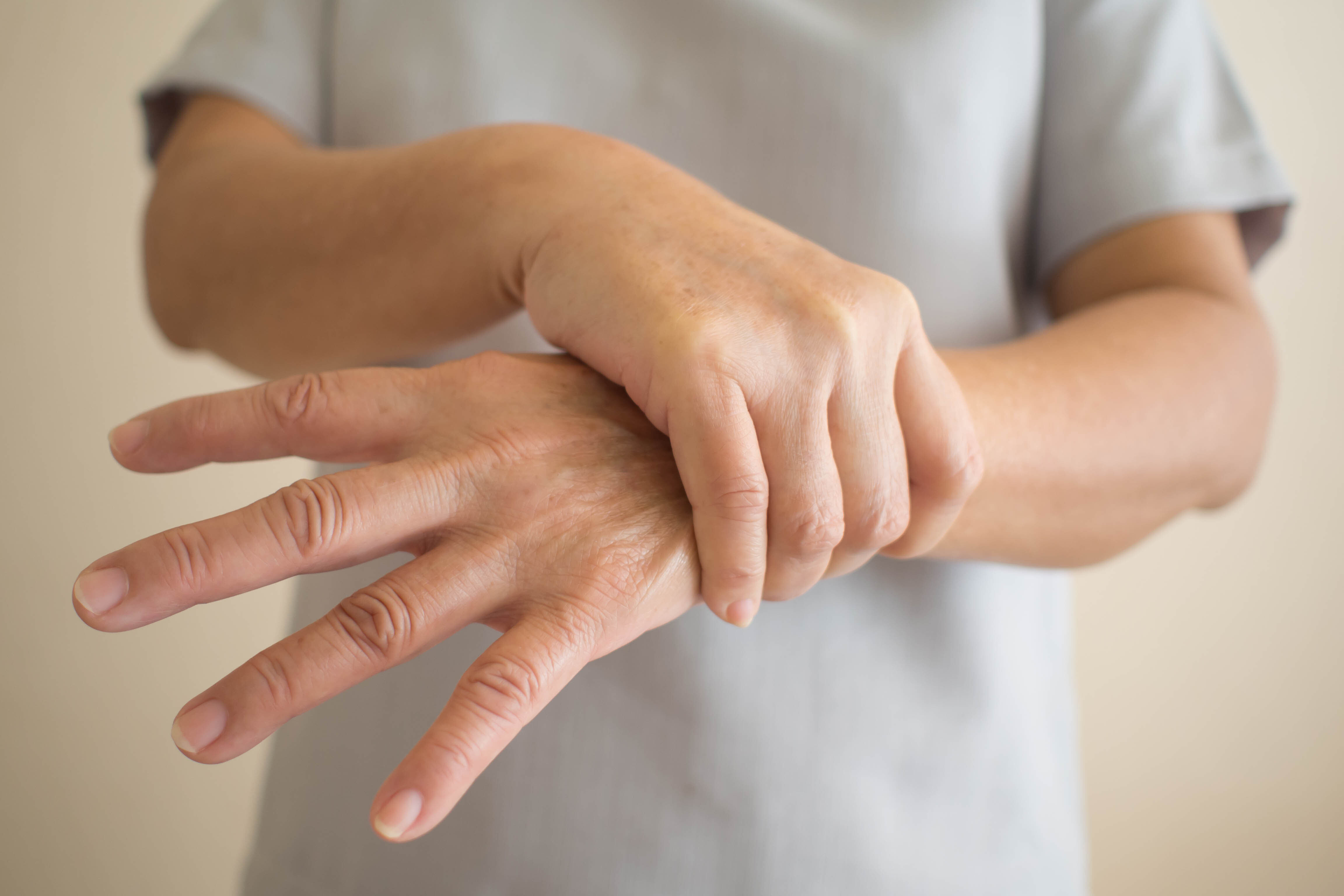






Bladder Pressure: Causes (Including Cancers) and Solutions

The feeling of bladder pressure, even though you don’t have to “go,” has many potential causes including three kinds of cancer.
Causes of Bladder Pressure Excluding Cancer
Urinary tract infection. “Urinary tract infections are common and can be quite painful,” says Walter Gaman, MD, FABFM, board certified in family medicine and the author of several award-winning books including “Age to Perfection: How to Thrive to 100, Happy, Healthy, and Wise.”
“The first sign of a UTI is often cloudy urine followed by painful urination. Urinary tract infections are more common in women than in men,” says Dr. Gaman.
Cystitis. The bacteria that cause a UTI can also inflame the bladder. The feeling of pressure on the bladder is caused by muscle spasms, not urine buildup.
Prostatitis. “The prostate is a gland the size of a walnut,” says Dr. Gaman. “It sits just below the bladder. The function of the prostate is to produce semen. When the prostate becomes enlarged, it’s called prostatitis.
“Although the cause of prostatitis isn’t always known, a common cause is bacterial infection that is relieved with antibiotics.
“Because of the location of the prostate, inflammation can put pressure on the bladder. That pressure can cause nighttime urination, painful urination, a feeling of fullness or pressure on the bladder, and even cloudy urine.
“Men often notice that their urine stream is weak, a tell-tale sign that they have prostatitis. This happens because the enlarged prostate is interfering with the bladder and urinary tract.”
Uterine fibroids. These benign masses can exert pressure that affects the bladder.
Endometriosis. Uterine tissue grows behind the uterus or endometrium, affecting the bladder.
Medical conditions not directly related to the urinary tract. These include a spinal cord injury or other neurological disorder that gives way to an overactive bladder. This is caused by impaired neuromuscular function.
Obstruction. A kidney stone or benign mass can cause an obstruction in the urethra, impeding the flow of urine.
Cancers that Can Cause Bladder Pressure
Obstruction. An obstruction in the ureter can also be a malignant mass.
Bladder cancer. You’ll feel you need to relieve yourself even though there is no urine to void. The tumor is pressing on the bladder. Other symptoms may be blood in the urine.
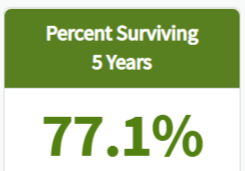
Survival rate for bladder cancer.
Ovarian Cancer. The growing cancerous mass can cause the ovaries and the uterus to put pressure on the bladder, creating the illusion that urine needs to be voided.
Bladder Pressure Remedies and Solutions
Preventing a urinary tract infection is the first line of prevention of bladder pressure.
“Prevention of urinary tract infections stems from the protection of the urethra from bacteria,” says Dr. Gaman. “If you are prone to UTIs, there are several things you can do to help prevent them.”
First, avoid wearing tight underwear; this can trap bacteria.
When you feel you must “go,” then do so. Holding it in can help proliferate bacteria.
“Always urinate and wash up before and after sex,” says Dr. Gaman. “This helps clear anything out of the urethra that may have been backwashed during intercourse.
“Limit the amount of sex you’re having to no more than four times a week. ‘Honeymoon bladder’ is a common term used by medical professionals to describe the common UTIs that occur in newlyweds who have frequent sex.
“Skip the bath and opt for showers instead. This is especially true if you add bath bubbles or body wash to your bath. If you do take a bath, be sure to urinate immediately after.
“Drink plenty of water. Dilute urine is better for a sensitive bladder and urinary tract than concentrated urine. Limit the amount of tea and coffee.
“Avoid spermicidal jelly and other lubricants that can cause irritation.
“Always wipe front to back. A common cause of UTIs is E.coli bacteria. E.coli is common in stool, but can cause serious infections if it reaches the vaginal area and travels to the bladder.”

Dr. Gaman is with Executive Medicine of Texas and is with the Staying Young Radio Show 2.0 podcast.
Lorra Garrick has been covering medical, fitness and cybersecurity topics for many years, having written thousands of articles for print magazines and websites, including as a ghostwriter. She’s also a former ACE-certified personal trainer.
.
Top image: Shutterstock/sasha2109
Senior Orphans–Lonely Elderly: Causes and Solutions

It’s a fast growing problem: elderly people “orphaned” by their families and the health care system, at high risk for abuse, depression and illness.
The word “orphan” usually conjures images of helpless children with no one to care for them, but that same term can apply to seniors as well.
It is becoming a growing problem with these seniors who fall through the cracks of the healthcare system.
Senior orphans are people over age 65 who have no family, are isolated from family either because of dysfunctional relationships or geographic distances, or who have family members who take advantage of them financially.
With more single adults and fewer women having children to potentially care for them, the plight of senior orphans is potentially a huge one.
Nearly 25 percent of Americans over age 65 are at risk of becoming senior orphans, according to a study from researchers at the North Shore-Long Island Jewish Health System and the Hofstra North Shore-LIJ School of Medicine.
An example is an elderly patient who lived with his sister. Both had made quite a bit of money in their careers, but once in their eighties, both developed dementia and mental illness.
They had years of magazines and unopened mail stacked in their home, and had meals delivered so they could survive.
A neighbor befriended them and had them sign over power of attorney documents so he could “help them” pay bills.
In doing so, that neighbor also helped himself to money from their accounts.
Their patient advocate intervened by calling Catholic Charities, which in turn contacted the state guardianship office.
The couple was moved to an assisted living home, where they did quite well with adequate support and treatment for their multiple medical problems.
This story had a happy ending. Unfortunately, not all do. But there are steps people can take to prevent themselves from falling prey to a “helpful” neighbor or family member.
Solutions to Ending up a Forgotten Elderly Person
Start planning early. People should start putting a care plan in place in their fifties or early sixties.
The earlier the better, since the plans are cheaper when you’re younger. There are many different models of long term care (LTC) insurance.
Some, for example, are whole life plans that convert to LTC, and if the policy owner dies first, the benefit still gets paid to the family.
Consider consulting an estate planning attorney. Many people benefit from asset allocation trusts developed with monies already available; this is particularly important when chances are that the senior will eventually run out of money and have to rely on Medicaid.
An attorney can help clients prepare for Medicaid in ways that ease the transition. Trying to plan without expert help can be a bad idea.
Understand the costs. One of the biggest mistakes people make is giving away money to family members without understanding how much they may need that money for their own care down the road.
Nursing home costs are expensive—typically from $6,000 to $10,000 per month. People often run out of money quickly once they enter skilled nursing care homes.
Medicare usually covers only 100 days of rehab yearly but may ask you to leave a facility after three weeks if progress is not being made. After that, the patient is responsible for all of the costs.
Know that the best care comes at a price. The higher-quality nursing homes rarely admit people when their resources are almost depleted and they are in the process of applying for Medicaid.
The reality is that the more money one has, the more choices there are.
Recognize that family members don’t always have your best interests at heart.
There is, unfortunately, a big problem with elder financial abuse in this country.
Healthcare professionals regularly encounter sons and daughters who are reticent to approve needed expenses for long-term care of their parents because they are experiencing financial stresses themselves.
They are afraid that there will be no inheritance left for them if Mom or Dad gets transferred to an assisted living or quality skilled nursing facility.
Seniors do have legal protection if people try to take advantage of them financially. Elder financial abuse is a felony.
When abuse is reported, bank accounts can be frozen, a guardian appointed and perpetrators sent to jail. “But why get to that point?”
With a plan in place, seniors can make sure their needs are well taken care—even if they reach a time when they can no longer take care of themselves.
 Teri Dreher, RN, CCM, is the founder of NShore Patient Advocates. A critical care nurse for 35+ years, she’s also the author of “How to Advocate for Yourself & Your Loved Ones,” available on Amazon.
.