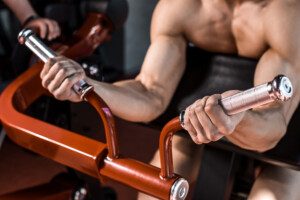
Just how important are biceps curls? We see them everywhere for fitness ads, in fitness articles, posters at gyms, ads for protein products, etc. They’re everywhere.
But does this mean that curling a dumbbell or barbell is among the most valuable strength training exercises you could do?
Frankly, biceps curls are over-rated. But there’s several reasons for this.
Easy Pose for Photographers’ Models
If you scroll through photo libraries, whether the images are free or licensed, you’ll see many images of arm curls if you do a search on “strength training” or similar.
It’s easy to have a model, including ones who don’t train at all, hold little dumbbells in a curling position.
Plus, photographers already know that the biceps curl is a premier show move in the marketing world.
Mimics the “Make a Muscle” Command
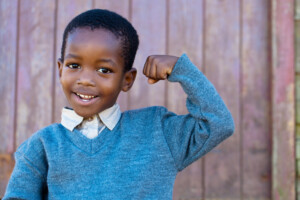
hutterstock/Nolte Lourens
When someone asks you to “make a muscle,” what do you do?
You flex the biceps, of course! This can be done in more than one position.
All of those positions flex the biceps, such as keeping the upper arm down and bringing the forearm up against the abdomen, then flexing.
Or, one or both upper arms are raised to shoulder height, parallel to the floor, with the forearm bent to 90 degrees to flex the biceps.
This is such a common response to “show me your muscles” or similar prompts, that photographers relentlessly use it in their work — and writers and bloggers gobble up these images.
Who flexes a quadricep when asked to make a muscle?
I’d be lying if I said I never did this, as I am proud of my quads!
But back to the biceps: They are the easiest muscle to show a flex with.
Thus, it stands to reason that it’s the most popular pose.
Biceps Are Easily Visible
This muscle group is more commonly visible than any other muscle.
Even in wintertime when everyone’s wearing long pants, many still wear short-sleeve shirts, easily exposing a prominent biceps group.
Heck, you can even easily spot a well-trained biceps under a long sleeve form-fitting shirt.
Arm Curls Are Easy to Do
Among the first exercises that beginners head for at the gym is the standing biceps curl.
It feels easy for them, and there’s a dumbbell weight amount for every level of beginner.
However, just because this exercise seems easy doesn’t mean that there can’t be errors in form.
Many beginners swing their whole body into arm curls when the weights are too heavy.
Or, they flare their upper arms out (they should be against their sides).
I’ve seen people doing arm curls with a crooked body, tilting to one side.
Nevertheless, the arm curl comes across as very rudimentary to beginners, and this has appeal.
Easy to Feel
When someone wants to feel a muscle on a muscular person’s body, where’s the first — and often the only — place their hand goes? You know the answer.
You can flex the quads, but not as well as the biceps. And it’s harder to give a visible flex to the deltoids and chest.
None of these reasons, though, mean that it’s crucial to perform a lot of arm curls to gain strength and fitness.
In fact, isolating the biceps is very important to bodybuilders — way more than to anyone who just wants to be strong, fit and preserve muscle mass in older age.
Going overboard with curling exercises could put the elbow tendons at risk for chronic inflammation.
Have you seen people at the gym with wraps around their elbows? That’s due to tendonitis!
How well do biceps curls work?
Biceps curls do strengthen the biceps, but that’s a pretty small piece of the overall picture.
As we get older, the bigger concern is maintaining as much total muscle mass, strength, balance and physical ability as possible.
Spending a big chunk of your workout doing curls doesn’t do much for those things. The much better choices are the deadlift and pulling movements, which do engage the biceps.
This doesn’t mean you should skip the biceps curls.
There are many ways to isolate this muscle group:
- Standing or seated standard dumbbell curl
- Incline curl
- Spider curl
- Concentration curl
- Preacher style (with E-Z bar, dumbbells or machine)
- Cable and tension band variations
- Even kettlebells can be used.
It’s actually a versatile exercise due to all these variations.
There’s nothing wrong with them if you want “guns” or wish to complement your compound routines.
The problem is when curls become a major part of a workout while more useful exercises get pushed aside.
Think about what you actually need your muscles to do in everyday life.
For younger and middle age adults, that could be picking heavy items from the floor, lifting heavy things into and out of a car trunk, hoisting heavy things around in the yard or at the workplace, carrying kids, etc.
A routine of deadlifts, squat variations, kettlebell swings and pulling movements will better serve your body (along with pressing movements) when compared to biceps isolating movements.
For older people, getting up from a chair, climbing stairs, carrying groceries, lifting something off the floor, getting in and out of cars, and staying steady on your feet all require several large muscle groups working together.
For them, it’s again the squat variations and other classic compound exercises to get a lot of bang for one’s buck.
Compound (multi-joint) movements involve more muscle at once and more closely resemble the kinds of movements you actually need to do in everyday life, regardless of age.
The Tendons
Repeatedly hammering the same isolation movement can irritate the elbow and the tendons around it, especially if you’re using heavy weights or doing a high number of repetitions.
So if your main goal is a buff strong physique or fighting age-related muscle loss, don’t get distracted by the mirror muscles.
You can still get a good-looking biceps with back exercises that use the biceps as secondary movers: narrow-grip pull-down, seated row, bent-over dumbbell or barbell row, chin-up.
A few curls are fine. Just keep your regimen in perspective, and don’t confuse a good-looking biceps pump with a well-rounded strength workout if your goals are more about overall strength, fitness and anti-aging rather than having a bodybuilder’s look.