
Men get varicose veins too, but even if a man doesn’t care about looks, he needs to worry about possible medical complications of these abnormal vein formations.
Varicose veins affect a large portion of the population. By age 60, roughly 70 percent of women and 40 percent of men are affected.
In fact, half of the population over age 50 experiences some sort of vein issue.
However, while women are more likely to have them, men are more likely to suffer from serious complications.
Men are less likely to go to the doctor, especially for conditions they might not consider serious.
Many have the misconception that vein issues are purely cosmetic and fail to prioritize them. However, if varicose veins are left untreated, they could lead to severe complications and even be fatal.
Since not all vein issues are cosmetic, men need to be more proactive about their vein health and seek treatment when it might be a more serious issue. Failing to do so can lead to serious consequences.
There are two main types of vein issues, spider veins and varicose veins.
Spider Veins
Spider veins are not a health hazard. They are less than 2 millimeters wide and are tiny, damaged or dilated blood vessels that appear in red, blue or purple spider-web or branch-like patterns just below the skin’s surface.
They are commonly (but not exclusively) found on the legs, ankles and the face, rarely causing physical symptoms beyond cosmetic concerns.
Varicose Veins
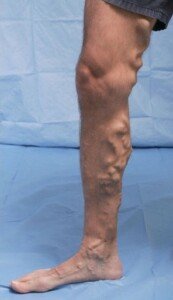
Varicose veins in a man. FerIndigo97/CC
Varicose veins, on the other hand, can progress to a dangerous degree.
Varicose veins are over 4mm in size and bulge beneath the skin. This is not just a cosmetic problem, but an indicator of underlying venous insufficiency that can lead to serious health complications.
If you have varicose veins, it’s a good idea to get them checked right away before they progress.
Venous insufficiency is a condition characterized by leaky valves in the veins, leading to reversed blood flow.
The damaged veins fail to return blood to the heart, causing it to pool in the legs, leading to chronic pain, aching, heaviness and extreme leg swelling.
This results in pressure on the tissue, causing vein damage and severe leg swelling.
- Venous insufficiencies can also cause ulcers and blood clots in the legs.
- The clots can travel to the lungs, causing a pulmonary embolism, which can be fatal.
Have you checked your legs lately?
It’s critical that you go to the doctor if you start to experience venous insufficiency symptoms.
If you have varicose veins measuring 4 millimeters or more, or any swelling in one or both legs, you should see a doctor immediately.
Four millimeters is a little less than the diameter of a typical pencil eraser.
If you need to relieve early symptoms, use support stockings or socks, and elevate the legs.
It may be difficult for some men to tell if they have varicose veins because of their muscle mass. Excess fat, as well, can make these abnormalities more difficult to visually detect.
Weightlifters and bodybuilders tend to have muscles large enough to pinch out drainage from the veins, which is not dangerous.
However, if somebody with enough muscle mass has a venous insufficiency, it would be hard to tell.
These individuals need to pay attention to persistent swelling, aching or heavy legs. However, the mere presence of high muscle mass is not a risk factor for developing varicose veins.
Of note, though, is that straining during squats, deadlifts or other maximal lifts can temporarily increase pressure in leg veins. Repeated high pressure could theoretically worsen vein valve stress over time.
Don’t let this stop you from weight workouts; most men with varicose veins or venous insufficiency are not built up with muscle from gym sessions.
In fact, those with a muscular body from working out typically have a healthful diet, are nonsmokers and are fit from resistance exercise, and thus, any vein issue that they may have would rarely be fatal.
It’s especially important to be proactive about vein health if you have underlying conditions.
People with cancer have a much higher risk of blood clotting. This can make complications fatal.
Immobility and being overweight can also interfere with vein health and cause swelling in the legs.
If you think you might have venous insufficiency, do not ignore the signs. If you notice varicose veins growing or spreading, or leg swelling, consult your doctor immediately.
Paying attention to varicose veins is a necessary part of good health protocol.
 Dr. Lawrence Presant, DO, is chief medical officer at Arizona Vein Specialists in Phoenix, and a certified diplomat of the American Board of Venous and Lymphatic Medicine. A vein surgeon specialist, his passion is phlebology, the diagnosis and treatment of painful and unsightly vein disorders.
.