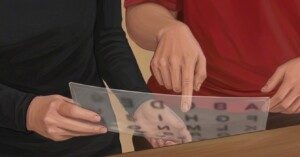
Many are wondering why Mary Brown doesn’t let autistic son Woody himself hold the letter board as he points to spell words. There’s a reason.
Thousands of comments have poured in to the two YouTubes about Mary’s claim that her severely autistic, nonverbal son wrote a novel (“Upward Bound”), by pointing to one letter at a time on a plastic card.
Out of thousands of comments, literally only a few people believe any of this is true; most believe that Mary herself (a former story analyst for film) wrote “Upward Bound.”
This article will answer the question that hundreds of commenters want to know:
- Why does she hold that plastic card?
- Why can’t Woody hold it in one hand and point with the other?
On “The Today Show” YouTube channel, there are three sustained up-close shots of Woody’s index finger landing in different spots on the laminated card.
Another YouTube, which criticizes the New York Times for running this story for feel-good points, shows a somewhat side view of Woody tapping at the board while his mother holds it and “reads” off what he’s spelling.
First, when the “Today” shots are viewed at 0.25 speed, you can easily see where his finger points: random letters, spaces between letters, plus hovering for which it’s impossible to tell which letters he points at.
Occurring alongside these zoom-ins are text blurbs of what Mary is reciting he’s spelling.
Second, in the reaction YouTube, if you slow it to 0.25 speed, you can see Woody’s pointing doesn’t – in the least – correspond with what Mary is “reading.”
This man is illiterate. Being that he’s illiterate, the answer to “Why does she hold the letter card for Woody?” becomes strikingly obvious.
When the footage is slowed down, it presents undeniable proof that this young man lacks even rudimentary literacy. Nothing gets spelled in those shots, not even, M-Y N-A-M-E I-S W-O-O-D-Y I L-I-K-E T-R-A-I-N-S.
Instead, for instance, starting at 1:54 on the “Today” YouTube, it’s: T J O/P B G D/F H/J I V/B N V Z/X A. The other two close-ups are similar gibberish.
A side view shows him tapping same spots several times, moving to one or two other locations and then hitting the same spot repeatedly again.
Several other commenters have posted minor variations of my slo-mo tracking of his pointing.
But the commonality is that, regardless of which commenter translates, it comes out as gibberish.
For most of the time that Woody taps in any scene showing his face, his eyes are either trained on a small screen to the side showing preschool cartoons or looking anywhere but at the rows of letters before him.
His body appears as though he spends 15 hours a day slumped in a chair viewing screens (his favorite is the Thomas the Tank Engine cartoon).
Does all this sound like someone who can write a novel and answer reporters’ questions at poet laureate level? Well, never mind that; just view the shots in slo-mo.
What would happen if Mary gave Woody the letter card?
Based on what all we now know, it’s reasonable to conclude that his nonverbal autism comes with the co-morbidity of significant intellectual disability.
Thus, he’s not capable of holding the card steady in one hand and pretending to spell with the other.
He has no idea that he’s a puppet in a sham and has been trained by Mom to randomly tap at the board when she gives the prompts.
He perhaps functions at only preschool level, completely unaware that his mother has put his name on a novel.
So giving him the board would bust the sham wide open. Woody might flap it around, toss it about, turn it ‘round and ‘round, maybe even put the corner in his mouth while viewing Thomas, who knows?
Mary can’t risk blowing her deceptive, moneymaking scheme, and also knows Woody isn’t cognitively capable of learning how to hold the card before himself, randomly tap and make it all look like he’s communicating.
But he IS capable of learning to aimlessly point when she prompts him to while she holds the card – and the ongoing screens to his side are what keeps him settled in the seat while he’s being filmed or while a reporter is interviewing them.
Hundreds of commenters want to know, “Why doesn’t he just type on a regular keyboard?”
Well, you now know the answer to that one.
Proponents of this rapid prompting method will say that a motor control condition (apraxia) prevents use of a keyboard.
But this begs more questions, namely, instead of what’s essentially a piece of paper, why not teach nonspeaking autistic individuals to communicate with assistive technology?
Today’s tech can accommodate all sorts of sensory preferences and neuromotor challenges.
I just viewed a nonstop video of a nonspeaking autistic tween pointing to letters on what appeared to be a hybrid keyboard and letter board (held by her mother) — connected to a computer screen.
But every time her index finger made solid contact (not grazing contact), a voice sounded out the letter and it appeared on the screen. When a complete word was spelled, the voice then spoke the word.
The mother was holding the board too steadily to have deliberately or subconsciously moved it in a way that spelled out what appeared on the computer screen, which, to paraphrase, was as follows: “I like spelling meaningfully with my mother. I think being on tv is the coolest.”
Kaylie Clinton’s eyes were on the keyboard the entire time except occasionally when she appeared to be pausing. And even then, the gaze shift was brief and still within range of the keyboard.
Furthermore, her hunting for the letters was slow, calculated and erratic — which gives tremendous credibility to this communication method in her case — though I would’ve liked to have seen the keyboard resting on her lap without her mother holding it, and more footage showing simultaneously in the frame her typing and what was appearing on the screen. Nevertheless, her case appears very credible.
Kaylie didn’t tap-tap-tap-tap-tap at a quick, perfecly cadenced beat. She took her time visually searching for the next letter.
We don’t see any of this with Woody Brown. But never mind that; view him at 0.25 speed, people.
Another point to consider: The letters on Mary’s card are rather small. If Woody has apraxia or a fine motor control problem, shouldn’t the letters be a lot bigger?
How about a large board with big button-like letter tiles that are easier to find and point to?
Mary chooses a small letter board to make it more difficult for people to see just where Woody is pointing.
What she and “The Today Show” failed to consider is this wonderful little thing called Playback speed.
View the segment on the “Today Show” below: