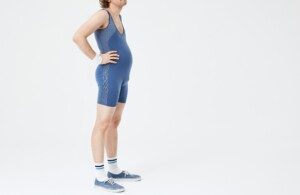
It’s still trendy for thin influencers to post pics of themselves in the middle of sitting up, using this trickery to claim that even they have fat in their abdomen.
A few things are going on here, depending on whom the “queen” is.
This foolery is designed by crafty influencers to go over the heads of impressionable followers, to make themselves come across as, well, a “queen” of inspiration and revolutionary insight. They know whom they’re manipulating.
On the other hand, it could also be (likely in most cases) that the influencer makes these posts to calm down outbursts of their own body insecurities.
Either way, what the photo is showing isn’t actually body fat at all, or, if fat tissue is involved in the appearance, this doesn’t mean it’s in excess. It’s been staged to look that way.
Posture Is a Big Deal
When someone sits in a slouched position, the pelvis rolls backward and the lower spine rounds.
This position compresses the abdominal area and relaxes the muscles that normally hold the abdomen in.
The abdominal contents shift slightly forward, and the lower belly can appear to puff out. Even very lean, fit people can create this effect instantly just by slumping in their chair.
This is why these kinds of posts anger many overweight women who can’t instantly make tummy rolls disappear, hence their clap-back side-by-sides titled, “This body … is also this body,” showing the same visible degree of tummy bulge or thigh puff in both images.
The “pooch” that appears in these demonstrations by thin or straight-size women is frequently just the result of posture mechanics rather than surplus fat.
One has to wonder what kept happening earlier in the life of these thinner influencers that got them caught up in such cringe.
The “Core”
Our so-called core isn’t just the visible six-pack when body fat gets low, in combination with toned muscles.
It’s a coordinated system involving the diaphragm, the deep abdominal muscles, the pelvic floor and the muscles along the spine including those of the lower back.
When you sit upright with a neutral spine, the core naturally provides light support to the abdomen.
In fact, the core provides support whenever you walk, especially uphill or up a staircase. It enables the upper and lower body to work in synch, which is why it gets activated when we do squat exercise.
But when you collapse into a slouch, that support system switches off. Anyone who’s had an unexpected form break in the barbell squat will know this.
In a collapsed body position, the deep stabilizing muscle, the transversus abdominis, relaxes.
- The ribcage drops forward, and the abdominal wall lengthens.
- The organs inside the abdomen shift slightly outward and downward.
- The result is that familiar lower belly protrusion and “rolls” that people often assume is mostly fat.
But can that bulge be molded into something more permanent?
Posture doesn’t just create the appearance of a bulge in the moment.
Over time, habitual slouching can actually encourage that lower abdominal protrusion to become more noticeable.
This is why very sedentary people who aren’t what we’d consider “fat” or even plump can have a disproportionately paunchy middle.
This isn’t always from a big appetite or heavy beer drinking. It’s from too much sitting with bad posture. This is why it can occur in adults who are otherwise straight size or even slender in build.
Quite simply, the human body adapts to the positions it spends the most time in.
Look at the Bodies of Very Sedentary Adults
If someone regularly sits in a rounded, collapsed posture for hours each day, the abdominal wall can gradually lose some of its resting tone.
This can happen even in young adults and even teens.
The deep core muscles become less active during everyday sitting.
The lower abdomen can start to rest outward more when relaxed, even when the person isn’t deliberately slouching.
I’ve seen notably overweight women at the gym, who regularly do kick-butt workouts, who actually had flatter midsections than very sedentary thinner people!
The human body was not meant to lounge around all day. And when it does, it becomes misshapen.
Ironically, repeatedly demonstrating the “Look, I have belly fat when I sit” pose may reinforce the exact posture that encourages the protrusion in the first place. More than likely, it won’t, though, but why take the chance?
It’s also possible that in an effort to feel better about her body, the influencer purposely sits slouched in everyday life – to view her “real” self – to keep reminding herself that “all bodies look this way even when toned from exercise.”
We should all go back to that iconic advice from our mothers: “Sit up straight; stop slouching!”
Remind yourself that a slouched posture compressing the abdomen isn’t a meaningful example of excess body fat.
It’s more like squeezing a pillow. If you bend it in the middle, it bulges somewhere else.
Simply sitting with the ribs stacked over the pelvis, keeping a gentle natural curve in the lower back, and maintaining light core engagement allows the abdomen to rest in a more supported position.
How to Improve Seated Posture
You’ll need to make a conscious effort. I myself often find that after being a while at the computer, my posture has somewhat degraded.
I then perk it back up. You just have to be more aware. However, there are seating options that can help.
For example, there are chairs that enable you to get into a position for desk work, while keeping your spinal column erect.
There are back supports you can put on your favorite desk chair that force your vertebral column into an erect position and help keep it that way.
Some people have found that replacing a chair with a large fitness ball does the trick.
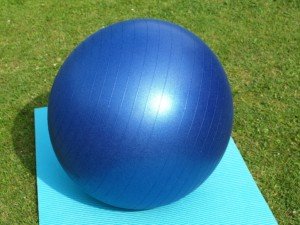
Sitting on these balls (which come in different sizes to accommodate height) forces an arch in the lower back, leading to good posture while seated.
Due to their portability, they can be easily interchanged on the job with your traditional chair.