
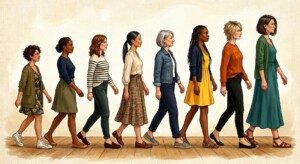
Why is it that when a tall person is overweight, they’re often called “big” or “large boned”?
This incorrect labeling makes some tall men and women — who are overweight — believe they don’t need to lose the excess unhealthy fat.
Why aren’t overweight tall people ever called “plump,” “chubby,” “chunky,” or — in the case of a lot of excess weight — “fat” or “obese”?
Instead they’re called “big” or, “She has a large frame.” Another common reference is “He’s just big boned.”
The funny thing is that when a very tall individual is quite thin, many people attribute this to the height.
Yet at the same time, when a very tall person is overweight or “big,” people attribute this to the height or bones!
What’s the cutoff height after which it’s impossible to be overweight and instead you just have big bones?
What’s the cutoff height after which it’s impossible to be overweight and instead you just have big bones?
Dinosaurs have big bones. People can have long bones.
The bones of a healthy (no pituitary disorder) very tall man or woman are not disproportionately thicker or wider than the bones of average height people. “Disproportionately” is the key word here.
The limb bones of a 6’5 woman will be greater in circumference than the bones of a 5’1 woman, but the difference will proportionately reflect the difference in height.
Longer bones aren’t bigger. They are longer — and proportionately larger in circumference.
The frame of a tall person is longer. This doesn’t cause extra fat in fat cells.
If your definition of big is that which has extra length, then I guess tall people are big. But let’s be fair with terminology.
A slender but exceptionally tall person is never referred to as “big” or “large framed.”
Tallness Is an Excuse for Thinness but Also Bigness
We’ve all heard talk about how skinny a woman is because she’s so tall, and that her body is stretched out, or — all the food she eats gets spread out more, etc.
But then we hear that a very tall woman who’s overweight is “naturally big” or has “big bones.”
How can this swing both ways? Let’s stop this talk already. It’s so inaccurate and misleading.
Excess body fat in very tall people is just as harmful as it is in short people and everyone in between.
Of course, 190 pounds on a 6’4 WNBA player is going to consist of much more muscle and much less fat than on an average woman who’s only 5’3.
But a 6’4 woman who’s not athletic, doesn’t work out and over-indulges can be just as overweight as that 5’3 woman — as far as body fat percentage.
What’s the height cutoff?
What’s the height cutoff for which a woman with excess body fat would no longer be considered overweight, plump or chunky, but rather, “big boned”?
Is it 5’7? How about 5’9? What’s the cutoff for men? 6’2?
- Look, it doesn’t matter what the height is.
- Excess body fat means excess body fat, regardless of height.
I’ve taken body fat readings, using a caliper for skin folds, off of tall clients.
If the result was 31% body fat for a tall man, he was clinically obese — just as obese as my short male client also with 31% body fat.
Another way to look at this is where those “big bones” are located that are causing the perceived bigness.
This reminds me of my parents’ German shepherd, who was getting overfed and beginning to take on a tubular appearance when viewed from above while he was up on all fours.
Someone said, “He’s not overweight. He’s big boned!”
I replied, “Yeah, and most of those bones are in his waist!”
Skin-Fold Test to Determine Body Fat Percentage
A tall person who’s “just big” can get a skin-fold test with a simple tool: the skin-fold caliper.
Personal trainers can take the measurement of skin folds at various locations of the body.
If you belong to a gym, ask a personal trainer to use this tool to determine your body fat percentage.
A three-point skin-fold test is pretty decent at yielding an accurate body fat percentage, though more sites can be measured for even more accuracy.
The chief locations are the lower abs, the thigh and the back of the arm (triceps area).
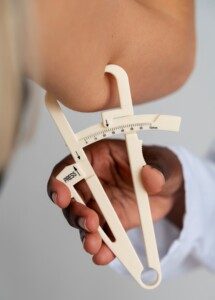
Skin-fold caliper to collect a bodyfat reading.
American Council on Exercise Body Fat Percentage Guide
- “Average” (men): 18-24%
- “Average” (woman): 25-31%
- “Obese” for men is 25% or more, and for women it’s 32% or more.
The term “average” is broad, because a woman can have a body fat percentage of 28% and clearly appear overweight (though not “fat”). This would be likewise for a man whose BF is 22%.
Nevertheless, these BF values apply to all heights in adults, whether just 4’9 or 6’9.
Bone Cells vs. Fat Cells
If a very tall person consumes a lot more calories than what he or she burns, that individual will be overweight (excess body fat).
Fat cells in the body will accumulate more fat, making them bigger, but bone cells will not become bigger.
- Caloric surplus = bigger fat cells, not bigger bone cells.
- Caloric deficit = shrunken fat cells, not smaller bone cells. This is why a “big” tall person can lose excess weight and no longer look big, but instead, appear lean.
Being exceptionally tall is no excuse for carrying around excess body fat.
Yet it’s not unheard of for an adult with a lot of height to use that as an excuse for being “husky,” “hefty” or “stocky.”
I once had a female client who stood a lofty 6’3. And I took her body fat percentage.
According to the ACE guidelines, she was obese. She wanted to lose weight and get fit. She was not a dinosaur. She was a human with very long bones and extra big fat cells.
There are plenty of very tall people who are lean (low body fat) as well.
Some have impressive musculature, such as NBA, NFL and NHL athletes.
And some tall athletes aren’t that muscled, but are thin in appearance, such as high jump specialists and volleyball players.
Likewise , very tall athletes may have some extra fat, as it does not interfere with their performance (e.g., strongmen competitors, shot putters, discus throwers, hammer throwers, wrestlers, football linemen, powerlifters).
But the extra fat has nothing to do with their height or bone structure.
Being “big” does not automatically come with extra height any more than being skinny automatically comes with being short.
Remember, you are not a dinosaur. And remember, no big boned human skeleton has ever been found.
If this article provided you with helpful information or reassurance, please consider supporting my work through Ko-fi. Donations help me continue writing detailed medical content that’s easy to understand.
