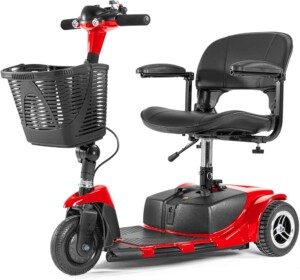
Why would you use a motorized scooter if you have full upper body mobility?
Can cheating your upper body of work cost you down the road in terms of health?
This topic needs more attention, because a large number of people – with perfectly functioning upper-body mobility, right down to the fingertips – are living their lives out of motorized scooters.
These devices come in different makes and models, such as the one pictured above, and another popular type for which a small joystick on the armrest provides locomotion and directional control.
I recently met a woman, “Sue,” who had become paraplegic from a car accident that severed her spinal cord at midsection level, preserving full function of her upper body including hands and fingers.
When I was told she’d be coming into the dining area, I envisioned a woman rolling in with a manual wheelchair. Instead Sue came in with a motorized scooter (the joystick kind).
These motor powered chairs allow smooth locomotion with minimal effort.
Sue was significantly overweight. Of course, she may have been obese prior to the accident, but it’s logical that since the accident, she had gained a lot of weight simply due to the extreme sedentary lifestyle of living out of a motorized wheelchair.
It’s easy to say that losing the use of one’s legs could result in substantial weight gain even if the individual self-propels all day with a manual chair. And in fact, this outcome is certainly heard of.
But we’ve also all seen plenty of paraplegics who were of normal weight or maybe slightly over.
In fact, you’ve probably seen quadriplegics who looked underweight – despite their greatly reduced daily caloric expenditure.
Nevertheless, it’s clear that there’d be less weight gain if a paraplegic used a manual wheelchair, which would require persistent “walking” of their arms!
Lack of upper body movement will have cascading effects on the paraplegic’s overall health.
- It’s one thing when a cervical spinal cord injury limits or prevents upper body mobility; the person has no choice but to rely upon a motorized chair.
- But many with paraplegia use these devices; they’re marketed as super convenient, flashy and cool, and eliminate repetitive arm pushing.
Sue mentioned she’d had a deep vein thrombosis, lymphedema and lipedema – which are all much more likely to occur in someone with whole-body inactivity rather than just lower body inactivity.
She also had a caregiver with her. I don’t know to what extent the caregiver aided Sue, but the level of obesity indicated that there was no way that Sue was self-transferring, such as from bed to chair, even putting on pants by herself.
Meanwhile, there are plenty of other paraplegics who’ve always used manual wheelchairs – all that self-propulsion has kept their upper bodies a lot fitter and capable, which is why they’re able to transfer without assistance (especially if they strength train with weights), self-bathe, self-dress, and even roll around on a basketball court or participate in marathons.
Sedentary Lifestyle and Weight Gain
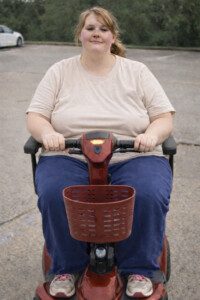
Because Sue has not used a manual wheelchair, her shoulders and arms are free from the built-in daily exercise of self-propulsion.
Over time, this reduced movement — regardless of body weight — will lead to severe deconditioning.
However, extreme inactivity is a major risk factor for significant weight gain.
Of course, not all paraplegics – including even those who use motorized chairs – gain significant weight.
But the absence of obesity does NOT mean the absence of severe deconditioning of the upper body.
I knew of two paraplegic students (a man and woman) at my college with fairly normal body weight.
They had full use of their hands and fingers, yet got around on T-bar-controlled scooters. Needless to say, the upper bodies of both had a very obvious lack of muscle tone.
Ironically, at this same dormitory was a student with incomplete quadriplegia who self-propelled with a manual chair – pushing palms with permanently curled fingers against the knobs of the wheels.
Research supports the link between reduced upper body activity and weight gain in paraplegics.
A study in Spinal Cord (Bauman et al., 2019) found that individuals with paraplegia who had greater levels of inactivity were significantly more likely to develop obesity and metabolic syndrome.
Muscle Usage and Cardiovascular Health
Manual wheelchair users engage their arms constantly. Every push, as well as change of direction or turn, involves shoulder, arm and core muscles.
Over time, this builds strength, endurance and cardiovascular health.
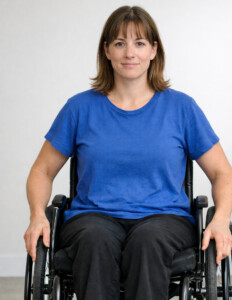
Self-propulsion all day in a wheelchair is a form of ambulation our bodies were not designed for, which is why it’d be very fatiguing if an able-bodied person were to, as an experiment, spend all day using a manual chair.
This upper body ambulation is nothing to sneeze at, and it’s a shame that so many paraplegics don’t realize the importance of replacing their legs with arms instead of motors.
Manual chair use will make it easier for a person to transfer themselves, dress without assistance and perform daily tasks with relative ease.
A study in the Journal of Rehabilitation Medicine (West et al., 2018) explains that active wheelchair users had significantly better cardiovascular profiles, lower body fat percentages and stronger upper body musculature than those who relied on motorized devices exclusively.
The implications are clear: Mobility choices directly influence long-term physical health.
The Role of Obesity in Complications
Obesity in paraplegics carries unique risks. Beyond reduced mobility, it increases the likelihood of secondary conditions.
The link between obesity, inactivity and blood clots is well-established.
A study in Thrombosis Research (Cohen et al., 2020) found that immobility combined with obesity significantly increased the risk of DVT in those with spinal cord injuries.
Regular upper body exercise, as seen in manual wheelchair users, can reduce these risks by improving circulation and metabolic function.
Transfers, Daily Function and Independence
One of the most overlooked consequences of relying solely on a motorized scooter is the impact on daily independence.
Transfers — from bed to chair, chair to toilet, or chair to car — require both strength and mobility.
People who use manual wheelchairs develop the strength and coordination to perform these transfers more easily.
Studies in Disability and Rehabilitation (Smith et al., 2017) show that upper body conditioning in paraplegics directly correlates with independence in daily living activities.
Researchers in Frontiers in Neuroscience (Jones et al., 2018) found that paraplegics who used manual wheelchairs displayed better proprioception, upper body coordination and postural control than those who used only motorized scooters.
The Psychological Component
Active wheelchair users often report higher levels of self-efficacy and independence.
The confidence gained from being able to navigate environments under one’s own power translates to better overall well-being.
Conversely, use of a motorized scooter can exacerbate feelings of dependency.
It just has to be so demoralizing to Sue that she must depend on a caretaker. I just can’t see Sue independently doing things that so many other paraplegics can do, based on not just her size, but from long-term use of that joystick.
Even if she had been that exact size prior to the accident, several years of living out of a scooter has certainly made her upper body far more weaker than if she’d been pushing manual wheels for that same amount of time.
Research in Spinal Cord (Miller et al., 2021) shows that physical activity in paraplegics is strongly linked to better mood, reduced anxiety and greater perceived independence.
It’s important to note that manual wheelchairs are easier to roll than you may realize.
Manufacturers take into consideration that some users may have compromised upper body strength for any number of reasons yet still elect to use a manual device.
Some wheels have knobs, while others don’t; knobs are often used by those such as with incomplete quadriplegia or a condition that weakens the upper body along with the legs.
A Call for Awareness
Sue’s life could’ve looked very different had she been using a manual wheelchair for most of the time.
While motorized chairs are helpful and often necessary for paraplegics under certain circumstances, they should not replace common everyday locomotion from a manual chair in people capable of self-propulsion.