
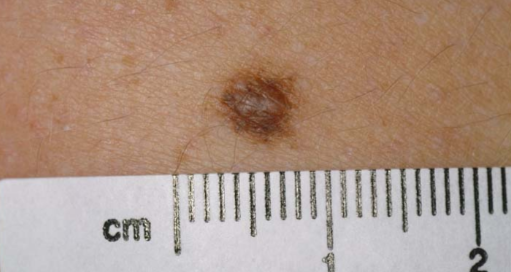
How Common Are Grey Moles?
You may have read that moles can be grey in color, but how normal or common is this?
“The most common moles usually have an even pink, tan or brown color,” says Dr. Michael Shapiro, MD, Medical Director and Founder of Vanguard Dermatology in NYC, NY.
“People with darker complexion usually have darker moles than those with fairer skin.
“Grey moles are fairly uncommon and usually seen in discoloration of moles — one of the symptoms of melanoma.
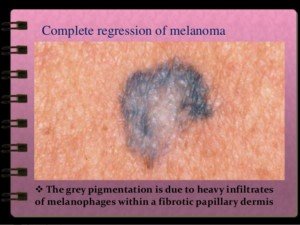
“If the mole changes from its original color to grey, seek out professional medical care.”
A mole that changes colors, regardless of the original color, is suspicious for melanoma skin cancer.
“There’s no specific evidence about patients with grey moles, but I would recommend seeing a doctor if there is any indication of grey or discoloration.”
Data does not exist regarding how common a benign grey mole is. In fact, have you ever seen a grey mole on anyone?
The big question, however, is if a grey mole on your skin used to be the common and normal tan, beige or brown.
A grey mole that was formerly any shade of brown or tan needs to be evaluated by a dermatologist who will likely remove it for a biopsy.
Melanoma often causes a normal pigmented lesion to become altered in color.
Only a biopsy can determine what exactly is going on.
A change in color is a very concerning sign and warrants an immediate evaluation by a dermatologist.
 Dr. Shapiro is a board certified dermatologist and Mohs surgeon and has treated over 12,000 Mohs cases for skin cancer. He is widely published in peer-reviewed academic journals.
 Lorra Garrick has been covering medical, fitness and cybersecurity topics for many years, having written thousands of articles for print magazines and websites, including as a ghostwriter. She’s also a former ACE-certified personal trainer.
Can Sun Spots Become Melanoma?
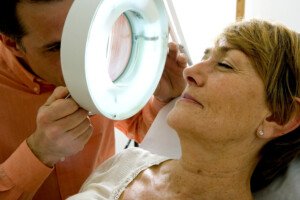
Sun spots mean there’s been damage to the skin. Whether or not these might one day transform into melanoma is a fair question.
“While sun spots do not automatically mean skin cancer, people with sun spots are at an increased risk” of melanoma, says Dr. Michael Shapiro, MD, Medical Director and Founder of Vanguard Dermatology in NYC, NY.
Just what is a “sun spot” anyways?“
Sun spots are a result of sun exposure and darken the skin area which also increases its absorbency to UV rays,” continues Dr. Shapiro.
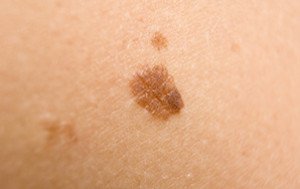
“It is possible for sun spots to become cancerous, so make sure to get these checked if you have any concerns.”
This is a layman’s term that can have more than one meaning.
For example, if you’ve ever seen tan or brownish spots on an elderly person’s hands and forearms, you may have thought of these as sun spots that have accumulated over time, though these are actually more often referred to as age spots.
As people approach 40 and beyond, and even in their 30s, they may begin developing tan to light brown colored spots or speckles on their face — the result of cumulative sun damage in their earlier years that’s finally manifesting itself. Sometimes these are referred to as sun spots.
The term “sun spots” has also been used to refer to a type of skin problem called actinic keratosis, which is quite common in people over 40. This is also known as solar keratosis.
It’s sun damaged skin; the cells are atypical. Actinic keratosis, left untreated, has about a 10 percent chance of turning into cancer — but not the melanoma type.
The skin cancer that the actinic keratosis “sun spot” can turn into is squamous cell carcinoma.
A true sun spot cannot become the melanoma type.
Check with your dermatologist to find out if the lesions on your skin are actual sun spots, freckles, liver spots, age spots, actinic keratoses, etc.
Actinic keratoses, however, almost always are not tan or brown.
They’re pink or reddish, and when you glide your fingertip over these splotches, they feel kind of like sandpaper. They should be removed.
Dr. Shapiro is a board certified dermatologist and Mohs surgeon and has treated over 12,000 Mohs cases for skin cancer. He is widely published in peer-reviewed academic journals.
Lorra Garrick has been covering medical, fitness and cybersecurity topics for many years, having written thousands of articles for print magazines and websites, including as a ghostwriter. She’s also a former ACE-certified personal trainer.
.
Top image: Shutterstock/Image Point Fr

Can a Melanoma on the Face Look Like a Typical Pimple?
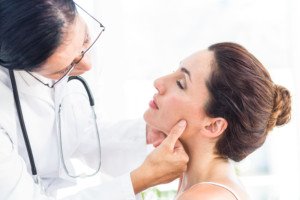
“Sometimes, nodular melanoma can resemble a pimple you might find on your face,” says Michael Shapiro, MD, Medical Director and Founder of Vanguard Dermatology in NYC, NY.
“Nodular melanoma spots, unlike pimples, will be asymmetrical and vary in color — from pink to dark brown.
“This type of melanoma is more commonly found in men than women and more so in patients older than 60.
“Nodulars will grow rapidly in thickness as opposed to diameter, much like a pimple — but it may not have a readily visible phase of development, as it may occur beneath the skin’s surface.
“You may not notice drastic changes in the spot over time, which causes most patients to bypass any medical treatment.
“However, if you follow the ABCDE rule and have any of the symptoms, seek professional medical help right away.”
ABDCE stands for asymmetry, border (check for jagged or uneven edges), diameter (increasing is a warning sign), color (change in color or multiple colors are a warning sign) and evolving (a changing mole is a warning sign).
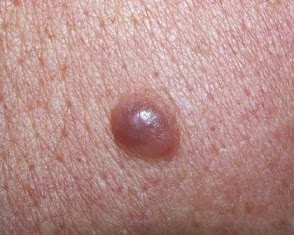
Nodular melanoma
If the “funny” appearance of a pimple bothers you, it’s time to have it checked by a dermatologist.
Another thing to consider is that a pimple will eventually go away, but a nodular melanoma will stay there (until surgically removed).
Dr. Shapiro is a board certified dermatologist and Mohs surgeon and has treated over 12,000 Mohs cases for skin cancer. He is widely published in peer-reviewed academic journals.
Lorra Garrick has been covering medical, fitness and cybersecurity topics for many years, having written thousands of articles for print magazines and websites, including as a ghostwriter. She’s also a former ACE-certified personal trainer.
.
Top image: Shutterstock/wavebreakmedia
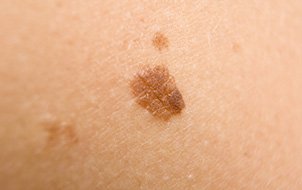
Age Spots vs. Melanoma: Appearance Comparison
Age spot
Can a melanoma look like an age spot and vice versa?
As people get older, their risk of melanoma rises, but they also start developing age spots.
Age spots commonly appear on sun-exposed areas of the skin, such as the hands, face, shoulders and arms.
They are typically a result of prolonged sun exposure and are associated with aging.
Can the physical appearance of age spots and melanoma overlap each other?
“Age spots are linked to both aging and sun exposure,” says Dr. Michael Shapiro, MD, Medical Director and Founder of Vanguard Dermatology in NYC, NY.
“Also known as liver spots or solar lentigines, age spots are typically oval, flat and typically black, brown or grey.”
Can age spots ever develop into skin cancer?
Dr. Shapiro says, “It isn’t scientifically proven that age spots can become melanoma, but they are linked together due to the similarity of sun exposure.”
Physical Appearance Comparison
Dr. Shapiro explains, “Age spots differ from melanoma in that they are typically oval, flat and brown in color as opposed to the asymmetrical, discolored malignant spots.”
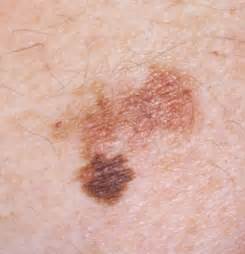
An extremely asymmetrical melanoma
“Malignant spots will also be itchy and may cause oozing or bleeding, while age spots don’t have that effect.”
It’s possible for a malignant tumor not to be itchy, however.
It’s also possible for an age or liver spot not to be oval, but a little asymmetrical.
But the asymmetry won’t be as pronounced as it often is in a melanoma lesion.
When someone develops multiple age spots over time, they look pretty much the same, though with varying size.

Clusters of age or liver spots. Shutterstock/Image Point Fr
Usually, a melanoma simply will not look right. It will stand out in appearance from any nearby benign lesions.
It will be the oddball, the funny, weird or ugly looking spot that doesn’t resemble the others.
That’s the one that should get your attention and get evaluated by a dermatologist.
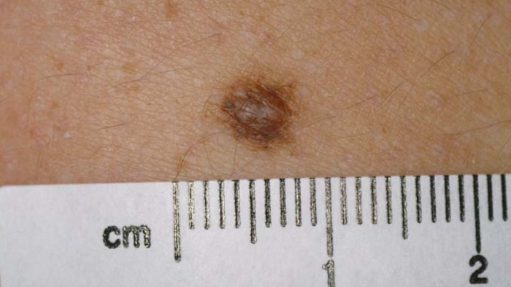
Melanoma can be brown, black, tan, grey, red, pink and even flesh colored. It can even have blue, shades of maroon and even white in it.
And in addition to being asymmetrical, this cancer often presents with jagged or erratic edges, or more than one color in the lesion, such as both brown and grey.
Another suspicious sign is that some portions of it may be elevated.
Yet another alarming sign is part of the border “leaking” out (in appearance, not literally) into the surrounding skin.
If this article provided you with helpful information or reassurance, please consider supporting my work through Ko-fi. Donations help me continue writing detailed medical content that’s easy to understand.
Dr. Shapiro is a board certified dermatologist and Mohs surgeon and has treated over 12,000 Mohs cases for skin cancer. He is widely published in peer-reviewed academic journals.
Lorra Garrick has been covering medical, fitness and cybersecurity topics for many years, having written thousands of articles for print magazines and websites, including as a ghostwriter. She’s also a former ACE-certified personal trainer.

Are You Fit Because You Do Housework?

If you suddenly decide that housework counts as true exercise, does this then magically make it so?
One of the biggest gimmicks over the past decade or so is this idea that housework gets included in the daily exercise quota.
So now, all that housework you’ve been doing for years counts as a workout.
Now that you’re convinced of this, will the weight start dripping off your body? Will your heart now become fitter, bones stronger, back stronger?
You’ve been doing housework all along. So if it’s such good exercise…why do you still sweat and feel wiped out after a major event like cleaning the oven, the bathroom, the garage, etc.?
As a personal trainer, I’ve never told my clients that any cleaning they do around their house can replace structured aerobics or strength training.
I’ve never told them, “On the days you don’t have a session with me, you don’t have to exercise because you already have a built-in workout regimen: housework!
Just go about your day as usual, and whatever cleaning you do is your exercise for that day!”
Cleaning your home is a constant; this constant is there every day. Yes, every day, you do some form of cleaning or chores.
To reap results like fat loss, body transformation, toned muscles, a durable low back, stronger joints, improved heart function, etc., you must CREATE A VARIABLE. It’s called strength training and aerobics.
I had one client who would tell me about all the cleaning she was doing in the new house she bought.
Prior to moving in, she had no idea what was in store for her. The previous owners left certain things a total mess.
She’d describe for me the tasks, which included cleaning out gobs of dead moths.
Despite all this cleaning, she was in very bad physical condition. She was very weak and had poor aerobic capacity.
Only when she began training with me did she start gaining strength, losing abdominal fat and looking better.
When it’s time to change a flat tire or shovel heaps of wet snow, what will come through for you?
- All the housework you’ve been doing?
- Or the deadlifts, weighted squats, dumbbell bent-over rows, kettlebell swings, pushups and barbell shoulder presses?
Be sensible. Don’t get caught up in gimmicky fad thinking just to excuse yourself from knowing what you need to do.
Putting your fussy child in a car seat, then taking him out, hardly compares to one set of breath-taking squat jumps holding a 10 pound dumbbell in each hand.
Even if you wrestle with the child several times a day with the car seat…there’s just no comparison.
WORKOUT
- A good set of heavy kettlebell swings to exhaustion
- followed by a 30 second rest
- followed by pushups to exhaustion
- then a 30 second rest
- then jump-switch lunges for one minute (yes, deal with the searing burn in your thighs and butt)
- 30 second rest
- then one minute of burpees
- 30 second rest
- concluding with one minute of bodyweight squats … I guarantee you, this will do significantly more for your body than will two hours of cleaning the house.
Lorra Garrick is a former personal trainer certified through the American Council on Exercise. At Bally Total Fitness she trained women and men of all ages for fat loss, muscle building, fitness and improved health.
.
Top image: Freepik.com

Pills Stuck in Esophagus vs. Perception of Being Stuck

Is there a way to tell if a pill is actually stuck in your esophagus vs. it just feels that way? Not necessarily.
Pill Stuck Feeling in Esophagus
“This is a something that is not well-understood,” says Jay Desai, MD, who specializes in colon cancer screening, upper endoscopy and consultative gastroenterology with New York Gastroenterology Associates.
Dr. Desai continues, “Feeling like something is stuck in your esophagus when it isn’t is called globus sensation.
“The perception of a stuck pill may be related to what we call motility disorders, which are disorders of the muscles and the nerves of the esophagus and the coordination of those muscle contractions.”
So why does it seem that pills, more often than food the same size (such as beans, peas, raisins and chunks of carrot, celery and nuts) get stuck behind the breastbone (sternum)?
“Pills tend to get stuck in the esophagus because the consistency is denser, whereas food tends to be on the softer, more pliable side,” says Dr. Desai.
“If there are certain lesions, such as rings or webs, which are common structural abnormalities in the esophagus, then solid items that cannot slip past these will get stuck.
“Certain pills are more dangerous if caught in your esophagus, such as antibiotics, specifically tetracycline — which is taken to help reduce acne, and common medications for osteoporosis.
“These medications are more concerning because if these pills do get stuck, they have the potential to cause life threatening ulcers.”
What about the mere sensation of a stuck pill in the esophagus or behind the breastbone?
What can lead to this feeling or perception?
“There are many conditions that can cause the globus sensation,” begins Dr. Desai.
“First, any mechanical narrowing of the esophagus, such as rings or webs, which are common structural abnormalities in the esophagus, can cause this sensation.
“Second, motility disorders, which are conditions where the muscles of the esophagus do not work properly and fail to push food down well, also create the sensation of a stuck pill.
“And finally, achalasia, a condition where the valve at the bottom of the esophagus doesn’t relax or open properly, causes pills/food to get stuck.”
Proper Swallowing
You can lower the chances of something getting trapped in the “food pipe” by swallowing pills, tablets and capsules with your head slightly downward.
This seems counterintuitive, but this positioning helps keep the passageway open more.
Think of how you swallow food to get it down. You don’t throw your head back, do you?
In fact, if you’re eating while reading, your head is down while you’re swallowing.
Apply this same concept to swallowing pills for medications or supplements.
They’ll go down easier and will help prevent that stuck sensation.
And don’t lie down for at least two hours after swallowing them.

Board certified in internal medicine and gastroenterology, Dr. Desai provides a wide range of GI services including for bacterial overgrowth, constipation, acid reflux and GERD, IBS, incontinence and small bowel disease. Twitter handle: @NYGADocs
Lorra Garrick has been covering medical, fitness and cybersecurity topics for many years, having written thousands of articles for print magazines and websites, including as a ghostwriter. She’s also a former ACE-certified personal trainer.
.
Top image: Shutterstock/Prostock-studio
Can GERD Cause ONLY Excess Saliva?
If your only symptom is excess saliva, can this be caused by GERD (gastroesophageal reflux disease)?
Excess saliva can be quite a scary symptom if you know that it’s a symptom of Bulbar-onset ALS.
But you have to realize that excess saliva not only results from the inability to efficiently swallow (caused by ALS), but the over-activity of the salivary glands — which is not caused by ALS but often by anxiety.
There is yet another mechanism that produces what a patient might describe as “a lot of saliva in my mouth.”
GERD’s Connection to Excess Saliva
Excess saliva can be caused by a number of conditions, but can this symptom be the only presentation of acid reflux?
“GERD is a condition that causes an abnormal amount of acid to reside in the esophagus,” says Jay Desai, MD, who specializes in colon cancer screening, upper endoscopy and consultative gastroenterology with New York Gastroenterology Associates.
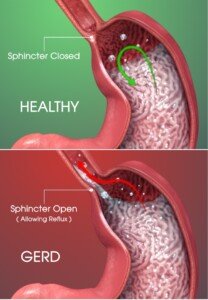
Scientific Animations, Creative Commons/BY-SA/Attribution-ShareAlike 4.0 International
Dr. Desai continues, “Some patients will not experience the classic sensation of burning.
“However, they may still have acid exposure in the mouth and esophagus which could manifest as excess saliva, coughing or a hoarse voice. It’s important to note that the mechanisms for this are unclear.”
Have you found that severe, ongoing anxiety causes excess saliva?
The anxiety actually triggers acid reflux, and hence, you have the annoying but benign symptom of the excess “saliva.”
However, in this case, the situation has nothing to do with the salivary glands becoming overly active.
At any rate, it’s a harmless symptom, and when the anxiety diminishes, you’ll notice that the symptom goes away.
Drinking water or herbal tea may provide some relief while the issue runs its course.
Board certified in internal medicine and gastroenterology, Dr. Desai provides a wide range of GI services including for bacterial overgrowth, constipation, acid reflux and GERD, IBS, incontinence and small bowel disease. Twitter handle: @NYGADocs
Lorra Garrick has been covering medical, fitness and cybersecurity topics for many years, having written thousands of articles for print magazines and websites, including as a ghostwriter. She’s also a former ACE-certified personal trainer.
Top image: Shutterstock/sirtravelalot
Sources: nyga.md
Facebook: facebook.com/NYGastroenterologyAssociates

Why Can GERD Cause the Esophagus to Narrow?

A narrowed esophagus can be caused by gastroesophageal reflux disease (GERD).
This narrowing may be the reason why you’ve been burping a lot lately or experiencing an unpleasant taste in your mouth.
“Long-term acid exposure at the bottom of the esophagus can cause scarring due to constant inflammation; this is called a stricture,” says Jay Desai, MD, who specializes in colon cancer screening, upper endoscopy and consultative gastroenterology with New York Gastroenterology Associates.
“However, this is much less common today because of the use of more effective antacid medication than in the past, such as omeprazole.”
Though long-term acid reflux is a risk factor for causing the esophagus (“food pipe”) to narrow, there are other risk factors as well for stricture.
These include diverticulosis (pouches in the colon), pain drugs including aspirin, prior surgery to the esophagus, skin diseases and scleroderma.
Symptoms of a Narrowed Esophagus
A narrowed esophagus can lead to a variety of symptoms that affect daily comfort and health.
One common symptom is heartburn, which is often described as a burning or abrasive sensation in the chest or upper abdomen.
In some cases, it may present as a more generalized aching sensation without the typical burning feeling.
Another sign of esophageal narrowing is a bad or bitter taste in the mouth, particularly noticeable in the morning or during the night.
This can occur as stomach acid backs up into the mouth.
Additionally, individuals may experience burping without an obvious cause, such as after drinking carbonated beverages, and frequent hiccups.
Unintentional weight loss might occur as well, which can be attributed to difficulty eating or absorbing nutrients.
However, weight loss may also have other causes, such as untreated type 2 diabetes.
Pain or trouble swallowing. Keep in mind that many unrelated conditions can cause issues related to swallowing.
Board certified in internal medicine and gastroenterology, Dr. Desai provides a wide range of GI services including for bacterial overgrowth, constipation, acid reflux and GERD, IBS, incontinence and small bowel disease. Twitter handle: @NYGADocs
Lorra Garrick has been covering medical, fitness and cybersecurity topics for many years, having written thousands of articles for print magazines and websites, including as a ghostwriter. She’s also a former ACE-certified personal trainer.
.
Top image: Shutterstock/Chayatorn Laorattanavech
Sources:
facebook.com/NYGastroenterologyAssociates
drugs.com/cg/esophageal-stricture.html

How Does GERD Cause a Trapped Food Feeling in Throat?

Acid reflux or GERD can cause the sensation of food being trapped in the throat.
GERD stands for gastroesophageal reflux disease.
“Acid reflux, or GERD, is a condition where an abnormal amount of acid is exposed to the esophagus,” says Jay Desai, MD, who specializes in colon cancer screening, upper endoscopy and consultative gastroenterology with New York Gastroenterology Associates.
“This may cause many different symptoms but usually includes a burning sensation in the pit of the stomach that travels up the chest towards the mouth.”
Additional symptoms may be a persistent daytime cough, overnight cough, chest pain, burping and waking with a foul taste in the mouth.
Food Stuck in Throat Feeling
“One condition that can cause food feeling stuck in the throat is called PPI-responsive esophageal eosinophilia,” says Dr. Desai.
“The acid exposure in the esophagus can cause certain types of blood cells, called eosinophils, to migrate to the esophagus; these cells can cause inflammation and interfere with normal swallowing of food.
“This then can lead to the sensation of food feeling trapped in the [upper] esophagus. The treatment of this condition is with antacid medication.”
Board certified in internal medicine and gastroenterology, Dr. Desai provides a wide range of GI services including for bacterial overgrowth, constipation, acid reflux and GERD, IBS, incontinence and small bowel disease. Twitter handle: @NYGADocs
Lorra Garrick has been covering medical, fitness and cybersecurity topics for many years, having written thousands of articles for print magazines and websites, including as a ghostwriter. She’s also a former ACE-certified personal trainer.
.
Sources facebook.com/NYGastroenterologyAssociates
Top image: Shutterstock/9nong




Can Nutritional Supplement Pills Irritate the Esophagus?
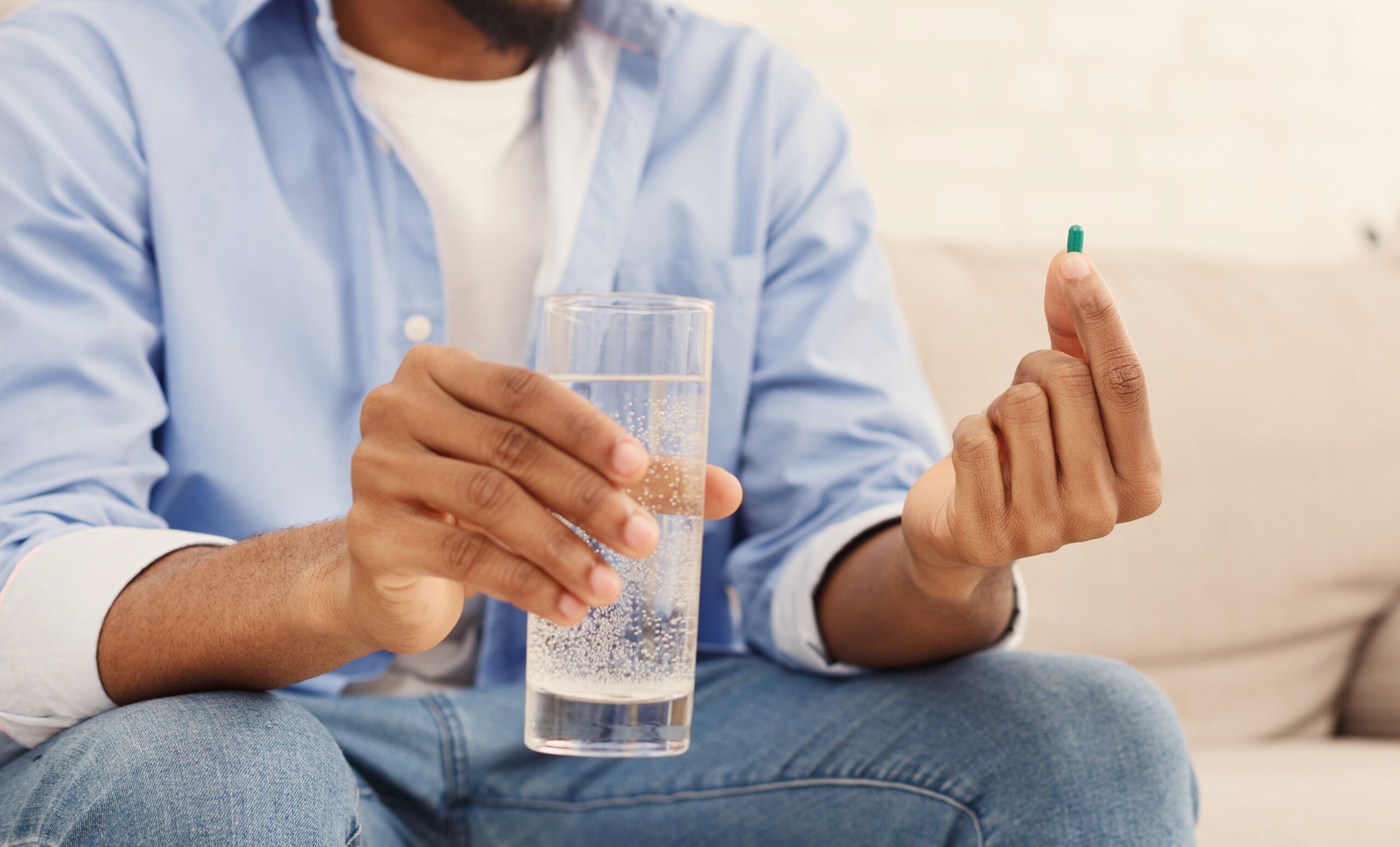
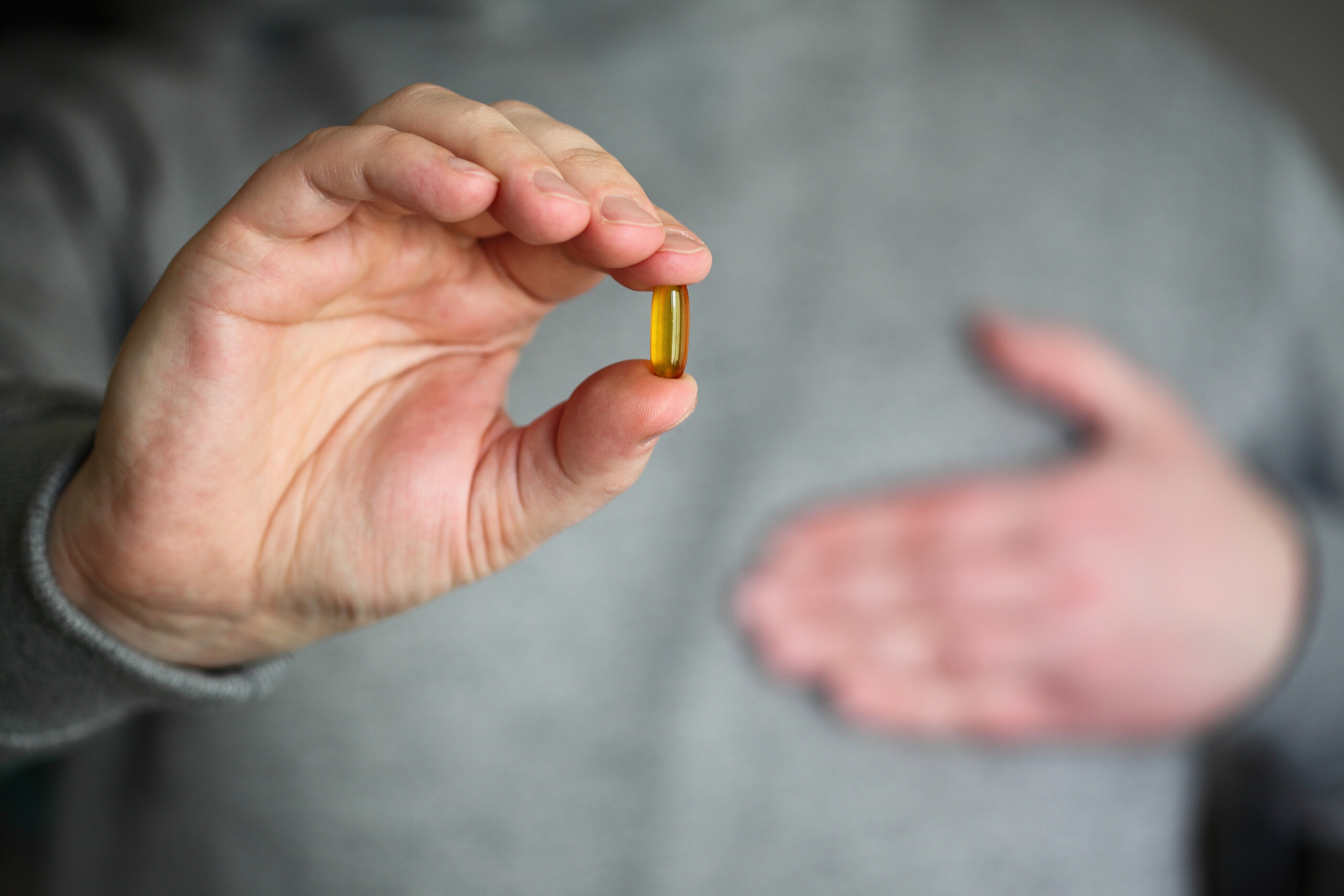
You’ve probably read about medications and irritation of the esophagus, but what about nutritional supplement pills, tablets and capsules?
Can these nutritional supplements, too, irritate the “food pipe”?
“Certain supplements such as iron, vitamin C and potassium pills can irritate or cause ulcers in the esophagus that prevent pills from passing into the stomach,” says Jay Desai, MD, who specializes in colon cancer screening, upper endoscopy and consultative gastroenterology with New York Gastroenterology Associates.
“To avoid ‘pill esophagitis,’ make sure you take these pills with a full glass of water and avoid lying down for at least two hours after swallowing them.”
In addition, have your head slightly downward when taking the supplements — and any other kind of pill, for that matter.
Tossing your head back when swallowing doesn’t allow maximum opening for the passageway.
When you swallow food, you don’t tilt your head back.
So when you think about it, why tilt back your head when you swallow supplements or medications?
Sure, it’s something we see in TV shows for dramatic effect.
But it is not mechanically necessary to effectively swallow a pill, tablet or capsule.
Dr. Desai also says, “If you develop chest pain after swallowing these pills, and it does not resolve shortly, contact your physician.”
Board certified in internal medicine and gastroenterology, Dr. Desai provides a wide range of GI services including for bacterial overgrowth, constipation, acid reflux and GERD, IBS, incontinence and small bowel disease. Twitter handle: @NYGADocs
Lorra Garrick has been covering medical, fitness and cybersecurity topics for many years, having written thousands of articles for print magazines and websites, including as a ghostwriter. She’s also a former ACE-certified personal trainer.
.